



- SPEECH
Climate change and monetary policy
Keynote speech by Philip R. Lane, Member of the Executive Board of the ECB, at the Climate, Nature and Monetary Policy Conference jointly organised by the ECB, the Centre for Economic Transition Expertise and the Frankfurt School of Finance and Management
Frankfurt am Main, 5 May 2026
Introduction
Global warming is no longer a distant threat.[1] The Copernicus Climate Change Service has confirmed that 2023, 2024 and 2025 were the hottest years in recorded human history (Chart 1, panel a).[2] The changing climate has also increased the frequency and intensity of extreme weather events: more severe heatwaves, longer-lasting droughts, heavier rainfall and flooding, and more destructive wildfires, to name just some cases (Chart 1, panel b). The evidence indicates that global warming has accelerated, with recent studies indicating that the planet is heating faster than at any point since the start of the available observational time series in the 1880s.[3] While climate change transition policies have been implemented and are planned in many countries, the world is on a trajectory towards a warming of around 2.8 degrees by 2100 under current policies and 2.3-2.5 degrees if all Paris Agreement policy commitments are delivered.[4]
Chart 1
Climate change and EU climate policies
a) Global mean temperature anomalies | b) Extreme weather event index | c) EU greenhouse gas emissions and EU targets |
|---|---|---|
(°C compared with 1850-1900 average) | (index) | (million tonnes of CO2 equivalent) |
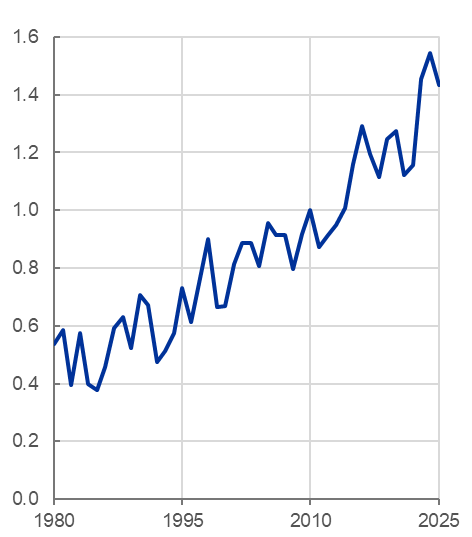 | 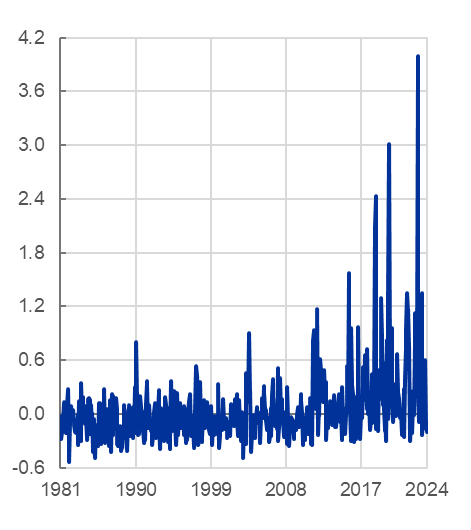 | 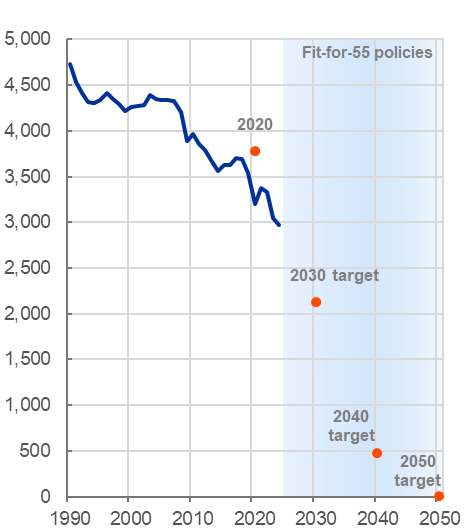 |
Sources: World Meteorological Organization (WMO), International Foundation Big Data and Artificial Intelligence for Human Development (IFAB), European Environment Agency (EEA) and ECB staff calculations.
Notes: Panel a): Average across nine global temperature datasets. Panel b): European Extreme Events Climate Index (E3CI), combining seven extremes, including extreme max/min temperature, drought, extreme precipitation, hail, fire, extreme wind. Standardised anomaly with respect to the reference values (1981-2010). For each individual category, an index above 1 indicates an extreme event. The chart shows the arithmetic average across all seven categories. An increasing average score indicates increasingly frequent and severe extreme events. Panel c): As of 2024, 14 EU countries have implemented carbon pricing. The red dots refer to EU emission targets. The latest observations are for left-hand side chart - 2025, middle chart - 2024 and right-hand side chart - 2024.
Global warming and the increase in extreme weather events cause substantial economic damage.
Recent analysis suggests that global GDP per capita would be more than 20% higher today had no warming occurred between 1960 and 2019: this corresponds to a 0.3% reduction in the annual growth rate over this period.[5] While climate change might account for only a limited proportion of the annual variation in growth rates, its persistence means that its cumulative impact is substantial.
In response, the European Union has agreed to ambitious climate policy targets, anchored by the Fit for 55 package - a set of laws adopted in 2023 committing the EU to reducing greenhouse gas emissions by at least 55% by 2030, on the path to full climate neutrality by 2050 (Chart 1, panel c).[6] The EU commitment to the green transition not only contributes to the required global slowdown in greenhouse gas emissions but also increases the resilience of the European economy, including by reducing dependence on imported fossil fuels.[7]
Overall, both climate change and transition policies are highly relevant for central banks through their impact on output and inflation dynamics, together with their impact on asset prices, financial intermediation and financial stability.[8]
For these reasons, in its 2021 Monetary Policy Strategy Review, the Governing Council committed – within its mandate – to ensuring that the Eurosystem fully takes into account the implications of climate change and the green transition for monetary policy and central banking.[9] In line with this commitment, the ECB and the Eurosystem have undertaken significant efforts to integrate climate change into their economic analysis, modelling and forecasting and their assessment of the transmission, stance and design of monetary policy.
In today's speech, I will describe how the ECB delivers on these commitments in the ways we monitor the economy and formulate our monetary policy. In the first part of my speech, I will discuss the economic analysis of climate change and the green transition at the ECB. In the second part, I will turn to the implications for monetary policy.[10]
Economic analysis of climate change and the green transition at the ECB
In this section, I will first discuss how a changing climate affects output and inflation, in the near term and at longer horizons. I will then examine the implications of the green transition for the euro area economy. Finally, I will discuss how the ECB has expanded its macroeconomic modelling toolkit to incorporate these factors and how it applies these expanded models in economic analysis and forecasting.
The impact of climate change on the euro area economy
Impact on output
Extreme weather events disrupt production, affect energy demand and supply, damage property and infrastructure, and reduce labour supply. While any individual extreme weather event can be viewed as a temporary shock to the economy, the cumulative effects of global warming can lower potential output through the degradation and loss of agricultural land, shifts in tourism, higher rates of mortality and sickness, climate-induced migration and reduced labour efficiency from higher temperatures.[11] In addition, the uncertainty associated with more frequent extreme events can dampen investment and innovation, weighing on future growth trajectories.[12] As discussed above, the overall weight of analytical and empirical research indicates substantial long-run economic damages from climate change, even if the range of estimates varies widely.
The slow-moving negative trend contribution of climate change to output is relevant for monetary policy to the extent that the trend in potential output anchors the analysis of shocks around the trend: mis-identification of the trend in potential output can lead to mis-diagnosis of cyclical shocks. At the same time, the primary focus of monetary policy is in managing cyclical shocks. In particular, purely transitory shocks need not trigger a monetary policy reaction, whereas longer-lasting persistent shocks may call for an adjustment in the monetary policy stance. It follows that, in analysing the cyclical impact of extreme weather events, the persistence of the shock plays a central role in determining the implications for monetary policy.
The effects of different types of extreme weather events also vary across countries and sectors. A detailed study that assesses impacts from extreme weather in the short-term for Germany, France, Italy and Spain reveals that activity in the pharmaceuticals sector appears to suffer especially under extreme heat.[13] By contrast, electricity and gas benefit from a boost in demand due to extreme cold snaps, while supply disruptions or efficiency losses under extremely high temperatures curb activity at longer horizons. Moreover, mining and construction appear to be particularly vulnerable to extreme rainfall, whereas these sectors tend to be favoured by extreme droughts, reflecting the high exposure of their operations to precipitation extremes.
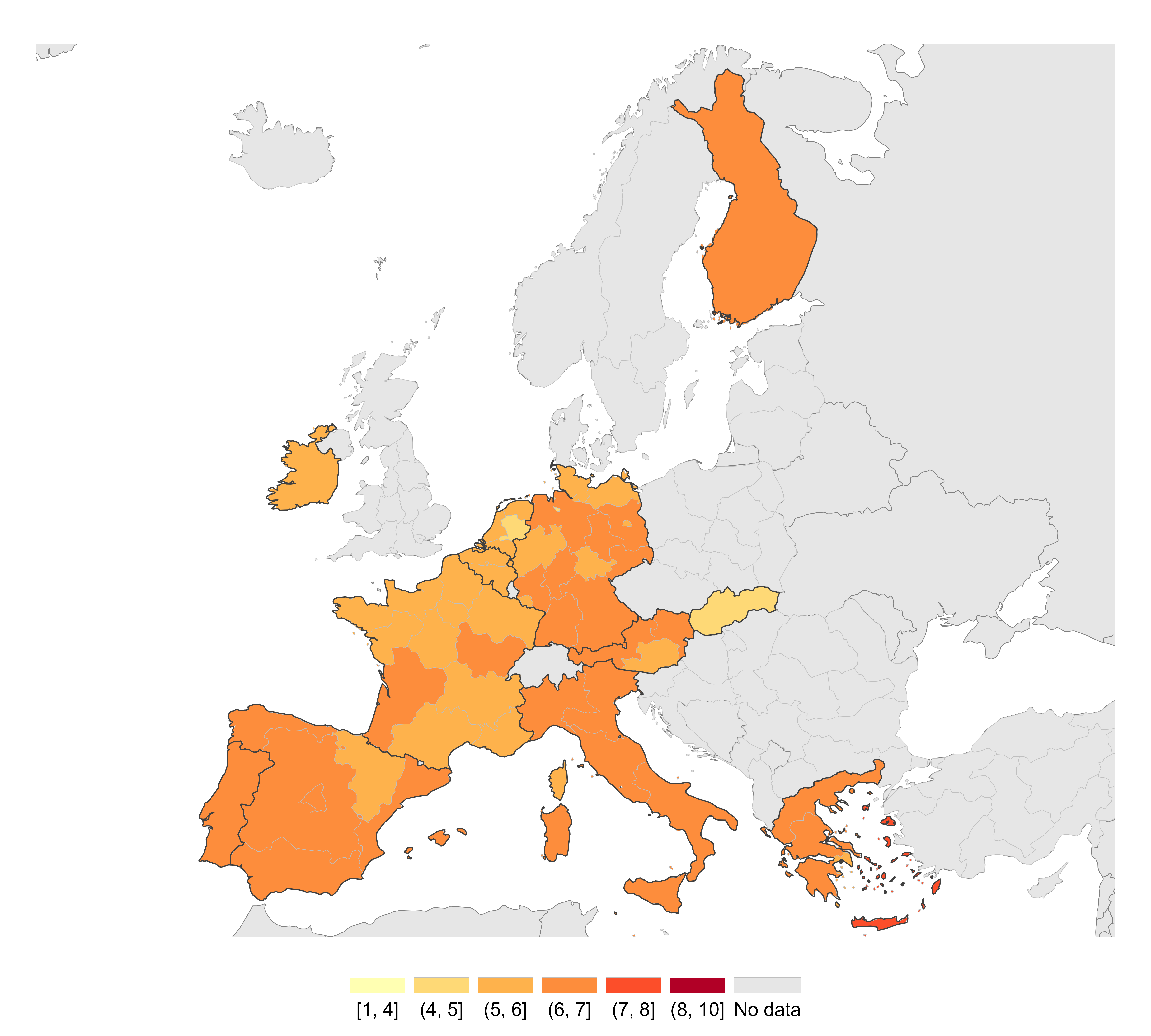
In line with the findings in these studies, firms participating in the Survey on the Access to Finance of Enterprises (SAFE) report somewhat heterogeneous views on how important are the consequences of climate change (Chart 2). Firms located in parts of southern European countries attribute a higher importance to the risk of extreme events (“natural hazard risk” in Chart 2), whereas the risks from nature degradation are also assessed as high in parts of Germany and France (“degradation risk” in Chart 2).
Chart 2
Firms’ assessment of the importance of consequences of climate change for the next five-years
a) Natural hazard risk | b) Degradation risk |
|---|---|
(1980-2023 average; percentages) | (x-axis: quarter, y-axis: percentage points) |
|
|
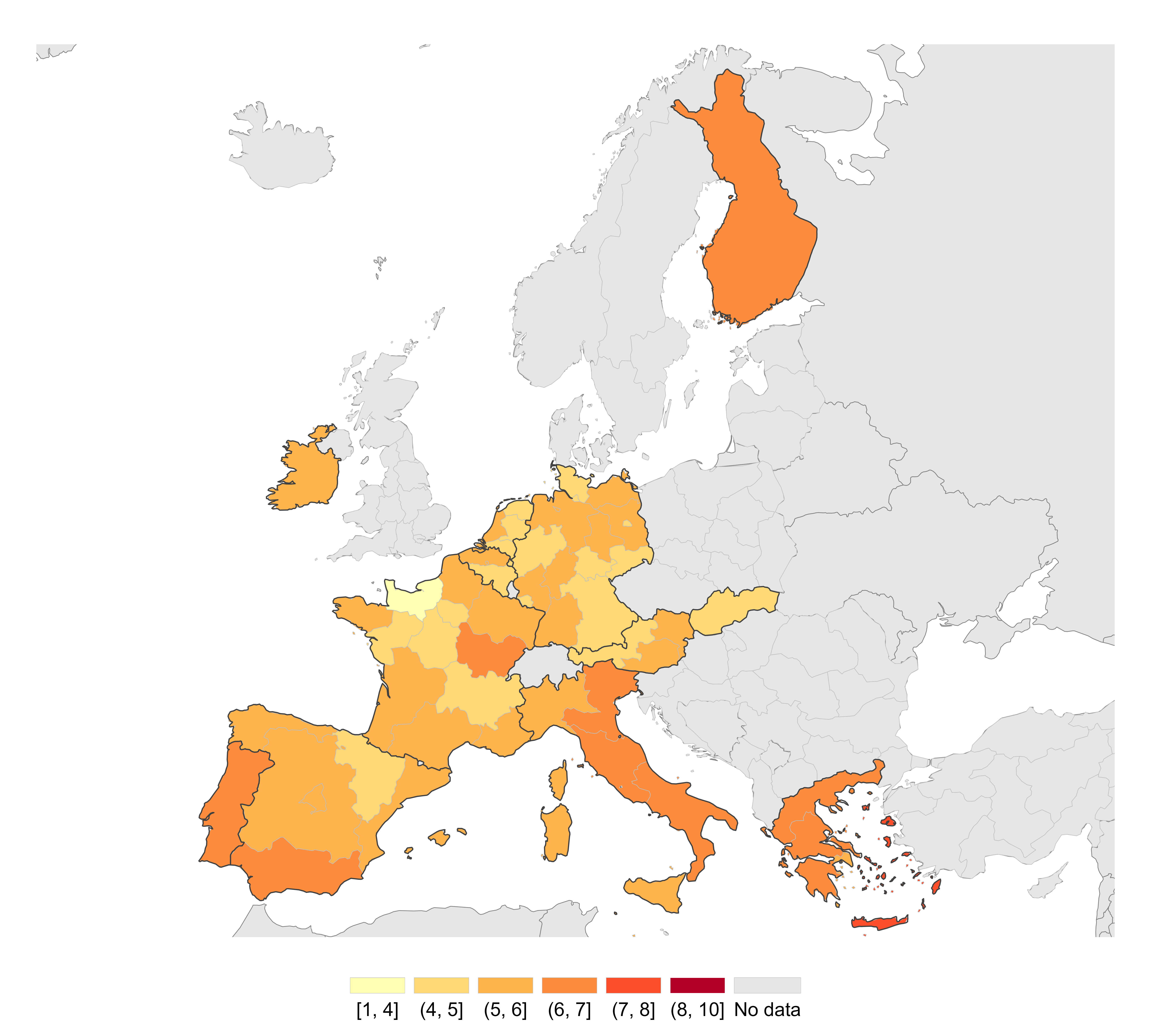
Sources: ECB and European Commission Survey on the access to finance of enterprises (SAFE).
Notes: The maps show the weighted average score for the importance of consequences of climate change for firms over the next five years by main socio-economic regions based on NUTS1 (2016 classification) in the euro area. Firms were asked to indicate how important the consequences of climate change (natural hazards, environmental degradation, and stricter climate standards) are for their current business model five years ahead on a scale of 1 (not at all important) to 10 (extremely important). The weighted average scores at NUTS1 level are averages of the responses within each bracket weighted by size class, economic activity, and country to reflect the economic structure of the underlying population of firms.
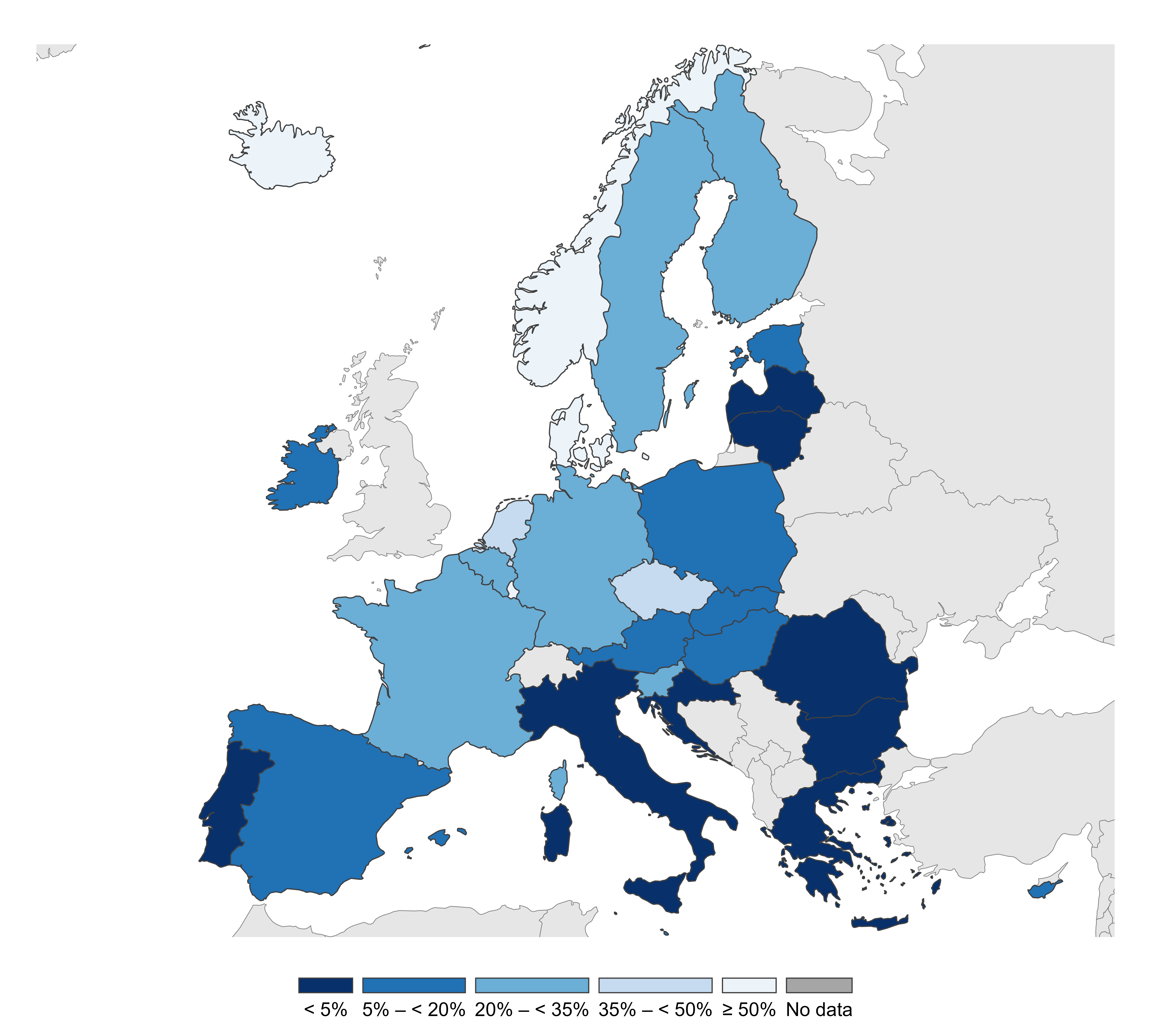
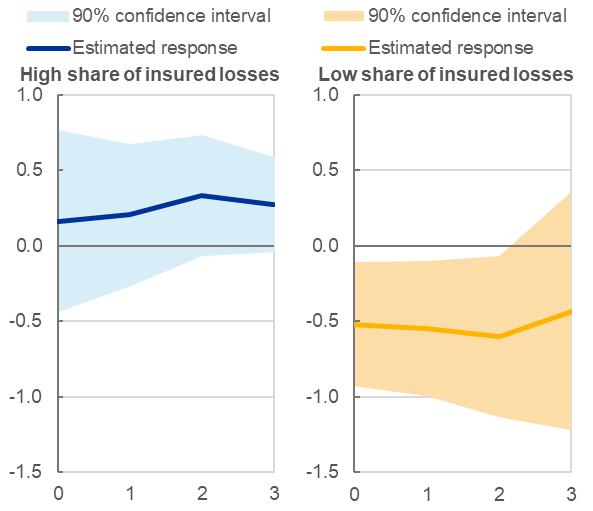
Due to relatively low levels of insurance coverage, many firms in the euro area currently have to bear most of the costs resulting from such extreme weather events (Chart 3, panel a). Recent research finds that closing this climate insurance protection gap could help to lower the impact of natural catastrophes on GDP (Chart 3, panel b).[14]
Chart 3
Share of insured economic losses related to natural catastrophes in Europe, and impact of large-scale disasters on annual GDP growth rate by share of insured loss
a) Share of insured economic losses related to natural catastrophes | b) Impact of a large-scale disaster on the annual GDP growth rate |
|---|---|
(1980-2023 average; percentages) | (x-axis: quarter, y-axis: percentage points) |
|
|
Sources: European Insurance and Occupational Pensions Authority (EIOPA) dashboard on insurance protection gap for natural catastrophes, European Environment Agency (EEA) Damaging earthquakes and secondary effects database (CATDAT), Emergency Events Database (EM-DAT), Organisation for Economic Co-operation and Development (OECD) and authors’ calculations. Giuzio, M., Rousová, L., Kapadia, S., Kumar, H., Mazzotta, L., Parker, M. and D. Zafeiris (2026): “Climate change, catastrophes, insurance and the macroeconomy” European Economic Review, Volume 182.
Notes: Chart a - data are available for countries of the European Economic Area. Chart b - based on quarterly panel regressions for 45 OECD countries. The two panels in the right-hand side shows the percentage point impact of the disaster on the year-on-year annual growth rate at the end of each quarter, from the disaster quarter (t=0) through the following three quarters. Large-scale natural disasters are defined as events with total damages exceeding 0.1% of the country GDP. The share of insured losses is defined as high when it exceeds the sample median of 35% (right-hand side, left panel) and low when it falls below this threshold (right-hand side, right panel). The sample includes 45 countries for which the OECD provides quarterly GDP data from 1996 to 2019.
Impact on Inflation
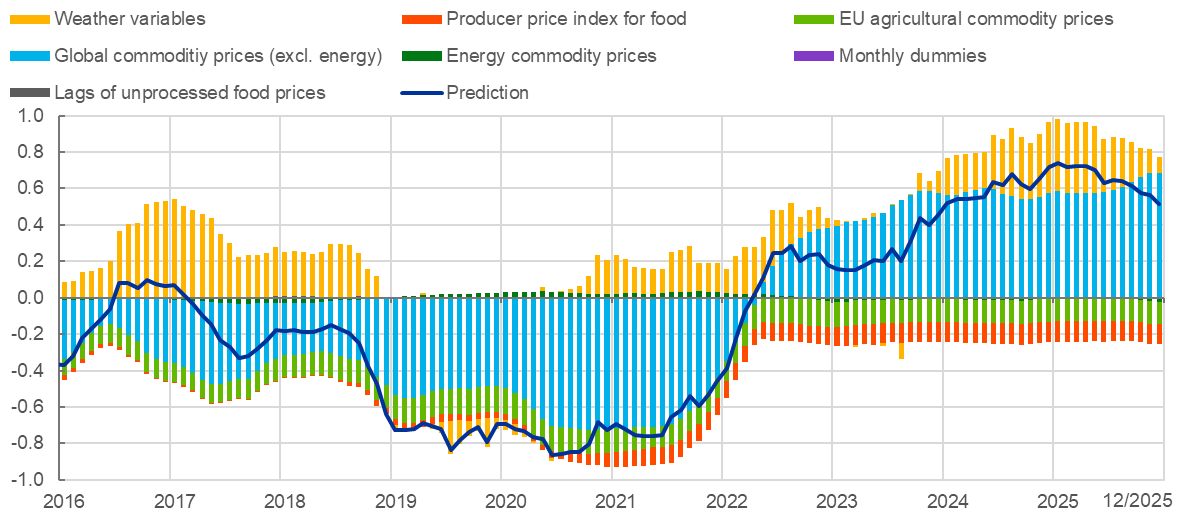
Extreme weather events also matter for inflation volatility – with the most direct effect found for the impact of summer heatwaves on food prices.[15] The heatwave during the summer of 2025 is estimated to have increased unprocessed food prices in the euro area by 0.4 to 0.7 percentage points over the course of one year (Chart 5, panel a).[16] The integration of weather data into non-linear machine learning models improves the near-term forecast for unprocessed food inflation, even after accounting for a wide range of commodity prices relevant for the agricultural sector (Chart 4).[17]
Chart 4
Forecasting unprocessed food inflation with a Random Forest model: the role of weather variables
(percentage point deviations from long-term model average)
Sources: Kuik, F., Osbat, C. and Vidal-Quadras Costa, I., forthcoming: Earth, Wind, Fire and grocery bills: exploring the forecasting power of weather variables for euro area food inflation, forthcoming.
Notes: 6-months ahead forecast of unprocessed food inflation using a Random Forest model, with hyperparameters tuned based on a training sample from 2000-2015, and the model re-trained with each month of additional data. The model uses a wide set of explanatory variables, including weather indicators, global commodity prices relevant for the food sector, energy commodity prices, EU agricultural commodity prices, producer prices in the food sector. Each variable enters with 1-12 lags, and 12 lags of the target variable (unprocessed food inflation) as well as monthly dummies are added. All variables enter without seasonal adjustment. The chart shows 12-months moving averages.
Looking ahead, a 2024 study estimated that future projected temperature increases could push up the response of food prices to summer heat further: food prices in Europe could rise by around 1.8 percentage points after an extreme summer in the climate that is expected to prevail in the 2060s, relative to a hypothetic scenario without any climate change (Chart 5, panel b).[18] More frequent and more intense shocks to food prices in a hotter climate would consequently also increase the volatility of food inflation. Food inflation plays an outsized role in determining the perceptions of households about the prevailing inflation rate and their near-term inflation expectations.[19]
Chart 5
Impact of summer heatwaves on food prices
a) Impact of the 2025 heatwave on euro area unprocessed food prices after 12 months | b) Estimated impact of a typical summer heatwave on food prices in Europe under future projected climate |
|---|---|
(percentage points) | (percentage points) |
|
|
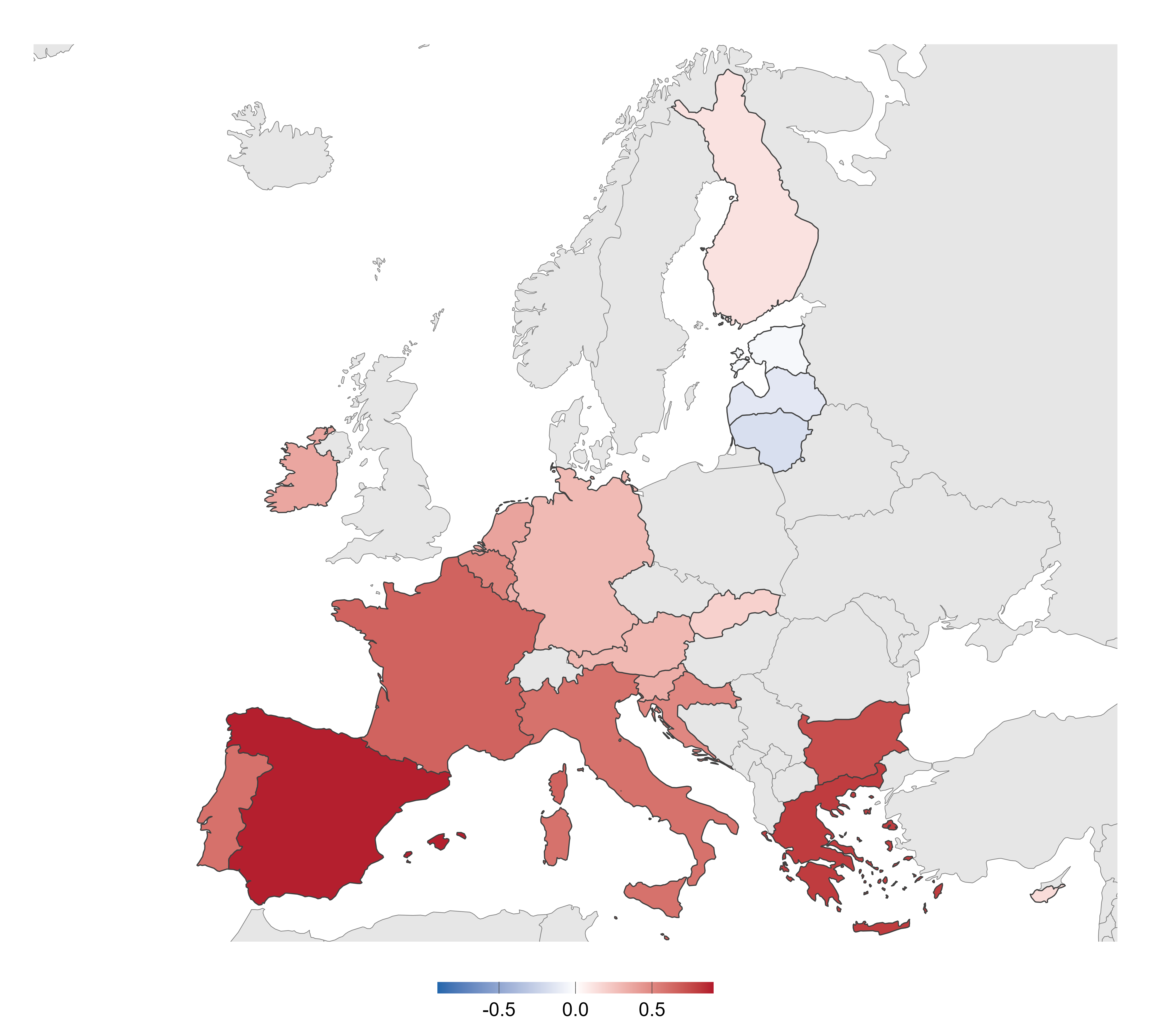
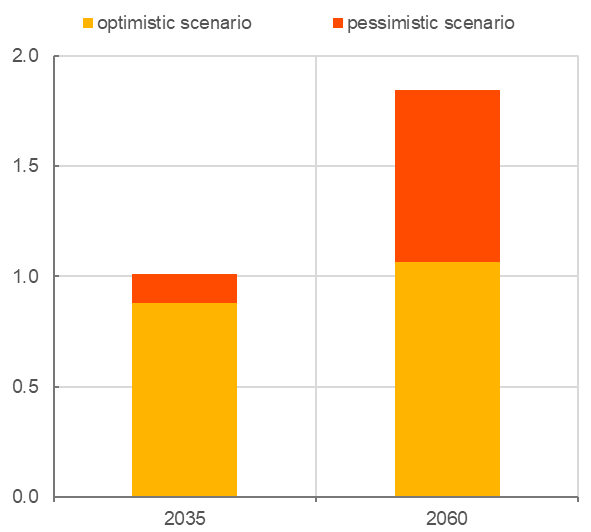
Sources: ECB analysis based on Kotz, M., Kuik, F., Lis, E. and C. Nickel (2024): “Global warming and heat extremes to enhance inflationary pressures.” Commun Earth Environ 5, 116.
Notes: Both charts show the cumulative deviation of prices from baseline after 12 months due to extreme June/July/August temperatures. The charts are based on combining elasticities of a 1°C increase in temperatures with realised 2025 summer temperatures (chart a) and results from 21 global climate models (chart b). Elasticities are estimated with a global panel regression approach, using monthly prices and high-resolution climate data. Chart b: Projected temperatures of an extreme summer (i.e., in the upper tail of the temperature distribution) in future climates are retrieved from climate model results under an optimistic (“below 2°C by 2100”, Representative Concentration Pathway 2.6) and a pessimistic (“hot house world”, Representative Concentration Pathway 8.5) emissions scenario. The estimates can be understood as the additional impact on food inflation attributed to future higher temperatures. The approach does not make any assumptions about future inflation dynamics, macroeconomic factors or adaptation to climate change and can therefore be understood as a stylised sensitivity analysis.
At the same time, the overall impact of climate change on headline inflation is not obvious, since the upward impact of negative supply shocks on agriculture and food prices might be offset by climate change related negative demand shocks in other components.[20] A study of the four largest euro area countries points to generally asymmetric and heterogeneous impacts of higher temperatures on inflation, depending on the component, country and timing of the shock.[21] In particular, increases in inflation rates following higher summer temperatures are contrasted with an overall deflationary effect from higher temperatures during the other seasons of the year. This is especially pronounced for energy inflation, which drops in response to higher winter and spring temperatures, likely linked to a reduction in energy demand for heating during warmer spring and winter seasons. The evidence in the literature is also mixed when it comes to the impact of other types of extreme weather events or environmental degradation on different inflation components and the medium-term outlook for inflation.[22]
Looking to the future, the climate-economy relation is non-linear.[23] The crossing of climate "tipping points" could trigger economic disruptions far larger than observed so far if self-reinforcing climate changes become irreversible.[24] How well economies adapt to a warmer climate will also affect the extent to which climate change affects the level and volatility of output and inflation, adding a further layer of uncertainty.[25]
Challenges and opportunities of the green transition for the euro area economy
The adverse consequences of climate change underline the urgency of transitioning to net-zero emissions. Decisive action to reduce greenhouse gas emissions will most likely be less costly than the macroeconomic and societal burden of a world that continues to get hotter.[26] In the EU, policies and actions to spur a green transition are starting to take effect. In addition to the policies at EU level, countries have implemented national climate policies.
Transition policies to meet the EU’s 2030 emissions target are likely to reduce growth and push up inflation in the short term. The impact of additional policies needed to meet the EU’s 2030 emission reduction target, on top of those that have already been implemented, can be assessed using scenario analysis.
For instance, the December 2025 Eurosystem macroeconomic projections included scenario analysis to trace out the impact of alternative EU transition policies.[27] If the 2030 target is met solely through higher carbon taxes (Chart 6, blue bars), the impact on inflation peaks at 0.4 percentage points above the baseline in 2027 and remains elevated until 2030.[28] However, such a surcharge on the price of dirty energy alone cannot deliver the Fit for 55 targets for energy use and clean energy. In the Fit for 55 policy mix scenario (Chart 6, yellow bars), which considers a mix of carbon taxes and non-carbon tax elements to meet the 2030 emission reduction target, HICP inflation increases to a somewhat lesser extent in 2027 and 2028.
At the same time, the higher level of clean energy productivity assumed in this scenario increases the clean energy share, and greater substitution elasticities reduce energy consumption, in line with EU targets. This higher clean energy efficiency reduces the required carbon tax rates, mitigating both the fall in GDP and the increase in inflation. This supports the view that the macroeconomic impacts of transition policies are policy mix-dependent, which is also consistent with findings in the broader literature.[29]
Chart 6
Impact of climate policy scenarios on output and inflation
a) Euro area real GDP | b) Euro area headline inflation |
|---|---|
(percentages) | (percentage points) |
|
|
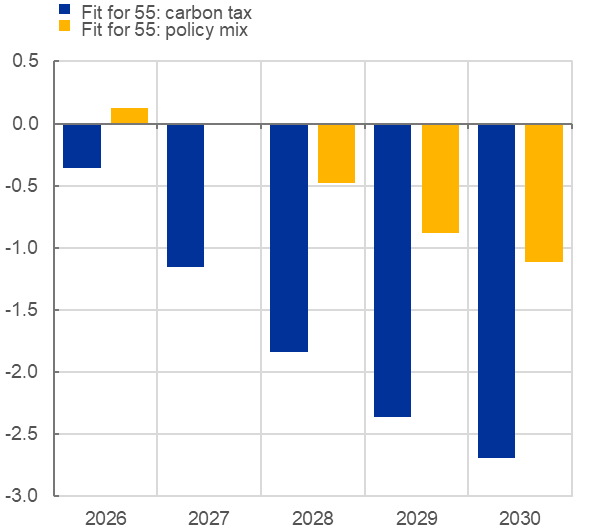
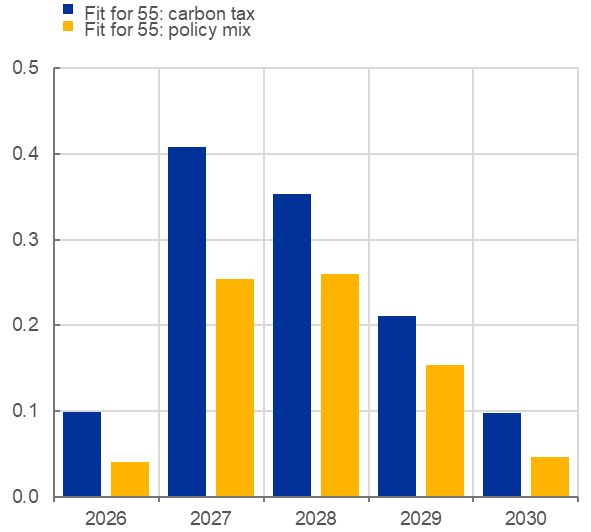
Source: Aguilar García, P., Durero, F., Ferdinandusse, M., Kuik, F. and Priftis, R. (2025): The macroeconomic impact of climate change policies in the euro area, Eurosystem Staff Macroeconomic Projections for the Euro Area.
Notes: Charts show the impact of additional measures needed to meet the EU’s 2030 emission reduction target, on top of those already implemented at national and EU level, using the New Area-Wide Model (NAWM-E). Scenarios are based on the effective carbon price as calculated by the OECD, with the “Fit for 55: carbon tax” scenario satisfying the target only through higher carbon prices and the “Fit for 55: policy mix” scenario considering a mix of carbon taxes and non-carbon tax elements. The policy mix scenario also meets secondary targets on the clean energy share and energy consumption, proxied through a 1.2% increase in clean energy total factor productivity, higher elasticities of substitution between dirty and clean energy, as well as between energy and other inputs of production and consumption. The impacts are reported relative to the December 2025 projections baseline. Simulations start in 2026 and assume that economic agents have perfect foresight regarding the expected future path of the carbon tax and any productivity changes. The policy rate remains constant throughout the projection horizon.
In general, the impact of the green transition on inflation remains uncertain, given that the green transition likely incorporates short-run negative supply shocks but longer-run positive supply shocks and also operates as multi-layered demand shock (positive for investment but negative for consumption).
In terms of positive supply shocks, large declines in the costs of transition technologies – notably wind, solar and batteries – have resulted in increasingly competitive alternatives to carbon-intensive production and power generation (Chart 7). Over time, the greater share of low-carbon electricity sources, and the switch of passenger transport away from fossil fuels, is likely to affect the relative price and weight of electricity and motor fuel within HICP energy, and possibly the weight of energy in the overall basket. For example, greater installation of renewable energy capacity is estimated to have already substantially lowered electricity costs in Spain.[30]
In terms of demand dynamics, some studies find a negative impact, since expectations of lower future income depress current demand, driven by the anticipation of higher carbon prices in the future or if the costs of the transition are expected to turn out to be higher than the gains in energy efficiency.[31]
Chart 7
Costs of renewable energy
a) Plummeting costs of renewable sources of electricity | b) Worldwide additions of utility scale renewable electricity |
|---|---|
(2024 USD/kWh, levelised costs) | (gigawatts) |
|
|
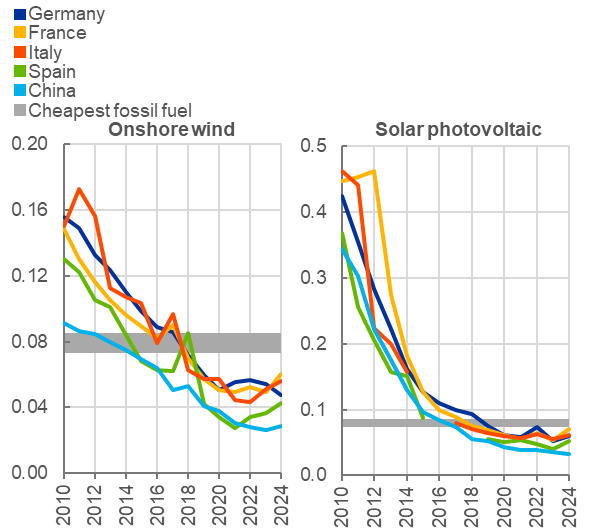
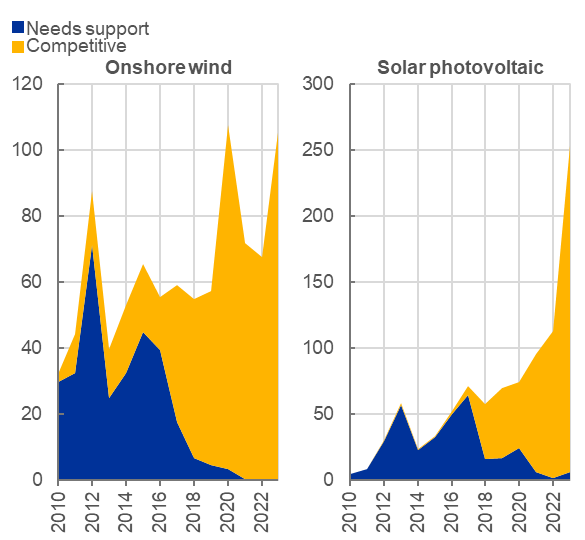
Sources: Parker and Rodrigues: Overcoming structural barriers to the green transition, ECB Economic Bulletin Issue 1/2026, based on International Renewable Energy Agency (IRENA).
Notes: panel a) levelised costs incorporate the cost of financing, building and operating a new power plant over the course of its projected lifespan. The fossil fuel range shown in the chart incorporates the worldwide average levelised costs of coal and combined-cycle gas turbines. panel b) for each year, the project-level levelised cost of electricity generation for newly deployed renewable energy is compared with the counterpart country or regional-weighted average from fossil fuel sources. Where the levelised cost for renewable sources is below that of fossil fuels, the project is labelled competitive, whereas it is labelled as needing support when it is above such levels.
Two recent events have provided a stark demonstration of how the green transition generates a wider set of gains beyond the decarbonisation of the economy.[32] Europe was highly vulnerable to the supply disruptions and price spikes in fossil energy prices seen when Russia invaded Ukraine in 2022, and again at the start of the Iran war in spring 2026. In 2022, this vulnerability led to euro area energy inflation peaking above 40%, pushing up headline inflation and subsequently passing through to core inflation. Since the start of the Iran war at the end of February 2026, the prices of crude oil, natural gas and refined diesel have increased sharply. While the overall impact on euro area inflation will depend on the scale and persistence of the shock (together with the strength of indirect and second-round effects), consumer liquid fuel prices have already increased rapidly following the developments in wholesale prices, driving up euro area energy price inflation sharply from -3.1% in February 2026 to 5.1% in March and 10.9% in April 2026. Yet the current energy crisis also shows the potential of renewable and nuclear electricity to shield European consumers from fossil fuel price shocks: whereas wholesale – and then consumer – electricity prices closely followed developments in gas prices during the 2021/2022 energy shock, their reaction to the latest shock has been more muted in countries that have higher shares of renewable or nuclear electricity (Chart 8).
Chart 8
Low-carbon electricity generation and electricity prices
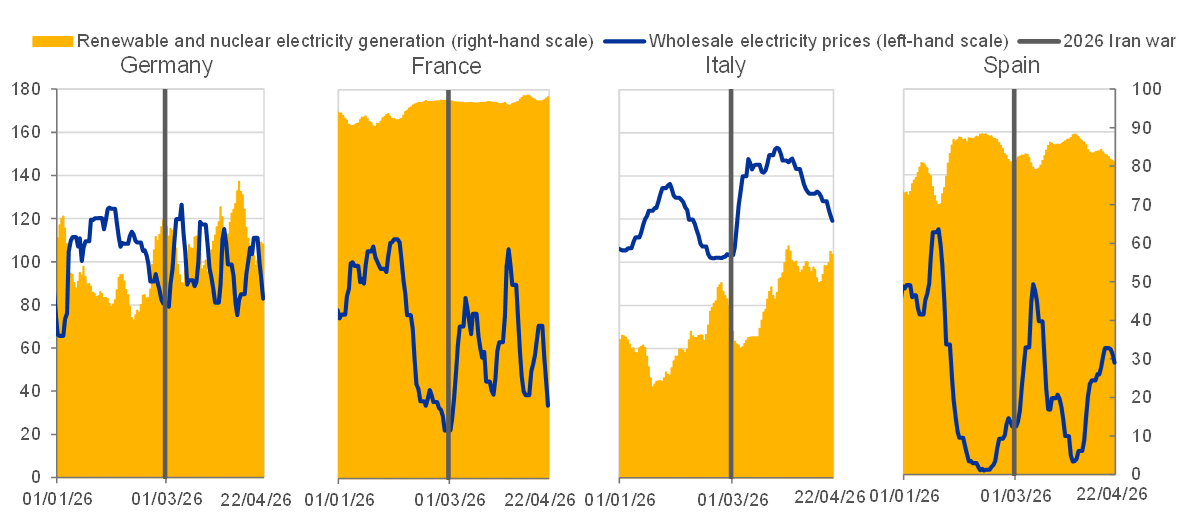
Sources: ENTSO-E (European Network of Transmission System Operations for Electricity), Refinitiv and ECB calculations
Notes: The chart illustrates that wholesale electricity prices tend to have reacted less to higher gas prices since the start of the Iran war in countries where the share of renewable and nuclear electricity generation is higher. Chart based on daily data. Germany, Italy: yellow bars show electricity generation with renewables (no nuclear power in the energy mix). Chart shows 7-day moving averages. The “2026 Iran war” vertical line refers to 28 February 2026. The latest observations are from 22 April 2026.
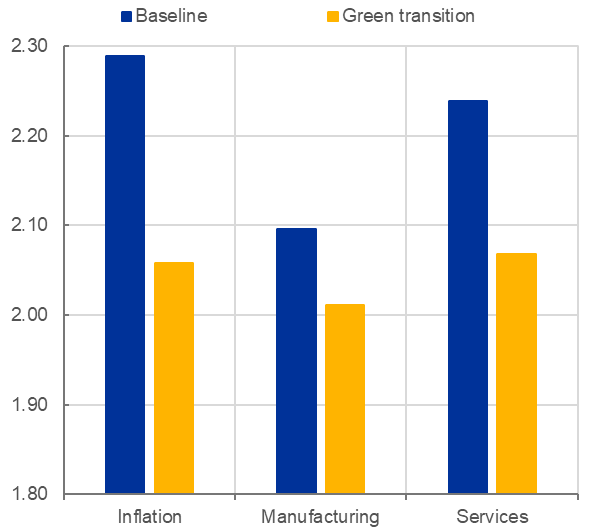
Beyond the immediate impact on energy prices, a green transition that reduces dependence on foreign inputs and on fossil fuels may eventually help to reduce inflation volatility.[33] Model-based simulations suggest that by reducing the reliance of the services and manufacturing sectors on fossil energy, the sensitivity of consumer prices to changes in the prices of energy commodities would fall (Chart 9, panel a). With a share of fossil energy 50 per cent lower than under the baseline, inflation volatility decreases substantially (Chart 9, panel b). While both the services and manufacturing sectors benefit, it is particularly the energy-intensive industrial sectors for which volatility is reduced.
It follows that a green transition leading to lower dependence on fossil fuel imports could have a triple dividend: (a) cutting greenhouse emissions; (b) reducing the impact of global energy shocks on inflation; and (c) and increasing energy security.
Chart 9
Change in inflation volatility and transmission of shocks after the green transition
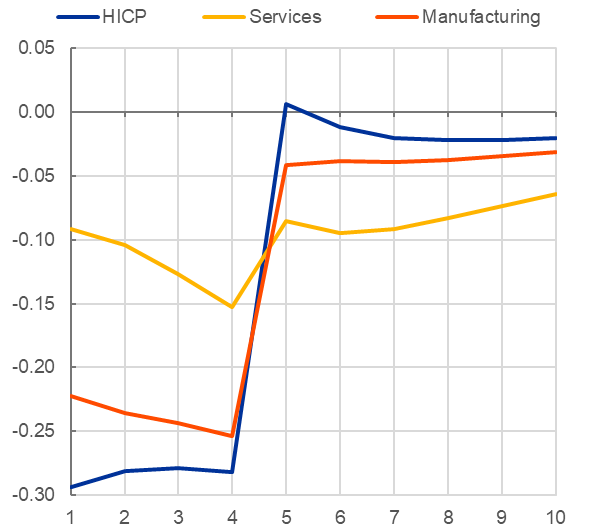
Source: ECB staff calculations based on Chafwehe, B., Colciago. A., and Priftis, R. (2025): Reallocation, productivity, and monetary policy in an energy crisis, European Economic Review Volume 173.
Notes: The green transition is modelled as an environment where the share of energy from fossil fuels (“dirty energy”) is 50% lower (35%) and the elasticity of substitution between dirty and clean energy is 50% higher. Chart a: deviation from baseline response without a green transition. The inflationary consequences of a fossil energy price shock are lower: as manufacturing relies more on (dirty) energy, the inflationary response after a green transition is relatively weaker. Chart b: A green transition lowers inflation volatility by reducing the reliance of the services and manufacturing sectors on fossil energy.
The additional investment required to overcome the barriers to the green transition is substantial. According to recent estimates, changing technologies from carbon-intensive to carbon-free equivalents requires additional investment of between 2.7 and 3.7 percent of EU GDP each year until 2030.[34] These are not marginal adjustments and represent a fundamental reorientation of the capital stock of the European economy, with ancillary implications for the optimal public financial management.
In recent years, central bank analysis documents that the Next Generation EU (NGEU) programme, aimed at supporting the green and digital transition, led to increased capital expenditure, both through direct government investment and via transfers to firms.[35] In the period since the launch of NGEU in 2020, euro area firms have overall associated the green transition with positive sentiment for investment, according to text analysis of earnings calls in this period.[36]
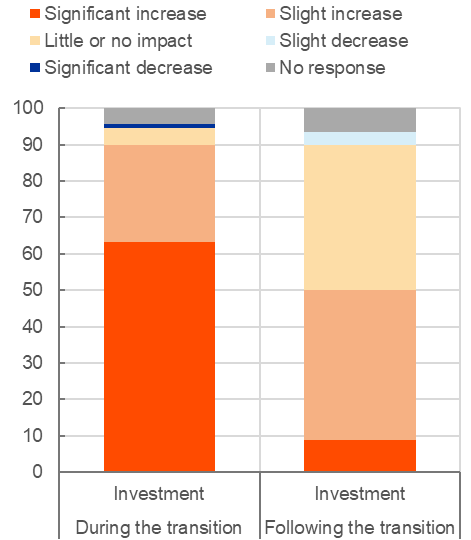
This is consistent with evidence from the ECB’s Corporate Telephone Survey, suggesting that the actions needed to address climate change should be supportive of investment. In 2022, the ECB carried out a survey of large corporates about the impact of climate change on activity and prices.[37] The responses at the time indicated that climate change and related policies are expected to increase investment, especially during the transition phase (Chart 10, panel a). At the time, more than 90% of respondents anticipated higher investment during the transition phase, with two-thirds expecting this increase to be significant. And even following the transition, 50% thought that investment would still be higher than in a hypothetical baseline without any climate change or climate-related policies.[38]
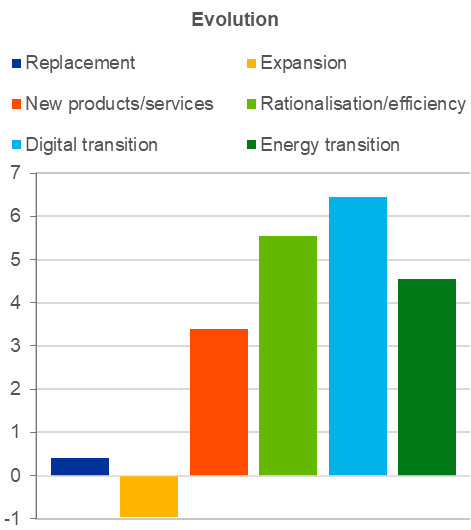
In a more recent survey in 2025, the firms identified, on average, more than 10% of their investment as being dedicated to the energy transition.[39] This was broadly comparable to the shares dedicated to developing new products and services, rationalisation and efficiency, and the digital transition. Moreover, after rationalisation and efficiency and the digital transition, the energy transition was seen as the third most important driver of their investment growth in the euro area; ahead of the development of new products and services, and ahead of traditional replacement and expansion investment (Chart 10, panel b).
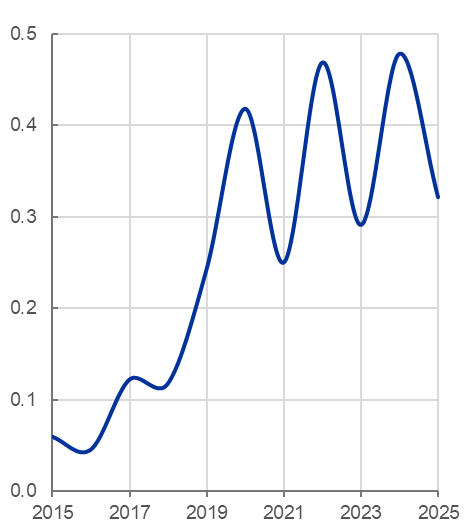
In the same survey, around three quarters of the firms said that the climate crisis had been important in causing them to rethink their investment strategies, although a similar share also cited climate regulation and energy costs as factors constraining their investment in the euro area. More broadly, regular contacts in the context of the Corporate Telephone Survey also suggest that the energy transition is a very prominent factor in firms investment decisions. An analysis of interview summaries of past discussions using ECB internal AI tools suggests a sharp increase in references to the energy transition and decarbonisation around the turn of the decade whenever firms talked about investment.[40] Roughly speaking, since 2020, if investment was discussed in one or more calls with a particular company in any particular year, the chance that the energy transition featured in at least one of these discussions has been about one-third, whereas a decade or so ago it was less than one-tenth (Chart 10 panel c).
Chart 10
Climate change and investment: insights from the ECB contacts with large firms
a) Impact of the green transition on investment | b) Investment by asset: expected evolution over the next three years | c) References to decarbonisation investment over total investment |
|---|---|---|
(percentage of responses) | (percentage changes over the next three years) | (share of investment discussions referring to investment in decarbonisation) |
 |  |  |
Sources: ECB.
Notes: Chart a - Respondents were asked in 2022 to assess the overall impact of climate change on different metrics against a hypothetical baseline without any climate change or climate-related policies. Chart b - Respondents were asked in 2025, “Of your total euro area investment, roughly what share is dedicated to each of the following areas?” and “How do you expect your euro area investment in each of these areas to evolve over the next 3 years?”. The evolution over the next three years is derived by aggregating the shares of firms replying “decrease by more than 20%” (rounded to -20%), “decrease by 5-20%” (averaged to -12.5%), “roughly the same (±5%)” (averaged to 0%), “increase by 5-20%” (averaged to 12.5%), and “increase by more than 20%” (rounded to 20%). Chart c - Share of write-ups of Corporate Telephone Survey calls featuring references to decarbonisation-related investment as a share of those referring to investment generally.
In terms of overall investment dynamics, there are potential interactions between the green transition and the AI transition.[41] In one direction, if the energy demand of AI is met by fossil fuels – as may be the case in the short run, given the pace of renewable deployment – the digital transition could complicate the green transition. Conversely, AI itself could be a powerful tool for optimising energy systems, accelerating clean technology development, and improving climate modelling.[42] Understanding their interaction – synergistic in some respects, conflicting in others – is essential to enable an accurate medium-term assessment.
Modelling the impact of climate change and the green transition
The empirical evidence on the importance of climate change for macroeconomic developments creates a clear demand: central banks need macroeconomic models and forecasting procedures that can reflect the impact of a changing climate and keep track of the changing structure of the economy.[43]
Chart 11
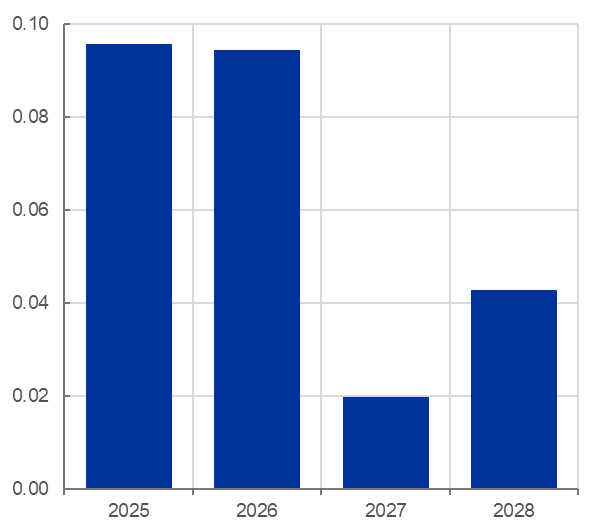
December 2025 projections: effects of transition policies on headline HICP
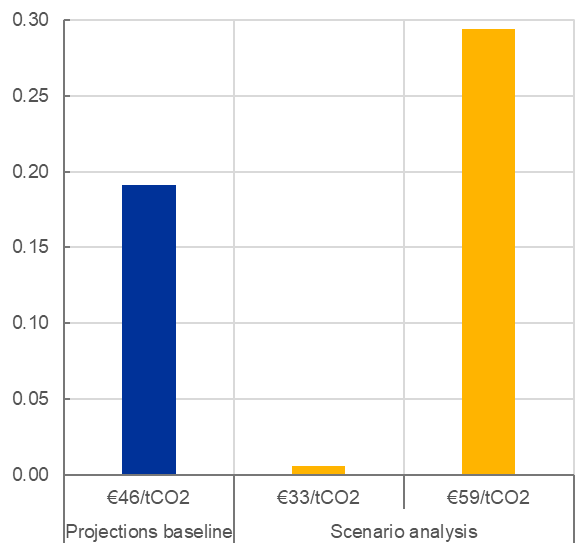
a) Impact of national discretionary green fiscal policy measures euro area headline HICP | b) Impact of ETS2 on euro area headline HICP in 2028 |
|---|---|
(percentage points) | (percentage points) |
 |  |
Source: Aguilar García, P., Durero, F., Ferdinandusse, M., Kuik, F. and Priftis, R. (2025): The macroeconomic impact of climate change policies in the euro area, Eurosystem Staff Macroeconomic Projections for the Euro Area.
Notes: Chart a – based on Eurosystem National Central Banks’ assessment. Chart b - in the projections baseline, country-specific assumptions have been made regarding the speed and timing of the pass-through to consumer prices, largely in line with historical patterns, and regarding the way ETS2 is introduced in each country. The scenario analysis assumes full and immediate pass-through, and a replacement of national carbon pricing schemes by ETS2 in all countries.
Since 2022, the effects of climate policy measures in the near-term and medium-term are regularly assessed in the context of the ECB macroeconomic projections exercises.[44] The most recent assessment – based on the models and data maintained by the national central banks – points to relatively small effects on growth and inflation over 2026-2028 from changes in nationally-implemented green discretionary fiscal policy measures (Chart 11, panel a).[45]
Additional effects come from policies implemented at European level. As regards the existing EU Emissions Trading Scheme (EU ETS1), assumptions on its prices are included in the information set underpinning the staff projections. Its impact on the euro area economy materialises indirectly, as the ETS1 mainly affects the production costs of firms, including production costs in the electricity sector. However, the aggregate impact of recent changes in the carbon price under the EU ETS1 on euro area headline inflation has been limited.[46]
The most notable effect is expected to arise from the planned introduction in 2028 of the new EU Emissions Trading System for emissions from transport, building heating and small industrial installations, the ETS2. The prices will be determined by the market and there is still uncertainty around how they will evolve. Assuming a price of 46 EUR per ton of CO2 in 2028, the Eurosystem staff baseline estimate from the December 2025 projections was that the introduction of the ETS2 will add around 0.2 percentage points to headline inflation in 2028 (Chart 11, panel b).
Scenario analysis is a particularly useful tool when it comes to assessing the risks and uncertainties surrounding the macroeconomic impacts of climate change: the trajectory and effects of climate change crucially depend on how successfully emissions will be reduced, but also on how effectively the economy adapts to a warmer climate and more extreme weather. At the same time, there is also still uncertainty about the evolution of EU climate policies, in particular carbon price pathways. As an example, the December 2025 Eurosystem staff macroeconomic projections assessed the range of likely impacts from the introduction of the ETS2 (Chart 11, panel b). Extreme weather events affecting food commodity prices were also considered as a risk factor that could push up food prices.
The ECB has also made considerable progress in developing macroeconomic models that can be used to explore the impacts of climate transition policies and their implications for monetary policy conduct. Examples include an extension of the main structural models: the New Area Wide Model (NAWM-E), and its multi-country counterpart DREAM.[47] These models include a disaggregated energy sector, where energy is used for consumption and production. Energy is produced using a “dirty” composite and a “clean” composite, where each composite in turn uses natural resources. Production of dirty energy leads to carbon emissions being released as a byproduct.
The NAWM-E is regularly used to complement the assessment of different climate-related policies in the macroeconomic projections (see Chart 7). This analysis complements the assessment of the Eurosystem National Central Banks of the impacts of policies implemented at national and EU level, and makes it possible to derive the potential effect of additionally necessary climate policy measures in a more stylised way. Its starting point is the finding of an “emissions gap” – a gap between the likely emission reductions of implemented policies, and those needed to meet the EU’s climate goals.
In order to make the modelling approach more robust, improve our understanding of transmission channels, and account for heterogeneity across different models, ECB staff contributed to two model comparison exercises to assess the macroeconomic impacts of carbon transition policies and fossil fuel price increases: one exercise examined the NAWM-E and other satellite models at the ECB; the other exercise ran comparisons with models from other institutions as part of the Network For Greening The Financial System (NGFS).[48] Both exercises indicate that higher carbon prices are associated with a moderate decline in output and upward pressure on inflation, with the magnitude of these effects highly sensitive to assumptions about the degree to which households are forward or backward looking, energy substitutability, renewable supply responsiveness and capital adjustment.
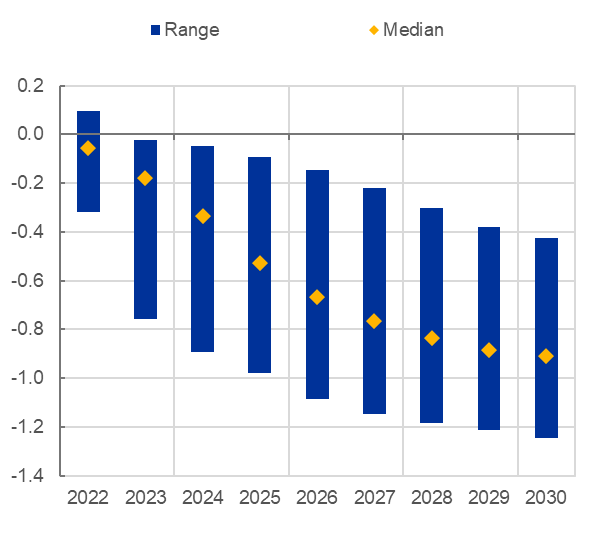
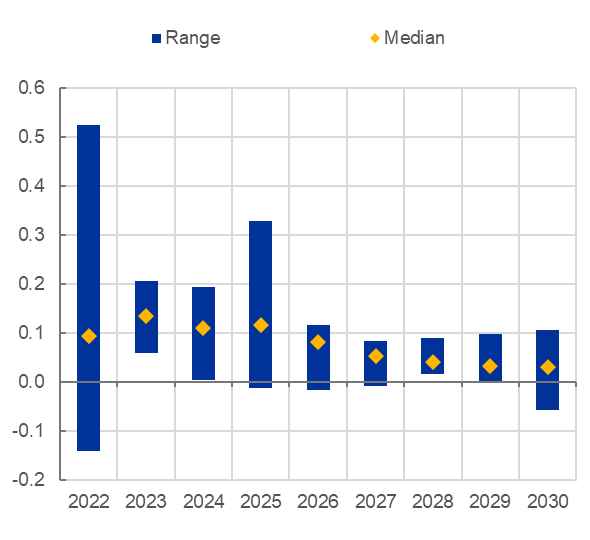
In the ECB exercise, a stylised carbon tax path aligned with an international net-zero scenario leads to a gradual and limited but persistent drop in GDP by 2030 and a moderate, fading inflation impact with some differences in near-term inflation dynamics (Chart 12).[49] In the NGFS exercise, the responses to temporary increases in the price of fossil fuel are short-lived for both output and inflation, whereas permanent increases cause more persistent output losses and inflation dynamics that depend crucially on monetary policy and expectation formation.
Chart 12
Macroeconomic effects of carbon taxes
a) Euro area real GDP | b) Euro area headline HICP |
|---|---|
(percentage/percentage point deviations from steady state) | (percentage/percentage point deviations from steady state) |
 |  |
Sources: Brand, C., Coenen, G., Hutchinson, J. and A, Saint Guilhem (2023): The macroeconomic implications of the transition to a low-carbon economy, ECB Economic Bulletin Issue 5/2023
Notes: These charts show the impact (range and median) that the carbon tax scenario has on euro area real GDP and headline inflation between 2022 and 2030. The scenario is compared with a baseline which assumes that there is no further change in the carbon tax and that no climate events occur. Fiscal policy is sufficiently passive and, depending on the model, carbon tax revenues are paid back to households as a lump sum or used to reduce public debt. The model-specific interest rate responds to a measure of inflation and activity. Panel b): differences in near-term inflation dynamics depend on the model type. In DSGE models used, the impact is more frontloaded, with firms setting their prices in a more forward-looking manner, also factoring in energy price increases in the future. In other models with more backward-looking price-setting behaviour of firms, the inflation impact is more gradual.
While there has been important progress in modelling the macroeconomic impact of transition policies, it remains challenging to integrate long-run climate change into higher-frequency macroeconomic models. However, it is essential that the two-way interaction between longer-run and shorter-run frequencies is properly recognised. For instance, the design of transition policies should take into account not only their long-run impact but also their interaction with near-term output and inflation dynamics, taking into account the nominal rigidities that shape the immediate responses to policy shifts.[50] In addition, specific aspects of climate change can be captured via dedicated satellite models.
In order to keep up with the changing reality of climate change and the adjusting economy, the Eurosystem will need to continue to assess and incorporate the impact of transition policies in its forecasting and models.[51] As the ambitious “Fit-for-55” policies are gradually phased in between 2026 and 2030, it will be important to regularly re-assess the macroeconomic effects of these policies in the projections for the euro area. Amid a highly uncertain environment, alternative climate scenarios to reflect climate-related risks should also increasingly be integrated into macroeconomic models and the analytical framework used for the macroeconomic projections for the euro area. And it will be increasingly important to better understand the macroeconomic effects of the evolving climate crisis, including climate change adaptation. This includes the structural consequences of the green transition, and its linkages with other structural developments such as geopolitical fragmentation, fossil energy price shocks, and AI – drawing not only on Eurosystem research but also findings from the wider research community.
Monetary policy implications
Let me now examine how climate change and the green transition affect our thinking about monetary policy. I will first discuss how climate factors can affect the strength of monetary transmission. I will then turn to how climate factors can influence the monetary policy stance, both through their contribution of macroeconomic shocks and their impact on the neutral rate. Finally, I will outline how climate factors influence the design of our monetary policy instruments.
Monetary policy transmission
A precondition for monetary policy to be effective is that it transmits smoothly and reliably through the financial system and to the spending decisions of firms and households. Climate change and the green transition can affect the transmission mechanism in two ways: (i) by independently influencing financial conditions that can either reinforce or work against the monetary policy stance; and (ii) by altering the sensitivity of firms, households and financial intermediaries to the monetary policy stance.
Economic research and survey evidence, much of which has been produced at the ECB, provide some initial insights into how climate-related factors can affect transmission. Even if the quantitative scale of these effects might be limited today, their impact may strengthen in the future as the climate deteriorates and the green transition advances. Accordingly, it is appropriate to embed these climate factors into the information set underlying our integrated and comprehensive assessment of the transmission process.[52]
Chart 13
Cumulative returns of long-term bonds regressed on physical risk beta after Paris Agreement
(percentages, out of sample cumulative returns)
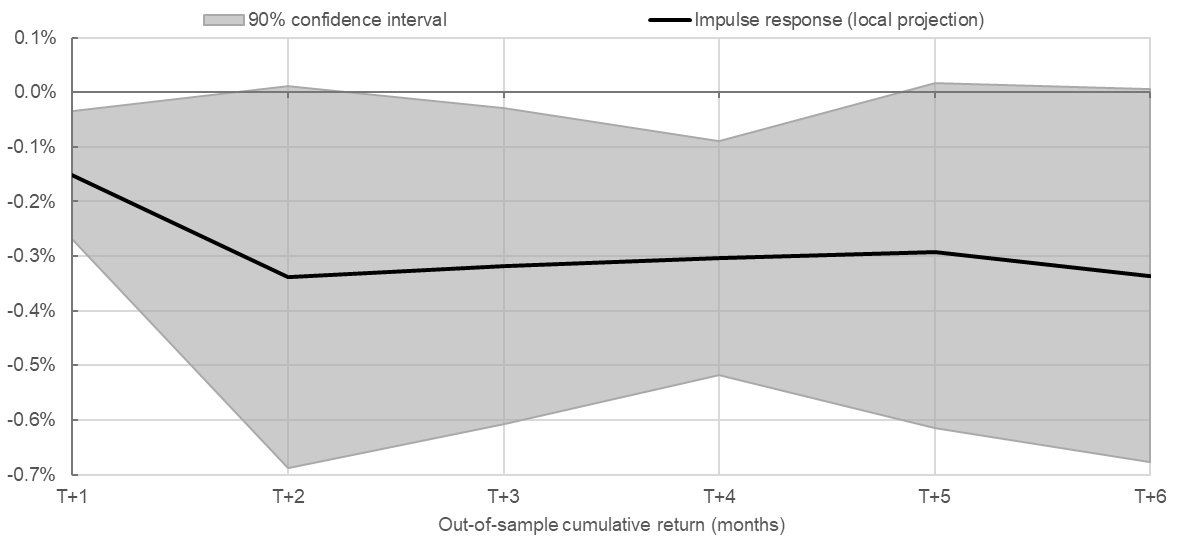
Sources: Bats, J., Bua, G. and Kapp, D. (2024), Bloomberg, iBoxx.
Notes: Fama-Macbeth cross-sectional regressions of the future cumulative excess returns of long-term bonds. To facilitate the economic interpretation of the results, the y-axis shows the average Fama-Macbeth slope coefficients multiplied by the difference in the average physical risk beta between lowest and highest portfolios. The data cover the period from January 2015 to September 2021, after the (anticipation of the) Paris Agreement. The dotted lines represent the 90% confidence intervals using Newey-West adjusted standard errors.
One key transmission channel works through asset prices. Evidence from the earnings calls of a sample of US and European firms suggests that the perceived cost of capital has declined for green firms relative to brown firms since 2016.[53] In a related vein, recent ECB research indicates that climate risk weighs significantly on long-term corporate bond returns (see Chart 13).[54] Conversely, bonds that are either explicitly labelled as green or issued by firms with strong environmental scores benefit from lower yields than otherwise similar securities. This green premium, or “greenium”, varies over time, for instance in response to uncertainty about transition policies or the physical effects of climate change.[55]
Besides creating an independent source of variation in financial conditions, climate factors may also to directly shape the transmission of monetary policy. For instance, some recent evidence for the euro area suggests that monetary policy shocks have asymmetric effects on the equity valuations of green and brown firms.[56] This means climate factors may act as a self-standing source of heterogeneity (across firms, sectors and regions) in monetary policy transmission.
Climate considerations are also relevant for the bank lending channel of monetary policy transmission. In particular, banks in the euro area account for climate considerations when deciding on the allocation of credit. According to the results of our bank lending survey, lending conditions are easier for firms with low carbon emissions or credible decarbonisation plans and tighter for high-emitting firms that lack such plans (Chart 14, left panel).[57]
Chart 14
Impact of climate change on banks’ credit standards
(net percentages of banks; over the past 12 months and the next 12 months)
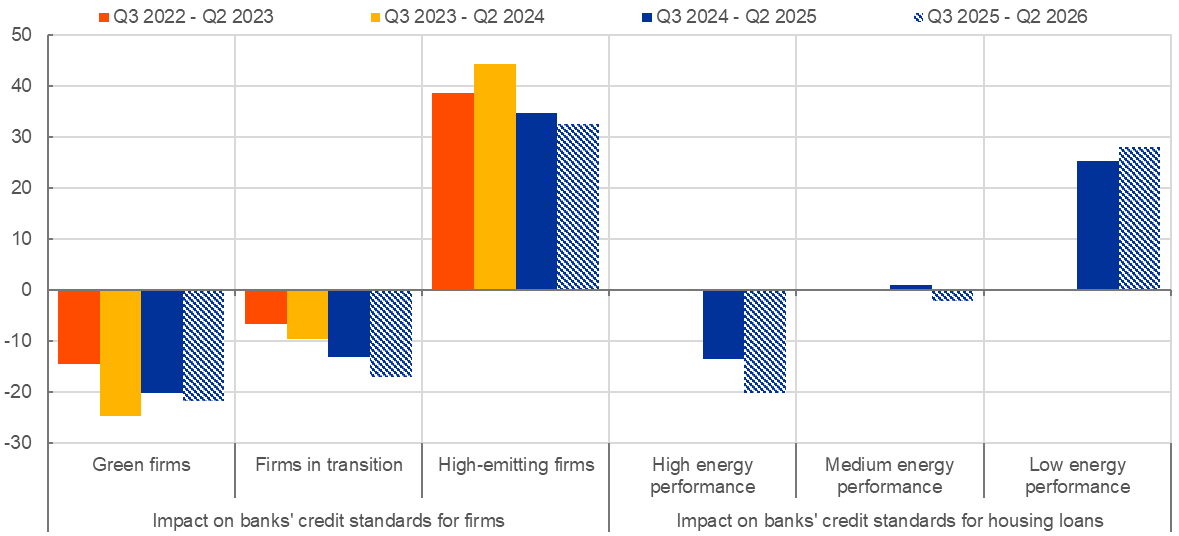
Sources: ECB Bank Lending Survey (BLS) and Köhler-Ulbrich, P., Schuster Y. and Tushteva, N. (2025), "Climate performance matters for bank credit in the euro area", The ECB Blog, 10 November.
Notes: Net percentages are defined as the difference between the percentages of banks responding “contributed considerably/somewhat to tightening” and the percentages of banks responding “contributed somewhat/considerably to easing”. The striped bars denote expectations indicated by banks in the latest round.
Similarly, banks also tend to charge higher lending rates to high-emission than low-emission firms and higher rates to firms that lack credible emission reduction targets compared with those firms which have committed to reduce carbon emissions (Chart 15).[58] In addition, the contractionary effect of tighter monetary policy on lending is milder for low-emission firms, in terms of both credit standards and loan volumes.[59]
Chart 15
Average interest rates charged on bank loans
a) to low and high carbon-emission firms | b) to firms with and without emission reduction targets |
|---|---|
(percentages) | (percentages) |
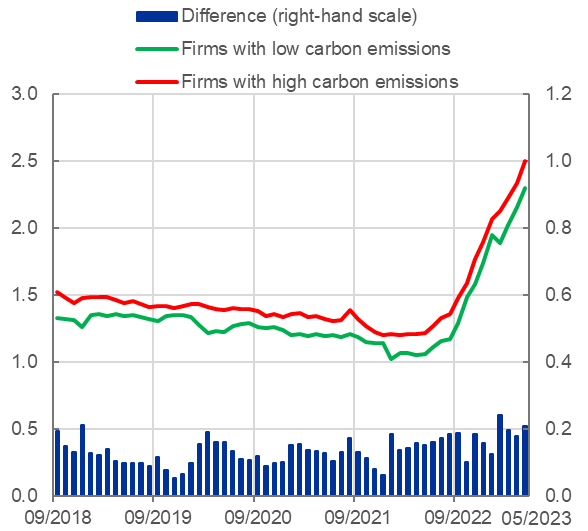 | 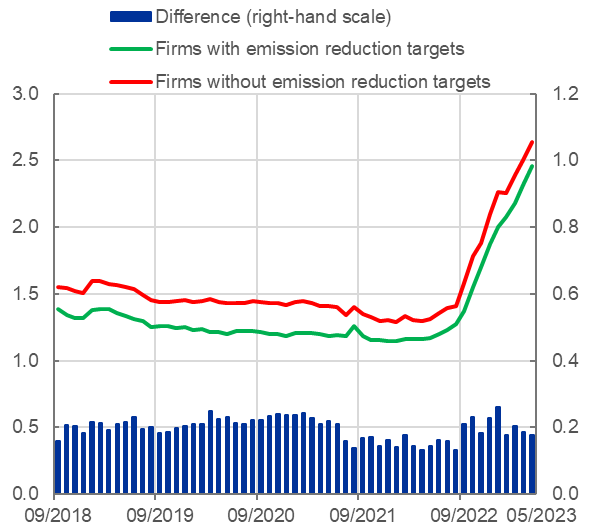 |
Source: Altavilla, C., Boucinha, M., Pagano, M. and Polo, A., (2024), “Climate risk, bank lending and monetary policy”, Working Paper Series, No 2969, ECB .
Banking supervision plays an important role in this context.[60] Banks under the ECB’s supervision have started to implement frameworks to monitor and manage climate risk and have included climate risk in their stress testing frameworks. This encourages banks to take climate risk into account in their credit risk management.
Credit ratings may add to this disciplining effect. In particular, recent research shows that firms with high carbon emissions have seen a deterioration in their ratings following the Paris agreement.[61] At the same time, the same analysis indicates that firms can mitigate this adverse effect on ratings by disclosing emissions and committing to reduce them.
While much of the emphasis has been on firms, similar patterns emerge for the household sector. In particular, bank lending conditions for residential mortgages are now bifurcated by energy performance: conditions are easier for high-performance buildings and tighter for low-performance buildings (Chart 14, right panel).[62] As these differentials widen and are reflected in house prices, the real-estate collateral underpinning much of household credit becomes more climate-sensitive, adding volatility to the wealth and balance-sheet channels of transmission.
Just like for the direct transmission to financial markets, climate factors also affect the bank lending channel in two ways: first, climate factors introduce an additional source of variation we need to understand in order to judge the prevailing ease or tightness of financing conditions for firms and households; and, second, climate factors alter how financing conditions react to a given change in monetary policy.
Finally, banks are themselves affected. In particular, banks with higher exposure to transition risk face elevated borrowing costs in interbank repo markets, a premium that intensifies during periods of financial stress (Chart 16). This bank-level fragility can amplify or attenuate the pass-through of the policy rate depending on the exact circumstances.
Chart 16
Estimated increase in the repo rates of banks associated with a one-standard-deviation increase in financed emissions, by repo collateral type
(basis points)
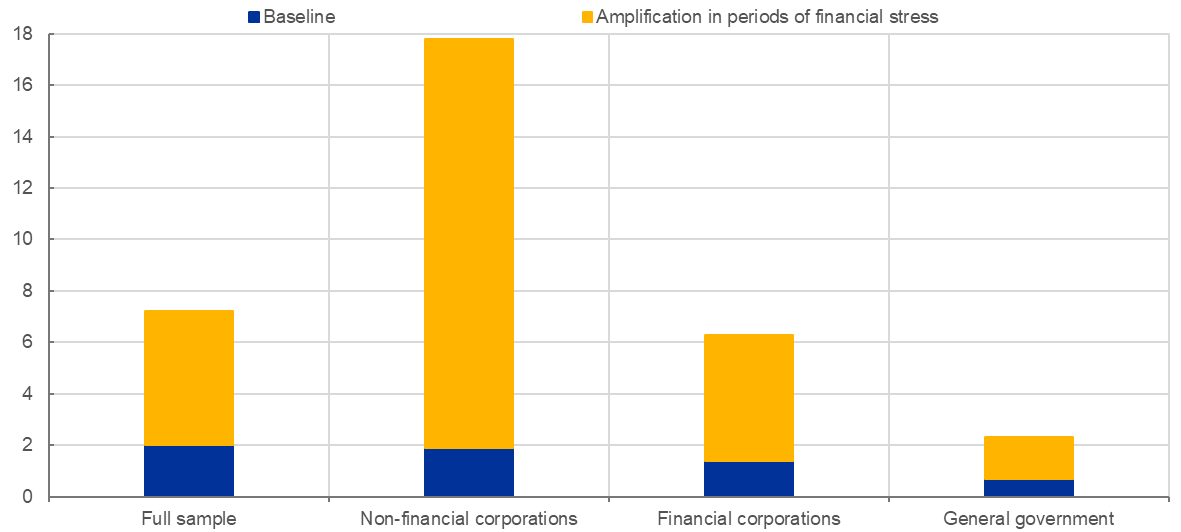
Sources: MMSR, AnaCredit, RIAD, EU Emissions Trading System, Eurostat air emissions accounts, Office of Financial Research and Giuzio, M., Kahraman, B. and Knyphausen, J. (2026), “Climate change, bank liquidity and systemic risk”, Working Paper Series, No 3168, ECB.
Notes: Estimates are based on a panel regression in which the dependent variable is the repo rate spread over the deposit facility rate of the ECB. The full sample includes all O/N, S/N, and T/N transactions. Results are also reported for subsamples of transactions collateralised by bonds issued by non-financial corporations, financial corporations, and general government. Financed emissions are measured as banks’ volume-weighted emission intensities at the bank-year level, computed from all commercial loans exceeding €25,000 and scaled by bank revenues. Control variables include bank size, leverage ratio, liquidity ratio, capital ratio, and return on assets. Periods of financial stress are defined as observations in which the Office of Financial Research Financial Stress Index falls within the top tercile of its distribution over the period 2019-22.
Over a longer horizon, it is important to recognise that the structure of the European financial system may adapt in response to the structural financing needs generated by climate change and the green transition. In particular, innovative green technologies inherently carry higher risk, making bank funding more costly and less available. The enhanced provision of risk capital via financial markets, supported by progress with the EU Savings and Investment Union, could mitigate this challenge.
This includes expanded roles for equity funding and state-contingent bond funding. For instance, in the ECB’s SAFE, firms reported that they consider the equity market as a relevant source for financing the green transition.[63] Conversely, greater use of equity finance tends to go along with lower CO2 emissions, in particular by inducing carbon-intensive sectors to reduce emissions relative to output, and potentially also by reallocating investment towards less polluting sectors.[64]
In relation to the bond market, while the euro area issuance of sustainable bonds has increased in recent years, its share in the overall issuance of euro area debt securities has remained limited, standing at around 6% in early 2026 (Chart 17). At the same time, the EU is set to become the world’s largest issuer of green bonds which may benefit both the environment and the EU if investors are willing to pay a “greenium”. As part of the NGEU, the European Commission has pledged to issue up to €250 billion or 30% of the NGEU bonds, as green bonds, confirming its commitment to sustainable finance and supporting the transition towards a greener Europe.[65] Thus, the EU is not only entering the green bond market, but it is also set to become one of the biggest green bond issuers globally.[66] So far, the EU has issued five green bonds that have been absorbed well by investors and amount to €80 billion, while the outstanding amount of conventional EU bonds stands at around €674 billion. This suggests that green bonds not only support climate-related projects, but also benefit from favourable pricing dynamics, reinforcing their importance for the EU in the transition to a sustainable economy.
If such structural changes in the euro area financial system, like more equity funding and a larger green bond market, take place, these will alter the transmission mechanism of monetary policy, with a lower relative role for the bank lending channel and a larger relative role for market-based transmission.
Finally, public support mechanisms, such as subsidised loans and public guarantees, could boost progress in the green transition.[67] While transition and physical risk tighten lending conditions by generating higher credit risk, climate-related fiscal support can have an easing impact on bank lending conditions, supporting loan demand and fixed investment (Chart 18).
Chart 17
Euro area issuances of sustainable debt securities
(Left-hand scale: EUR, outstanding amounts at face value; right-hand scale: percentages)
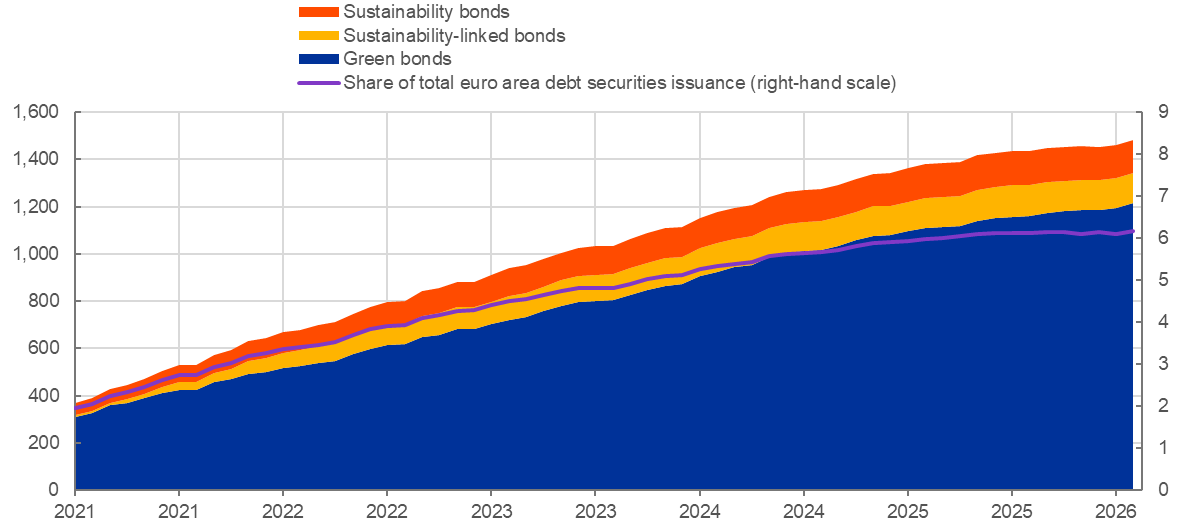
Source: Centralised Securities Database (CSDB).
Notes: Issuance for all levels of assurance. “Share of total euro area debt securities issuance” refers to the amount of all sustainable securities categories as a share of all debt securities issued in the euro area. Green bonds are debt securities whose proceeds are used to finance projects with clear environmental benefits. Sustainability bonds are debt securities whose proceeds are used to finance a combination of both green and social projects. Sustainability-linked bonds are debt securities for which the financial and/or structural characteristics can vary depending on whether the issuer achieves predefined sustainability/environmental, social and governance (ESG) objectives. Social bonds are excluded; these are debt securities whose proceeds are used to finance projects that address social issues and seek to achieve positive social outcomes.
Chart 18
Impact of selected climate-related factors on bank lending conditions and loan demand from firms
(net percentages of banks)
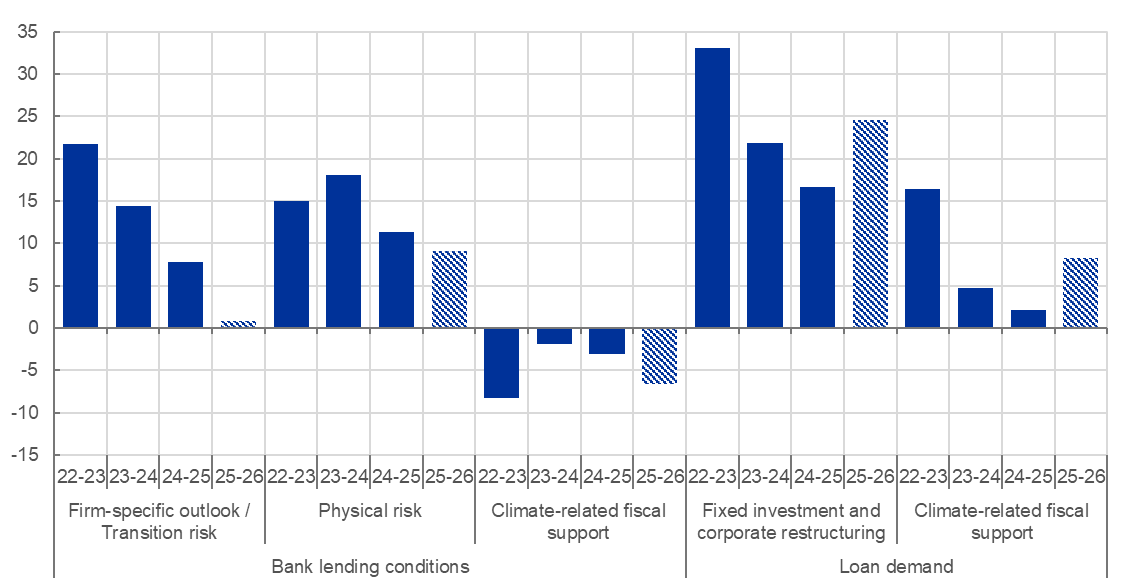
Source: ECB Bank Lending Survey (BLS).
Notes: The chart shows how climate-related factors contribute, according to the banks, to the impact of climate change on bank lending conditions and loan demand from firms. For bank lending conditions, positive values denote a tightening impact, while negative values denote an easing impact. For loan demand, positive values denote a supportive impact, while negative values denote a dampening impact of the respective factors. The last period denotes banks’ expectations for the coming 12 months, reported in the third quarter of 2025.
The monetary policy stance
Beyond transmission, climate change and the green transition alter the strategic environment for monetary policy in three dimensions: the frequency of shocks; the trade-offs these shocks entail over typical policy horizons; and the neutral policy rate.[68]
Besides raising the frequency of shocks, the nature of the shocks originating from climate factors poses a challenge for the monetary policy stance. This is because physical climate events tend to generate adverse supply conditions, at least initially.[69] For instance, examining extreme temperature events across Europe for over a century, recent research documents a tendency for output to fall and inflation to rise, thus creating a dilemma between price stability and supporting the economy.[70]
At the same time, supply contractions are not the only mechanism through which climate shocks may affect the economy. For example, by reducing wealth and income – and thereby causing a risk-induced tightening of financing conditions and falling collateral values, as well as a generalised deterioration of confidence, the initial supply shock may also weigh on demand.[71] That may explain why the historical pattern has been for central banks to ease monetary policy in response to episodes of abnormally high temperature, in order to offset the loss in output rather than leaning against the rise in inflation.[72]
However, uniform policy prescriptions cannot be derived from these historical patterns. For instance, if climate-related shocks grow more frequent and salient, the risk of de-anchored inflation expectations becomes more acute. If so, always looking through climate-driven supply shocks may not always present the most appropriate choice.[73]
How climate-related disruptions in general, and specific climate events in particular, feed through to inflation and the economy in the medium-term remains highly uncertain and dependent on the scale, persistence and type of shock, as well as the conditions prevailing at its inception. This uncertainty calls for a data-dependent, case-by-case approach to determining the policy response.
The nature of shocks may also become harder to disentangle as climate change is accompanied by mitigation measures. As discussed above, the direct impact of climate change can be viewed as an adverse supply shock. While transition measures add to cost-push dynamics (e.g. rising carbon-related taxes) to some degree, but also can constitute a positive demand shock through the associated higher investment in abatement and mitigation measures.[74] Furthermore, uncertainty about the future path of climate policies is an additional dimension of macroeconomic risk.[75]
In terms of the impact of monetary policy on the green transition, monetary policy tightening both slows down the transition away from fossil fuels (by lowering oil and gas prices) and worsens the financing conditions for green innovators, which tend to be disproportionately reliant on external finance.[76] Subject to the robust anchoring of inflation expectations (as discussed above) and within the context of a medium-term inflation-targeting framework, such considerations can be relevant in determining the speed at which a central bank returns inflation to target following an inflation shock.[77]
At the same time, the scale of the impact of the green transition on inflation and output dynamics is likely to remain moderate under realistic policy scenarios. As discussed earlier, ECB analysis of carbon price paths consistent with the International Energy Agency’s net-zero scenario finds that their impact on euro area GDP and inflation over the current decade would be moderate, with only modest inflation-output trade-offs for monetary policy as it seeks to preserve price stability (Chart 19).[78] However, the flip side of this finding is equally important: the estimated reductions in carbon emissions by 2030 under such a path would be limited, amounting to around one-quarter of the EU’s intermediate emissions target. Achieving the deeper cuts to emissions required to stay on track with EU climate commitments would require substantially higher carbon prices, with correspondingly larger effects on inflation and output and more significant trade-offs for monetary policy.
Chart 19
Monetary policy response to carbon tax policy
(percentage point deviations from baseline)
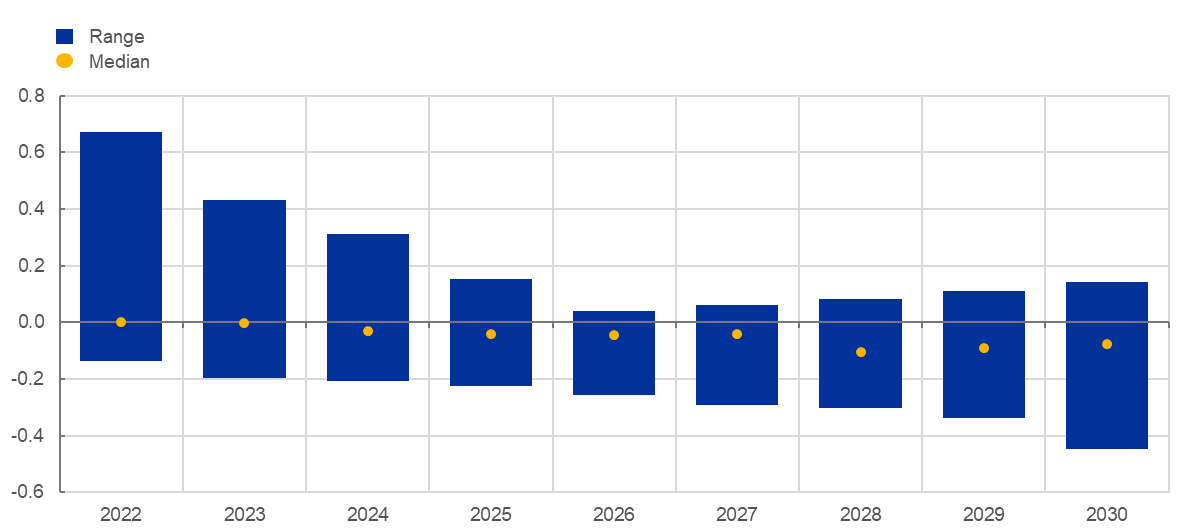
Sources: Brand et al., (2023), op. cit.. Based on results from Coenen, G., Lozej, M. and Priftis, R. (2023), “Macroeconomic effects of carbon transition policies: an assessment based on the ECB’s New Area-Wide Model with a disaggregated energy sector”, Working Paper Series, No 2819, ECB; May; Priftis, R. and Schoenle, R., “Fiscal and macroprudential policies during an energy crisis”, European Economic Review, Vol 179, October 2025; E Ferrari, A. and Nispi Landi, V., (2023), “Toward a green economy: the role of central bank’s asset purchases”, International Journal of Central Banking, Vol 19, No 5, December; McKibbin, W.J. and Wilcoxen, P.J., “The theoretical and empirical structure of the G-Cubed model”, Economic Modelling, Vol 16, No 1, January 1998, pp. 123-148; Hantzsche, A., Lopresto, M. and Young, G. (2018), “Using NiGEM in uncertain times: Introduction and overview of NiGEM”, National Institute Economic Review, Vol 244, May, pp. 1-14; and Oxford Economics’ Global Economic Model.
Note: The chart displays the impacts (range and median) of the carbon tax scenario on the short-term nominal interest rate between 2022 and 2030.
Climate change and transition policies may also affect the neutral real interest rate which – in the absence of major shocks – stabilises inflation around target and closes the output gap. In particular, key structural drivers of the neutral rate, such as productivity growth and the saving-investment balance, are likely to be affected by climate change.
However, the direction of this impact is uncertain in net terms.[79] For instance, climate damages divert resources from innovation and reduce total factor productivity growth.[80] Moreover, they increase precautionary saving as households and firms seek to insure against risk, especially if insurance companies retreat following natural catastrophes.[81] Both effects would tend to depress the neutral rate, especially if the supply of safe assets is structurally scarce and inelastic.[82] By contrast, the massive investment needs of the green transition and adaptation, including from fiscal authorities, and the innovation incentives created by the deployment of clean technology could raise productivity and push the neutral rate upwards.[83] Given these opposing forces, the net impact on the neutral rate is an empirical matter that will be closely monitored by ECB staff. [84]
Monetary policy design: greening the ECB’s instruments
The ECB has so far revised two components in the design of its toolbox of monetary policy instruments. First, the Eurosystem introduced a tilting framework for corporate asset purchases that steered reinvestments toward issuers with better climate performance. Financial disclosures show that this has played a meaningful role in reducing financed emissions in monetary policy portfolios since 2021.[85] Second, in July 2025, the Governing Council decided to introduce a new measure within the collateral framework to better manage financial risks related to the climate transition. This will be applicable to marketable assets issued by non-financial corporations from the second half of 2026.
The case for these steps is grounded in risk management as well as in the ECB’s mandate to support, without prejudice to price stability, the general economic policies in the EU, including environmental protection.[86] In particular, climate-related risks may weigh on the value of collateral, asset prices and credit risk, potentially exposing the Eurosystem balance sheet and affecting the transmission of monetary policy. For these reasons, adjusting the portfolio composition and collateral framework to reflect these risks is a mandate-consistent response, not an extension of the mandate. The design of the operational framework will also aim to incorporate climate change-related considerations into structural monetary policy operations.[87]
Conclusion
Let me summarise the main points. First, climate change both reduces the trend level of output and increases the volatility of output and inflation, including through the increased frequency and severity of extreme weather events. Second, the investment requirements associated with the green transition are making a material contribution to investment dynamics. Third, while the rise in carbon-related taxes imposes some short-term costs, the shift towards renewables will make the euro area more resilient by reducing dependence on fossil fuel imports and should also ultimately reduce the volatility of inflation. Fourth, there have been major advances in Eurosystem’s analytical toolkit for assessing the impact of climate change on inflation and growth especially in scenario analyses, even if the full incorporation of climate change into the ECB’s macroeconomic models is still a work in progress.
Fifth, in relation to the calibration of the monetary policy stance, the joint impact of climate risk and the green transition is both an independent source of variation in financing conditions and also alters the sensitivity of the financial system and the economy to shifts in the monetary policy stance.
Sixth, both physical climate events and transition measures can generate cyclical dynamics that may call for a monetary policy response: however, there is no “one size fits all” playbook in terms of determining the net impact on the stance. Seventh, in related manner, climate risks and transition policies may also influence the neutral rate but the net impact remains unclear.
In the context of high uncertainty about the precise timeline for global warming, a data-dependent approach provides the best framework for monetary policy decisions. But the information set we need to track is increasingly shaped by the physical and transition dynamics of climate change. That is the challenge and the commitment that guides our work.
I am grateful to Malin Andersson, Leonardo Carrai, Günter Coenen, Marien Ferdinandusse, Johannes Gross, Margherita Giuzio, Federic Holm-Hadulla, Sujit Kapadia, Petra Köhler-Ulbrich, Gerrit Koester, Friderike Kuik, Noëmie Lisack, Cristian Marques, Alexandros Melemenidis, Richard Morris, Carolin Nerlich, Christiane Nickel, Virginia di Nino, Miles Parker and Romanos Priftis, for their contributions to this speech. For previous ECB speeches on climate change and nature degradation, see, amongst other contributions, Cœuré, B. (2018), “Monetary policy and climate change”, speech at a conference on “Scaling up Green Finance: The Role of Central Banks”, organised by the Network for Greening the Financial System, the Deutsche Bundesbank and the Council on Economic Policies, Berlin, 8 November; Schnabel, I. (2022), “A new age of energy inflation: climateflation, fossilflation and greenflation”, speech at a panel on “Monetary Policy and Climate Change” at The ECB and its Watchers XXII Conference, Frankfurt am Main, 17 March; Lagarde, C. (2024), “Central banks in a changing world: the role of the ECB in the face of climate and environmental risks”, speech at the Maurice Allais Foundation, Paris, 7 June; Elderson, F. (2024), “Nature-related risk: legal implications for central banks, supervisors and financial institutions”, keynote speech at the ESCB Legal Conference, Frankfurt am Main, 6 September; Lagarde, C. (2025), “Europe’s road to renewables”, speech at Norges Bank’s Climate Conference, Oslo, 21 October. The implications of climate change for monetary policy was also extensively studied by Eurosystem staff during the 2021 Monetary Policy Strategy Review: see Workstream on climate change (2021), “Climate change and monetary policy in the euro area,” ECB Occasional Paper No. 271.
The current level of global warming is around 1.4 degrees Celsius above the pre-industrial level. At current warming rates, the limit of 1.5 degrees Celsius above pre-industrial levels targeted in the Paris Agreement could be reached by the end of this decade. Europe is also warming faster than the global average. See Copernicus Climate Change Service (2025), Global Climate Highlights 2024; Copernicus Climate Change Service and World Meteorological Organization (2026), European State of the Climate 2025; and the Paris Agreement, the climate change treaty adopted at the UN Climate Change Conference (COP21) in Paris on 12 December 2015.
Foster, G. and Rahmstorf, S. (2026), “Global Warming Has Accelerated Significantly”, Geophysical Research Letters, Vol. 53, No 5, March.
United Nations Environment Programme (2025), Emissions Gap Report 2025, 4 November.
See Bilal, A. and Känzig, D. (2026), “The Macroeconomic Impact of Climate Change: Global Versus Local Temperature”, The Quarterly Journal of Economics, Vol. 141, No 2. At the same time, there is a wide range of estimates of the economic damage from climate change: see also Lemoine, D., Hausman, C. and Shrader, J.G. (2026), “Navigating the “Problem from Hell”: A Guide to Climate Damages,” Journal of Economic Literature, forthcoming. Burke, M., Zahid, M., Diffenbaugh, N. and Hsiang, S. (2023), “Quantifying Climate Change Loss and Damage Consistent with a Social Cost of Greenhouse Gases”, NBER Working Paper Series, No 31658, National Bureau of Economic Research; and Moore, F.C., Drupp, M.A., Rising, J., Dietz, S., Rudik, I. and Wagner, G. (2024), “Synthesis of evidence yields high social cost of carbon due to structural model variation and uncertainties”, Proceedings of the National Academy of Sciences, Vol. 121, No 52.. Other prominent contributions include: Nordhaus, W.D. (1992), “An Optimal Transition Path for Controlling Greenhouse Gases,” Science, Vol. 258, No 5086, pp. 1315-1319; Dell, M., Jones, B. and Olken, B. (2012), “Temperature Shocks and Economic Growth: Evidence from the Last Half Century”, American Economic Journal: Macroeconomics, Vol. 4, No 3, pp. 66-95; Moore, F.C. and Diaz, D.B. (2015), “Temperature impacts on economic growth warrant stringent mitigation policy,” Nature Climate Change, Vol. 5, pp. 127-131.; Burke, M., Hsiang, S.M. and Miguel, E. (2015), “Global non-linear effect of temperature on economic production”, Nature, Vol. 527, pp. 235-239. Other related work has focused on the economic impact of natural disasters such as storms, heatwaves and El Niño; see, for example, Roth Tran, B. and Wilson, D.J. (2024), “The Local Economic Impact of Natural Disasters”, Federal Reserve Bank of San Francisco Working Paper Series, No 2020-34; Callahan, C.W. and Mankin, J.S. (2023), “Persistent effect of El Niño on global economic growth”, Science, Vol. 380, No 6649, pp. 1064-1069; or Dingel, J.I., Meng, K.C. and Hsiang, S.M. (2023), “Spatial correlation, trade, and inequality: Evidence from the global climate”, NBER Working Paper Series, No 25447, National Bureau of Economic Research. See, among many others, Fernández-Villaverde, J., Gillingham, K. and Scheidegger, S. (2024), “Climate Change through the Lens of Macroeconomic Modeling”, NBER Working Paper Series, No 32963; Bilal, A. and Stock, J.H. (2026), “A Guide to Macroeconomics and Climate Change”, NBER Working Paper Series, No 33567; Dell, M., Jones, B.F. and Olken, B.A. (2014), “What Do We Learn from the Weather? The New Climate-Economy Literature”, Journal of Economic Literature, Vol. 52, No 3, pp. 740-798; Hassler, J., Krusell, P. and Olovsson, C. (2024), “The macroeconomics of climate change: Starting points, tentative results, and a way forward”, Working Paper, No 24-8, Peterson Institute for International Economics; Barrage, L. and Nordhaus, W. (2024), “Policies, projections, and the social cost of carbon: Results from the DICE-2023 model”, Proceedings of the National Academy of Sciences, Vol. 121, No 13; Kahn, M.E., Mohaddes, K., Ng, R.N.C., Pesaran, M.H., Raissi, M. and Yang, J.-C. (2021), “Long-term macroeconomic effects of climate change: A cross-country analysis”, Energy Economics, Vol. 104; Newell, R.G., Prest, B.C. and Sexton, S.E. (2021), “The GDP-Temperature relationship: Implications for climate change damages”, Journal of Environmental Economics and Management, Vol. 108; and the Cross-Working Group Box on “Estimating Global Economic Impacts from Climate Change” in Intergovernmental Panel on Climate Change (2022), Assessment Report 6, Working Group 2 on Impacts, Vulnerability and Adaptation, Chapter 16.
The package operates through interlocking instruments. These include strengthened Emissions Trading Systems that, taken together, are set to cover around 75 per cent of the European Union’s greenhouse gas emissions. The current agreement foresees an expansion of the existing European Emissions Trading System (ETS1), and the start of a new, complementary Emissions Trading System (ETS2) to cover emissions from road transport, building heating and small industrial installations. A political debate is ongoing to review the ETS1 in light of high energy prices, with the European Commission set to present a proposal in July 2026. See European Commission (2026), “EU reinforces the stability and predictability of its carbon market”, press release, 1 April. The ETS1 is complemented by a Carbon Border Adjustment Mechanism to impose the same carbon costs on imported goods as faced by European producers. A Social Climate Fund will support vulnerable households through the adjustment.
Notwithstanding the externality characteristic (whereby the global benefits exceed the domestic benefits), Bilal and Känzig (op. cit) calculate that unilateral decarbonisation by a sufficiently-large country may be cost effective, in view of the scale of the damages caused by rising global temperatures.
See, for example, Kuik, F., Nickel, C., Parker, M. and Modery, W. (2023), “The price of inaction: what a hotter climate means for monetary policy”, The ECB Blog, ECB, 18 December.
See ECB (2021), “An overview of the ECB’s monetary policy strategy – 2021”. In its 2025 assessment of its monetary policy strategy, the Governing Council extended this commitment to incorporate the impact of nature degradation. The same externalities that generate unsustainable climate change also threaten biodiversity and erode “natural” capital. See also Dasgupta, P. (2021), The Economics of Biodiversity, Independent Report to the UK Government.
My focus is on monetary policy; I do not cover the financial stability risks, nor the implications for banking supervision.
Parker, M. (2023), “How climate change affects potential output”, Economic Bulletin, Issue 6, ECB. In addition, the impact of severe weather events at the regional level can far exceed the impact at the national level, as illustrated in Usman, S., González-Torres Fernández, G. and Parker, M. (2025), “Going NUTS: the regional impact of extreme climate events over the medium term”, European Economic Review, Vol. 178; Frost, J., Madeira, C. and Martínez Jaramillo, S. (2025), “The economics of water scarcity”, BIS Working Papers, No 1314, Bank for International Settlements. For an integrated perspective on regional and global developments, see Krusell, P. and Smith, A.A. (2022), “Climate Change Around the World”, NBER Working Paper Series, No 30338, National Bureau of Economic Research.
An increase in the frequency and intensity of extreme weather events translates into a higher-variance shock process and, through standard propagation, raises the unconditional variance of output. See also Alessandri, P. and Mumtaz, H. (2025), “The macroeconomic cost of temperature risk”, Journal of International Economics, Vol. 158; Cantelmo, A., Fatouros, N., Melina, G. and Papageorgiou, C. (2024), “Monetary Policy under Natural Disaster Shocks”, International Economic Review, Vol. 65, No 3, pp. 1441-1497; Cevik, S. and Jalles, J.T. (2023), “Eye of the Storm: The Impact of Climate Shocks on Inflation and Growth”, IMF Working Papers, No 2023/087, International Monetary Fund.
Andersson, M., Battistini, N. and Bobasu, A. (2026), “Heatwaves, coldwaves, floods, and droughts: the short-term impact of extreme weather events on economic activity”, Working Paper Series, No 3203, ECB.
Giuzio, M., Rousová, L., Kapadia, S., Kumar, H., Mazzotta, L., Parker, M. and Zafeiris, D. (2026), “Climate change, catastrophes, insurance and the macroeconomy”, European Economic Review, Vol. 182; ECB and EIOPA (2024), “Towards a European system for natural catastrophe risk management”, Discussion Paper. In addition, recent research finds that fiscal transfers to regions or states hit by natural disasters can also support recoveries. See Fernandez-Gallardo, A. and Pappa, E. (forthcoming), (2026): “Natural disasters and fiscal shelters”, Working Papers, No. 2612, Banco de España.
See also Wegner, O., Dees, S., Boullot, M., Lesterquy, P., Serfaty, C., Thubin, C., Ulgazi, Y., Boitout, A. and Gabet, M. (2025) “Seeds of Inflation: Macro Modelling of Nature-Related Risks through Agricultural Prices”, Working Paper, No. 1006, Banque de France..
Bates, C., Kuik, F., Wieland, E. and Zekaite, Z. (2025), “Inside the food basket: what is behind recent food inflation?”, Economic Bulletin, Issue 8, ECB. Food inflation in the euro area can also be affected through the commodity price channel, making it vulnerable to extreme weather in different parts of the world, as observed for example with the rise in coffee and cocoa prices in 2023-24. See Kotz, M., Donat, M.G., Lancaster, T., Parker, M., Smith, P., Taylor A. and Vetter, S.H. (2025),“Climate extremes, food price spikes, and their wider societal risks”, Environmental Research Letters, Vol. 20, July. Effects can also arise through natural modes of climate variability, such as El Niño, see Adolfsen, J. F. and Lappe, M.-S., “Risks to global food commodity prices from El Niño”, ECB Economic Bulletin, Issue 6, 2023.
Kuik, F., Osbat, C. and Vidal-Quadras Costa, I. (forthcoming), “Earth, Wind, Fire and grocery bills: exploring the forecasting power of weather variables for euro area food inflation”.
Kotz, M., Kuik, F., Lis, E. and Nickel, C. (2024), “Global warming and heat extremes to enhance inflationary pressures”, Communications Earth & Environment, Vol. 5, No 116. The study uses state-of-the-art climate data combined with monthly price data from 121 countries to assess the response of different inflation components to increases in temperature, temperature variability, heavy precipitation and drought, using global panel regressions with country, month and country-month fixed effects. In addition to the climate variables, the regression includes interaction terms to capture the dependence of the impacts on historical average temperature and temperature variability. The empirical responses of food inflation to higher temperatures are then used to calculate the impact of extremely hot summers in the future, making use of the fact that climate change will alter the distribution of future summer temperatures predominantly by shifting their mean. Two climate scenarios that are commonly referred to are used to evaluate potential future impacts, representing a high and a low emissions scenario. The resulting estimates can be understood as the additional impact on food inflation attributed to future higher temperatures. The approach does not make any assumptions about future inflation dynamics or macroeconomic factors affecting those and can therefore be understood as a stylised sensitivity analysis.
Bobeica, E., Koester, G. and Nickel, C. (2025), “When groceries bite: the role of food prices for inflation in the euro area”, The ECB Blog, ECB, 25 September.
Ciccarelli, M. and Marotta, F. (2024), “Demand or Supply? An empirical exploration of the effects of climate change on the macroeconomy”, Energy Economics, Vol. 129.
Ciccarelli, M., Kuik, F. and Martínez Hernández, C. (2024), “The asymmetric effects of temperature shocks on inflation in the largest euro area countries”, European Economic Review, Vol. 168.
Parker M. (2018), “The impact of Disasters on Inflation”, Economics of Disasters of Climate Change, Vol. 2, No 1, pp. 21-48.
Faccia, D., Parker, M. and Stracca, L. (2021), “Feeling the heat: extreme temperatures and price stability”, Working Paper Series, No 2626, ECB; Ciccarelli, M., Kuik, F. and Martínez Hernández, C. (2024): “The asymmetric effects of temperature shocks on inflation in the largest euro area countries”, European Economic Review, Vol. 168; Andersson, M., Battistini, N. and Bobasu, A. (2026): “Heatwaves, coldwaves, floods, and droughts: the short-term impact of extreme weather events on economic activity”, Working Paper Series, No 3203, ECB.
See, for example, Armstrong McKay, D.I. et al. (2022), “Exceeding 1.5°C global warming could trigger multiple climate tipping points”. The study finds that six tipping points become likely and another four possible even within the Paris Agreement warming range of 1.5 to below 2°C. These include the collapse of the Greenland and West Antarctic ice sheets, die-off of coral reefs around the equator, and widespread abrupt permafrost thawing. A recent study finds a significantly higher than previously assumed risk that the Atlantic Meridional Overturning Circulation (which is crucial for mild weather in Europe) slows down already as of mid-century, and under the current emission trajectory, see Portmann, V. et al. (2026), “Observational constraints project a ~50% AMOC weakening by the end of this century”, ScienceAdvances, Vol. 12.
This high level of uncertainty may also influence the beliefs of households about medium-term inflation dynamics: survey evidence shows that consumers exposed to temperature rise scenarios revise their five-year-ahead inflation expectations upward significantly. See Georgarakos, D., Kenny, G., Meyer, J. and van Rooij, M. (2025), “How do rising temperatures affect inflation expectations?”, Working Paper Series, No 3132, ECB. The authors use randomised temperature scenarios within the ECB’s Consumer Expectations Survey. However, other surveys find that climate-concerned households have somewhat lower inflation expectations; see Meinerding, C., Poinelli, A. and Schüler, Y. (2023), “Households’ inflation expectations and concern about climate change”, European Journal of Political Economy, Vol. 80, December. The results of these two studies are not necessarily contradictory: the German survey taps a narrower concept of climate concern, while the CES experiment captures expectations under a concrete temperature scenario.
See, for example, UK Climate Change Committee (2026), “Cost of Net Zero by 2050 less than a single fossil fuel price shock”; Golosov, M., Hassler, J., Krusell, P. and Tsyvinski, A. (2014), “Optimal taxes on fossil fuel in general equilibrium”, Econometrica, Vol. 82, No 1, pp. 41-88; Pindyck, R.S. (2013), “Climate change policy: What do the models tell us?”, Journal of Economic Literature, Vol. 51, pp. 860-872; or Miftakhova, A. (2021), “Global sensitivity analysis for optimal climate policies: Finding what truly matters”, Economic Modelling, Vol. 105.
See Aguilar García, P., Durero, F., Ferdinandusse, M., Kuik, F. and Priftis, R. (2025), “The macroeconomic impact of climate change policies in the euro area”, Eurosystem staff macroeconomic projections for the euro area, December.
The model used for this analysis was the New Area-Wide Model (NAWM-E); see the section on “Modelling the impact of climate change and the green transition”. In particular, the model does not distinguish between a carbon tax and a carbon price under an emissions trading scheme. Both instruments would be captured as surcharges on the price of dirty energy. The findings in the empirical literature on the impact of carbon pricing and emissions trading schemes are mixed in terms of the findings of impacts on inflation and output, see for example Bilal, A. and Stock, J.H. (2025), “A guide to macroeconomics and climate change”, NBER Working Paper Series, No 33567, and references therein. But, notably, Känzig and Konradt (2024) study the difference in impacts of carbon pricing and emissions trading in Europe and find that a positive shock to EU ETS prices leads to a significant rise in headline HICP and HICP energy, with impacts on headline HICP peaking just below 0.4 percentage points after three years. It also finds a significant fall in industrial production, and higher unemployment. On the other hand, they find that higher national carbon taxes are only associated with a limited increase in prices and a short-lived economic downturn. Their findings suggest that the difference in how tax revenues are recycled in the ETS and national carbon taxes plays an important role in explaining the differing results. See Känzig, D. and Konradt, M. (2024), “Climate Policy and the Economy: Evidence from Europe’s Carbon Pricing Initiatives”, IMF Economic Review, Vol. 72. Other studies find only a limited impact of carbon taxes on inflation, for example in Konradt, M. and Weder di Mauro, B. (2023), “Carbon Taxation and Greenflation: Evidence from Europe and Canada”, Journal of the European Economic Association, Vol. 21, No 6, December, pp. 2518-2546. Further research suggests that an additional cornerstone of successful transition policies is the cooperation across countries, see Ferrari Minesso, M. and Pagliari, M. S., “No country is an island. International cooperation and climate change”, Journal of International Economics, Volume 145.
For a discussion of the best policy mix, see for example Blanchard, O., Gollier, C. and Tirole, J. (2023), “The portfolio of economic policies needed to fight climate change”, Annual Review of Economics, Vol. 15, pp. 689-722; Acemoglu, D., Aghion, P., Bursztyn, L. and Hemous, D. (2012), “The environment and directed technical change”, American Economic Review, Vol. 102, No 1, pp. 131-166; and Degasperi, R., Natoli, F. and Pallara, K. (2024), “The Macroeconomic Effects of the Green Transition”, Banca d’Italia Working Paper, No 1531.
Quintana, J. (2024), “The impact of renewable energies on wholesale electricity prices”, Economic Bulletin, Banco de España, September.
Bartocci, A., Notarpietro, A. and Pisani, M. (2024), ““Green” fiscal policy measures and nonstandard monetary policy in the euro area”,Economic Modelling, Vol. 136; Ferrari, A. and Nispi Landi, V. (2022), “Will the green transition be inflationary? Expectations matter”, Banca d’Italia Occasional Paper, No 686; Olovsson C. and Vestin, D. (2023), “Greenflation?”, Sveriges Riksbank Working Paper Series, No 420.
See also Elderson, F. (2026), “Europe’s fossil fuel dependence poses risks to price stability”, Financial Times, 7 April; and Lagarde, C. (2025), “Europe’s road to renewables”, speech at Norges Bank’s Climate Conference, Oslo, 21 October.
Domínguez-Díaz, R. and Hurtado, S. (2024), “Green energy transition and vulnerability to external shocks”, Working Papers, No 2425, Banco de España; Chafwehé, B., Colciago, A. and Priftis, R. (2025), “Reallocation, productivity, and monetary policy in an energy crisis”, European Economic Review, Vol. 173(C). See Section 3.3 in Nickel et al. (2025): A strategic view on the economic and inflation environment in the euro area, ECB Occasional Paper No 371.
Nerlich, C. et al. (2025), “Investing in Europe’s green future – Green investment needs, outlook and obstacles to funding the gap”, Occasional Paper Series, No 367, ECB; Pisani-Ferry, J. (2021), “Climate policy is macroeconomic policy and the implications will be significant”, Policy Brief, Peterson Institute for International Economics, August.
Bańkowski, K., Benalal, N., Bouabdallah, O., De Stefani, R., Huber, C., Jacquinot, P., Nerlich, C., Rodríguez-Vives, M., Szörfi, B., Zorell, N. and Zwick, C. (2024), “Four years into the Next Generation EU programme: an updated preliminary evaluation of its economic impact”, Economic Bulletin, Issue 8, ECB.
This results from an ECB staff analysis, using NL Analytics, retrieving the net sentiment of firms (number of sentences containing positive minus negative sentiment) related to investment and green transition or green policy or transition risk.
Kuik, F., Morris, R. and Sun, Y. (2022), “The impact of climate change on activity and prices – insights from a survey of leading firms”, Economic Bulletin, Issue 4, ECB.
A similar pattern of responses was observed for input costs and prices, which probably reflects to some degree how firms see these investments as necessary but also costly.
Andersson, M., Jarvis, V., Le Breton, G. and Morris, R. (2025), “The outlook for euro area business investment – findings from an ECB survey of large firms”, Economic Bulletin, Issue 4, ECB.
Freier, M., Melemenidis, A. and Morris, R. (2026), “Using AI to transform the ECB’s Corporate Telephone Survey”, The ECB Blog, ECB, 16 February.
See Lane, P. R. (2026), “AI and the euro area economy” keynote speech at ECB-SAFE-RCEA International Conference on the Climate-Macro-Finance Interface (3CMFI), Frankfurt, 23 March; and Parker, M. (2025), “AI versus green: clash of the transitions?“, The ECB Blog; 25 March.
See, for example, Brynskov, M. (2025), Novel AI applications in the energy sector, European Commission, June.
For a discussion of modelling the impact of climate change on the economy through integrated assessment models, see Fernández-Villaverde, J., Gillingham, K.T. and Scheidegger, S. (2025), “Climate Change through the Lens of Macroeconomic Modeling”, Annual Review of Economics, Vol. 17; pp 125-150.
Ferdinandusse, M., Kuik, F., Lis, E. and Sun, Y. ( 2023), “Climate-related policies in the Eurosystem/ECB staff macroeconomic projections for the euro area and the macroeconomic impact of green fiscal measures”, Economic Bulletin, Issue 1, ECB; Ferdinandusse, M., Kuik, F. and Priftis, R. (2024), “Assessing the macroeconomic effects of climate change transition policies, Economic Bulletin, Issue 1, ECB; Ferdinandusse, M. and Delgado-Tellez, M. (2024), “Fiscal policy measures in response to the energy and inflation shock and climate change”, Economic Bulletin, Issue 1, ECB; and ECB (2024), “Assessing the impact of climate change transition policies on growth and inflation”, Eurosystem staff macroeconomic projections for the euro area, December.
The largest contribution to inflation comes from increases in national carbon prices or pollution-based indirect taxes. See Aguilar García, P., Durero, P., Ferdinandusse, M., Kuik, F. and Priftis, R. (2025), “The macroeconomic impact of climate change policies in the euro area”, Eurosystem staff macroeconomic projections for the euro area, December.
This finding is also consistent with an assessment carried out by European Commission staff in the context of their Autumn 2025 forecast; see European Commission (2025), “Trends in carbon intensity and the macroeconomic role of the EU Emissions Trading System”, European Economic Forecast – Autumn 2025, November. Also see Ref. 30.
Coenen, G., Lozej, M. and Priftis, R. (2024), “Macroeconomic effects of carbon transition policies: An assessment based on the ECB’s New Area-Wide Model with a disaggregated energy sector”, European Economic Review, Vol. 167, August.
Brand, C., Coenen, G., Hutchinson, J. and Saint Guilhem, A. (2023), “The macroeconomic implications of the transition to a low-carbon economy”, Economic Bulletin, Issue 5, ECB; Box 3 in Ciccarelli, M., Darracq Parries, M. and Priftis, R. (2024), “ECB macroeconometric models for forecasting and policy analysis”, Occasional Paper Series, No 344, ECB; and Burgert, M. et al. (2026), “Macroeconomic effects of carbon-intensive energy price changes: a model comparison”, Working Paper Series, No 3192, ECB, February.
In this exercise, this pathway does not deliver sufficient reductions in emissions. The structures of the models matter greatly for the size of emission cuts achieved.
Sahuc, J.-G., Smets, F. and Vermandel, G. (2024), “The New Keynesian Climate Model”, CEPR Discussion Paper, No 19745, CEPR Press.
See also the ECB’s climate and nature plan 2024-2025.
For the link between financial conditions and green investment, see Phan, T., Necchio, F., Jordà, O. and Schwartzman, F. (2026), “Financial conditions and capital investment choices”, Federal Reserve Bank of San Francisco Working Paper 2026-05.
See Gormsen, N., Huber, K. and Oh, S. (2025), “Climate Capitalists”, mimeo, University of Chicago. Cross-validation of this result is provided by the empirical pattern that firms with expected high future emissions have lower equity values: see Pastor, L., Stambaugh, R. and Taylor, L. (2026), “The Carbon Burden,” mimeo, University of Chicago. However, if investors perceive that governments might, under adverse economic conditions, pull back from commitments to raise carbon taxes, this can motivate investors to hold brown stocks for hedging reasons: see Garleanu, N. and Pedersen, L. (2025), “Carbon Risk Pricing,” mimeo, Copenhagen Business School.
Bua, G., Kapp, D., Ramella, L., and Rognone, F. (2024), “Transition versus physical climate risk pricing in European financial markets: a text-based approach”, The European Journal of Finance, Vol. 30, Issue 17; Bats, J., Bua, G. and Kapp, D., (2024), “Physical and transition risk premiums in euro area corporate bond markets”, Working Paper Series, No 2899, ECB.
Fornari, F., Pianeselli, D., and Zaghini, A. (2026), “Environmental score and bond pricing: it better be good, it better be green”, Journal of International Money and Finance, Vol. 161. Pietsch, A. and Salakhova, D. (2024), “Pricing of green bonds: drivers and dynamics of the greenium”, Working Paper Series, No. 2728, ECB.
There are contrasting results on whether green firms or brown firms are more affected by monetary policy shocks. In Fornari, F. and Groß, J. (2024), “Green and Glowing or Brown in Disguise? How do monetary policy shocks shape the cross section of equity returns?”, the authors find that monetary policy shocks have larger effects on the equity valuations of green firms than those of brown firms and firms that do not disclose their emissions in the euro area. By contrast, Bauer, M., Rudebusch, E. and Offner, G. (2025), “Green stocks and monetary policy shocks: Evidence from Europe”, European Economic Review, Vol 177, August, the authors report evidence that green firms may be less sensitive to monetary policy shocks than brown firms.
Köhler-Ulbrich, P., Schuster, Y. and Tushteva, N., (2025),“Climate performance matters for bank credit in the euro area”, The ECB Blog, 10 November. See also Sections 5.4 and 5.5 on the ad hoc question on the impact of climate change on bank lending to firms and housing loans in ECB (2025), The euro area bank lending survey – Second quarter of 2025, July.
Altavilla, C., Boucinha, M., Pagano, M. and Polo, A., (2024), “Climate risk, bank lending and monetary policy”, Working Paper Series, No 2969, ECB. The underlying mechanism is a climate risk-taking channel by which banks respond to monetary policy tightening by increasing monitoring efforts and restricting lending to riskier borrowers (and vice versa for monetary policy easing), where the dimensions of risk considered include those related to climate.
Altavilla, C., Boucinha, M., Pagano, M. and Polo, A., op. cit.
See Section 2.2. of ECB (2026), Supervisory priorities 2026-28, November. See also Elderson, F. (2025), “From charting the course to staying the course: the path ahead for climate and nature risk supervision”, keynote speech at the ECB industry dialogue on “Climate and nature risk management: taking stock and looking ahead”, 1 October.
Carbone, S. et al., (2025), “The low-carbon transition, climate commitments and firm credit risk”, SAFE Working Paper Series, No 442, Leibniz Institute for Financial Research.
ECB, (2025), The euro area bank lending survey – Second quarter of 2025, July.
Nerlich, C., Köhler-Ulbrich, P. and Andersson, M. et al., op. cit.
See De Haas, R. and Popov, A. (2023): “Finance and green growth”, The Economic Journal, Vol. 133, No 650, pp. 637-668.
European Commission (2021), “NextGenerationEU: European Commission gearing up for issuing €250 billion of NextGenerationEU green bonds”, press release, 7 September. For a recent update see European Commission (2025), “EU becomes major Green Bond issuer”, press release, 10 December.
Hinsche, I. (2021), “A greenium for the next generation EU green bonds: Analysis of a potential green bond premium and its drivers”, CFS Working Paper Series, No 663, Center for Financial Studies.
See Section 3.2 of Nerlich, C. et al. (2025), “Investing in Europe's green future – Green investment needs, outlook and obstacles for funding the gap”, Occasional Paper Series, No 367, ECB. See also Ferrando, A., Groß, J. and Rariga, J. (2023), “Climate change and euro area firms’ green investment and financing – results from the SAFE”, Economic Bulletin, Issue 6, ECB, who highlight the important role played by public loan guarantees and private sector funds in directing resources towards the greening of the economy.
For a recent survey, see Bilal, D. and Stock, J. H. (2025), “The short-run macroeconomics of the energy transition: a review and directions for research”, Series on Central Banking Analysis and Economic Policies, No 31, Banco Central de Chile, October.
NGFS Workstream on Monetary Policy (2024), “Acute physical impacts from climate change and monetary policy”, Technical document, NGFS, August.
Baleyte, J., Bazot, G., Monnet, E. and Morys, M. (2024), “High Temperature Shocks are Supply Shocks: Evidence from One Century of Monthly Data”, CEPR Discussion Paper, No 19682, November.
NGFS (2024), op. cit. The nature of shocks may also become harder to disentangle as climate change is accompanied by mitigation measures. In particular, in Sahuc, J.-G., Smets, F. and Vermandel, G. (2024), “The New Keynesian Climate Model”, CEPR Discussion Paper, No. 19745, CEPR Press, the authors show that, in this case, the direct impact of climate change, which acts as an adverse supply shock, is accompanied by a mix of shocks related to transition measures, which partly add to the cost-push dynamics, but also in part constitute a positive demand shock owing to higher abatement expenditures in the economy. Moreover, the effect of climate policies may arise not only in relation to their implementation, but also to uncertainties surrounding their future path, which may lower output and emissions at the cost of higher commodity and consumer prices, again altering the context in which monetary policy operates (see Gavriilidis, K., Känzig, D.R., Raghavan, R., and Stock, J.H., (2026), “The Macroeconomic Effects of Climate Policy Uncertainty”, NBER Working Paper Series, No 34762, National Bureau of Economic Research).
Baleyte, J., Bazot, G., Monnet, M., and Morys, E. (2024), op. cit.
See also Lane, P.R. (2025), “Inflation Deviations and Monetary Policy”, keynote speech at the 15th workshop on exchange rates, co-organised by Banka Slovenije with the Banca d’Italia, the Bank for International Settlements, the European Central Bank and the Nationale Bank van België/Banque Nationale de Belgique, 3 December.
Sahuc, J.-G., Smets, F. and Vermandel, G (2024), “The New Keynesian Climate Model”, CEPR Discussion Paper No. 19745.
Gavriilidis, K., Känzig, D.R., Raghavan, R., and Stock, J.H., (2026), op. cit.
See Fornaro, L., Guerrieri, V. and Reichlin, L. (2025), “Monetary Policy for the Green Transition”, BIS Papers, No. 61. See also Serebriakova, S., Polzin, F. and Sanders, M. (2026), “Monetary policy and energy installation: Implications for the European green transition”, Energy Economics, Vol. 155, March.
For further discussion of the underlying trade-offs, see Benatiya Andaloussi., M., Carton, B., Evans, C., Jaumotte, F., Muir, D., Natal, J.M., Panton. A.J., and Voigts, S. (2022), “Near-term macroeconomic impact of decarbonization policies”, World Economic Outlook: Countering the Cost-of-Living Crisis, International Monetary Fund, October.
Brand, C., Coenen, G., Hutchinson, J., and Saint Guilhem, A., (2023), “The macroeconomic implications of the transition to a low-carbon economy”, Economic Bulletin, Issue 5, ECB.. A qualitatively similar conclusion for the historical effects of carbon taxes emerges from McKibbin, W., Konradt, M. and Weder di Mauro, B. (2021), “Monetary policy and climate policies: Implications for Europe”, Beyond the pandemic: the future of monetary policy – ECB Forum on Central Banking 28-29 September 2021, ECB. For a study of the effects of the green transition on the US economy, see Del Negro, M., di Giovanni, J., and Dogra, K. (2023), “Is the Green Transition Inflationary?” Staff Reports, No 1053, Federal Reserve Bank of New York. While the latter paper points to the inflation-output trade-off being sizeable, it is assessed to be short-lived, fading out over a one-year horizon.
Section 3.6.3 of ECB (2025), “A strategic view on the economic and inflation environment in the euro area”, Occasional Paper Series, No. 371.
Parker, M. (2023), “How climate change affects potential output”, Economic Bulletin, Issue 6, ECB; Kahn, M.E., Mohaddes, K., Ng, R.N.C., Pesaran, M.H., Raissi, M. and Yang, J.-C. (2021), “Long-term macroeconomic effects of climate change: A cross-country analysis”, Energy Economics, Vol. 104.
Giuzio, M., Rousová, L., Kapadia, S., Kumar, H., Mazzotta, L., Parker, M. and Zafeiris, D. (2026), “Climate change, catastrophes, insurance and the macroeconomy”, European Economic Review, Volume 182, February.
Rachel, L. and Smith, T. (2017), “Secular drivers of the global real interest rate”, Staff Working Papers, No. 571; Bank of England, December; Caballero, R.J. and Farhi, E. (2018): “The Safety Trap”, The Review of Economic Studies, Vol. 85, No 1, pp. 223–274.
For instance, in Sahuc, J.-G., Smets, F., and Vermandel, G., (op. cit.) abatement spending raises the natural rate of interest. For a comprehensive overview of the channels involved, see also Pisani-Ferry, J. (2021), “Climate policy is macroeconomic policy, and the implications will be significant”, Policy Briefs, No 21-20, Peterson Institute for International Economics.
A recent ECB survey suggests that the weight of model-based analyses would argue that downward forces dominate, lowering r* and constraining the effective scope of conventional monetary policy to react to disinflationary shocks. However, the analysis also confirms that the sign and magnitude of the net effect is hard to predict, with results sensitive to assumptions about the speed of the transition and the potency of new technologies. See Mongelli, F.P., Pointner, W. and van den End, J.W., (2022) “The effects of climate change on the natural rate of interest: a critical survey”, Working Paper Series, No. 2744, ECB, November.
ECB (2025), “ECB adds indicator of nature loss in climate-related financial disclosures as portfolio emissions continue to decline”, press release, 12 June. The tilting framework has been responsible for around one-quarter of emission reductions in the monetary policy corporate bond holdings of the Eurosystem since 2021. Quantitative interim emission reduction targets are set for corporate bond holdings in the asset purchase programme (APP) and the pandemic emergency purchase programme (PEPP).
For a formal analysis of how the tilting of corporate bond purchases supports the green transition, see Nakov, A. and Thomas, C. (2026), “Climate-conscious monetary policy”, Journal of Political Economy Macroeconomics, forthcoming.
For the outcome of the 2024 operational framework review, see ECB (2024), “Changes to the operational framework for implementing monetary policy”, Statement by the Governing Council, 13 March.
Europeiska centralbanken
Generaldirektorat Kommunikation och språktjänster
- Sonnemannstrasse 20
- 60314 Frankfurt am Main, Tyskland
- +49 69 1344 7455
- media@ecb.europa.eu
Texten får återges om källan anges.
Kontakt för media