




- THE ECB BLOG
Learning from misses: what forecast errors reveal about the nature of shocks
27 February 2026
Economic forecasts rarely hit the mark as reality is full of surprises. Thankfully we can learn from the patterns of forecast errors. They shed light on the types of shocks that are shaping the economy beyond what forecasts anticipated.
Forecast errors are often seen as unavoidable gaps between forecasts and reality.[1] Nobody likes to make mistakes, so forecast errors might sometimes be perceived as embarrassing and unfortunate. But they can also be an opportunity, as the pattern of forecast errors can provide valuable information for economic analysis. This blog post considers the ECB and Eurosystem staff projections through this lens. It shows how forecast errors can shed light on the nature of shocks, particularly during periods of heightened uncertainty. Turning these errors into a diagnostic tool also helps to understand why forecasts have occasionally missed their mark. And that, in turn, helps to improve forecasting methods.
When growth or inflation data turn out to be different from what was projected, these surprises provide a valuable window into the economic forces at play. Forecast errors have long been used to assess the quality of macroeconomic projections.[2] The analysis presented in this blog post contributes to a growing literature that uses forecast errors to infer which shocks were misjudged.[3] By examining both the size of the forecast errors and the co-movement of GDP and inflation errors, we can distinguish between demand and supply-driven surprises. We can then use these insights to strengthen risk assessments, improve how scenarios are designed and refine the economic narrative around the baseline forecasts.
Understanding what forecast errors reveal
Forecasters inevitably base their projections on assumptions about how demand, supply, external conditions and other factors will evolve. When actual outcomes differ from the forecasts, the direction of these surprises can provide valuable insights. If GDP and inflation errors move together – in other words, if both increase or both decrease – the surprise is usually demand-driven. This could reflect stronger or weaker than expected spending, fiscal impulses or policy transmission effects. If they move in opposite directions – if one increases while the other decreases – supply‑side shocks are more likely to be at play. These could be swings in energy prices, supply chain disruptions or changes in productive capacity.
This simple mapping helps to interpret forecast misses without complex modelling.
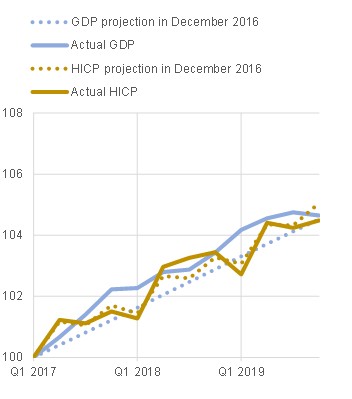
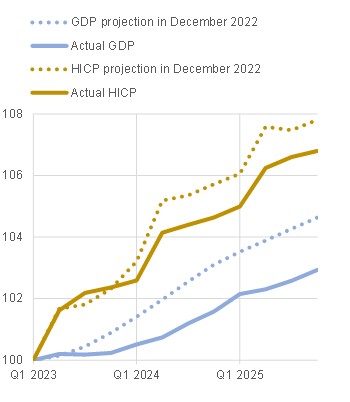
The past few years illustrate just how informative this lens can be. Chart 1 compares past forecasts with actual outcomes. It shows how uncertainty, especially after the pandemic and the 2022 energy shock, made forecasting particularly challenging. Yet, the joint behaviour of GDP and inflation surprises provides important information about the nature of the underlying shocks.
Two developments stand out. First, during the relatively tranquil period before the pandemic, the tendency to underestimate GDP – meaning that economic activity turned out to be stronger than forecast – did not translate into higher than expected inflation. This could reflect either unexpectedly strong potential output or a particularly weak Phillips curve relationship (which links economic slack to inflation) during that period.
Second, since 2023, this pattern has been reversing. Forecasts have tended to overestimate GDP, with actual activity proving to be weaker than anticipated. At the same time, inflation has also been lower than expected. A straightforward explanation is that the Phillips curve has steepened. This means that inflation has become more sensitive to economic slack than in the past, or the disinflationary effects of monetary policy have been stronger than anticipated. This evidence suggests that analysing forecast errors for output and inflation together can offer valuable insights into the structural shocks driving the euro area economy. Building on this, we explore how these forecast errors can be used to determine whether shocks have been underestimated or overestimated relative to the baseline forecasts.
Chart 1
Projected and actual real GDP and HICP forecast revisions in the euro area
(index: left panel: Q1 2017 = 100; right panel: Q1 2023 = 100)
 |  |
Sources: Eurostat, Eurosystem staff projections and ECB staff calculations.
Note: The latest observations are for the fourth quarter of 2025 for GDP and December 2025 for inflation.
Mapping forecast errors to demand and supply drivers
We bring together two complementary perspectives to analyse the joint behaviour of GDP and inflation surprises.
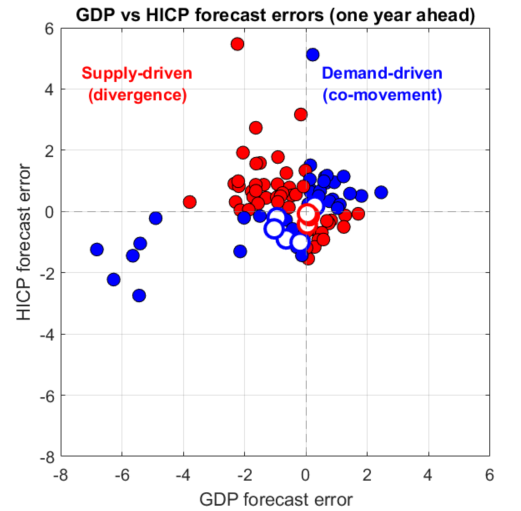
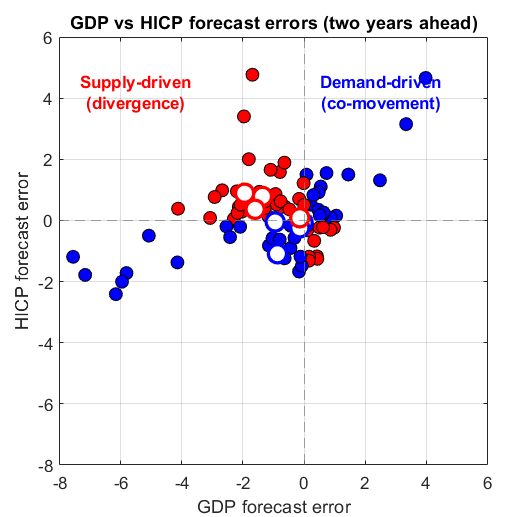
First, we use a visual mapping of growth and inflation forecast errors. Chart 2 presents forecast errors for GDP and inflation one year ahead (left panel) and two years ahead (right panel) over the past two decades. The blue dots represent episodes where GDP and inflation forecast errors move in the same direction – typically linked to demand-driven surprises. These potentially include unexpected monetary or fiscal policy loosening or tightening that tends to lead to stronger/weaker activity and higher/lower than forecast inflation. By contrast, the red dots indicate forecast errors where GDP and inflation move in opposite directions. This pattern is characteristic of supply-driven surprises, such as unexpected energy price surges/declines or increases/declines in supply chain bottlenecks, which tend to push inflation up/down and activity down/up compared with the forecast.
Over the past two decades, the largest share of forecast errors came from supply-driven surprises. Across the entire sample (excluding the 2020 pandemic shock), supply shocks have been more prevalent. When we look specifically at one-year-ahead forecast errors, we see that supply shocks accounted for around 55 episodes, compared with around 45 episodes related to demand shocks. Since the pandemic, negative supply shocks have weighed on growth, while more resilient demand has partially offset that impact, leading to smaller, albeit still visible, deviations from forecasts. The supply-related surprises remain visible in forecast errors for GDP and HICP even two years ahead, highlighting the lasting impact of the energy shock. Recent observations point to fewer extreme shocks, but there has been a continued mix of mild demand and supply surprises (red and blue hollow circles).
Chart 2
Forecast errors for GDP and HICP inflation one year ahead and two years ahead
(percentage points)
|
|
Sources: Eurosystem staff projections and ECB staff calculations.
Notes: The chart shows the scatter plot of GDP and HICP forecast errors across four quadrants based on the co-movement of the two series. A supply-driven shock is identified by GDP and HICP forecast errors going in opposite directions, while a demand-driven shock is identified by GDP and HICP forecast errors going in the same direction. The hollow circles represent the last eight observations. The sample covers the period from 2000 to 2025, excluding 2020. The latest observations are for the third quarter of 2025.
Second, we use a small model to break down the drivers of forecast errors. The model includes three variables: forecast errors for real growth, forecast errors for inflation excluding energy, and forecast errors for energy inflation. The shock identification scheme is intuitive: a positive demand shock pushes up the forecast errors for growth and inflation; a negative supply shock pushes down the forecast error for growth and pushes up the forecast error for inflation; a negative energy shock pushes down the forecast error for growth, pushes up the forecast error for inflation and does not respond to the demand and supply-side shocks. The aim is not to precisely identify every shock, but to have a clearer understanding of which forces consistently pushed forecasts off track.
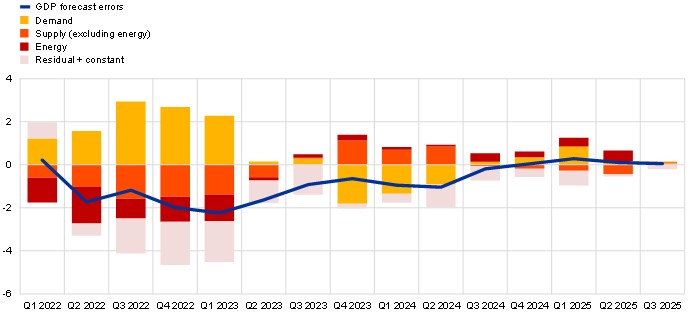
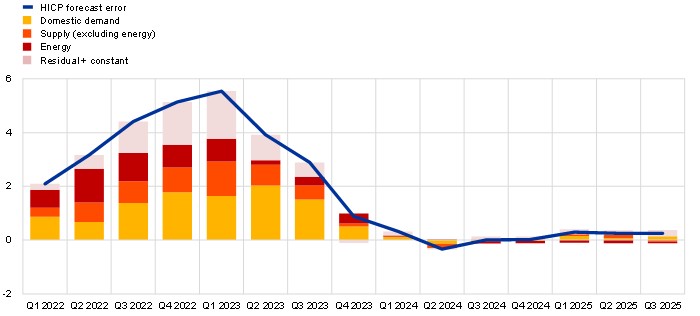
Systematic forecast misses were primarily driven by underestimated supply-side shocks, particularly during periods of heightened volatility. Chart 3 breaks down one-year-ahead forecast errors for real GDP and HICP inflation (excluding energy) into contributions from underlying structural drivers.[4]
Rather than focusing only on the size of forecast misses, the chart helps explain why forecasts deviated from actual outcomes. In the earlier part of the sample, GDP forecast errors were predominantly negative, indicating a systematic tendency to overestimate economic activity. The breakdown shows that these misses were largely driven by adverse supply-side factors, most notably energy-related shocks, which turned out to be stronger than assumed in baseline forecasts. Demand factors also contributed, but to a lesser extent.
Moving to the middle of the sample, supply and external shocks become even more prominent. Energy prices, global supply disruptions and other external disturbances account for a substantial share of both GDP and inflation forecast errors. This pattern highlights that unusually large, predominantly external shocks – rather than domestic cyclical dynamics – were the dominant source of forecast misses during this period. At the same time, the model identifies only a limited set of structural shocks. As a result, the residual component seems to reflect the influence of other supply shocks that are not explicitly captured by the model. These shocks are not identified separately within the framework, but nonetheless appear to have had a non-negligible influence on macroeconomic outcomes.
In the most recent period, forecast errors have narrowed noticeably. Contributions are more evenly distributed across drivers, and no single shock dominates the breakdown entirely. It is likely that this reflects a combination of less extreme shocks than during the pandemic and energy crisis period and forecasts that have become better aligned with actual outcomes. A key finding is therefore that these breakdowns are most informative in periods of heightened uncertainty, when non-linearities, missing channels in forecasting models and structural changes become more relevant.
Chart 3
Breakdown of one-year-ahead forecast errors for real GDP (upper panel) and HICP inflation excluding energy (lower panel)
(percentage points and percentage point contributions)
 |
 |
Sources: Eurostat, ECB and ECB calculations.
Notes: The results are based on a structural vector autoregression (SBVAR) model identified with sign and zero restrictions. The forecast errors are computed as annual outcome projections; “one year ahead” refers to the projection for the annual rate of change for the same quarter in the year following the respective publication. The latest observations are for the third quarter of 2025.
Why does this matter for policy?
Learning from forecast errors is essential in an environment of large and frequent macroeconomic shocks. Interpreting misses through the lens of demand and supply forces provides a clearer understanding of risks and structural changes as they unfold.
This approach helps to:
- sharpen the narrative around the baseline forecasts;
- design more realistic risk scenarios;
- enhance communication on uncertainty by linking forecast misses to identifiable economic drivers;
- potentially detect economic shifts earlier if the forecast errors turn out to be persistent and systematic.
Turning forecast errors into a structured analytical tool enhances both the narrative of the analysis and the quality of policy decision‑making. It helps policymakers learn from the past, refine their understanding of the evolving structure of the economy and better anticipate future risks even when uncertainty is elevated.
The views expressed in each blog entry are those of the author(s) and do not necessarily represent the views of the European Central Bank and the Eurosystem.
Check out The ECB Blog and subscribe for future posts.
For topics relating to banking supervision, why not have a look at The Supervision Blog?
References:
Chahad M., Hofmann-Drahonsky, A.-C., Meunier, B., Page, A. and Tirpák, M. (2022), “What explains recent errors in the inflation projections of Eurosystem and ECB staff?”, Economic Bulletin, Issue 3, ECB.
Coibion, O. and Gorodnichenko, Y. (2015), “Information Rigidity and the Expectations Formation Process: A Simple Framework and New Facts”, American Economic Review, Vol. 105, No 8, August, pp. 2644-2678.
Giannone, D. and Primiceri, G. (2025), “How real-time data misled policymakers during the post-COVID recovery”, VoxEU Column, Centre for Economic Policy Research, 20 January.
Jurado, K., Ludvigson, S.C. and Ng, S. (2015), “Measuring Uncertainty”, American Economic Review, Vol. 105, No 3, March, pp. 1177-1216.
Kanngiesser, D. and Willems, T. (2024), “Forecast accuracy and efficiency at the Bank of England – and how errors can be leveraged to do better”, Staff Working Papers, No 1078, Bank of England.
Koch, C. and Noureldin, D. (2023a), “How We Missed the Recent Inflation Surge”, F&D Magazine, International Monetary Fund, March.
Koch, C. and Noureldin, D. (2023b), “How We Missed the Inflation Surge: An Anatomy of Post-2020 Inflation Forecast Errors”, IMF Working Papers, No 102, International Monetary Fund, May.
Lambrias, K. and Page, A. (2019), “The performance of the Eurosystem/ECB staff macroeconomic projections since the financial crisis”, Economic Bulletin, Issue 8, ECB.
Mincer, J. A., & Zarnowitz, V. (1969), “The evaluation of economic forecasts”, Economic forecasts and expectations: Analysis of forecasting behavior and performance, National Bureau of Economic Research
Kontogeorgos, G., & Lambrias, K. (2019), “An analysis of the Eurosystem/ECB projections”, Working Paper Series No. 2291, European Central Bank
Forecast errors are unavoidable in practice. Macroeconomic models are simplified representations of a complex economy, data are imperfect in real time and economic outcomes are continuously affected by unforeseen shocks.
For an early contribution on this topic, see Mincer J.A. and Zarnovitz, V. (1969). For the Eurosystem forecast errors, see Kontogeorgos, G. and Lambrias, K. (2019).
Key examples of the use of forecast errors to understand economic behaviour include Coibion and Gorodnichenko (2015), who use forecast errors to examine the rationality of expectations and the presence of information rigidities, and Jurado, Ludvigson and Ng (2015), who construct measures of uncertainty based on forecast errors. In more recent studies, Kanngiesser and Willems (2024) use forecast errors learn about structural economic drivers, and Koch and Noureldin (2023a) explicitly link the joint behaviour of output and inflation surprises to several identified structural shocks over recent years.
The results also hold with the breakdown of forecast errors for two years ahead.