


- INTERVIEW
Interview with El Mundo
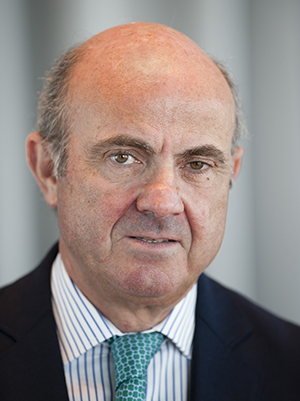
Interview with Luis de Guindos, Vice-President of the ECB, conducted by Carlos Segovia on 20 March 2026
23 March 2026
How will the war in the Middle East affect the euro area economy?
At our meeting on Thursday we concluded that it will have a strong impact on both growth and inflation. Needless to say, the longer and more widespread the conflict, the greater its impact will be.
What is the ECB’s baseline scenario for how long the conflict will last?
In our projections, we don’t specify how long the conflict could go on for. But we do make some assumptions regarding how long energy market disruptions will last. The baseline scenario assumes a peak in energy prices in the second quarter of 2026, followed by a sharp decline in oil and gas prices. Meanwhile, in the adverse scenario the crisis is assumed to last until the third quarter of 2026, whereupon supply is likely to normalise. And in the severe scenario – our most acute scenario – the crisis would be more pronounced. The situation would only begin to normalise early next year and the recovery would be slower than in the other scenarios, with prices remaining at higher levels in general.
In other words, the alternative scenarios are defined not just in terms of the peak energy prices themselves, but also the duration of this price increase.
Could this war trigger a recession in the euro area?
No, we don’t expect it to. Even in the most severe scenarios, we are still seeing positive growth, but I wouldn’t focus too much on the specific figures. Forecasts are always difficult, and even more so in the current context.
Is the ECB likely to raise interest rates in the coming months, before summer?
We are following a data-dependent approach, and we will analyse that data at our next meetings.
Which data specifically?
Naturally, we will take into account developments in both headline and underlying inflation, and it is very important to see how the inflation expectations of different economic actors evolve. At the same time, we will also monitor specific developments in energy prices, fertiliser prices, food prices, and so on. But we are not pre-committing to a particular rate path. At the next Governing Council meeting in April, we will have more data on the conflict, which is the main source of uncertainty, and we will decide from there.
To give people an indication, are we now more likely to see rate hikes than further cuts?
We are ready to respond as necessary. Of course, we are concerned by the situation. Monetary policy cannot prevent the war from having an initial impact on both inflation and growth, but the ECB can monitor the situation and be alert to potential second-round effects.
What can governments, businesses and trade unions do – other economic actors besides the ECB?
It remains to be seen what the fiscal policy reaction will be and how the different economic actors will behave. First of all, we believe it is important that this is perceived as a transitory shock, regardless of the uncertainty about how long it will last – although, admittedly, the level of uncertainty is huge. Economic actors, including governments, will have to take this transience into account, otherwise there will be adverse second-round effects. And that would obviously force central banks to act.
The Spanish and Italian finance ministers are calling for the deficit rules to be suspended again to provide more spending capacity during this crisis. What are your thoughts?
That is a matter for the European Commission, but several factors will have to be taken into account. First, there are new fiscal rules in place. Second, European countries have already committed to a significant increase in defence spending, from 2% to 3.5% of GDP. Should governments introduce fiscal measures in response to the current conflict in the Middle East, we recommend making these measures temporary and tailoring them to help the most vulnerable groups, who will be hardest hit by higher energy prices.
So they shouldn’t be making sweeping tax cuts?
The ECB has never recommended general measures in such circumstances – always temporary and targeted measures.
What do you think of the cuts that the Spanish Government has just approved?
I can’t comment on the cases of individual countries.
How much leeway do heavily indebted countries like Italy, France and Spain have to tackle this crisis?
Fiscal capacity is limited, because the public deficit is averaging 3% of GDP and public debt is close to 90% of GDP. We also have to consider the commitment to increasing defence spending, which is an existential priority for Europe.
And yet risk premia are low. Does this mean that the markets are betting that the most heavily indebted countries can handle it all: increasing pensions, while contending with military expenditure and this crisis?
Since the conflict began we have seen the dollar appreciate and US markets outperform their European counterparts. There has also been a slight rise in sovereign yields. This suggests that the markets do not believe the conflict will go on for too long or be too costly, but the uncertainty we feel is also felt by the markets.
So governments should not place too much trust in this market scenario...
It’s important that we all keep the heightened level of uncertainty in mind.
To what extent does it matter whether a government approves a budget every year. The Spanish Government has not submitted one…
A budget is the main economic policy instrument of any government, particularly at times of heightened uncertainty, and that goes for Spain as for any other euro area country.
In other words, with the current conflict in the Middle East, having a budget matters even more?
It’s even more important, because having a budget is not just compatible with taking extraordinary measures, but it actually makes it easier to make decisions and adopt measures to mitigate the energy shock. Besides, the main issue is the reason behind the lack of a budget. What would be concerning is a government that is unable to approve specific measures and actions in Parliament.
Precisely what is happening in Spain...
I do not wish to comment on any country in particular, but the lack of a budget owing to the absence of a clear parliamentary majority reflects not only a budgetary issue, but it also points to an inability to adopt other measures at such a delicate time.
Are weak governments and political risk now a major stumbling block in the euro area?
There are clearly internal divisions in many parliaments, but progress has been made. In the case of France, budgets have been passed, and the same is true in Belgium. At a time of tremendous uncertainty, of tremendous volatility, the ability to pass and maintain a budget is crucial and a positive signal from the standpoint of markets.
How do you think the European Union should respond to Donald Trump’s threats? Is the policy of appeasement working?
It’s important that Europe becomes more independent and autonomous with respect to the United States. Defence is a case in point. Europe is facing the threat from Russia and we find that the US umbrella is slowly being withdrawn. Greater autonomy is also needed in terms of technology, the cloud, artificial intelligence and, for instance, in areas such as payment methods.
On payment methods, Europe is utterly dependent on US credit card companies...
That’s right. The main payment methods in Europe are controlled by US firms, which is why we argue that to further the strategic autonomy I mentioned earlier, it’s very important to speed up the roll-out of the digital euro.
Nonetheless, the introduction of the digital euro is highly controversial, even for liberal economists. As a liberal yourself, what can you say in its defence?
It’s not hard to make a case for the digital euro from a liberal standpoint, since it’s simply one more option. It doesn’t replace anything. It doesn’t replace cash first of all, nor does it prevent the private sector from launching its own initiatives. The fact is that there is no single payment scheme for the entire euro area, and we would all be delighted to have one. The digital euro will be a sort of digital wallet for all of Europe that will be available on our mobile phones.
Your eight-year term is coming to an end. Are we likely to see another Spaniard on the Executive Board next year?
I don’t know about next year, but soon I hope. Several positions will be opening up in the coming years and Spain is a very important euro area economy, plus it has a sound financial system and is competitive.
Could Spain be a contender for the ECB presidency for the first time?
It’s always a possibility and we will see. The handover is still some way off because, despite the rumours, President Christine Lagarde has conveyed her intention to complete her term.
Should the Government try its luck with Pablo Hernández de Cos, who is currently best placed?
Pablo was a very good governor and is now at the BIS. He would be a fine candidate, but it’s the Government that understands the circumstances and knows how to best play its hand. Above and beyond individual names, I think that what really matters is that Spain has a presence on the ECB’s Executive Board.
How is the Spanish economy going into this crisis?
Over the past decade, Spain’s economy has had two major advantages. The first is that it has become much more competitive. The second is that, after the severe crisis, the Spanish banking sector is sound, in terms of capital and liquidity, and can fulfil its financing role. In addition, since the pandemic there have been other cyclical factors that have supported growth in Spain.
For example?
The most significant factor has been the population growth owing to immigration, which is crucial for Spain. According to our internal estimates at the ECB, this population increase accounts for over half of Spanish GDP growth. Another factor is that Spain has received over €55 billion in Next Generation EU funds that it does not need to pay back.
Which will need to be properly invested…
Yes, of course. They need to be invested well, but for now it is cost-free funding that does not need to be paid back. The third factor is tourism. Thanks to all this, Spain’s GDP growth is nearly double the European average, although in terms of GDP per capita or consumption per capita, growth is much more limited. It’s now important to keep in mind that these cyclical factors aren’t without their drawbacks.
Like what?
With strong population growth comes increased demand for rental housing. At the same time, regulations in Spain aren’t favourable for the rental market. Together, those two factors have led to a significant increase in prices and created a bottleneck that affects young people in particular. So it would be essential to revisit the regulation in order to boost rental housing supply.
A bigger population also means greater demand for public services…
That’s another bottleneck, because a large population increase requires a rethink of public services to ensure that they don’t deteriorate.
That implies more public investment to support these services at a time when the deficit needs to be managed…
Spain is meeting the government deficit target, but with a very sharp increase in revenues and without significantly reducing public debt issuance. So the reduction in the structural deficit has been much more modest. It would have been good to enter a period of considerable uncertainty like the current one with a bigger fiscal buffer to deal with the necessary measures.
The Government has been critical of the “bad bank” Sareb, which you created, because of the heavy losses it has generated. How do you see it almost 15 years on?
That was a joint proposal from the ECB, the European Commission and the International Monetary Fund – it was not something created by me or [Mariano] Rajoy. It was an important process for the restructuring of credit institutions. The idea behind Sareb was to buy some time, in other words, to finance those properties or real estate assets and wait for property prices to go up over a temporary period of ten or 15 years so that the debt that was issued to fund the purchase of real estate from former savings banks could be repaid. That plan has come to fruition.
The Government has decided against trying to recover more money through Sareb and instead focus on social policy. Do you think that’s a bad idea?
It’s a policy choice. The Government could have taken advantage of this rise in property prices either to repay the debt or to use the properties for social policy purposes. It’s a choice. What you can’t do is both at the same time.
Are you surprised that the Banco de España hardly comments on the Government’s economic policy now?
At the Banco de España there are excellent professionals who have an in-depth knowledge of the Spanish economy and I am sure that the Bank will continue producing reports on that subject sooner or later.
What will you do after you leave the ECB?
I have an offer from a private university to create a professorship in European political economy, as well as an offer from a business school to work with them. So, activities related to education, both at university level and in a business school context.
And will there never be a return to politics?
I was a minister for six and a half years. With that experience plus the eight years I have spent as Vice-President of the ECB, I think I can make important contributions to the general interest without necessarily being in public office.
Eiropas Centrālā banka
Komunikācijas ģenerāldirektorāts
- Sonnemannstrasse 20
- 60314 Frankfurt am Main, Germany
- +49 69 1344 7455
- media@ecb.europa.eu
Pārpublicējot obligāta avota norāde.
Kontaktinformācija plašsaziņas līdzekļu pārstāvjiem