


Economic Bulletin Issue 4, 2026
Economic, financial and monetary developments
Summary
The Governing Council is committed to setting monetary policy to ensure that inflation stabilises at its 2% target in the medium term. In line with this commitment, at its meeting on 11 June 2026 it decided to raise the three key ECB interest rates by 25 basis points. The war in the Middle East is generating inflation pressures, and the decision to raise rates is robust across a range of scenarios mapping out how the shock might evolve and affect the medium-term outlook for the euro area.
In the baseline of the June 2026 Eurosystem staff macroeconomic projections for the euro area, headline inflation is expected to average 3.0% in 2026, 2.3% in 2027 and 2.0% in 2028. For inflation excluding energy and food, the baseline foresees an average of 2.5% in 2026 and 2027, and 2.2% in 2028. Compared with the March 2026 ECB staff macroeconomic projections for the euro area, staff have revised up their baseline projection for inflation in 2026 and 2027 owing to a higher path for energy prices, which, to some extent, is expected to feed into food, goods and services inflation. The baseline sees economic growth at an average of 0.8% in 2026, 1.2% in 2027 and 1.5% in 2028. This is a downward revision for 2026 and 2027, reflecting a more pronounced impact of the war on commodity markets, real incomes and confidence.
The outlook remains uncertain, with upside risks for inflation and downside risks for economic growth. The full implications of the war for medium-term inflation and growth will depend on the intensity and duration of the energy price shock, as well as the scale of its indirect and second-round effects. This uncertainty is also reflected in the broad range of outcomes for inflation and growth in the updated illustrative scenarios put together by Eurosystem staff, as published as part of the June 2026 projections on the ECB’s website.
With its decision on 11 June, the Governing Council remains well positioned to navigate the uncertainty caused by the war. It will closely monitor the situation and follow a data-dependent and meeting-by-meeting approach to determining the appropriate monetary policy stance. In particular, the Governing Council’s interest rate decisions will be based on its assessment of the inflation outlook and the risks surrounding it, in light of the incoming economic and financial data, as well as the dynamics of underlying inflation and the strength of monetary policy transmission. The Governing Council is not pre-committing to a particular rate path.
Economic activity
Adjusting for a temporary factor in Ireland, the euro area economy grew in the first quarter of 2026, supported by domestic demand and exports. Yet the war in the Middle East is weighing on activity and survey results are pointing to a slowdown, especially in services. Manufacturing has held up so far. In part, this is because firms have been building up stocks to cope with supply chain pressures. It also reflects higher defence spending.
The labour market remains resilient. Unemployment, at 6.3% in April 2026, remains close to historical lows. The first quarter saw additional jobs being created, although at a slower pace than in the last quarter of 2025. Labour demand has cooled further, and firms and households expect the labour market to weaken.
Looking ahead, staff expect domestic demand to be weaker than they projected in March 2026 as the war weighs on confidence and higher energy costs erode real incomes. At the same time, household balance sheets are solid overall, and consumption should remain the main driver of growth. Higher energy costs and lower confidence will dent private investment in the short run, but it should be underpinned by firms investing in new digital technologies. Governments spending more on defence and infrastructure should continue to support public investment. These factors are expected to provide some cushioning against the fallout from the war.
The Governing Council highlighted the urgent need to strengthen the euro area economy while maintaining sound public finances. Fiscal sustainability is a crucial anchor for broader economic stability. Fiscal responses to the energy price shock should be temporary, targeted and tailored, as emphasised in the European Commission’s 2026 European Semester Spring Package. Reforms to enhance the euro area’s growth potential and accelerate the energy transition to reduce reliance on fossil fuels are more vital than ever. Completing the savings and investments union is key to funding innovation, supporting the green and digital transitions and improving productivity. The digital euro and tokenised wholesale central bank money will enhance Europe’s strategic autonomy, competitiveness and financial integration, and will boost innovation in payments. It is thus essential to swiftly adopt the Regulation on the establishment of the digital euro. Simplifying and harmonising rules across the EU’s Single Market will help European firms grow faster.
Inflation
Inflation rose to 3.2% in May 2026, from 3.0% in April. Energy price inflation ticked up to 10.9%, after 10.8% in April, while food price inflation fell from 2.4% to 2.0%. Inflation excluding energy and food picked up to 2.5%, from 2.2% in April, as goods inflation edged up to 0.9% and services inflation increased from 3.0% to 3.5%.
Domestic cost pressures eased in the first quarter of 2026, supported by slower growth in wages and profits. The ECB’s wage tracker and the results of surveys on wage expectations continue to indicate that wage growth should ease over the year. However, it is becoming more expensive for firms to source other inputs and they therefore expect to put up their selling prices. Moreover, some indicators of underlying inflation have already been driven higher by the energy shock. Inflation expectations over shorter horizons remain well above levels before the outbreak of the war in the Middle East. At the same time, most measures of longer-term inflation expectations stand at around 2%, supporting the stabilisation of inflation around target in the medium term.
The increase in energy prices will lift inflation further over the summer and keep it well above target into the first half of 2027. It will also have an impact on food, goods and services inflation. Inflation should then return to target in the second half of 2027, supported by falling energy prices and slower increases in other prices. However, the war in the Middle East remains a major source of uncertainty. The longer energy prices stay high, the more likely they are to drive up broader inflation through indirect and second-round effects. The Governing Council will therefore closely monitor the size and persistence of the energy price increase, and how it feeds through to price and wage-setting, inflation expectations and overall economic dynamics.
Risk assessment
The risks to the growth outlook are to the downside, mainly owing to the war in the Middle East, which has added to the volatile global policy environment. Prolonged disruption of energy supplies could increase energy prices further and for longer than currently expected. These factors would erode real incomes even more and make firms and households more reluctant to invest and spend. The drag on growth would intensify if the closure of major shipping routes were to cause acute shortages of key inputs that forced euro area firms to curtail output. A worsening of global financial market sentiment or a tighter supply of credit could dampen demand. Additional frictions in international trade could also further disrupt supply chains, reduce exports and weaken consumption and investment. Other geopolitical tensions, in particular Russia’s unjustified war against Ukraine, remain a major source of uncertainty. By contrast, growth could turn out to be higher if the economy and energy markets were to adapt more quickly than expected to the disruption caused by the war in the Middle East or if the war was resolved promptly and sustainably. Moreover, planned defence and infrastructure spending, reforms to enhance productivity and euro area firms adopting new technologies may drive up growth by more than expected. A deeper integration of the Single Market could also boost growth beyond current expectations.
The risks to the inflation outlook are to the upside. If energy prices were to rise by more and for longer than currently expected, euro area inflation would increase further. This could be reinforced and become more persistent if higher energy prices were to spill over by more than expected to other prices and to wages, if longer-term inflation expectations were to rise in response, or if global supply chains were disrupted more broadly. Ongoing trade tensions could also give rise to more fragmented global supply chains, curtail the supply of critical raw materials and worsen capacity constraints in the euro area economy. Extreme weather events, and the unfolding climate and nature crises more broadly, could drive up food prices by more than expected. By contrast, inflation could turn out to be somewhat lower if the economic effects of the war in the Middle East proved to be more short-lived than currently expected or if indirect or second-round effects proved less pronounced than anticipated. More volatile and risk-averse financial markets could weigh on demand and thereby lower inflation as well.
Financial and monetary conditions
Financial conditions have been broadly unchanged since the Governing Council’s meeting on 30 April 2026, but remain tighter than before the war. The cost of issuing market-based debt rose to 4.0% in April, from 3.9% in March. Bank lending rates for firms remained at 3.6% in April and mortgage rates at 3.4%.
The annual growth rate of bank lending to firms increased to 3.4% in April, from 3.2% in March, while the growth rate of corporate bond issuance rose to 4.6%. Mortgage lending in April again grew by 3.0%.
In line with its monetary policy strategy, the Governing Council thoroughly assessed the links between monetary policy and financial stability. Euro area banks are resilient, supported by strong capital and liquidity ratios, solid asset quality and robust profitability. However, a sudden, sharp drop in asset prices, potentially amplified by the non-bank financial sector and deteriorating asset quality, particularly in energy and trade-sensitive sectors, would pose risks to financial stability. These risks increase the longer the current geopolitical conflicts last. Macroprudential policy remains the first line of defence against the build-up of financial vulnerabilities, enhancing resilience and preserving macroprudential space.
Monetary policy decisions
At its meeting on 11 June 2026, the Governing Council decided to raise the three key ECB interest rates by 25 basis points. Accordingly, the interest rates on the deposit facility, the main refinancing operations and the marginal lending facility were increased to 2.25%, 2.40% and 2.65% respectively, with effect from 17 June 2026.
The asset purchase programme and pandemic emergency purchase programme portfolios are declining at a measured and predictable pace, as the Eurosystem no longer reinvests the principal payments from maturing securities.
Conclusion
The Governing Council is committed to setting monetary policy to ensure that inflation stabilises at its 2% target in the medium term. It will follow a data-dependent and meeting-by-meeting approach to determining the appropriate monetary policy stance. Its interest rate decisions will be based on its assessment of the inflation outlook and the risks surrounding it, in light of the incoming economic and financial data, as well as the dynamics of underlying inflation and the strength of monetary policy transmission. The Governing Council is not pre-committing to a particular rate path.
In any case, the Governing Council stands ready to adjust all of its instruments within its mandate to ensure that inflation stabilises sustainably at its medium-term target and to preserve the smooth functioning of monetary policy transmission.
1 External environment
Global economic activity remained resilient in early 2026, but the prolonged war in the Middle East is dampening the outlook through higher energy prices, tighter financial conditions and heightened uncertainty. At the start of the year, global economic activity and trade were supported by strong manufacturing output and AI-related investment. Furthermore, this activity was supported by the precautionary stockpiling of energy-sensitive goods, which was particularly visible in the United States, China and other emerging Asian economies. The direct impact of the spillover of the war in the Middle East on non-energy trade and maritime shipping has so far been limited, but supply pressures have intensified for oil, refined fuels and other energy-sensitive goods. At the same time, global inflation has risen, as higher energy costs have started to feed into broader price pressures. Therefore, the June 2026 Eurosystem staff macroeconomic projections for the euro area point to weaker global growth in 2026 than in the previous projection exercise, alongside higher global inflation in both 2026 and 2027.
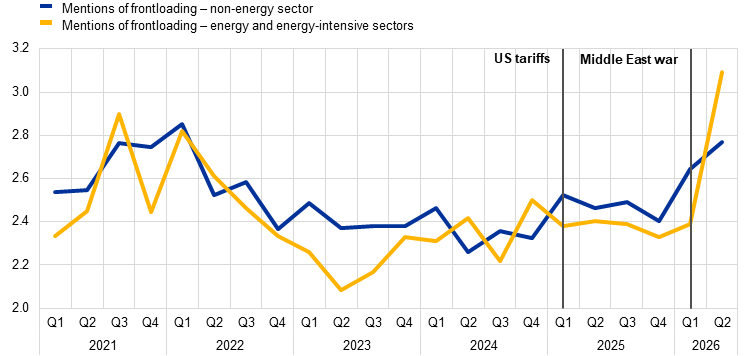
Global economic activity remained resilient at the start of 2026, supported by manufacturing output and the precautionary stockpiling of energy-sensitive goods. Incoming national accounts data suggest that global economic output expanded by 0.7% quarter on quarter in the first quarter of 2026, compared with 0.8% in the fourth quarter of 2025. Survey indicators point to continued resilience at the beginning of the second quarter of 2026, with the global composite output Purchasing Managers’ Index (PMI) rebounding in April and May 2026 following a sharp decline in March (Chart 1, panel a). This pick-up was driven mainly by the manufacturing sector, whereas the recovery in the services sector was more subdued. References to “frontloading”, “safety stocks” and related terms in earnings calls from energy and energy-intensive sectors increased substantially, suggesting that firms have been creating buffers in response to heightened uncertainty associated with the war in the Middle East and the potential supply disruptions (Chart 1, panel b). According to the June 2026 Eurosystem staff macroeconomic projections for the euro area, strong growth in the first quarter of 2026 and the temporary factors supporting global economic activity partly mitigate the adverse effects of the war in the Middle East in the near term, but they are not expected to prevent a broad-based slowdown in this activity in 2026.
Chart 1
Global output PMI (excluding euro area) and global firms’ earnings calls references
a) PMIs
(diffusion indices)

b) Firms’ earnings calls
(number of sentences per earnings call)
Sources: S&P Global Market Intelligence, NL Analytics and ECB staff calculations.
Notes: In panel a), the horizontal line at 50 marks the neutral baseline dividing expansion and contraction. In panel b), earnings calls refer to the average number of times companies worldwide mention “frontloading” and related terms during their earnings calls. Energy and energy-intensive sectors include fossil fuels, renewable energy, uranium, chemicals, transport, food and drug retailing, and applied resources. US tariffs refers to the first major implementation of tariff measures introduced during President Trump’s second term. The war in the Middle East refers to the start of the conflict. The latest observations are for May 2026 for panel a) and for 15 May 2026 for panel b).
The global economic growth outlook has weakened as the conflict in the Middle East weighs on energy prices and financial conditions, thereby amplifying uncertainty. The disruptions around the Strait of Hormuz and the absence of a final peace agreement have continued to exert upward pressure on energy prices, particularly on oil prices. While robust AI-related investment, resilient trade flows and supportive policy measures are providing some relief, higher energy costs and tighter financial conditions are expected to weigh increasingly on private demand going forward. Global real GDP growth excluding the euro area is projected to slow from 3.6% in 2025 to 3.0% in 2026, before gradually recovering to 3.2% in 2027 and 3.3% in 2028.[1]
Commodity prices remain highly volatile, with energy markets continuing to be shaped by the blockade of the Strait of Hormuz and with shifting expectations regarding a potential final peace agreement. Oil prices declined by 15% to USD 94 per barrel over the review period (19 March to 10 June 2026), yet they are still 32% higher than pre-war levels. This initial decline followed the announcement of a ceasefire between the United States and Iran in April, and the subsequent weakening in oil prices reflected renewed expectations that an extended ceasefire could pave the way for a broader peace agreement between the two countries. Nevertheless, oil prices remained highly volatile throughout the review period, as energy goods exports through the Strait of Hormuz continued to face severe disruptions. Persistent constraints on transit through the Strait of Hormuz mechanically tighten global energy supply conditions, thereby exerting sustained upward pressure on energy prices. European gas prices also fell markedly, declining by 21%. As was the case in the oil markets, expectations of a prolonged ceasefire were the main drivers of the decrease in gas prices over the review period. In addition, subdued imports of liquefied natural gas (LNG) into Asia helped contain upward pressure on gas prices in March and April 2026, reflecting milder weather conditions and increased substitution from gas to coal in China. The situation remains highly volatile and uncertain, however, as LNG flows also continue to be disrupted.[2] Food prices remained broadly stable overall, as lower coffee prices – supported by strong production in Brazil – were largely offset by higher cocoa prices amid concerns over a potentially strong El Niño season later in the year. Metal prices increased by 13%, driven by disruptions to aluminium supply in the Middle East and expectations of lower copper production in Chile.
Supply pressures have increased, but current evidence points to concentrated shortages of specific inputs rather than broad-based disruptions to global logistics. PMI supplier delivery times lengthened in April, particularly in the euro area and in the United Kingdom, with firms reporting worsening shortages of oil, polymers and chemicals. While these shortages remain above normal levels, evidence does not yet point to widespread disruption to global logistics. Container shipping outside of the Strait of Hormuz has remained largely unaffected. In this respect, the current situation resembles an isolated input-supply shock rather than the broader disruptions to global logistics that was seen in 2021 and 2022. However, physical shortages could intensify if the closure of the Strait of Hormuz persists, especially for oil, refined fuels and other energy-intensive inputs. This continues to represent a significant downside risk to economic activity and an upside risk to global inflation.
Global inflation increased in April, and pipeline price pressures have since intensified as the energy shock has begun to spread. Global headline inflation across the member countries of the Organisation for Economic Co-operation and Development (OECD) excluding Türkiye rose from 3.3% in March 2026 to 3.5% in April, mainly reflecting higher energy inflation (Chart 2).[3] The energy shock is also expected to push up core inflation through higher production costs. Global PMI manufacturing input prices rose in April, suggesting that a broader share of firms reported rising input costs, whereas services input price indicators increased more moderately. Since PMI indicators measure the share of respondents to have reported price increases rather than the magnitude of price changes, these data point to broader pipeline price pressures. Global inflation excluding the euro area is projected to rise to 3.5% in 2026 before easing to 3.0% in 2027 and 2.5% in 2028.
Chart 2
OECD CPI inflation
(year-on-year percentage changes, percentage point contributions)

Sources: OECD and ECB staff calculations.
Notes: The OECD aggregate includes euro area countries that are OECD members and excludes Türkiye. It is calculated using OECD consumer price index (CPI) annual weights. The latest observations are for April 2026.
Global import growth surprised on the upside in the first quarter, but momentum is expected to weaken as stockpiling effects wane. National accounts data point to robust growth in the first quarter of 2026, supported by buoyant imports in the United States, China, South Korea and other advanced Asian economies. This strength in import growth reflected resilient economic activity, AI-related trade and the precautionary stockpiling of energy-sensitive goods, with stockpiling expected to decrease over the next few quarters. That said, global import momentum is expected to weaken in the second quarter, as the war in the Middle East weighs on energy-intensive economies through higher energy, freight and insurance costs. Global import growth excluding the euro area is projected to decline to 4.2% in 2026, before slowing further in 2027 and 2028. This reflects stronger incoming data, and more resilient underlying trade dynamics, which are supported by sturdier trade in AI- and technology-related inputs.
In the United States, real GDP growth rebounded in the first quarter of 2026, but the underlying momentum in private demand weakened. GDP growth recovered to 0.4% quarter on quarter, from 0.1% in the fourth quarter of 2025, as economic activity rebounded following the federal government shutdown. This recovery was supported by public consumption and investment, whereas private consumption slowed. Private fixed investment remained robust, bolstered by AI-related spending on computer equipment and software, although the net contribution of AI-related activity to GDP growth remains modest, given its high import content. Looking ahead, US growth is expected to remain broadly in line with potential. Higher oil prices and tighter financial conditions are likely to weigh on private consumption, although this is expected to be offset by strong AI-related investment.
US inflation accelerated in April as the impact of higher oil prices broadened despite a slowing pass-through from tariffs. Consumer price index (CPI) inflation rose from 3.3% in March 2026 to 3.8% in April, as energy inflation increased sharply to 17.9%, up from 12.5% in March. Retail petrol prices continued to rise in May towards levels last seen in mid-2022, suggesting further upward pressure on energy inflation in the near term. Price pressures also seemed to be broadening, driven by higher prices for freight transport and passenger air fares. Non-energy CPI and core inflation also edged up. This increase has transpired despite a slowing pass-through from tariffs, with inflation in consumer goods excluding food, energy, and used cars and trucks appearing to have peaked in March 2026. Higher oil prices have also lifted consumer inflation expectations. PMI surveys indicate increasing price pressures, notably in manufacturing industries. Personal consumption expenditures inflation is projected to continue rising until the first quarter of 2027 and to only return towards the Federal Reserve System’s 2% target in 2028.
In China, economic momentum weakened at the start of the second quarter of 2026 following a strong first quarter. Real GDP growth expanded by 1.3%, quarter on quarter, in the first quarter of 2026, supported by resilient exports and helpful policy measures. However, the data for April pointed to a broad-based slowdown. This reflects weaker retail sales and investment, and the rate of growth of industrial production slowed to 4.1% year on year – the weakest pace since mid-2023 – as higher oil prices weighed on activity in energy-intensive industries. The property sector remained a drag, with declines in house prices persistent and broader real estate indicators subdued. Exports continued to support economic activity, underpinned by AI-related trade, such as semi-conductors and competitive pricing, whereas domestic demand remained weak. Inflationary pressures from the energy shock have so far been more visible in producer prices than in consumer prices. Headline CPI inflation increased modestly to 1.2% year on year in April, while producer price inflation accelerated sharply to 2.8%. This suggests that higher energy costs are weighing more directly on industry and energy-intensive sectors than on households. Overall, economic activity is expected to slow gradually, as resilient exports only partially mitigate weak domestic demand and the ongoing adjustment in the real estate sector.
In the United Kingdom, economic activity picked up sharply in the first quarter of 2026, but this rebound is expected to prove temporary. GDP growth accelerated to 0.6% quarter on quarter, supported by both private and public consumption, whereas investment declined and net exports dampened growth. Incoming short-term indicators point to weaker momentum at the start of the second quarter, as higher energy prices and uncertainty weighed on confidence. Headline inflation fell in April, mainly reflecting lower services inflation, but is expected to rise again as higher energy costs pass through to household bills when the energy price cap is reset. Overall, growth momentum is expected to moderate after the first-quarter rebound, and renewed inflationary pressures are likely to emerge over the coming months.
2 Economic activity
The euro area economy (excluding volatile Irish data) grew moderately in the first quarter of 2026, supported by domestic demand and exports. The labour market remains resilient, with the first quarter seeing additional jobs being created, albeit at a slower pace than in the fourth quarter of 2025. With the outbreak of the war in the Middle East, short-term indicators of activity have declined since March, pointing to a weakening in consumption spending, deteriorating sentiment and lengthening supplier delivery times. Together, these developments suggest that the war in the Middle East is weighing on both current and expected activity. Much of the deterioration in overall sentiment is being driven by households and the services sector. Over the medium term domestic demand should be bolstered by a recovery in real income, fostered by falling energy prices, a resilient labour market and rising government spending on infrastructure and defence. These factors are expected to be complemented by increased investment related to artificial intelligence and the energy transition.
This outlook is broadly reflected in the June 2026 Eurosystem staff macroeconomic projections for the euro area, which foresee annual average real GDP growth of 0.8% in 2026, 1.2% in 2027 and 1.5% in 2028. This implies a small downward revision for 2026 and 2027, reflecting a more pronounced impact of the war on commodity markets, real incomes and confidence than previously expected. The war in the Middle East has made the outlook significantly more uncertain, creating upside risks for inflation and downside risks for economic growth. Given the very high levels of uncertainty about the impact of the war, which will depend strongly on its duration and intensity, the baseline is accompanied by updated illustrative alternative scenarios published with the staff projections on the ECB website.[4]
The euro area economy (excluding volatile Irish data) grew moderately in the first quarter of 2026. According to the latest Eurostat estimate, euro area real GDP fell by 0.2%, quarter on quarter, in the first quarter of 2026, after expanding by 0.2% in the fourth quarter of 2025. However, when excluding Ireland, real GDP increased by 0.3%, slightly down from 0.4% in the fourth quarter of 2025. Dynamics in domestic demand components saw a slowdown in the first quarter (Chart 3). Private and public consumption growth both weakened, and investment contracted. At the same time, changes in inventories decreased slightly, contributing negatively to GDP growth. Although net trade was negative in the headline figures, it turned positive when volatile Irish trade flows were excluded. Production in the first quarter was largely driven by services, once again supported by the information and communication services sector. Momentum in the construction sector dropped as a result of adverse weather conditions in parts of Europe, causing a contraction in construction activity following four quarters of growth. Developments in the manufacturing sector varied significantly across the euro area and were heavily affected by volatility in some countries, in particular a 35% drop reported by Ireland. While the sector is still facing headwinds stemming from higher tariffs and geopolitical uncertainty, at the same time it is being supported by production related to the defence industry. Notwithstanding the notable differences across countries, most Member States displayed positive GDP growth in the first quarter of 2026.
Chart 3
Euro area real GDP and its components
(quarter-on-quarter percentage changes; percentage point contributions)

Sources: Eurostat and ECB calculations.
Notes: The chart also shows GDP excluding Ireland, as Irish data are particularly volatile. However, the subcomponents display the GDP breakdown including Ireland. The latest observations are for the first quarter of 2026.
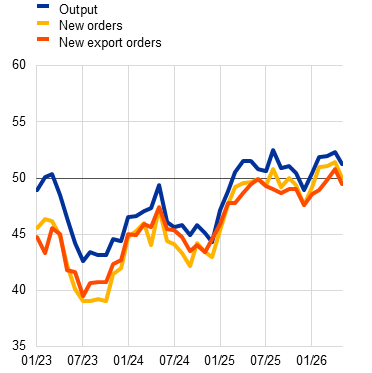
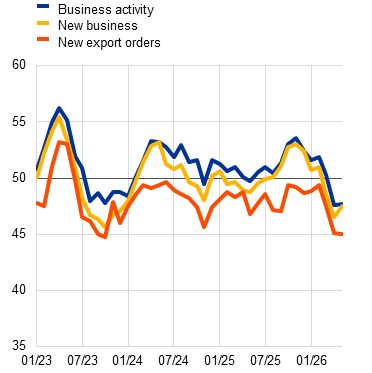
Short-term indicators have declined since March, pointing clearly to the adverse impact of the war in the Middle East on economic activity. The euro area flash composite output Purchasing Managers’ Index (PMI) declined further in May, thus remaining in contraction territory for two months in a row. The accumulated fall from 51.9 to 48.6 recorded between February and May 2026 highlights the adverse impact of the war in the Middle East on production perceptions. While this decline was driven by both manufacturing and services, the accrued fall in the services sector was significantly steeper, with the services business activity index reaching levels not seen since the beginning of 2021 (Chart 4). The European Commission’s business and consumer surveys portray a similar picture, with most of the deterioration in overall sentiment stemming from households and the services sector. PMI data also show that the more forward-looking survey results for new orders have deteriorated in parallel with output, while supplier delivery times have lengthened further, with vendor delays the worst seen since June 2022.
Chart 4
PMI indicators across sectors of the economy
a) Manufacturing | b) Services |
|---|---|
(diffusion indices) | (diffusion indices) |
 |  |
Source: S&P Global Market Intelligence.
Note: The latest observations are for May 2026.
The unemployment rate remains low, but job creation has slowed and labour demand continues to soften. The unemployment rate stood at 6.3% in March and April, having remained broadly stable at this level since mid-2024 (Chart 5). While total hours worked decreased by 0.2%, quarter on quarter, in the first quarter of 2026, employment continued to grow, supported by an expanding labour force. Thus, average hours worked per employee declined. Yet the pace of job creation moderated further to 0.1%, quarter on quarter, and 0.5%, year on year, at the beginning of 2026, following increases of 0.7% in 2025, 0.8% in 2024 and 1.4% in 2023. The gradual moderation in employment growth partly reflects a continued softening in labour demand. The job vacancy rate has been on a downward trend since the second half of 2022. After edging up slightly at the end of 2025, driven by developments in the construction sector, it fell further to 2.2% in the first quarter of 2026. Sectoral trends have diverged over the past year, with vacancies in construction rising, while vacancies in market services and industry have continued to decline.
Chart 5
Euro area employment, PMI assessment of employment and unemployment rate
(left-hand scale: quarter-on-quarter percentage changes, diffusion index; right-hand scale: percentages of the labour force)

Sources: Eurostat, S&P Global Market Intelligence and ECB calculations.
Notes: The two lines indicate monthly developments, while the bars show quarterly data. The PMI is expressed in terms of the deviation from 50, then divided by 10 to gauge quarter-on-quarter employment growth. The latest observations are for the first quarter of 2026 for euro area employment, May 2026 for the PMI assessment of employment and April 2026 for the unemployment rate.
Short-term labour market indicators suggest weak employment momentum in the second quarter of 2026. The monthly composite PMI employment index fell below the neutral threshold of 50 at the beginning of the year. It continued to decline to 49.0 in May from 49.6 in April, suggesting broadly unchanged employment in the second quarter of the year. The index now stands at its lowest level since November 2020. The PMI for employment in the services sector fell into contractionary territory in May 2026, reaching 49.4, while the PMI for employment in manufacturing deteriorated further to 47.8. Moreover, media-reported, firm-level restructuring announcements suggest subdued employment dynamics in the second quarter of 2026, particularly in the manufacturing sector (see Box 5).
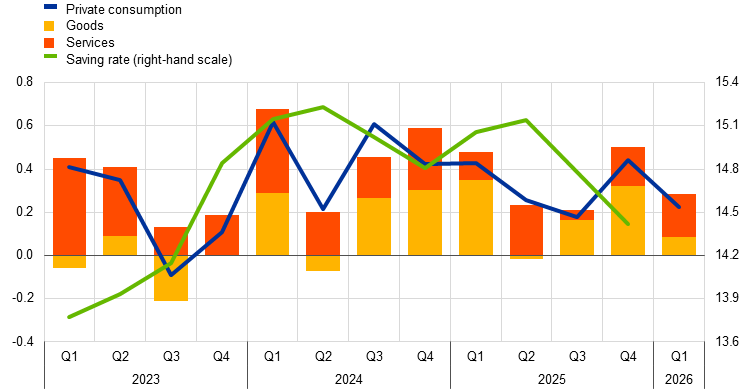
Private consumption moderated in the first quarter of 2026, and this momentum is likely to weaken further in the near term. Private consumption expanded by 0.2%, quarter on quarter, in the first quarter of the year, following stronger growth of 0.4% in the previous quarter (Chart 6, panel a). Domestic spending was mainly driven by services, which were supported by tourism, being partly offset by goods, which were dragged down by spending on non-durables. Turning to the second quarter, high-frequency indicators point to a marked slowdown in consumption momentum as the economic impact of the war in the Middle East gradually unfolds (see Box 4). Retail sales declined by 0.4%, month on month, in April, standing a notch below their average level in the first quarter (Chart 6, panel b). The European Commission’s consumer confidence indicator fell sharply in April and May on average, mainly owing to households’ expectations for individual major purchases and the general economic outlook. Based on the European Commission’s business surveys across sectors, consumer expected activity also dropped markedly in April and May, driven by retail trade, accommodation and food services, as well as travel services. These signals were confirmed by the Consumer Expectations Survey, which indicated that consumer confidence plummeted and spending on holidays and luxury items lost momentum in April, as higher-income households delayed discretionary spending. Looking ahead, the surge in energy prices and uncertainty triggered by the war in the Middle East is likely to have an adverse impact on private consumption. These negative consumption effects may be cushioned by robust balance sheets, which have largely recouped the losses in real net wealth incurred after the inflation surge in 2022. However, these losses are still sizeable for liquid assets, such as deposits, as well as for households in the bottom part of the wealth distribution, which typically exhibit a higher marginal propensity to consume. Hence, the cushioning effects of balance sheets for private consumption may be smaller this time than in the 2022 episode.
Chart 6
Household consumption and savings; consumer confidence, expected activity and uncertainty, and retail sales
a) Household consumption and savings
(quarter-on-quarter percentage changes, percentage point contributions; percentages of gross disposable income)
b) Consumer confidence, expected activity and uncertainty, and retail sales
(standardised percentage balances; retail sales: quarter-on-quarter percentage changes)

Sources: Eurostat, European Commission and ECB calculations.
Notes: In panel a), the levels of real domestic goods and services consumption are scaled to add up to the level of real private consumption in the main national accounts. In panel b), “consumer expected activity” refers to a weighted average of business expectations for the next three months with regard to production for manufacturing, employment for construction, business for trade and demand for services from the European Commission business survey, weighted according to the sectoral shares in euro area private consumption from the FIGARO input-output tables for 2023. “Consumer uncertainty” stands for the European Commission’s Consumer Economic Uncertainty Index. All series are standardised for the whole sample from January 1999, except consumer uncertainty, which is standardised for the whole sample from April 2019, owing to data availability. The latest observations are for the first quarter of 2026 in panel a), and for the second quarter of 2026 (based on April 2026) for retail sales and May 2026 for all other items in panel b).
Business investment grew moderately in the first quarter of 2026, but the war in the Middle East is expected to weigh more heavily on the second quarter. Non-construction investment (excluding volatile Irish intellectual property products) grew by 0.4%, quarter on quarter, in the first quarter of the year, with positive contributions from both intangibles and machinery and equipment (Chart 7, panel a). However, this aggregate outcome masks significant cross-country heterogeneity even among the largest economies (with Germany posting a decrease of 0.7%, quarter on quarter, while Italy saw growth of 1.8%). Looking ahead, business investment is expected to weaken in the second quarter as heightened uncertainty related to the war dampens confidence in the capital goods sector and weighs on output and production expectations among both producers of tangibles and intangibles. Consistent with this, the PMI new orders in both segments fell below the growth threshold in May. As long as the war continues, downside risks to the investment outlook for the rest of 2026 are likely to intensify. The biannual investment survey conducted by the European Commission (carried out in March and April) points to weak but positive annual growth for 2026. At the time of the survey, firms largely expected only temporary disruptions from the war, basing their investment plans for the year on solid pre-war fundamentals (including improving corporate profits, healthy balance sheets and low debt/service ratios). However, as the war continues, downside risks are likely to increase amid high uncertainty, weaker demand growth, rising costs and tighter financing conditions. Nonetheless, the underlying conditions remain in place for a recovery in business investment once the conflict has been resolved. These include ongoing digital needs and higher defence and infrastructure spending, supported by continuing Next Generation EU funds (see also Section 6 of this Economic Bulletin on Fiscal developments).
Chart 7
Real investment dynamics and survey data
a) Business investment
(quarter-on-quarter percentage changes; percentage balances and diffusion index)

b) Housing investment
(quarter-on-quarter percentage changes; percentage balances and diffusion index)

Sources: Eurostat, European Commission, S&P Global Market Intelligence and ECB calculations.
Notes: The lines indicate monthly developments, while the bars refer to quarterly data. The PMIs are expressed in terms of the deviation from 50. In panel a), business investment is measured by non-construction investment excluding Irish intangibles. For the confidence indicators, “tangibles” refers to the capital goods sector (the producers of tangible machinery and equipment) and “intangibles” is a weighted average of the subsectors supplying investment related to intellectual property products, i.e. publishing activities (NACE J58); computer programming and consultancy (NACE J62); and information activities (NACE J63). In panel b), the line for the European Commission activity trend indicator refers to the weighted average assessment of the building and specialised construction sectors of the trend in activity over the preceding three months, rescaled to have the same standard deviation as the PMI. The line for PMI output refers to housing activity. The latest observations are for the first quarter of 2026 for investment, May 2026 for PMI output and May for the European Commission indicators.
Housing investment declined significantly in the first quarter of 2026 but is expected to return to positive growth in the near term. Housing investment fell by 1.8%, quarter on quarter, in the first quarter of 2026, after expanding over the previous four quarters (Chart 7, panel b). This decline was partly related to unfavourable weather conditions, as also reflected in the unusually high share of managers in building and specialised construction reporting weather-related constraints in the first two months of the year, according to the European Commission survey. With weather conditions having normalised vis-à-vis the first quarter, housing investment is likely to have rebounded in the second quarter. This assessment is supported by the continued upward trend in residential building permits, which in January and February stood, on average, around 5% above their average level in the fourth quarter of 2025, pointing to a strengthening pipeline of residential construction activity. At the same time, the war in the Middle East appears to be weighing on the recovery in housing investment through rising supply-side pressures and weaker demand. Survey-based activity indicators – including the European Commission’s indicator of recent trends in building and specialised construction activity, and the PMI housing output index – weakened following the outbreak of the war. In addition, PMI survey data point to a marked intensification of input cost pressures, while the European Commission survey indicates weaker intentions among households to purchase or build a home and to undertake home improvements over the next 12 months. These developments are likely to weigh on near-term housing investment momentum. Nevertheless, the available indicators do not currently point to a renewed decline in housing investment.
After a positive outturn in the first quarter of 2026, the outlook for euro area exports has deteriorated, weighed down by the services sector and fading support from precautionary stockbuilding. Total euro area exports, excluding Ireland, expanded by 0.7% in the first quarter of 2026. This increase was driven by a more moderate decline in goods exports, which slowed to 0.1%, and robust growth in services exports of 2.7%, quarter on quarter. Survey indicators for manufacturing export orders point to an expansion at the beginning of the second quarter, partially driven by the precautionary stockbuilding that had supported goods exports in March. At the same time, euro area services export orders fell at their fastest rate since October 2023, driven by particularly steep drops in new orders for tourism and transportation. Growth in euro area imports stalled in the first quarter amid lower imports from the United States, while imports from China continued to increase even though imports from other Asian economies declined. The terms-of-trade deterioration remained moderate in the first quarter but is expected to strengthen as energy import prices rise and disinflationary pressures from China diminish, with the peak loss projected at around 0.4% of GDP in 2026, compared with 1.7% of GDP in 2022.
The economic outlook for the euro area remains highly uncertain amid the adverse effects of the war in the Middle East, the blockade of the Strait of Hormuz and elevated oil price volatility. Some of the risks identified in the March 2026 projections have partly materialised, with higher oil prices, emerging supply bottlenecks and markets now expecting the impact of the war to be more protracted.
The baseline projections foresee annual real GDP growth of 0.8% in 2026, 1.2% in 2027 and 1.5% in 2028. GDP growth has been revised slightly down for both 2026 and 2027, reflecting the stronger than initially expected impact of the war in the Middle East, while for 2028 it has been slightly revised up as this impact unwinds. Alternative assumptions about the magnitude and persistence of the war in the Middle East and the energy price shock, its impact on the international environment and uncertainty, as well as its propagation via indirect and second-round inflationary effects, would lead to markedly different macroeconomic outcomes. To illustrate this uncertainty, staff have prepared three alternative scenarios: a milder scenario, an adverse scenario and a severe scenario (see “Eurosystem staff macroeconomic projections for the euro area, June 2026”).
3 Prices and costs
Annual euro area headline inflation, as measured by the Harmonised Index of Consumer Prices (HICP), is 1.2 percentage points above the Governing Council’s 2% medium-term target. It increased to 3.2% in May 2026, from 3.0% in April, driven by a rise in energy inflation and in HICP excluding energy and food (HICPX), while food inflation declined.[5] HICPX inflation picked up to 2.5% in May, from 2.2% in April, owing to an increase in goods and services inflation. Indicators of underlying inflation have recently increased somewhat. Annual growth in compensation per employee decreased to 3.5% in the first quarter of 2026, from 3.7% in the last quarter of 2025.
The June 2026 Eurosystem staff macroeconomic projections for the euro area foresee headline inflation averaging 3.0% in 2026, before declining to 2.3% in 2027 and 2.0% in 2028. Compared with the March 2026 ECB staff macroeconomic projections for the euro area, headline inflation in 2026 and 2027 has been revised up owing to a higher path for energy prices, which, to some extent, is expected to feed into food, goods and services inflation. The upside risks to inflation reflect the consequences of the war in the Middle East. With the inflation outlook contingent on the intensity and duration of the energy price shock, as well as the scale of its indirect and second-round effects, the baseline projection is complemented by updated illustrative scenarios that are published as part of the June 2026 projections on the ECB’s website.[6]
Euro area HICP inflation rose to 3.2% in May 2026, up from 3.0% in April (Chart 8). This increase was driven by higher energy and HICPX inflation, while food inflation declined. The annual rate of change in energy prices edged up marginally to 10.9% in May, from 10.8% in April, reflecting a strong upward base effect, while energy inflation declined by 1.1% on a month-on-month basis. Food inflation fell from 2.4% in April to 2.0% in May. Within the food component, inflation for both processed and unprocessed food declined over the same period. The annual rate of change in processed food prices decreased from 4.6% to 4.2%, while that of unprocessed food prices fell from 1.6% to 1.1%. HICPX inflation picked up to 2.5% in May, from 2.2% in April, owing to increases in both non-energy industrial goods (NEIG) inflation and services inflation. NEIG inflation went up slightly from 0.8% in April to 0.9% in May, with services inflation rising from 3.0% to 3.5% over the same period. Although a detailed breakdown is not yet available, the acceleration in services inflation likely reflects stronger price pressures in transport and travel-related services, where the pass-through of higher energy costs tends to be more pronounced.
Chart 8
Headline inflation and its main components
(annual percentage changes; percentage point contributions)

Sources: Eurostat and ECB calculations.
Notes: “Goods” refers to non-energy industrial goods; HICPX stands for HICP excluding energy and food. The latest observations are for May 2026 (flash estimate).
Measures of underlying inflation have increased somewhat recently (Chart 9).[7] After mixed signals in April 2026, available exclusion-based measures went up in May. In April underlying inflation indicators ranged between 2.1% and 2.6%, with all model-based measures of underlying inflation recording an increase. The Persistent and Common Component of Inflation (PCCI) rose to 2.6% in April, up from 2.4% in March. At the same time, the PCCI excluding energy increased to 2.3% from 2.2%. The Supercore indicator, which comprises HICP items sensitive to the business cycle, edged up to 2.6% from 2.5% over the same period.
Chart 9
Indicators of underlying inflation
(annual percentage changes)

Sources: Eurostat and ECB calculations.
Notes: The grey dashed line represents the Governing Council’s inflation target of 2% over the medium term. HICPX stands for HICP excluding energy and food; HICPXX stands for HICPX excluding travel-related items, clothing and footwear. The latest observations are for May 2026 (flash estimate) for HICPX, HICPXX and HICP excluding energy, and April 2026 for the remaining measures.
Indicators of pipeline pressures for goods pointed to a strengthening of inflationary pressures at most stages of the pricing chain in April (Chart 10). At the early stages of the pricing chain, energy producer price inflation increased sharply to 12.3% in April 2026 from 4.0% in March, and energy import prices quadrupled to 34.8% in April from 8.7% in March. Pressures remain elevated for intermediate goods, owing to large increases in domestic producer prices and import prices, which jumped 3.9% and 5.7% respectively. Overall, at the later stages of the pricing chain, indicators of pipeline pressures on consumer goods signalled stronger inflationary pressures, with increases in both import price inflation (‑1.4%) and domestic producer price inflation for non-food consumer goods (1.9%). At the same time, pipeline pressures on prices for food continued to be weak. For manufactured food, the annual growth rate of producer prices continued to decline, reaching ‑0.8% and extending the gradual downward trend observed since September 2025, while that of import prices has been rising since March 2026 and reached ‑2.2% in April, up from ‑3.6% in February. Owing to the ongoing war in the Middle East, developments in energy and food prices, as well as pipeline pressures more broadly, are being closely monitored.
Chart 10
Indicators of pipeline pressures
(annual percentage changes)

Sources: Eurostat and ECB calculations.
Note: The latest observations are for April 2026.
Domestic cost pressures, as measured by growth in the GDP deflator, decreased to 2.3% in the first quarter of 2026, from 2.6% in the previous quarter (Chart 11). This reflects a fall in contributions from unit profits (from 0.5% to ‑0.1%), while contributions from unit labour costs increased and contributions from unit net taxes remained unchanged. The rise in the annual growth rate of unit labour costs (from 3.2% to 3.7%) was driven by a decline in labour productivity growth (from 0.5% to ‑0.2%). However, it was partially offset by a decrease in the annual growth rate of compensation per employee (from 3.7% to 3.5%). This decrease reflected a decline in the growth rate of negotiated wages, which slowed to 2.5% in the first quarter of 2026, down from 2.9% in the fourth quarter of 2025, and was partially offset by an increase in the contribution from the wage drift component to 1.4 percentage points, up from 1.1 percentage points over the same period. Looking ahead, the ECB wage tracker, which has been updated with data on wage agreements negotiated up to the end of May 2026, suggests that pressures on negotiated wages will moderate in the first half of 2026 before stabilising at lower levels to end the year at around 2.6%, down from 3.0% in 2025.[8] The June 2026 projections expect the annual rate of growth in compensation per employee to slow from 3.9% in 2025 to 3.2% in 2026, and then to remain around this level in 2027 and 2028 in line with the signs of easing wage pressures reflected in recent data and wage agreements.
Chart 11
Breakdown of the GDP deflator
(annual percentage changes; percentage point contributions)

Sources: Eurostat and ECB calculations.
Notes: Compensation per employee contributes positively to changes in unit labour costs; labour productivity contributes negatively. The latest observations are for the first quarter of 2026.
During the review period from 19 March to 10 June 2026, short-term market-based measures of inflation compensation changed little, on net, despite notable intra-period volatility driven by oil price swings related to the war in the Middle East, while longer-term inflation expectations remained firmly anchored at around 2% (Chart 12, panel a). Investors’ near-term inflation outlook varied widely over the review period. However, it ultimately returned close to the levels observed around the time of Governing Council’s meeting on 19 March 2026, as oil prices moderated in May on hopes of a peace deal that would end the war in the Middle East. By the end of the review period, the one-year forward inflation-linked swap rate one year ahead was only marginally up at 2.2%. For medium and longer-term maturities, inflation compensation measures displayed a relatively stable pattern, with the five-year forward inflation-linked swap rate five years ahead broadly unchanged over the review period, at around 2.2%. Once adjusted for inflation risk premia, i.e. the compensation that investors require for bearing the risk that future inflation outcomes could differ from inflation expectations, the market-based measures of medium and longer-term inflation expectations were even closer to the 2% inflation target. In both the ECB Survey of Professional Forecasters for the second quarter of 2026 and the ECB Survey of Monetary Analysts for April 2026, average and median longer-term inflation expectations remained at 2%.
Chart 12
Market-based measures of inflation compensation and consumer inflation expectations
a) Market-based measures of inflation compensation
(annual percentage changes)

b) Headline HICP inflation and the ECB Consumer Expectations Survey
(annual percentage changes)

Sources: LSEG, Eurostat, ECB Consumer Expectations Survey and ECB calculations.
Notes: Panel a) shows forward inflation-linked swap rates over two different time horizons for the euro area. The vertical grey line indicates the start of the review period on 19 March 2026. In panel b), the dashed lines show the mean rate and the solid lines show the median rate. The latest observations are for 10 June 2026 for panel a) and, for panel b), for May 2026 (flash estimate) for HICP inflation and April 2026 for the remaining measures.
Consumers’ short and medium-term inflation expectations moved broadly sideways in April 2026, while perceptions of past inflation picked up (Chart 12, panel b). According to the ECB Consumer Expectations Survey for April 2026, the median rate of perceived inflation over the previous 12 months increased to 4.0%, up from 3.5% in March.[9] Median expectations for inflation over the next 12 months remained stable at 4.0%, while those for three years ahead edged down to 2.9% from 3.0% in March. Median expectations for five years ahead were unchanged at 2.4%.
The June 2026 projections expect headline inflation to increase from 2.1% in 2025 to 3.0% in 2026, before declining to 2.3% in 2027 and then returning to 2.0% in 2028 (Chart 13). Headline HICP inflation is expected to peak at 3.4% in the third and fourth quarters of 2026 and remain above 3.0% until early 2027, driven by a surge in energy inflation as a result of the conflict in the Middle East. In the second quarter of 2027, it is projected to fall sharply to 2.3% and stabilise at around 2.0% over the medium term. Decreases in energy commodity prices, as embedded in futures prices, as well as large base effects, imply that energy inflation would decline, turning negative in 2027, and would then tick up in 2028, owing to the introduction of the EU Emissions Trading System 2 (ETS2). Food inflation is projected to increase in the short term, before receding later in the projection horizon towards 2%. Similarly, HICPX is projected to peak at 2.7% in early 2027, driven mainly by a pronounced increase in NEIG inflation, and then to moderate from the second quarter of the year, down to 2.2% in 2028. Compared with the March 2026 projections, headline HICP inflation has been revised up by 0.4 percentage points for 2026 and 0.3 percentage points for 2027. For 2028, it has been revised down by 0.1 percentage points. HICPX inflation has been revised up by 0.2, 0.3 and 0.1 percentage points for 2026, 2027 and 2028 respectively, reflecting higher services and NEIG inflation. Given the uncertainty surrounding the war in the Middle East and its impact on energy prices and the economy, the projections are complemented with a set of updated illustrative scenarios that differ in three main respects: the size of the energy shock, the degree of uncertainty and the strength of the transmission of the energy shock to non-energy prices.
Chart 13
Euro area HICP and HICPX inflation
(annual percentage changes)

Sources: Eurostat and Eurosystem staff macroeconomic projections for the euro area, June 2026.
Notes: The grey vertical line indicates the last quarter before the start of the projection horizon. The latest observations are for the first quarter of 2026 for the historical data and the fourth quarter of 2028 for the projections. The June 2026 projections were finalised on 27 May 2026 and the cut-off date for the technical assumptions was 21 May 2026. Both historical and projected data for HICP and HICPX inflation are reported at a quarterly frequency.
4 Financial market developments
Euro area financial markets experienced elevated volatility over the review period from 19 March 2026 to 10 June 2026, as market participants continuously reassessed the evolution of the war in the Middle East and its economic repercussions. Risk-free rates and sovereign yields rose over the first half of the review period, as the conflict pushed oil prices to their highest levels since June 2022, but later broadly retraced as emerging hopes of a peace deal pulled energy prices off their peak. At the end of the review period, the euro short-term rate (€STR) forward curve was pricing in around 70 basis points of cumulative policy rate hikes by the end of 2026, little changed from the level priced in on 19 March. Meanwhile, long-term risk-free rates ended the review period higher. Euro area sovereign bond markets generally proved resilient, with yields moving largely one-for-one with risk-free rates. Euro area equities recorded sizeable gains on the back of a robust earnings season, especially in the technology and financial sectors. However, they underperformed their US counterparts, which benefited more significantly from the rally in stocks related to artificial intelligence (AI). Corporate bond spreads narrowed in both the investment-grade and high-yield segments. In foreign exchange markets, the euro was broadly stable against the US dollar (+0.4%) and in trade-weighted terms (‑0.1%).
Euro area short-term risk-free rates ended the review period broadly unchanged, amid volatility driven by the ongoing war in the Middle East, while longer-term risk-free rates increased (Chart 14). The benchmark €STR stood at 1.93% at the end of the review period, following the Governing Council’s decisions at its meetings on 19 March 2026 and 30 April 2026 to keep the three key ECB interest rates unchanged. Excess liquidity decreased by around €148 billion to €2,216 billion, which mainly reflected the continuing decline in the portfolios of securities held for monetary policy purposes. Near-term forward rates moved higher between the March and April Governing Council meetings in the wake of concerns about a potential escalation of the Middle East war, reaching a peak on 29 April. They subsequently reverted as hopes emerged that the Middle East tensions would be resolved and global energy prices moderated. The €STR forward curve at the end of the review period implied cumulative interest rate hikes of about 70 basis points by the end of the year, similar to the level priced in on 19 March. Looking beyond 2026, €STR forward rates at the end of the review period had risen slightly relative to March. The ten-year nominal overnight index swap (OIS) rate increased by almost 15 basis points over the review period, to stand at 2.9%.
Chart 14
€STR forward rates
(percentages per annum)

Sources: Bloomberg Finance L.P. and ECB calculations.
Note: The forward curve is estimated using spot OIS (€STR) rates.
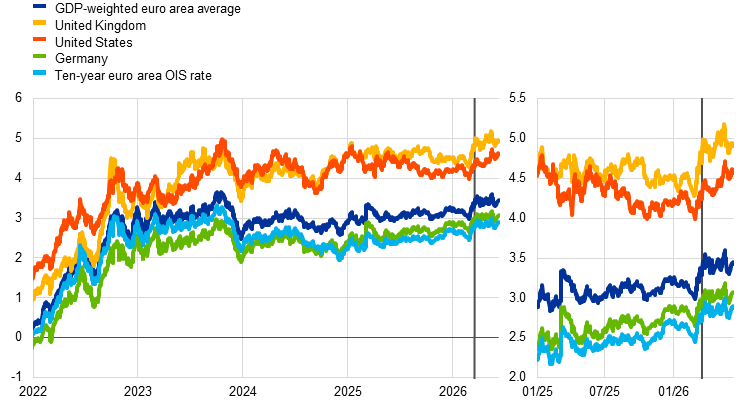
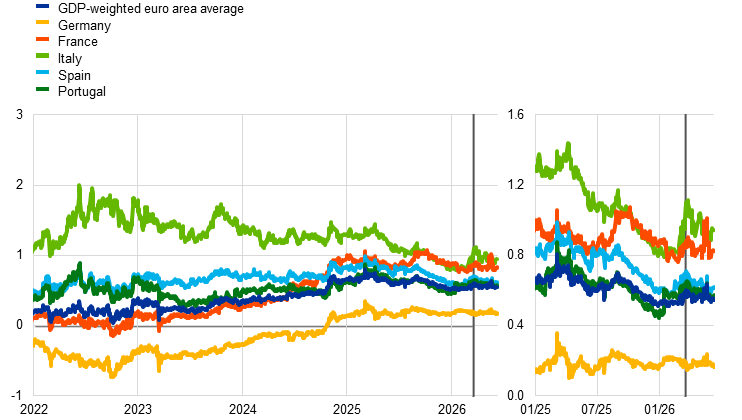
Euro area long-term sovereign bond yields rose slightly overall during the review period, with spreads relative to risk-free rates little changed, while more heavily indebted countries experienced some volatility (Charts 15 and 16). The ten-year GDP-weighted euro area sovereign bond yield increased slightly, closing the review period at around 3.5%. Ten-year sovereign yields across the euro area broadly tracked the risk-free OIS rate, and cross-country dispersion in sovereign spreads over risk-free rates remained at historically low levels. Sovereigns that are particularly exposed to the Middle East energy shock or have higher levels of debt recorded somewhat greater intra-period volatility. The ten-year US Treasury yield increased by around 30 basis points to stand at 4.6%. Ten-year UK gilt yields fluctuated significantly intra-period, reaching levels exceeding 5.0% before ending around 10 basis points higher, at 4.9%.
Chart 15
Ten-year sovereign bond yields and the ten-year OIS rate based on the €STR
(percentages per annum)
Sources: LSEG and ECB calculations.
Notes: The vertical grey line denotes the start of the review period on 19 March 2026. The latest observations are for 10 June 2026.
Chart 16
Ten-year euro area sovereign bond spreads vis-à-vis the ten-year OIS rate based on the €STR
(percentage points)
Sources: LSEG and ECB calculations.
Notes: The vertical grey line denotes the start of the review period on 19 March 2026. The latest observations are for 10 June 2026.
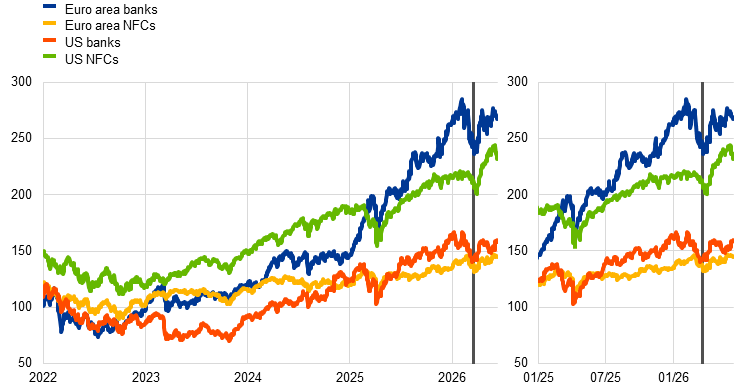
Euro area equities rebounded over the review period, offsetting the losses recorded during the first month of the Middle East war, as corporate earnings remained resilient and risk appetite improved following the ceasefire announcement on 8 April (Chart 17). Overall, euro area stock markets gained 7.7% over the review period, with the sub-index for non-financial corporations (NFCs) rising by 7.5% and bank stock prices moving up by 11%. In the United States, the broad equity market index rose by 10%, with NFCs and banks posting increases of 10.4% and 11.5% respectively. Listed firms on both sides of the Atlantic reported strong earnings, particularly in the technology sector, reinforcing optimism about the global AI infrastructure buildout. However, optimistic expectations for the long-term earnings growth of AI-related companies in the United States underpinned the outperformance of US equities over their euro area counterparts.
Chart 17
Euro area and US equity price indices
(index: 2 January 2020 = 100)
Sources: LSEG and ECB calculations.
Notes: The vertical grey line denotes the start of the review period on 19 March 2026. The latest observations are for 10 June 2026.
In corporate bond markets, euro area investment-grade and high-yield spreads narrowed over the review period, returning to their pre-war levels. The compression in euro area corporate spreads reflected an improvement in risk appetite following the initial deterioration triggered by the outbreak of the war. The narrowing was most pronounced in the high-yield segment, where spreads tightened by about 40 basis points. Investment-grade spreads declined by approximately 10 basis points for both NFCs and financial firms.
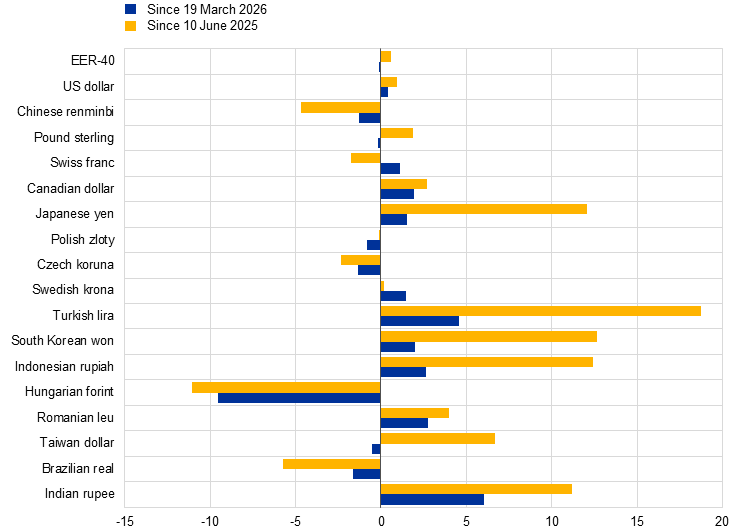
In foreign exchange markets, the euro was broadly stable against the US dollar and in trade-weighted terms (Chart 18). The nominal effective exchange rate of the euro – as measured against the currencies of 40 of the euro area’s most important trading partners – was largely stable over the review period (‑0.1%). The euro was little changed against the US dollar, settling at USD 1.15 per euro (+0.4%) at the end of the period. Having initially weakened against the US dollar following the outbreak of the war in the Middle East, the euro started to recover after the ceasefire agreement in early April. It later weakened again as uncertainty persisted around a potential peace deal, which continued to put upward pressure on energy prices. Since then, the currency pair has traded in a narrow range of USD 1.15-1.18 per euro. The euro appreciated against the Japanese yen (+1.5%), which weakened continuously throughout the period and rebounded only temporarily following foreign exchange interventions by Japanese authorities. By contrast, the euro lost ground against the Hungarian forint (‑9.6%) following parliamentary elections in Hungary that supported the forint, and also weakened against the Brazilian real (‑1.6%) and Chinese renminbi (‑1.3%).
Chart 18
Changes in the exchange rate of the euro vis-à-vis selected currencies
(percentage changes)
Source: ECB calculations.
Notes: EER-40 is the nominal effective exchange rate of the euro against the currencies of 40 of the euro area’s most important trading partners. A positive (negative) change corresponds to an appreciation (depreciation) of the euro. All changes have been calculated using the foreign exchange rates prevailing on 10 June 2026.
5 Financing conditions and credit developments
Following the outbreak of the war in the Middle East, financing conditions for firms and households have tightened. In April, bank lending rates for firms remained at 3.6% and mortgage rates held steady at 3.4%. Over the review period from 19 March to 10 June 2026, the cost to non-financial corporations of market-based debt changed little, while the cost of equity increased, driven by both a rising equity risk premium and higher risk-free rates. Growth in loans to firms increased further in April to 3.4%, while growth in loans to households was stable at 3%. The annual growth rate of broad money (M3) decreased to 2.7%.
Bank funding costs increased slightly following the outbreak of the war in the Middle East. The relatively muted increase in the composite cost of debt financing for euro area banks – to 1.6% in April from 1.5% in February (Chart 19) – was mainly driven by developments in risk-free rates. Following the outbreak of the war in the Middle East on 28 February, bank bond yields increased by around 70 basis points, levelling off by the end of April. At the same time, the composite deposit rate remained stable at 0.9% in April. Interest rates on overnight deposits and savings accounts remained the same, as did interbank rates, while rates on time deposits saw a small increase from March.
Chart 19
Composite bank funding costs in the euro area
(annual percentages)

Sources: ECB, S&P Dow Jones Indices LLC and/or its affiliates, and ECB calculations.
Notes: The composite cost of debt financing is an average of new business costs for banks for overnight deposits, deposits redeemable at notice, time deposits, bonds and interbank borrowing, weighted by their respective outstanding amounts. The composite cost of deposits is calculated as the average of new business rates on overnight deposits, deposits with an agreed maturity and deposits redeemable at notice, weighted by their respective outstanding amounts. The latest observations are for April 2026 for the composite cost of debt financing and the composite cost of deposits, and 10 June 2026 for bank bond yields.
Bank lending rates for firms increased slightly overall following the outbreak of the war in the Middle East, with rates for households also edging up (Chart 20). The cost of bank borrowing for non-financial corporations increased by 11 basis points from February to stand at 3.6% in April, which is around 170 basis points below its October 2023 peak. Rates increased for loans with medium-term fixation periods (between one and five years) and were broadly unchanged for loans with shorter-term fixation periods (below one year) and longer-term fixation periods (over five years). The spread between interest rates on small and large loans to firms remained broadly stable at low levels. The cost of borrowing for households for house purchase edged up by 7 basis points from February to stand at 3.4% in April, around 60 basis points below its November 2023 peak. This development reflects an increase in rates across all fixation periods, with rates for medium and longer-term loans rising more than those for short-term loans.
Chart 20
Composite bank lending rates for firms and households in the euro area
(annual percentages)

Sources: ECB and ECB calculations.
Notes: Composite bank lending rates are calculated by aggregating short and long-term rates using a 24-month moving average of new business volumes. The latest observations are for April 2026.
Over the review period from 19 March to 10 June 2026, the cost of market-based debt issued by firms changed little, while the cost of equity financing increased. The overall cost of financing for non-financial corporations – the composite cost of bank borrowing, market-based debt and equity – stood at 6.2% in April 2026 for the second consecutive month (Chart 21).[10] Following a significant jump in March, the cost of equity increased further in April. The impact of this increase in the cost of equity and a parallel increase in the cost of long-term bank borrowing on the overall cost of financing in April was compensated by a decline in the cost of market-based debt, which was due to the compression of the spreads on bonds issued by non-financial firms. Over the review period as a whole, the cost of market-based debt remained virtually the same, thanks to lower corporate bond spreads compensating for higher risk-free rates (see Section 4, “Financial market developments”). The increase in the cost of equity financing is primarily attributable to a higher equity risk premium, while rising long-term risk-free rates also contributed, albeit to a lesser extent.
Chart 21
Nominal cost of external financing for euro area firms, broken down by component
(annual percentages)

Sources: ECB, Eurostat, Dealogic, Merrill Lynch, Bloomberg Finance L.P., LSEG and ECB calculations.
Notes: The overall cost of financing for non-financial corporations is based on monthly data and is calculated as an average of the long and short-term costs of bank borrowing (monthly average data) and the costs of market-based debt and equity (end-of-month data), weighted by their respective outstanding amounts. The latest observations are for 10 June 2026 for the cost of market-based debt and the cost of equity (daily data), and April 2026 for the overall cost of financing and the long and short-term cost of borrowing from banks (monthly data).
Growth in loans to firms increased further in April, while growth in loans to households remained stable (Chart 22). The external financing of firms has strengthened since the outbreak of the war in the Middle East, driven by borrowing from banks, especially in the form of short and medium-term loans, and a rebound in the net issuance of debt securities. The annual growth rate of bank lending to non-financial firms rose to 3.4% in April, from 3.2% in March – still below its historical average of 4.3% since the start of 1999. Meanwhile, the annual growth rate of debt financing by firms increased to 3.7% in April from 3.4% in March, compared with 2.8% in January. By contrast, the annual growth rate of loans to households was stable at 3.0% in April, also standing below its historical average of 4.1% since the start of 1999. The growth in loans to households was mainly supported by strong growth in consumer credit and, to a lesser extent, in mortgage loans. By contrast, growth in other forms of lending to households, including loans to sole proprietors, remained weak. According to the latest ECB Consumer Expectations Survey for April 2026, the war in the Middle East has adversely affected household expectations regarding credit access, which in April were at their tightest level since the peak of the last policy rate hiking cycle in December 2023.
Chart 22
MFI loans in the euro area
(annual percentage changes)

Sources: ECB and ECB calculations.
Notes: Loans from monetary financial institutions (MFIs) are adjusted for loan sales and securitisation; in the case of non-financial corporations, loans are also adjusted for notional cash pooling. The latest observations are for April 2026.
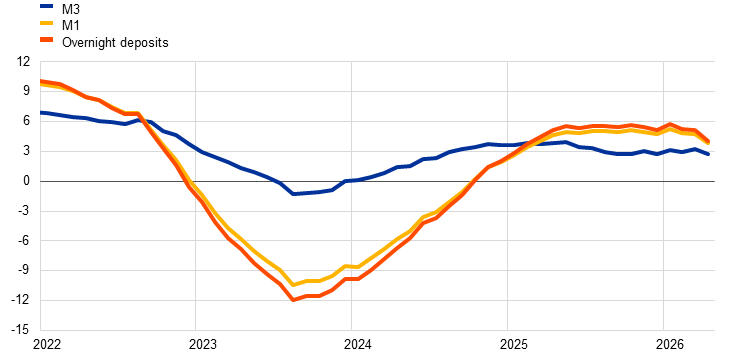
The annual growth rate of broad money (M3) decreased in April, amid sizeable deposit outflows from non-bank financial intermediaries (Chart 23). Annual growth in M3 declined to 2.7% in April, from 3.2% in March, returning to the level observed for most of the second half of 2025 and remaining well below its historical average of 5.2% since the start of 1999. The annual growth rate of narrow money (M1) – comprising the most liquid instruments, namely currency in circulation and overnight deposits – decreased from 4.7% in March to 3.8% in April, amid sizeable deposit outflows from non-bank financial intermediaries, reversing inflows seen in the previous month. From a counterpart perspective, money creation was supported by bank lending, while net foreign monetary outflows from the euro area and the reduction of the Eurosystem balance sheet weighed on M3 growth.
Chart 23
M3, M1 and overnight deposits
(annual percentage changes, adjusted for seasonal and calendar effects)
Source: ECB.
Note: The latest observations are for April 2026.
6 Fiscal developments
According to the June 2026 Eurosystem staff macroeconomic projections for the euro area, the general government budget deficit, which stood at 2.9% of GDP in 2025, is expected to increase substantially to 3.6% of GDP in 2026 and to peak at 3.7% in 2027. The euro area fiscal stance is projected to loosen in 2026, before tightening again in 2027 and 2028. The projected loosening in 2026 is mainly attributable to government investment and fiscal transfers, with the increase in investment primarily reflecting high defence and infrastructure spending, as well as projects under the Next Generation EU (NGEU) programme. The tightening in 2027 and 2028 is mainly explained by non-discretionary factors. The euro area debt-to-GDP ratio is expected to follow an upward path to reach 90% of GDP in 2028, as the continuous primary deficits and positive deficit-debt adjustments outweigh the favourable, though diminishing, effects of interest rate-growth differentials. As part of its 2026 European Semester Spring Package as released on 3 June, the European Commission notes that measures to strengthen energy security and reduce dependence on fossil fuels may benefit from existing flexibility in the framework.
According to the June 2026 Eurosystem staff macroeconomic projections, the euro area general government budget balance is expected to deteriorate, with the deficit peaking in 2027 well above the 3% threshold (Chart 24).[11] Looking back, the euro area budget deficit declined slightly from 3.0% of GDP in 2024 to 2.9% in 2025. Looking forward, it is projected to increase markedly to 3.6% of GDP in 2026, peak at 3.7% in 2027 and decline marginally to 3.6% in 2028. Most of the deterioration in the budget balance over the projection horizon reflects the steady rise in interest payments. In addition, the sharper increase in the budget deficit in 2026 reflects the loosening of the fiscal stance – as measured by the cyclically adjusted primary balance adjusted for NGEU grants – and a slight deterioration in the cyclical component, which reflects developments in the output gap.[12] The cyclical component is expected to continue to deteriorate slightly in 2027 – contributing to a higher deficit – before reversing in 2028 when, together with the projected fiscal tightening, it leads to a slight improvement in the fiscal position. Compared with the March 2026 ECB staff macroeconomic projections for the euro area, the budget deficit ratio turned out to be 0.1 percentage points lower in 2025 and is projected to be 0.2 percentage points higher in 2026, while remaining broadly unchanged in 2027 and 2028.
Chart 24
Budget balance and its components
(percentages of GDP)

Sources: ECB calculations and Eurosystem staff macroeconomic projections for the euro area, June 2026.
Note: The data refer to the aggregate general government sector of all 21 euro area countries.
Following a slight tightening in 2025, the euro area aggregate fiscal stance is projected to loosen in 2026 before tightening somewhat over 2027 and 2028. The 2026 loosening is expected to amount to 0.5 percentage points of GDP, driven primarily by higher government investment and transfers to households. The increase in investment reflects higher defence and infrastructure spending in Germany and a number of other, smaller countries, as well as NGEU-funded expenditure, though the latter is expected to be largely reversed over the subsequent years. The tightening in the fiscal stance foreseen for 2027 and 2028 is mainly explained by non-discretionary factors, notably fiscal drag and the decoupling of tax bases from GDP.[13] Compared with the March 2026 ECB staff macroeconomic projections, the fiscal stance is expected to be somewhat looser in 2026 and tighter to a similar degree in 2027, while remaining unchanged in 2028. The revisions mainly reflect the new temporary energy support measures adopted by governments since the start of the war in the Middle East (amounting to about 0.1% of GDP), as well as developments in government consumption.
The euro area debt-to-GDP ratio is expected to follow an upward path over the projection horizon, reaching 90% of GDP in 2028 (Chart 25). The significant reduction in the debt-to-GDP ratio observed between 2021 and 2023, which had been driven almost exclusively by favourable interest rate-growth differentials, came to an end in 2024. The debt-to-GDP ratio is now expected to increase from 87.4% in 2025 to 90.0% in 2028. This increase reflects continuous primary deficits and small but consistently positive deficit-debt adjustments, which are only partly offset by still favourable, albeit diminishing, interest rate-growth differentials. The general government debt ratio has been revised up throughout the projection horizon compared with the March 2026 ECB staff macroeconomic projections, mainly owing to less favourable interest rate-growth differentials and higher deficit-debt adjustments.
Chart 25
Drivers of change in the euro area government debt-to-GDP ratio
(percentage points of GDP, unless otherwise indicated)

Sources: ECB calculations and Eurosystem staff macroeconomic projections for the euro area, June 2026.
Note: The data refer to the aggregate general government sector of all 21 euro area countries.
The Commission released its 2026 European Semester Spring Package on 3 June.[14] The EU Council has so far approved the activation of the national escape clause for 14 euro area countries, with the request from Spain approved at the Council meeting of 12 June.[15] The Council has also abrogated the excessive deficit procedure (EDP) for Malta. After taking into account the flexibility provided under the national escape clause, where relevant, the Commission considers that effective action has been taken by the euro area countries subject to an EDP.[16] It is considering whether to open a procedure for Bulgaria. Furthermore, the Commission notes that measures to strengthen the structural resilience of the European energy system and accelerate the transition away from fossil fuels may benefit from existing flexibility in the framework. Specifically, it proposes broadening the scope of the national escape clause to accommodate temporary measures aimed at reducing dependence on imported fossil fuels, while maintaining the existing flexibility for defence spending. It proposes that, within the existing cap of 1.5% of GDP for additional defence spending under the national escape clause, a dedicated annual cap of 0.3% of GDP be applied to energy-related support measures over 2026-28, subject to a cumulative cap of 0.6% of GDP over the same period.
Boxes
1 AI and the US labour market: effects on employment growth
As firms around the world adopt AI tools, the impact of AI on labour markets is being widely discussed.[17] While AI’s potential to disrupt job markets could be significant, its effects on aggregate employment appear to be muted so far. Still, there is growing evidence that AI is negatively affecting employment for specific occupational sub-groups, particularly junior workers in highly exposed occupations.[18] This box analyses the effects of AI on employment growth in recent years, focusing on the United States, where such effects are likely to have become visible earlier than in other major economies, given that it is home to some of the most advanced early-adopting firms and has a relatively flexible labour market.
More2 How US financial markets react to geopolitical shocks hitting oil supply
Recent geopolitical shocks have disrupted global energy markets. The two largest geopolitical shocks in recent years – Russia’s invasion of Ukraine and the current war in the Middle East – triggered sharp energy price spikes in the two weeks following the start of the conflict, with oil prices rising by about 30% and 50% respectively (Chart A). While geopolitical shocks typically weigh on economic growth (Caldara and Iacoviello, 2022), their inflationary effects are less clear (Ferrari Minesso et al., 2023; Brignone et al., 2024).[19] However, shocks involving global energy supply disruptions, such as the closure of the Strait of Hormuz, drive oil prices up. This fuels inflation, likely amplifying the contractionary effect on growth and affecting the reactions of financial markets. Focusing on the United States, this box examines these reactions using a new measure of oil-related geopolitical shocks from Iacoviello and Tong (2026).
More3 State aid in the EU: an evolving landscape
State aid expenditure in the EU has risen sharply in recent years, driven by economic shocks and a global resurgence of interventionist industrial policy. This has triggered a wider debate, with proponents underscoring the need for public intervention to address market failures and strategic vulnerabilities (Evenett et al., 2024), and critics cautioning against the attendant risks of inefficiency, rent seeking and Single Market fragmentation (Hodge et al., 2024). From an ECB perspective, State aid warrants attention due to its implications for fiscal policy, resource allocation and competition. Against rising geopolitical tensions and new EU State aid Temporary Frameworks permitting a more flexible deployment of aid (most recently in support of sectors affected by the Middle East crisis), this box examines its evolving role and allocation.
More4 Higher oil prices from the war in the Middle East: assessing the headwinds for euro area growth
The war in the Middle East has led to a sharp rise in oil prices and is likely to weigh noticeably on euro area economic activity. Following the outbreak of the war in late February 2026, Brent crude oil prices increased markedly, reflecting disruptions to oil flows through the Strait of Hormuz and a decline in oil production in the Middle East. Compared with past major geopolitical oil supply disruptions, the current shock appears to be of intermediate magnitude (Chart A). Although peak oil price levels have been broadly similar to those seen after Russia’s invasion of Ukraine in early 2022, the increase in oil prices triggered by the current shock has so far been larger than the rise observed after the Russian invasion. That shock reflected supply interruptions and heightened uncertainty around Russian oil exports, against a backdrop of persistently elevated oil demand in the aftermath of the COVID-19 pandemic and a much sharper rise in natural gas prices.[20] However, the oil price increase from the current shock is smaller than that observed during the Gulf War in the early 1990s, when Iraq’s invasion of Kuwait removed significant oil supply from the market.
More5 Tracking euro area labour market developments through restructuring announcements
This box examines the extent to which media-reported, firm-level restructuring announcements covering both job reductions and job creations can provide more timely signals of euro area labour market dynamics than standard statistical measures. It draws on the European Restructuring Monitor (ERM), a firm-level dataset compiled by the European Foundation for the Improvement of Living and Working Conditions (Eurofound) through the daily screening of national business media and company websites across all EU Member States and Norway since 2002. A restructuring event is recorded when at least 100 jobs are affected, or when the affected workforce represents at least 10% of an establishment employing more than 250 people.[21] Events need to materialise within nine months from the announcement and are classified by type (e.g. internal restructuring, expansion, offshoring, merger or bankruptcy), offering information on the nature of the underlying shock which is not available in standard aggregate statistics. As such, the ERM may provide timely, high-frequency insights into labour market developments ahead of official data releases.
More6 What has kept goods inflation low? The role of the import exposure to China
Since the second half of 2025, prices of imports from China have been declining year on year, putting downward pressure on euro area goods inflation. The prices of imports from China fell by 3.3% year on year in March 2026, following a 4.6% decrease in February. This decline was much larger than that of total extra-euro area import prices and the prices of imports from countries other than China, with these latter import prices declining by 2.4% year on year in February 2026 (Chart A). At the same time, the share of China in extra-euro area imports has increased from 14% to 17% since 2024, supported by the increasing competitiveness of Chinese products. High exposure to imports from China and falling prices for some consumer goods have contributed to keeping euro area inflation for non-energy industrial goods (NEIG) subdued. This box analyses how the increase in euro area imports from China, and their relatively low and declining prices, are affecting euro area goods inflation.[22]
More7 Liquidity conditions and monetary policy operations from 11 February to 5 May 2026
This box describes the Eurosystem liquidity conditions and monetary policy operations in the first and second reserve maintenance periods of 2026. Together, these two maintenance periods ran from 11 February to 5 May 2026 (the “review period”).
More8 The narrowing of the euro area current account balance in 2025
The euro area current account surplus narrowed markedly in 2025 under the impact of US trade tariffs, the activities of US multinational enterprises (MNEs), structural shifts in global trade in goods, and rising digital and artificial intelligence (AI)-related investment. The surplus declined to 1.7% of GDP in 2025, from 2.7% in 2024 (Chart A). Excluding the period 2022-2023, which was marked by the energy shock following Russia’s full-scale invasion of Ukraine, this was the lowest surplus since 2012, when the euro area current account balance moved from a deficit to a surplus in the wake of the sovereign debt crisis.[23] This box examines the main drivers of the narrowing of the euro area current account surplus in 2025.
MoreArticle
1 Five years of the ECB Survey of Monetary Analysts: evolution and insights
The European Central Bank’s (ECB’s) Survey of Monetary Analysts (SMA) is a valuable information set for monitoring the expectations of financial market participants regarding monetary policy and the macroeconomic outlook in the euro area. Launched as a pilot in April 2019 and placed on a fully operational footing in June 2021, the SMA is conducted ahead of each monetary policy meeting of the Governing Council. It provides structured information on the views of a representative panel of financial market institutions.[24]
MoreStatistics
https://www.ecb.europa.eu/pub/pdf/ecbu/ecb.eb_annex202604~df576b695f.en.pdf© European Central Bank, 2026
Postal address 60640 Frankfurt am Main, Germany
Telephone +49 69 1344 0
Website www.ecb.europa.eu
All rights reserved. Reproduction for educational and non-commercial purposes is permitted provided that the source is acknowledged.
For specific terminology please refer to the ECB glossary (available in English only).
The cut-off date for the statistics included in this issue was 10 June 2026.
PDF ISSN 2363-3417, QB-01-26-050-EN-N
HTML ISSN 2363-3417, QB-01-26-050-EN-Q
For further details, see Box 1 of “Eurosystem staff macroeconomic projections for the euro area, June 2026”, published on the ECB’s website on 11 June 2026.
Note that this section discusses changes in spot prices between March and June 2026. These may differ from the changes in technical assumptions between the March and June 2026 projection exercises owing to differences in market cut-off dates, as well as to the use of oil spot and futures prices averaged over several business days during the projection production process.
The Eurosystem staff macroeconomic projections for headline CPI inflation include a broader range of countries, including major emerging economies such as China, India, Brazil and Russia, which are not accounted for in OECD CPI inflation.
See “Eurosystem staff macroeconomic projections for the euro area, June 2026”, published on the ECB’s website on 11 June 2026.
The cut-off date for data included in this issue of the Economic Bulletin was 10 June 2026. According to the full HICP data release published by Eurostat on 17 June 2026, annual euro area inflation stood at 3.2% in May 2026.
See “Eurosystem staff macroeconomic projections for the euro area, June 2026”, published on the ECB’s website on 11 June 2026.
The outcomes of the underlying indicators of inflation are now based on the European Classification of Individual Consumption According to Purpose version 2 (ECOICOP 2), which includes revised historical weights and the addition of games of chance as a new item in the product coverage of the HICP. These methodological changes entail some loss of comparability with the previous outcomes, although this is expected to be limited for the main aggregates. For more details, see Eurostat, Questions & Answers on the improvements in the Harmonised Index of Consumer Prices (HICP) effective January 2026, European Commission, Luxembourg, 25 February 2026. The methodology for compiling the Supercore indicator has also been refined.
For further details, see “New data release: ECB wage tracker points to stable negotiated wages pressures in 2026”, press release, ECB, 17 June 2026.
The fieldwork for the April 2026 ECB Consumer Expectations Survey concluded on 4 May 2026.
Owing to lags in the availability of data on the cost of borrowing from banks, data on the overall cost of financing for non-financial corporations are only available up to April 2026.
See “Eurosystem staff macroeconomic projections for the euro area, June 2026”, published on the ECB’s website on 11 June 2026.
The fiscal stance reflects the direction and size of the stimulus from fiscal policies to the economy beyond the automatic reaction of public finances to the business cycle. It is measured here as the change in the cyclically adjusted primary balance ratio net of government support to the financial sector. Given that the higher budget revenues related to NGEU grants from the EU budget do not have a contractionary impact on demand, the cyclically adjusted primary balance is adjusted to exclude those revenues. For more details on the euro area fiscal stance, see the article entitled “The euro area fiscal stance”, Economic Bulletin, Issue 4, ECB, 2016.
Fiscal drag refers to the increase in tax revenue that occurs when nominal tax bases grow, but the parameters of a progressive tax system are not adjusted accordingly.
For further details, see “2026 European Semester: Spring package”.
The national escape clause has been activated for Belgium, Bulgaria, Germany, Estonia, Greece, Spain, Croatia, Latvia, Lithuania, Austria, Portugal, Slovenia, Slovakia and Finland. Further information on the national escape clause for defence expenditure is available on the Council’s website.
The euro area countries currently subject to an EDP are Belgium, France, Italy, Austria, Slovakia and Finland. The Commission expects Italy to correct its excessive deficit in 2026, in line with the deadline set by the Council.
The box focuses on the labour market effects of AI adoption on the demand side and does not explicitly capture potential employment gains arising from the supply side, such as job creation linked to investment in AI development and deployment.
See, for example, Brynjolfsson et al. (2025) for an analysis of US payroll data. Note that Lambert and Schindler (2026) question the finding that generative AI is replacing junior workers. They find that exposure to generative AI is strongly correlated with another post-pandemic shock: working from home.
Ferrari Minesso et al. (2023) highlight the mixed effects of geopolitical risk on oil prices and inflation. Brignone et al. (2024) show that uncertainty-driven shocks increase oil prices and inflation but that realised adverse events are deflationary.
For a comparison of the current shock with that triggered by Russia’s invasion of Ukraine and a discussion of the likely propagation to inflation, see Arce et al. (2026).
For a description of the dataset and methodology, see Litardi and Brattlund (2025).
See Di Sano et al. (2023), Boeckelmann et al. (2025) and Al-Haschimi et al. (2025).
See Emter et al. (2023).
For a description of the design and governance of the SMA and the initial experience during the pilot phase, see Brand and Hutchinson (2021).