





Main findings from the ECB’s recent contacts with non‑financial companies
Published as part of the ECB Economic Bulletin, Issue 5/2026.
This box summarises the main findings from recent contacts between ECB staff and representatives of 76 leading non-financial companies operating in the euro area.[1] The exchanges mainly took place between 22 June and 1 July 2026, i.e. shortly after the signing of the US-Iran Memorandum of Understanding (MoU) in mid-June, which subsequently broke down in early July amid renewed hostilities around the Strait of Hormuz.
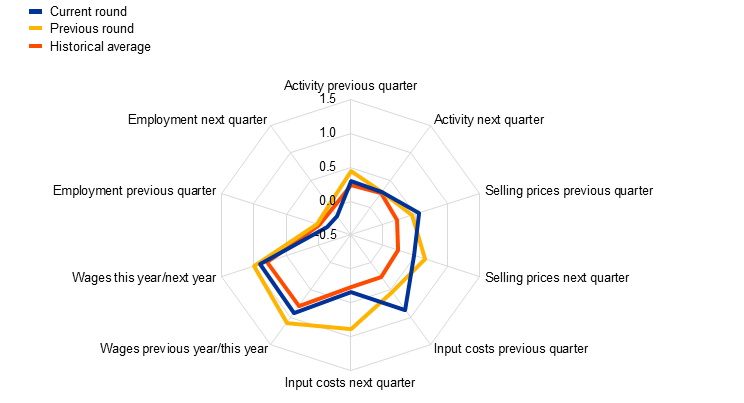
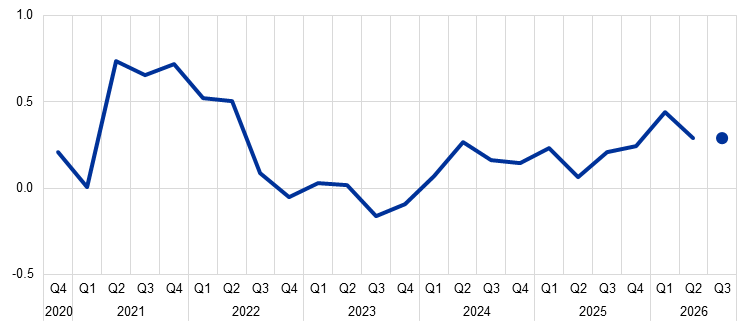
Reports from contacts pointed to moderate growth in activity in the second quarter and towards broadly unchanged momentum in the third quarter. While the war in the Middle East and consequent rise in fuel prices had reduced travel and was weighing on consumer spending somewhat, the overall impact on activity seemed quite limited. This was partly because some firms had benefited from reduced competition from Asian competitors (whose costs had increased by more or whose supply had been temporarily disrupted) and precautionary buying in anticipation of higher prices. This had resulted in a shift in the composition of growth towards manufacturing and away from services. However, the global economy had proved resilient and Asian economies remarkably flexible in overcoming disruption caused by the blockage of the Strait of Hormuz, and global trade was now growing robustly again.
Chart A
Summary of views on activity, employment, prices and costs
(averages of ECB staff scores)
Source: ECB.
Notes: The scores reflect the average of scores given by ECB staff in their assessment of what contacts said about quarter-on-quarter developments in activity (sales, production and orders), input costs (material, energy, transport, etc.) and selling prices, and about year-on-year wage developments. Scores range from -2 (significant decrease) to +2 (significant increase). A score of 0 denotes no change. For the current round, previous quarter and next quarter refer to the second and third quarters of 2026 respectively, while for the previous round these refer to the first and second quarters of 2026. Discussions with contacts in January and in March/April regarding wage developments normally focus on the outlook for the current year compared with the previous year, while discussions in June/July and September/October focus on the outlook for the next year compared with the current year. The historical average is an average of scores compiled using summaries of past contacts extending back to 2008.
Growth in consumer spending was reportedly modest. Food retailers said that higher fuel prices in the second quarter left less money for spending on other items and reinforced the tendency for consumers to shift away from branded products to private labels. In clothing retail, demand in the mid-price range was falling, while unbranded, luxury and outlet sales continued to grow. In consumer electronics, demand for mid-sized products was benefiting from a recovery cycle (as items purchased during the pandemic needed replacing). General market conditions were tough, however, with Chinese manufacturers increasingly offering innovative products at low prices. Around half of the retailers we spoke to thought that the conflict in the Middle East had reduced consumer demand; but others gave more upbeat assessments describing consumer spending as surprisingly resilient. The latter applied to car sales, which had been picking up thanks to electric vehicle subsidies re-introduced by some governments, the introduction of more affordable models amid intensifying competition from Chinese manufacturers and the rise in fuel prices improving sentiment towards electric vehicles.
The war in the Middle East reduced air travel, albeit with shifts in demand that could benefit summer tourism in the euro area. According to contacts in the aviation industry, travel to and from euro area airports was around 2-4% lower than it otherwise would have been in the second quarter. This was partly because airlines reduced capacity on less profitable routes and partly because passenger demand fell (by more than expected) in response to higher ticket prices. But with seat prices falling again and fuel shortages less of a concern, the summer was now looking “okay”. Moreover, there had been a clear shift in travel away from destinations in the eastern Mediterranean in favour of summer holiday destinations in the euro area.
Contacts pointed to the boom in artificial intelligence (AI) driving business investment and spending, while competitiveness concerns weighed on traditional capital expenditure. Contacts reported strong growth in demand for sovereign cloud infrastructure and tech independence, encouraging European companies to team up with US providers to deliver localised solutions. Investment in data centres was fuelling demand for related construction materials as well as a boom throughout the semiconductor supply chain. AI adoption was transforming the business model in the consulting sector, and its uses were being widely explored across industry. Investment in renewable energy was another growth driver (given new impetus by the conflict in the Middle East) as was aerospace. Residential construction had rebounded in the second quarter after a first quarter affected by bad weather and was growing on the back of improvements in affordability (mortgage rates, prices of building materials) in 2025. However, affordability indicators were now deteriorating again. The outlook for machinery and equipment investment was reportedly mixed, with some contacts pointing to a sustained pick-up in orders since late 2025, while others perceived traditional capital spending as rather flat and weighed down by high energy, labour and regulatory costs and uncertainty. This was causing European manufacturing firms to increasingly focus their investments on Asia or eastern Europe rather than the euro area.
Chart B
Views on developments in and the outlook for activity
(averages of ECB staff scores)
Source: ECB.
Notes: The scores reflect the average of scores given by ECB staff in their assessment of what contacts said about quarter-on-quarter developments in activity (sales, production and orders). Scores range from -2 (significant decrease) to +2 (significant increase). A score of 0 denotes no change. The dot refers to expectations for the next quarter.
Employment dynamics were rather subdued, with many firms in cost-cutting mode. This was particularly the case for firms in the manufacturing sector for which production in the euro area had become uncompetitive and which were therefore reducing their employment footprint in the region. Employment in the services sector was more stable. Across the economy, firms continued to report widespread testing of AI use cases to raise productivity and reduce labour costs, although the impact on aggregate employment was limited as yet. Consistent with their feedback in the previous round, recruitment agencies pointed to their activity bottoming out (after several quarters of contraction) though driven by a pick-up in temporary placement activity rather than permanent hiring.
Contacts reported stronger increases in selling prices in the second quarter, albeit less than anticipated in the previous round, with a slight moderation expected for the third quarter. Developments in – and expectations for – prices and costs were heavily affected by developments in the Middle East and consequent movements in the price of oil. Around 40% of contacts said that prices in their sector had increased in response and a similar number said that margins had been squeezed. Prices had increased most in the intermediate goods and transport sectors, being those most directly affected by the price of oil and its derivatives. Prices for petrochemicals, for example, had increased by 20-30%. In upstream (intermediate and capital goods) manufacturing, the pass-through from costs to prices was relatively swift. This was because some firms reacted by adjusting prices more frequently than usual while others (having learned from the inflation surge induced by the pandemic and Russia’s invasion of Ukraine) had introduced clauses into contracts providing for automatic pass-through of material, energy and logistics costs. In businesses closer to the consumer, however, the pricing environment was more challenging, and there had been little adjustment of prices so far. In non-food retail (and especially in consumer electronics), import competition from Asia kept a lid on – or resulted in downward pressure on – prices. Moreover, consumers remained very price sensitive. If oil prices had remained at the levels seen during the ceasefire between the United States and Iran, this would likely have kept the pass-through to final consumer prices limited.
Chart C
Views on developments in and the outlook for prices
(averages of ECB staff scores)

Source: ECB.
Notes: The scores reflect the average of scores given by ECB staff in their assessment of what contacts said about quarter-on-quarter developments in selling prices. Scores range from -2 (significant decrease) to +2 (significant increase). A score of 0 denotes no change. The dot refers to expectations for the next quarter.
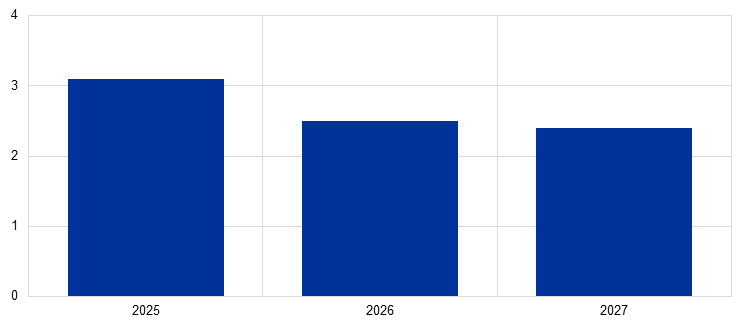
Contacts continued to anticipate slowing wage growth. On average, the quantitative indications provided imply that wage growth is expected to slow from 3.1% in 2025 to 2.5% in 2026 and 2.4% in 2027. These perceptions and expectations are slightly lower than in the previous survey round, which may in part reflect a different composition of the panel rather than a change in the outlook. Around 20% of contacts thought that the uptick in inflation caused by the conflict in the Middle East would result in higher wage demands, and around 10% expected their firms to implement inflation compensation packages. Most contacts, however, did not anticipate any notable impact on wage growth, citing the subdued economic conditions and employment outlook.
Chart D
Quantitative assessment of wage growth
(percentages)
Source: ECB.
Notes: Averages of perceptions of wage growth of contacts in their sector in 2025 and their expectations for 2026 and 2027. The averages for 2025, 2026 and 2027 are based on indications provided by 67, 70 and 52 respondents respectively.
References
Elding, C., Morris, R. and Slavík, M. (2021), “The ECB’s dialogue with non-financial companies”, Economic Bulletin, Issue 1, ECB.
For further information on the nature and purpose of these contacts, see Elding, Morris and Slavík (2021).