


The Eurosystem’s comprehensive payments strategy
The nature of payments is changing, with digitalisation and new technologies at the heart of this transformation. Given this ever-faster development, the Eurosystem has set out its vision for a comprehensive payments strategy. This new strategy takes a cohesive and forward-looking approach to further developing an innovative and competitive European payments market across wholesale, business-to-business, retail and cross-border payments.
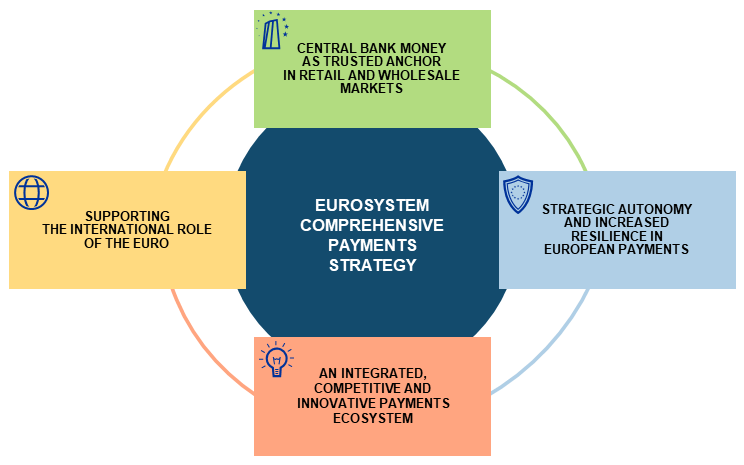
The Eurosystem’s approach is two-pronged: improving the existing payment infrastructures at the same time as catalysing and supporting new ones. This approach is based on four strategic aims: (i) to ensure the effectiveness of monetary policy, financial stability and the smooth functioning of payment systems by maintaining the role of central bank money as the anchor of a two-tier monetary system, (ii) to achieve strategic autonomy and increased resilience for European payments, (iii) to foster an integrated, competitive and innovative payments ecosystem, and (iv) to support the international role of the euro.
These strategic aims involve:
- developing a European market for tokenised settlement assets. The innovative potential of tokenisation should be leveraged, and central bank money should be maintained as the anchor for settlement, complemented by private settlement assets. These private settlement assets include tokenised deposits and stablecoins that are EU-governed, euro-denominated and properly designed and regulated.
- improving the existing infrastructure and investing in distributed ledger technology (DLT)-based solutions for wholesale payments. The Eurosystem will continue to support and invest in its real-time gross settlement (RTGS) system T2, including by exploring the extension of its operating hours. T2 will therefore continue to act as the backbone of the euro area payment system. At the same time, the Eurosystem will future-proof its infrastructure in line with technological innovation, developing central bank money for the settlement of DLT-based wholesale payments and securities transactions through its Pontes and Appia initiatives.
- enhancing standardisation, automation and process integration in corporate payments. Business-to-business (B2B) payments are at the core of economic activity. The Eurosystem intends to facilitate more proactive engagement between the supply side and the corporate sector to catalyse more efficient and innovative solutions for European businesses, allowing them to more seamlessly integrate payment flows into their business processes and leverage innovations such as conditional payments.
- achieving resilient, integrated, innovative and competitive euro retail payments through the digital euro and market-led solutions. Preserving the role of central bank money is equally important in retail markets. With the digital euro project, the Eurosystem is adapting central bank money to the digital age. At the same time, it will continue to foster a resilient, integrated, innovative and competitive euro retail payments market with EU-governed, pan-European, market-led solutions for retail payments at the point of interaction (POI).
- advancing the G20 roadmap to enhance cross-border payments. The Eurosystem will continue its work to shape and advance the G20 roadmap for faster, cheaper, more transparent and more inclusive cross-border payments, by both expanding the use of current efficient solutions such as the interlinking of fast payment systems and taking advantage of innovations based on tokenisation. The Eurosystem will take action in its various roles to support European businesses and individuals with their payments outside the EU.
The Eurosystem will actively monitor developments and adapt its strategy as needed.
This strategy will be key in shaping the European payments landscape of tomorrow, supporting competitiveness, innovation and resilience, and delivering tangible benefits for European citizens, businesses and markets.
1 Introduction
The Eurosystem’s comprehensive payments strategy takes a cohesive and forward-looking approach to payments in response to an increasingly digital ecosystem. Developments in recent years, in particular the ever-faster adoption of new technologies, such as DLT and tokenisation, have prompted the Eurosystem to review and expand the scope of its payment policies and strategies and to set out a new, holistic vision for the European payments market. This document focuses on digital payments and therefore does not cover cash aspects that are the subject of a separate dedicated strategy[1].
The Eurosystem takes a two-pronged approach to payments: it wants to improve the existing payment infrastructures and solutions at the same time as supporting and catalysing new ones. It takes into account recent developments in tokenisation and DLTs and the implications these may have for its own role in the payments ecosystem. Moreover, it considers the following main payment use cases: (i) wholesale payments (large-value, time-critical transactions between banks and/or other financial market participants); (ii) B2B payments (transactions between firms, often with specific requirements related to invoicing, reconciliation and liquidity management); (iii) retail payments (low‑value transactions between consumers and businesses or public administrations, as well as person‑to‑person transfers); and (iv) cross-border payments outside of the EU.
The following four strategic aims will ensure a consistent, future-oriented approach across the payments landscape.
- To ensure the effectiveness of monetary policy, financial stability and the smooth functioning of payment systems by maintaining central bank money as the anchor of a two-tier monetary system
Preserving the role of central bank money – in both retail and wholesale markets – in a growing digital economy is key to safeguarding monetary sovereignty, financial stability, settlement finality, at-par convertibility and the singleness of money[2] across the euro area. As the digital economy grows, and, with it, digital payments, the role of central bank money in the payment system must be preserved to ensure trust and stability. Supporting digital as well as physical central bank money secures the monetary anchor of a two-tiered monetary system, and therefore the singleness of money, throughout the euro area. - To achieve strategic autonomy and increased resilience for European payments
The EU must strengthen strategic autonomy and operational resilience in payments in order to withstand external and technological threats. The EU’s over-dependency on a small number of non-European payment providers and solutions has exposed vulnerabilities which could be exacerbated by heightened geopolitical uncertainties and the risk of payment solutions being used for economic or political leverage. At the same time, technological advancements such as artificial intelligence and quantum computing expose cyber resilience and payments security to further threats. Recent geopolitical tensions underline the urgency for the EU to establish a more resilient and independent payments ecosystem capable of weathering external pressures.[3] - To foster an integrated, competitive and innovative payments ecosystem
The Eurosystem envisages an integrated, competitive and innovative payments market that benefits consumers and businesses alike on a pan-European basis. Improving the efficiency and integration of the European payments market through pan-European payment solutions that cover all relevant use cases, receive broad acceptance in the euro area and have the scale to ensure efficiency and the financial strength to be able to invest in innovation is vital for fostering financial inclusion, reducing transaction costs and improving user experience. Payment infrastructures and services need to evolve to support new technologies and to ensure an efficient, integrated ecosystem that facilitates private sector innovation. Fostering a more integrated and efficient ecosystem for wholesale transactions across the euro area would support the achievement of the goals of the European Commission’s savings and investments union. - To support the international role of the euro
Efficient, secure and integrated euro payment systems can play a supportive role in reinforcing the international role of the euro. This would bring tangible benefits, including lowering borrowing costs, reducing exposure to currency fluctuations and providing insulation from sanctions and coercive measures.
Figure 1
The aims of the Eurosystem comprehensive payments strategy
2 Tokenisation, distributed ledger technology and the changing settlement assets landscape
Tokenisation can alter the structure of the payments ecosystem by introducing new ways to represent, transfer and settle value. It enables transactions to occur through programmable platforms[4] that integrate processes traditionally managed separately, such as messaging, reconciliation and settlement. These developments have the potential to improve efficiency and transparency. However, it is crucial that, when the benefits of tokenisation are exploited, the potential downsides are limited and action is taken to ensure that payment systems remain secure, efficient, resilient and interoperable, and high standards of integrity are maintained.
The landscape in which these technologies emerge relies on a mix of public and private settlement assets. Central bank money anchors the financial and monetary system by providing the risk-free means of final settlement, both in retail and in wholesale markets. Commercial bank money[5] complements this by enabling the bulk of day-to-day transactions in the economy. Tokenisation does not replace these forms of money. Instead, it introduces new digital representations of them and adds new private instruments that may circulate in parallel.
Figure 2
Taxonomy of the digital settlement asset landscape
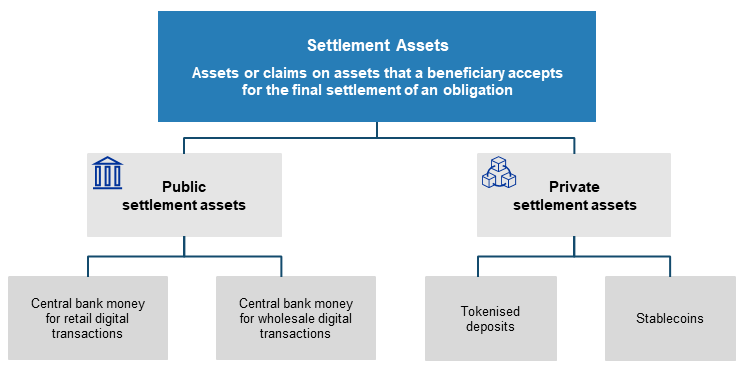
Note: This taxonomy focuses on settlement assets that play a role within the evolving digital asset landscape. It does not include established forms of public and private settlement assets such as banknotes, traditional bank deposits and e-money.
The wholesale settlement asset landscape is taking shape along two linked axes.[6] First, public and private settlement assets can be used in tokenised forms within programmable environments. This includes tokenised central bank money and tokenised commercial bank deposits. Second, privately issued instruments, such as stablecoins, are available for settlement purposes in the same technological environments, although with different legal and prudential characteristics. These developments broaden the range of settlement assets without changing the fundamental distinction between public and private settlement assets. They do, however, change how these assets interact with each other and the infrastructure that supports them.
Developments in tokenisation have created a settlement landscape in which a broader set of assets can operate on platforms capable of executing transfers, enforcing conditions and embedding rules. In both public and private settlement assets, new tokenised forms are appearing and yet the established functions and uses remain in place. The result will not merely expand the framework to allow both established and new forms of settlement assets to function, but will potentially have a broader impact on the structure of the monetary system.
2.1 Developing an integrated European market for tokenised settlement assets
Within a tokenised ecosystem, central bank money in tokenised form is the foundational settlement layer and plays a critical role in preserving the singleness of money. By facilitating convertibility and interoperability between different forms of tokenised settlement assets, central bank money in tokenised form enhances efficiency across the value chain. Tokenised central bank money also fosters market integration by preventing the development of fragmented silos based on separate private settlement assets. As set out in detail below, tokenised deposits have not yet achieved significant scale, possibly because evolving aspects of their governance have yet to be appropriately addressed. However, they have the potential to play a more prominent role over time, being well suited as a private settlement asset to tokenised transactions, particularly where credit risk can ultimately be minimised by using central bank money for final settlement between banks. Thus far, tokenised deposits appear well placed to deliver many of the functional benefits currently associated with stablecoins, which are the most widespread form of tokenised settlement asset today owing to their role in providing liquidity in decentralised finance and in facilitating trading in crypto-asset markets. However, stablecoins are also used as settlement assets in illicit and fraudulent transactions. Further monitoring and analytical work is still necessary to fully decipher the respective benefits, risks and use cases of tokenised deposits, including for their different forms.[7]
The Eurosystem supports responsible innovation in private settlement assets within the two‑tier monetary system, prioritising the preservation of the singleness, scalability and integrity of money, and the avoidance of fragmentation. The development of a robust European market for tokenised, euro-denominated settlement assets based on EU infrastructure is integral to combining technological innovation with financial sovereignty and resilience, and it can help to ensure a sufficient degree of strategic autonomy in payments. Such private settlement assets could also support the international role of the euro by meeting international demand for the euro in areas to which they are better suited than currently available alternatives. By embracing new technologies such as DLT, the Eurosystem will foster an integrated, efficient and competitive financial ecosystem that supports investment, growth and prosperity in the EU, at the same time as making sure that key markets and infrastructures remain anchored in Europe. With the introduction of the EU DLT Pilot Regime in March 2023 and the European Commission’s proposal in December 2025 to broaden it and make it more flexible, it is expected that there will be an increase in demand for an instrument to settle the cash leg of tokenised assets that qualify as financial instruments (securities in particular) using DLT. This development also has clear implications for wholesale payments.
Properly designed and regulated euro-denominated stablecoins may provide benefits in specific use cases, including programmability, atomic settlement and global reach. These benefits stem from DLT itself and are not unique to stablecoins. Stablecoins may offer particular benefits for payment use cases with a cross-border dimension, where these features are especially relevant. At the same time, their adoption may have implications for financial stability, monetary sovereignty, payment systems and monetary policy implementation and transmission.
The Eurosystem recognises the development of EU-governed, euro-denominated, properly designed and regulated stablecoin initiatives (i.e. initiatives that comply with the Markets in Crypto-Assets Regulation (MiCAR) and that address anti-money laundering/countering the financing of terrorism (AML/CFT) issues) that are interoperable with other payment systems and other stablecoins and that serve the objectives of the Eurosystem’s comprehensive payments strategy. At the same time, demand for such instruments will be influenced by developments in the broader tokenised ecosystem and efforts to enhance cross-border payments. This demand will also be shaped by parallel developments in the EU, including the implementation of the Instant Payments Regulation.
The Eurosystem is keen for MiCAR and related legislation[8] to be fully enforced and for regulatory frameworks around the globe to be aligned to avoid fragmentation or arbitrage. The Financial Stability Board’s thematic peer review on crypto-assets, published in October 2025, revealed that the global regulatory framework and its implementation remain fragmented, with inconsistent and insufficient cross-border cooperation and coordination.[9] International standards and recommendations must be consistently implemented across jurisdictions in order to ensure a level playing field.
The innovative potential of tokenisation should be seized, while keeping central bank money as the anchor for settlement, complemented by private settlement assets such as tokenised deposits and stablecoins. These private settlement assets should be EU-governed, euro-denominated, and properly designed and regulated, to support innovation at the same time as safeguarding monetary sovereignty and financial stability. However, even properly designed and regulated stablecoins may be less suitable as settlement assets. This is due to potential deviations from par, limitations to scalability, fragmentation, conduct and integrity concerns arising from their use in illicit and fraudulent transactions, as well as the potential implications for the banking sector’s capacity to extend credit to the economy. As a result, they may be more appropriate for specific use cases. Tokenised deposits appear well suited as a private settlement asset for tokenised transactions. However, to fulfil this function they need to gain scale, which is partly dependent on their transferability being enabled. The Eurosystem will continue to closely monitor developments in stablecoins (as well as in other crypto-assets), including concerns about stablecoins and their impact on the Eurosystem’s mandate. The Eurosystem’s stance regarding stablecoins and other private settlement assets may change over time as market developments and regulatory frameworks progress.
3 Wholesale payments
3.1 Developments in wholesale payments
Innovation from both public and private sector initiatives in the wholesale payments market is endeavouring to achieve efficiency gains and stronger settlement conditions that can support the broader aims of the EU’s savings and investments union. Private sector players are currently offering and exploring services for programmable transactions to be executed once pre-defined conditions are met, such as embedding tighter links between cash and securities. Market initiatives aim to make transactions more efficient, faster and safer by leveraging the capability of DLT to integrate the full life cycle of a financial transaction on a single platform, covering issuing, trading, settlement and custody of assets. Public institutions are exploring the improved capabilities of RTGS systems and tokenised central bank money (or “wholesale central bank digital currency”) offerings that will strengthen finality, availability and further integration. These initiatives seek to improve wholesale settlement and are in line with the EU’s objectives of strengthening its economy, competitiveness and strategic autonomy.
3.2 Improving the existing infrastructure and developing it in line with technological changes
The Eurosystem seeks to modernise its infrastructures in line with technological innovation, including DLT, so that wholesale payments and securities settlement can continue to be done in central bank money, the safest form of money. Exploratory work conducted in 2024[10] upheld market demand and the Eurosystem’s own view that DLT can support efficient, programmable and automated wholesale transactions. In the event that DLT starts to be increasingly used for these transactions, it will be important that interbank settlement remains anchored in central bank money, in order to preserve the singleness of money, contain settlement risk and mitigate financial stability risks as new technologies come into use.
The Eurosystem is now enhancing its existing infrastructures while developing DLT‑compatible central bank money for wholesale use through a dedicated Eurosystem work programme.[11] Through Pontes[12], it aims to deliver a central bank money settlement solution by the end of the third quarter of 2026. In Appia[13], the Eurosystem will explore infrastructures that could serve as a utility for issuing, recording, trading and settling tokenised assets that enable programmability. One key question for these initiatives is how best to accommodate tokenised forms of private settlement assets, i.e. EU-governed, properly designed and regulated stablecoins and tokenised deposits, as they will play a complementary role in such wholesale transactions in the future ecosystem. Some private settlement assets need a settlement system to ensure reach: a clear example here is non-bearer tokenised deposits, which can only be held by customers of the bank that issued them. Pontes and Appia, by providing interbank settlement in central bank money, could allow banks to overcome this limitation. Other private settlement assets, such as stablecoins, might circulate among end-users longer, but could still benefit from being integrated into a broader ecosystem, to increase interoperability (among stablecoins and with other settlement assets).
By providing settlement of financial instruments in central bank money as the foundational anchor, Pontes and Appia seek to support the development of a robust, integrated European digital asset ecosystem. The key objectives are to preserve the singleness of money by facilitating convertibility between different forms of money, promoting efficiency across the value chain by supporting programmability of transactions involving private money and central bank money, and fostering market integration by overcoming or preventing the proliferation of silos using different forms of private money.
In parallel, the Eurosystem will continue to support and invest in its RTGS system T2 and will ensure that it continues to play its vital role as the backbone of the euro area payment systems. In this regard, the Eurosystem is committed to enhancing the functionalities of T2, for instance by examining possibilities for extending its operating hours and improving resilience.
4 Business-to-business payments
4.1 Current needs of the corporate sector
The Eurosystem has interacted with business representatives to understand the challenges they face and their needs. Overall, it emerged that issues and opportunities in B2B payments are not unique to B2B use cases, they mirror the challenges and innovations relevant across other payment contexts.[14]
The main feedback was the need for increased standardisation to help improve process efficiency. Increased transparency of payments could aid reconciliation of payments and invoices; the rollout of EU digital identification standards, including the legal entity identifier (LEI), could help reduce AML and “know your customer” hurdles; and a common payment acceptance standard would increase efficiency and potentially reduce costs as a result of increased competition, as it would be easier to switch service providers. Businesses could also benefit from increased straight-through processing, which could be enabled following the migration to ISO 20022[15]. Another advantage could be the further embedding of financing within operational processes. Thus more efficient payment and procurement processes exploiting rich transaction data in a standardised form would help forecast cash flows, including for optimisation of cross-border liquidity management (foreign exchange).
Another factor was the dependence of the sector on payment service providers offering new innovative solutions. This reliance is particularly acute in the case of solutions for smaller players, who would have less influence over providers to secure affordable solutions that could reduce frictions and potentially help increase competitiveness compared with Asia and the United States. The offerings by enterprise resource planning (ERP[16]) companies and B2B marketplaces were noted – with API integration[17] paving the way for further optimisations. A lack of standardisation in the approaches taken by payment service providers (especially banks) also creates frictions. For example, implementation of verification of payee in firms’ ERP systems is still lagging behind, or banks are advising firms to opt out because of potential operational disruptions to high-volume, automated and batch payment processes.[18] Finally, conditional payments for B2B payments were identified as a promising area.[19]
4.2 Enhancing standardisation, automation and process integration in corporate payments
As offering instant payments is mandated across the EU under the Instant Payments Regulation, enhancing payment solutions to facilitate B2B payments is a promising avenue in connection with the development of electronic invoices. The Eurosystem’s instant payment settlement system, TIPS, which is capable of handling retail payments of any value, is well suited to catering for B2B transactions. TIPS, which offers 24/7 settlement in central bank money, 365 days a year, allows businesses to make and receive payments in euro (and increasingly in other currencies, such as Swedish kronor and Danish kroner) within seconds, offering a robust alternative to traditional, slower payment methods. The Eurosystem continues to invest in TIPS, including its services in other currencies, and is working to expand interlinking to other fast payment systems, as detailed in the section on cross-border payments. It recently extended access to non-bank payment services providers in TARGET Services. TIPS, which is based on settlement in central bank money, eliminates counterparty and settlement risk, providing a high level of security for corporate cash management. However, despite this unified infrastructure across Europe, participants are dependent on being able to ensure that ERP and treasury systems are integrated with the payment service provider's instant payment capabilities to take full advantage of the speed.
The Eurosystem encourages payment service providers to step up their responsiveness to the changing needs of businesses. This includes considering improved channels and services offered, in addition to further work on increased standardisation and greater transparency of payments. The Euro Retail Payments Board (ERPB), which brings together the supply and demand side, should play a more proactive role in this respect. The ERPB could be given a specific mandate to address the enhancement of innovative (instant) payment solutions to facilitate B2B payments, involving the relevant stakeholders that are not ERPB members, such as ERP providers. This mandate could also include such topics as increased standardisation, increased transparency and traceability of payments. The ERPB had previously considered its role vis-à-vis the rollout of EU digital identification standards – this could now be reassessed in the context of B2B payments.
5 Retail payments
5.1 The main challenges of today’s retail payments landscape
Europe’s payments landscape remains fragmented, with many countries relying heavily on non-European providers for digital transactions. More than two-thirds of euro area card-based transactions are processed based on the business rules set by non-European companies and 13 euro area countries depend on international card schemes or mobile solutions for their in-store payments. These private sector solutions may not always be accessible to everyone or guaranteed to function in all circumstances.[20]
In addition, there is no “home-grown” electronic payment option that covers the entire euro area, despite recent momentum. Current home-grown European digital payment solutions, such as cards issued under the rules of European payment schemes, mainly cater to national markets and specific use cases. The lack of European payment solutions available on a European scale and the difficulty faced by European payment service providers in keeping pace with technological advances mean that Europe is not competitive within its own market.
At the same time, payment habits are shifting towards more use of electronic payment options.[21] In 2024 cash accounted for only 24% of day-to-day payments and the share of companies that do not accept cash has tripled to 12% over the past three years. Over the period from 2019 to 2024, the value of goods purchased in e-commerce doubled, from 18% to 36%.[22] These trends, driven by the digitalisation of the economy and in line with what has been observed in highly digitalised economies, expose Europe’s payment infrastructure to external risks and constrain its strategic autonomy.
5.2 Preserving the role of central bank money in the digital age: the digital euro
The aim of the Eurosystem’s digital euro project is to adapt central bank money to the digital age and to address the current challenges facing the European payments ecosystem. As retail payments become increasingly digital, the digital euro would ensure that central bank money continues to be universally accessible for Europeans’ everyday transactions, not just in physical form, but also in digital form. Moreover, it would enable citizens to pay in any circumstances and anywhere in the euro area without needing to rely on a small number of mostly non-European, private sector providers that currently dominate the retail payments landscape.
The digital euro would give Europeans access to central bank money in digital form (serving as digital cash), complementing physical cash and supporting sovereignty in retail payments. This digital form of cash, issued by the Eurosystem, would be universally accepted and free for basic use. It could be used for person-to-person and retail transactions in both physical and digital environments, embedding the highest privacy and data protection standards. Consequently, it would serve as a public good and preserve the freedom of choice in digital payments for all individuals and businesses in the euro area, strengthening the strategic autonomy of the European retail payments sector.
The digital euro is being designed to ensure payments remain possible under all circumstances, contributing to resilience and inclusion. From accessible design features to local support and continued availability in situations without connectivity, the digital euro would ensure that all euro area citizens – regardless of income, digital skills or accessibility needs – and merchants can benefit from cost-efficient, secure and easy-to-use digital payments. Finally, the digital euro would preserve the two-tier system of central bank money and commercial bank money, ensuring that banks are not disintermediated and thereby maintaining their key role in financing the euro area economy and in the transmission of monetary policy.[23]
The digital euro, beyond providing a single way to pay across the euro area, much like physical cash, would also support scalability and innovation in the payments ecosystem. The digital euro would provide opportunities for banks’ payment business. The absence of scheme fees would contribute to lower costs for payment service providers and merchants.[24] Moreover, the digital euro would allow European payment service providers to scale up and expand their reach and features at a reduced cost. More specifically, the digital euro – thanks to its legal tender status, like that of cash, – would help standardise the European acceptance networks at the POI by mandating existing market standards or developing new ones in areas where market standards are currently absent. In this way, private sector payment schemes could adopt these same standards, and thus be more easily integrated into merchants’ POI. Finally, the digital euro could also be co-badged on physical cards, reducing the need to use non-European card schemes for acceptance outside the home country within the euro area; similarly, digital euro could be hosted next to private sector solutions in (multi-)bank wallets to ensure usability in the event of an acceptance gap for the private sector solution. Overall, this coexistence is designed to establish a mutually beneficial collaboration between public and private solutions that strengthens Europe’s strategic autonomy and credibility in the retail payments market.
In October 2025, the Governing Council decided to move the project to its next phase, in order to be ready to issue the digital euro in 2029, subject to co-legislators adopting the Regulation on the establishment of the digital euro in 2026.[25] The Governing Council’s decision aligns with European leaders’ request to accelerate progress on the digital euro, as announced at the October 2025 Euro Summit.[26] In this phase, the Eurosystem will build the necessary technical capacity for the digital euro ahead of a possible decision to issue, while maintaining flexibility and alignment with the legislative process. A pilot exercise and initial transactions could take place as soon as mid-2027, to prepare for a potential issuance. The Governing Council‘s final decision on whether to issue the digital euro, and when, will only be taken once the legislation has been adopted.
5.3 Fostering a resilient, integrated, innovative and competitive euro retail payments market
As a complement to the work on the digital euro, the Eurosystem set a number of goals to foster a resilient, integrated, innovative and competitive euro retail payments market. The Eurosystem’s strategy for retail payments promotes European retail payment solutions that are safe and efficient for society as a whole, and with this, it aims to meet the rising challenges to European sovereignty in the retail payments market. The Eurosystem first developed its retail payments strategy in 2019, expanding it in 2020 and updating it in 2023. Strengthening the European payments market through the creation of a pan-European solution for retail payments at the POI and enhancing the “classic” Single Euro Payments Area (SEPA) have been at the heart of the Eurosystem’s efforts to improve retail payments within the euro area. The strategy’s goals also include improving cross-border payments beyond the EU (covered more extensively in the next section). The further goals are to increase the resilience of retail payments, support innovation and digitalisation, support accessibility, and achieve a sustainable payments ecosystem.
As explained back in 2023, the Eurosystem’s retail payments strategy and the digital euro project, launched in October 2021, are complementary, such that the digital euro could contribute to the aforementioned goals in several ways. Both the strategy and the project are aiming for a higher level of efficiency, strategic autonomy and resilience, as well as supporting digitalisation and innovation in retail payments. As explained in the previous paragraph, the digital euro would offer a pan-European payment solution, making as much use as possible of existing industry standards, components and technology, and allowing synergies with private solutions and enabling them to also achieve a pan-European reach.
The Eurosystem will continue to engage with market stakeholders to advance concrete measures that will maximise potential benefits for private sector initiatives based on the findings of the ERPB’s report on the fit of the digital euro in the payments ecosystem.[27] The objective of this is that the market’s efforts for the acceptance layer are joined up with and synergetic to the digital euro scheme rulebook – instead of being developed in parallel and without a timeline to plan changes and investment of resources, as this would lead to inefficient double investments. The measures already identified in collaboration with stakeholders during the workstream focus on establishing how the digital euro would co-exist with the private sector European card and account-to-account (A2A) schemes, taking advantage of existing infrastructure and utilising the work by the Rulebook Development Group to maximise cost-efficiency. This work would also steer greater cooperation between the market and the digital euro project in terms of the POI acceptance standards to be used. Moreover, further work is being planned on “co-branding/co-badging” to assess business logic and technical feasibility, while still catering to merchant preference and final consumer choice.
Starting with the first and main goal of the retail payments strategy, the Eurosystem continues to support the creation of pan-European solutions for retail payments at the POI, namely at the physical point of sale and in the mobile and e-commerce space, governed at the European level. The Eurosystem supports market-led initiatives to develop solutions provided they meet the following five key objectives:
- pan-European reach and customer experience;
- convenience and low cost;
- safety and efficiency;
- European brand and governance;
- global acceptance (in the long run).
Specifically, pan-European retail payment solutions for the POI based on instant payments could increase the resilience of retail payments across the EU. In this context, the Eurosystem recognises the positive advancement of the European Payments Initiative (EPI)’s Wero wallet and reiterates the support it gave back in July 2020 and April 2023 to this market-led initiative for a pan-European POI payment solution. The Eurosystem would also support other payment solutions provided it is concluded that they are working to meet the aforementioned five key objectives. In this respect, the Eurosystem takes note of the announced efforts on the part of EPI and members of the European Payments Alliance to facilitate cross-border payments within Europe and will follow developments closely to assess the implications in terms of the ability of these efforts to fulfil the objectives set out in the strategy.
The second goal is to strengthen the “classic” SEPA, through the expansion and adoption by the market of its set of technical solutions. Such technical solutions are the backbone for innovative European retail payment services. They support use cases beyond the POI, which is the focus of the first goal, notably including person-to-business (e.g. utility payments) and business-to-person (e.g. salary payments) use cases. The adherence to SEPA Instant Credit Transfer (SCT Inst) has been achieved with the help of the European legislator.[28] However, despite progress in the adoption of SCT Inst, evidenced by the share of SCT Inst transactions in the total volume of credit transfers increasing to almost 34% in the fourth quarter of 2025,[29] the full deployment of instant payments also requires additional functionalities to be developed and the barriers to using instant payments to be overcome. Payment service providers could use the already developed SEPA Request-to-Pay (SRTP) scheme, a messaging framework enabling payees to request payments in real time for online or physical transactions, to develop POI solutions that rely on SCT Inst. SRTP could be a major driver of instant payments for public administrations, businesses and consumers.[30] It can help avoid late payments in transactions, such as tax payments, and help improve liquidity, with features such as standardised, automated processes and limited manual reconciliations; prefilling of transaction details, including IBANs and payment references; and structured billing information and receipts. Besides SCT Inst, the “classic” SEPA is built on the SEPA payment schemes for regular credit transfer (SCT) and direct debit (SDD Core and SDD B2B). These schemes will need to be future-proofed to address the changing needs of stakeholders. The SEPA Payment Account Access (SPAA) Scheme, setting out conditions facilitating the initiation of payments by third-party providers that go beyond the basic “open banking” services as mandated by the EU Payment Services Directive (PSD2), has not yet been taken up. SPAA-based or PSD2-based payment solutions can play a positive role in ensuring a choice of payment solutions at the POI. The forthcoming Payment Services Regulation (PSR) and Payment Services Directive (PSD3) might further support the uptake of A2A payment initiation solutions based on instant payments.
Work on increasing the resilience of retail payments is progressing, as part of the overall objective of achieving strategic autonomy and increased [operational] resilience, and this continues to be a priority.
With regard to operational resilience, as highlighted in the retail payments strategy, payment service users should consider having one or more fallback options. This means having a second payment account at a different payment service provider, more than one type of payment solution or carrying some cash. Merchants and businesses as receivers of payments should also make the necessary arrangements. Work is ongoing to develop a template for communication messages. The availability of contingency solutions for card payments, including a cost-benefit analysis for different risk scenarios and technical solutions, is also currently being explored. The digital euro would also enhance the overall operational resilience of the system. First, the provision of an additional alternative for all daily retail payments would guarantee people’s ability to pay even in exceptional circumstances that hindered the use of private payment systems. Moreover, the digital euro would benefit from its offline mode, which would maximise certain cash-like characteristics in terms not only of privacy but also of resilience. Finally, the digital euro would adhere to established standards and best practices for operational and security resilience, promoting the adoption of these benchmarks across the entire payment ecosystem.
Furthermore, the Eurosystem supports enhancing cooperation among authorities and market participants to address payment fraud in view of changing fraud tactics. In this respect, it promotes structured cooperation to strengthen fraud prevention, in line with EU legislative initiatives (PSD3, the PSR and the AML package) and market engagement to maintain trust in digital payments. The Eurosystem is also committed to supporting the European Commission in its establishment of a platform on combatting fraud under the PSR and actively contributing on the basis of its experience and expertise.
The Eurosystem is continuing its work on the environmental sustainability of payment transactions and infrastructures, and on ensuring access to safe, efficient and convenient means of payment in view of the all-encompassing digitalisation process. In this regard, the Eurosystem has defined a set of environmental best practices for electronic retail payments aimed at reducing paper, minimising energy use and using sustainable materials for payment devices while taking into account the need to ensure financial inclusion.[31] These best practices will be reviewed based on implementation monitoring. In addition to this, a set of recommendations addressed to payment service providers was drawn up to foster accessibility in the context of the increased digitalisation of retail payments.[32]
6 Cross-border payments
6.1 Developments in cross-border payments
In 2020 the G20 adopted and later refined a roadmap[33] to address four key challenges facing cross-border payments – high cost, slow speed, limited direct access to payment systems for non-banks, and insufficient transparency.
Despite the achievement of a number of milestones, progress remains slow and uneven globally, with many transactions still beset by high costs, slow processing times, and limited access and transparency. Some progress has been driven by technological advancements in domestic payments in certain countries, while legislative action taken in the EU will also improve transparency. However, the average cost of international retail payments remains high, with nearly one-fifth of global payment corridors in 2025 exceeding the 3% fee which is considered the maximum in the G20 roadmap ambitions. The goal is that the global average cost of such payments should not be more than 1%. Insufficient competition in certain market segments, alongside geopolitical tensions and increased risks of fragmentation in global payments have further exacerbated the challenges of improving the efficiency and interoperability of payment systems across borders.
6.2 Eurosystem action to improve cross-border payments
The Eurosystem seeks to advance the integration of global cross-border payments by improving the existing infrastructure. In October 2024 the Governing Council decided to take concrete steps (i) to implement a baseline capability for cross-border payments between TIPS and other fast payment systems; (ii) to implement a cross-currency settlement service within TIPS, initially between the euro area, Sweden and Denmark; (iii) to explore connecting TIPS to a multilateral network of fast payment systems through Project Nexus, led by the Bank for International Settlements (BIS), to enable instant processing of cross-border payments to and from the euro area and the other countries that use the TIPS platform; and (iv) to assess the feasibility of creating a bilateral link with India’s Unified Payments Interface, which has the highest volumes of instant payment transactions in the world. The TIPS cross-currency service has been available to all participants since October 2025. It is currently available for Sweden and Denmark and could be extended to countries joining TIPS at a later stage.
In September and November 2025 the Governing Council announced the launch of the exploration phase to interlink TIPS with the Swiss Interbank Clearing Instant Payments system and the launch of the realisation phase to interlink TIPS with India’s United Payment Interface, while continuing to assess and simultaneously finalise the necessary legal arrangements and agreements to connect TIPS with Nexus Global Payments.[34] TIPS can thus help to improve cross-border payments beyond the EU/European Economic Area. In this context, the One-Leg Out Instant Credit transfer (OCT Inst) scheme of the European Payments Council is an important contribution towards more efficient cross-border payments, but efforts still need to be directed at achieving widespread adoption to enable reachability, which is vital to reap the benefits of this new scheme.
TIPS interlinking, by retaining the role of banks in the payment chain, facilitates global trade services, which smaller firms can typically only access through banks. In addition, relying on banks and regulated non-banks as payment service providers ensures that payments remain within a regulated space, in which AML/CFT standards are firmly established and effectively implemented. Possible synergies between this work and tokenised settlement assets (both private and public) will also be explored. In addition, further interlinking of TIPS and fast payment services could be undertaken to try to align the geographical mapping with the main supply chains for European businesses. In line with the recommendation under the B2B section earlier, the ERPB could be given a specific mandate to address this mapping, involving relevant stakeholders.
In terms of wholesale payments, the work planned by the Eurosystem under Appia will incorporate cross-border elements (beyond the EU). In this context, the Eurosystem will investigate how the European ecosystem can be interconnected and made interoperable with the rest of the world. This may involve shared ledgers (as explored in, for example, the BIS Innovation Hub project Agorá) and/or interoperable approaches.
© European Central Bank, 2026
Postal address 60640 Frankfurt am Main, Germany
Telephone +49 69 1344 0
Website www.ecb.europa.eu
All rights reserved. Reproduction for educational and non-commercial purposes is permitted provided that the source is acknowledged.
For specific terminology please refer to the ECB glossary (available in English only).
See the ECB’s web page on the Eurosystem cash strategy.
The “singleness of money” refers to a situation where all forms of money denominated in the same currency (e.g. central bank money and commercial bank deposits at different institutions) are fully interchangeable at a fixed one‑to‑one rate, irrespective of the form or issuer. This is based on the combination of (i) the use of central bank money as the ultimate settlement asset and (ii) convertibility of private monies into central bank money at par, which together ensure that within a currency area there are no fluctuating exchange rates between different monetary instruments (see “The role of central bank money in payment systems”, Bank for International Settlements (BIS) Committee on Payment and Settlement Systems, August 2003; Padoa-Schioppa, T., “Shaping the payment system: a central bank’s role”, speech at the Bank of Korea’s Conference on Payment Systems, Seoul, 13 May 2004).
A recent European Parliament study highlighted the need to further strengthen the resilience of the EU payment system; see Ramos Munoz, D., Lamandini, M. and D’Alvia, D. (2025), “Resilience of the Banking Union’s Non-Cash Payment Systems – Disruptions Involving Third-Country Service Providers”, Economic Governance and EMU Scrutiny Unit (EGOV), European Parliament, November. The ECB’s “Report on card schemes and processors”, February 2025, showed that most EU countries rely on international card schemes for card payments.
The term “programmable platforms” refers to technologies that allow eligible participants to develop and execute applications that update a common ledger. See “Tokenisation in the context of money and other assets: concepts and implications for central banks: Report to the G20”, BIS and Committee on Payments and Market Infrastructures (CPMI), October 2024.
Other established forms of money include regulated e-money.
As tokenisation initiatives are currently taking place predominantly in the wholesale sphere, the Eurosystem’s efforts are primarily directed towards wholesale tokenisation. At the same time, the digital euro would use token-based techniques for offline payments, which would be settled directly between two devices (such as mobile phones or smart cards) by the near-instantaneous transfer of cryptographically secure tokens. The transfer would not involve any online system – a key innovation that does not yet exist in the market – and tokens would remain securely on the devices. Moreover, the digital euro infrastructure has been designed to ensure that intermediaries can reap benefits comparable to those of tokenisation (e.g. 24/7 settlement, conditional payment flows, reduced friction, etc.), while still using their existing standards and infrastructure. Finally, the technical architecture of the digital euro would build on key design principles from DLT to enhance resilience, efficiency, overall performance and reliability. This relates mainly to geographical distribution across multiple independent sites, decentralised execution of settlement transactions, atomicity and immutability of transactions, and the use of a sophisticated distributed consensus mechanism.
At present, market practice reflects two dominant approaches to the design of tokenised deposits, broadly distinguished between bearer and non-bearer forms. See “Report on tokenised deposits”, EBA/REP/2024/24, European Banking Authority, December 2024. Bearer and non-bearer tokenised deposits have different implications for the singleness of money and, consequently, financial stability.
It is noted that the supervisory part of MiCAR is under review through the savings and investment union package published in December 2025, with the amendments seeking to transfer the authorisation, monitoring and supervision of all crypto-asset service providers from national competent authorities to the European Securities and Markets Authority.
See “Thematic Review on FSB Global Regulatory Framework for Crypto-asset Activities – Peer review report”, Financial Stability Board, 16 October 2025.
See: “The Eurosystem’s exploratory work on new technologies for wholesale central bank money settlement”, ECB, 2025.
See: “ECB commits to distributed ledger technology settlement plans with dual-track strategy”, press release, ECB 1 July 2025.
See: “Pontes”, ECB’s website.
See: “Appia”, ECB’s website.
This includes business-to-person and other use cases.
ISO 20022 is an open, international standard for financial messaging, creating a common, data-rich language for financial communications across payments, securities, trade services and foreign exchange. It replaces older, fragmented standards and facilitates interoperability, automation, straight-through processing, improved resilience and better fraud prevention, leading to greater efficiency and improved financial services globally (see “About ISO 20022”, ISO 20022 Registration Authority website).
ERP systems are a type of software that integrates and manages a company's core business processes into a single, unified system.
Application programming interfaces (APIs) allow different software systems to communicate and interact with each other. API integration refers to the process of connecting two or more applications using their APIs to exchange data and functionality.
It appears that providers did not prioritise the testing and implementation of solutions for businesses. Businesses often submit files containing a large volume of payments (e.g. for salaries or supplier invoices). In the event that verification of payee results in one payment therein showing a "no match" or "close match" result, the entire batch could potentially be held up, requiring manual intervention to correct.
As part of its preparations for potential issuance of a digital euro, the ECB launched the digital euro innovation platform, comprising a visionary and a pioneer workstream. Of the 70 participants, seven (three visionaries and four pioneers) focused on B2B in their final presentations/reports. This series of workshops culminated in the publication of the “Digital euro innovation platform – Outcome report: pioneers and visionaries workstreams”, ECB, September, 2025.
See Table 1 of “The preparation phase of a digital euro – Closing report”, ECB, 2025 for an overview of market leadership and relevant domestic payment options across euro area countries.
See “Study on the payment attitudes of consumers in the euro area (SPACE)”, ECB, 2024.
See “Use of cash by companies in the euro area in 2024”, ECB 2024.
The design of the digital euro ensures that it would not have a negative impact on financial stability. See also: “Technical data on the financial stability impact of the digital euro”, ECB, 2025.
This is because the Eurosystem will not charge scheme or settlement fees, creating savings for banks that should be transmitted to merchants. The co-legislators will define the maximum amounts that merchants can pay for digital euro acceptance in view of its legal tender status.
See “Eurosystem moving to next phase of digital euro project”, press release, ECB, 30 October 2025.
See “Statement of the Euro Summit, meeting in inclusive format”, European Council, 23 October 2025.
The work started with the workshops on the digital euro’s “fit in the payment ecosystem” that were held between November 2024 and April 2025. In such discussions, the ECB engaged, in dedicated technical sessions as a dedicated workstream of the ERPB, payment service providers, merchants and consumers around three key thematic pillars: competition, synergies and business model. Participants’ written feedback was published on the ECB’s website and an outcome session for each theme concluded the respective topics. See the final report “Fit of the digital euro in the payment ecosystem”, ECB, October 2025.
See Regulation (EU) 2024/886 of the European Parliament and of the Council of 13 March 2024 amending Regulations (EU) No 260/2012 and (EU) 2021/1230 and Directives 98/26/EC and (EU) 2015/2366 as regards instant credit transfers in euro (OJ L, 2024/886, 19.3.2024).
Based on data collected by the European Payments Council, in the fourth quarter of 2025 the share of SCT Inst transactions in the total volume of SCT and SCT Inst transactions reached 33.7%, compared with 19.7% in the third quarter of 2024. The latest quarterly updates can be accessed on the European Payments Council's website.
In March 2023 the ECB published a brochure entitled “Benefits of SEPA Instant Credit Transfer (SCT Inst)”, outlining the benefits of SCT Inst for public administrations.
See “Environmental Best Practices in Electronic Retail Payments”, ECB, 2024.
See “Recommendations for PSPs on fostering accessibility to electronic retail payments”, ECB, November 2025.
See “G20 Roadmap for Enhancing Cross-border Payments: Priority actions for achieving the G20 targets”, Financial Stability Board, 23 February 2023.
See “ECB and SNB explore link between instant payments systems”, MIP News, ECB, 29 September 2025, and “Eurosystem moves forward on work to connect TIPS with India’s Unified Payments Interface and with Nexus Global Payments”, MIP News, ECB, 20 November 2025.