





Published as part of the The international role of the euro, June 2026.
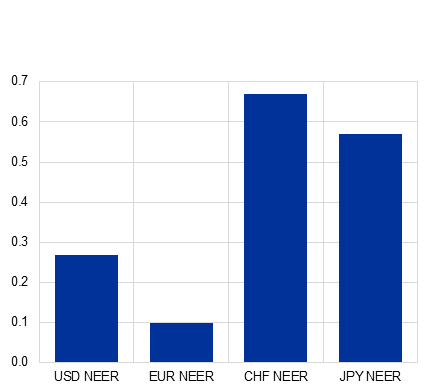
Safe-haven currencies offer refuge to investors during periods of market stress. Global risk-off episodes trigger capital flows into safe-haven assets that are expected to retain value or even appreciate in periods of stress. These portfolio-rebalancing decisions often result in temporary declines in the yields of highly rated sovereign bonds, such as US Treasuries and German Bunds, while safe-haven currencies such as the US dollar, the Swiss franc and the Japanese yen typically appreciate (Chart A, panel a). Historically, the euro effective exchange rate has experienced only modest appreciations during risk-off events compared with other safe-haven currencies (about 0.1%, against almost 0.7% for the Swiss franc).[1]
Chart A
The euro acted as a safe-haven currency on some occasions in 2025 and early 2026
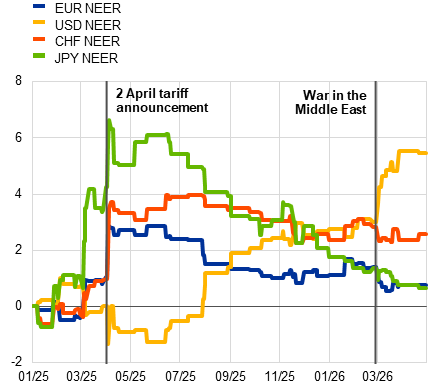
a) Average exchange rate changes over three days after risk-off days between January 2006 and April 2026 | b) Cumulative exchange rate changes on risk-off days between January 2025 and April 2026 |
|---|---|
(percentage points) | (percentage points) |
 |  |
Sources: Haver Analytics and ECB staff calculations.
Notes: Risk-off days are defined as days when changes in the VIX index exceed the 85th percentile of their distribution and the Dow Jones global equity index returns fall below the 15th percentile of their distribution. NEER = nominal effective exchange rate. Panel a) shows the average percentage point changes in NEER over three days after the risk-off days between 1 January 2006 and 30 April 2026. Panel b) shows percentage point changes in NEER on risk-off days, cumulated over all risk-off days between 1 January 2025 and 30 April 2026.
There were signs that the euro behaved like a safe-haven currency during several risk-off events that marked 2025 and early 2026, prone to exchange rate fluctuations driven by sharp shifts in market sentiment (Chart A, panel b). The introduction of tariffs by the US administration on 2 April 2025 triggered high volatility in global financial markets and sizeable appreciations of the euro exchange rate (blue line) alongside traditional safe-haven currencies such as the Swiss franc and the Japanese yen (red and green lines). By contrast, the US dollar exchange rate depreciated (yellow line), while the yields on US Treasury bonds rose – a cross-asset correlation that is atypical for risk-off episodes. Similar patterns emerged in several risk-off events emanating from the United States that punctuated 2025 and early 2026. For instance, following the announcement that the US Department of Justice had issued subpoenas to the Federal Reserve and the US administration’s threats to increase tariffs on European imports amid escalating tensions around Greenland, the US dollar exchange rate depreciated, while the euro, Swiss franc and Japanese yen exchange rates appreciated.[2]
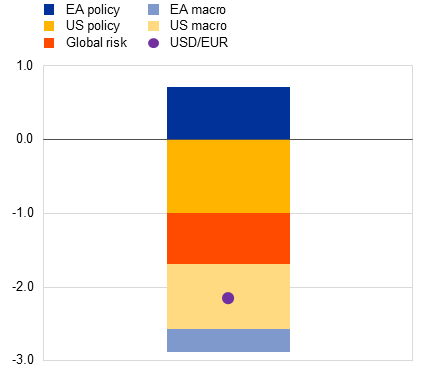
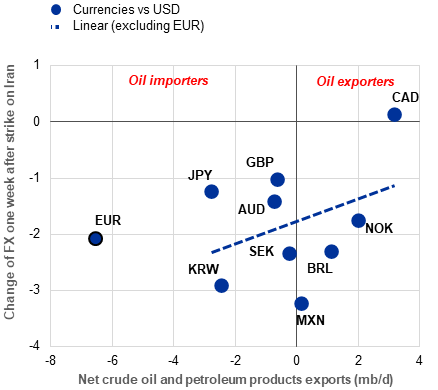
Following the outbreak of the war in the Middle East, the euro initially depreciated, partly reflecting heightened global risk, before reversing some of its initial losses as geopolitical tensions eased. The Swiss franc and the Japanese yen followed similar patterns to the euro, while the US dollar initially appreciated before giving up some of its earlier gains. Global risk factors explain a significant portion of the initial strength of the US dollar relative to the euro, underscoring its continued role as a safe-haven currency (see the purple section of the bar in Chart B, panel a). However, additional factors beyond global risk have also contributed to developments in the US dollar’s exchange rate. Specifically, the United States, as an energy exporter, experienced a positive terms-of-trade shock following the outbreak of the war, while the euro area, as a net energy importer, faced a negative terms-of-trade shock. The resulting divergence in economic outlooks across the two sides of the Atlantic exerted additional downward pressure on the euro. In fact, the broad-based appreciation of the US dollar can be partly attributed to countries’ varying levels of exposure to the energy shock (Chart B, panel b). The euro subsequently regained ground against the US dollar amid an easing of global tensions but remained below pre-war levels. US Treasury International Capital data provide further evidence of the US dollar’s enduring safe-haven status, with strong demand for US assets persisting through most of 2025 and early 2026.[3] However, more recently, the value of US Treasuries held in custody at the New York Federal Reserve by official institutions – a group largely made up of central banks – dropped by USD 82 billion to USD 2.7 trillion in March 2026 – the lowest level since 2012, possibly suggesting shifting dynamics in foreign holdings of US assets.[4]
The euro area can best insulate itself from exchange rate volatility in today’s uncertain global environment by rapidly fostering deeper and more integrated capital markets, thereby advancing the euro’s progress towards becoming a truly global international currency. Currencies that act as safe-haven currencies but are not widely used internationally often face sharp exchange rate movements when market sentiment shifts.[5] Similar to the US dollar, the Japanese yen and the Swiss franc appreciate sharply during crises, as they receive large capital inflows. However, their less deep and liquid underlying capital markets relative to the US dollar can hinder their ability to absorb such inflows smoothly, especially since these flows are volatile and largely driven by global risk aversion rather than confidence in the receiving country. Since April 2025 the euro has occasionally exhibited patterns typical of safe-haven currencies. Going forward, the euro area should foster scale and develop deeper, more liquid capital markets, adhering to an ambitious timetable and putting words into action. This strategy would allow the euro to absorb capital inflows efficiently and channel them into productive investments.[6]
Chart B
The war in the Middle East drives euro exchange rate down amid diverging economic outlooks
a) Drivers of the USD/EUR exchange rate response one week after the outbreak of the war in the Middle East | b) Exchange rate response one week after the outbreak of the war in the Middle East vs net oil exports |
|---|---|
(percentages) | (x-axis: million barrels per day (mb/d); y-axis: percentage change vis-à-vis the US dollar) |
 |  |
Sources: OPEC, ECB and ECB staff calculations.
Notes: One week after the outbreak of the war in the Middle East refers to the period from 27 February to 6 March 2026. Panel a) shows estimates from a two-country BVAR model based on Brandt et al., “What drives euro area financial market developments? The role of US spillovers and global risk”, Working Paper Series, No 2560, ECB, 2021. The endogenous variables include the 10-year euro area OIS rate, euro area stock prices in log changes, USD/EUR exchange rate in log changes, the spread between the 10-year euro area OIS rate and US Treasury bond yield and the US stock prices in log changes. The model is identified using sign restrictions on impact and is estimated using daily data from 1 January 2005 to 30 April 2026. Positive values indicate an appreciation of the euro and positive contributions. Panel b) shows net oil exports, including crude oil and petroleum products, for selected countries in 2024. A negative change in the exchange rate on the y-axis indicates an exchange rate depreciation relative to the US dollar.
Unwinding of carry trade strategies amid increasing volatility may explain some of the appreciation of low-yielding currencies.
Other indicators provide complementary evidence of the stronger global appeal of the euro in a year of elevated volatility. Convenience yields for German bunds (see Box 2, Chart A, panel b) increased in 2025. Meanwhile, purchases of euro area debt and equities by foreign investors increased to multi-year highs by the end of 2025, pointing to solid appetite for euro area financial assets (Chart 12, panel a).
Increased demand from investors in the rest of the world offset net outflows by Japanese and Chinese investors, as well as the modest demand from European investors.
According to data on marketable US Treasury securities held in custody published weekly by Federal Reserve System. See also “Foreign central banks sell US Treasuries in wake of Iran war”, Financial Times, 31 March 2026.
International currencies are used in cross-border transactions to facilitate trade, investment and economic activities between countries and function as a common medium of exchange, a store of value and a unit of account in global markets. The safe-haven status of a currency is not necessarily tied to the international status of the currency. For instance, the US dollar is both a global international currency and a safe-haven currency, whereas the Swiss franc is considered a safe-haven currency but has more limited standing as an international currency.
See Lagarde, C. “Turning openness into strength: the moment of the euro”, speech at Business France event “Business en Européens”, Paris, France, 7 October 2025.