







- THE ECB BLOG
From Grexit to Grecovery: Greece’s path out of the woods – and what still needs to be done
21 March 2026
After a decade of Greek recovery, questions remain: Are banks strong enough to support the economy? What can be done to close the gap in living standards? This post explores Greece’s achievements, challenges and lessons on the path from crisis to recovery, and towards resilience.
Greece stands for one of the worst economic crises and, at the same time, one of the most impressive recoveries in modern European history. As a result of mistakes of the past, in 2010 Greece found itself grappling with a sharp decline in GDP, sky-rocketing unemployment and a surge in public debt. What followed was a decade of painful rebalancing, supported by macroeconomic adjustment programmes and accompanied by inevitable fiscal consolidation and sweeping structural reforms.
Fast forward to today, and the Greek economy is showing remarkable strength. The question is whether Greece has sustainably turned the page on the crisis. The role of its banking system is critical: has its ability to finance the real economy been fully restored? And perhaps most importantly, has Greece transformed its economic growth model enough to ensure improved living standards in line with the rest of the euro area? This blog post assesses the extent of Greece’s economic recovery while highlighting achievements and remaining challenges.[2]
The banking sector is back in business
Greece’s banks have made a remarkable recovery since the crisis of the early 2010s. Back then, they were hit by losses on government bonds, a surge in bad loans and a sharp drop in deposits. Several major measures have turned things around since. Banks have increased their capital and managed a decisive clean‑up of their balance sheets, also supported by strengthened banking supervision.
The establishment of the Hellenic Asset Protection Scheme (HAPS) played a key role, helping banks securitise and sell about €57 billion of non-performing loans (NPLs) by 2025. As macroeconomic conditions stabilised and confidence returned, banks benefited from stronger liquidity, higher profits and better capital positions. Mergers – such as that of Pancreta Bank and Attica Bank – have also contributed to reshaping the sector.
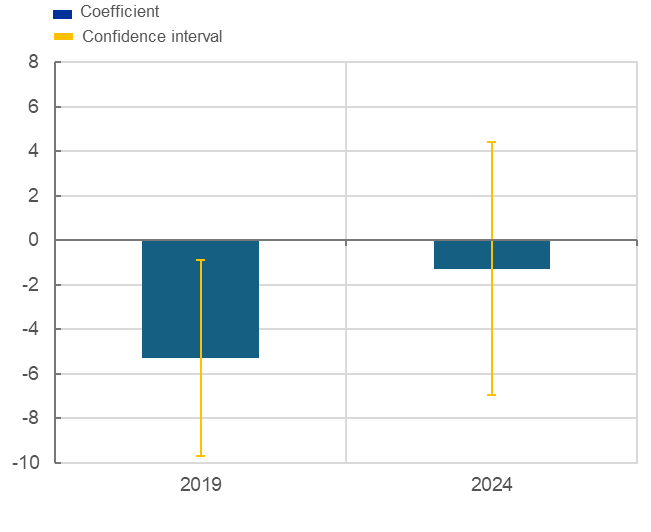
All of this has meant that Greek banks are again able to finance households and businesses, which supports investment. Loans to non-financial corporations have increased markedly and mortgage loans are recovering. Notably, bank lending standards for small and medium-sized enterprises – a backbone of the Greek economy – have eased more strongly than for large corporations, according to the Bank of Greece’s Bank Lending Survey. Empirical evidence based on AnaCredit data – the euro area credit register – shows that by 2024 credit access for micro firms had improved compared with 2019. In fact, while micro firms still received less credit compared with large firms in 2019, that penalty for being very small faded away in 2024 (Chart 1). Still, micro and small firms in Greece – much like their peers elsewhere – continue to face constrained access to finance, due to higher risk perceptions, limited collateral and a higher cost of borrowing.
Chart 1
Access to bank credit by micro firms has improved
(x-axis: firm size and year; y-axis: percentages)
Sources: AnaCredit and own calculations.
Notes: The chart reports the coefficients of a regression of loan growth on firm-size dummies and other controls for micro-sized companies compared with loan growth to large companies. The base dummy is represented by large firms. To assess if credit growth improved over time, two regressions are estimated, one for 2018/19 and one for 2023/24. The AnaCredit dataset employed in the analysis relates to loan-level data from 38 Greek banks’ lending to approximately 38,000 firms, aggregated at the bank-firm level. Firms were classified by size following the EU standard classification of companies. Regressions incorporate bank, industry and location fixed effects, with confidence intervals reported at the 95% level.
Even more encouraging is the fact that that this progress spanned a wide range of industries, signalling a more inclusive recovery. Several factors are likely to have contributed to these positive developments. Greece’s broader economic recovery, coupled with a reduction in risk premia, fuelled demand for credit from micro firms and banks’ willingness to lend to these firms. In addition to stronger bank balance sheets, the Recovery and Resilience Fund further supported credit growth also for smaller firms.
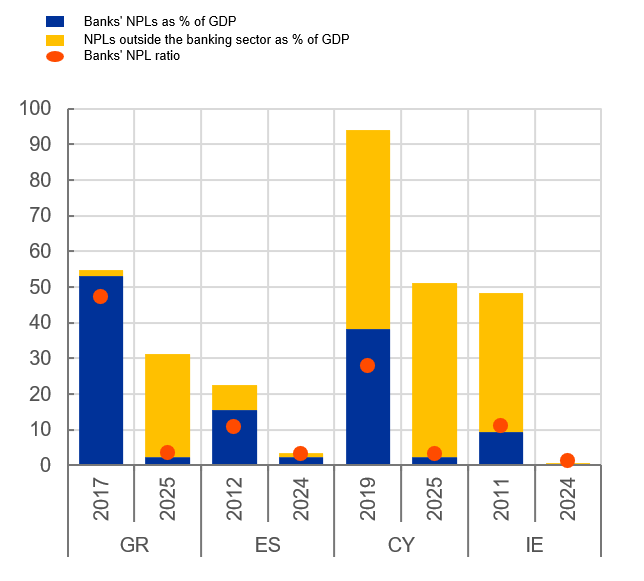
Greece’s banks have made tangible progress in strengthening their balance sheets. However, one consequence is that a large part of the country’s private debt problem now sits outside the banking system. By end-2024, most NPLs had moved to foreign funds under the HAPS and were handled by credit servicing companies. The assets involved are equivalent to about a third of Greece’s GDP. Dealing with this huge amount of distressed loans remains one of the toughest challenges.
To tackle this legacy burden, Greece introduced a new insolvency framework and an electronic auction system. But progress has been slower than hoped for. Structural and institutional hurdles continue to get in the way. Gaps in the auction system and court backlogs make debt enforcement and restructuring a lengthy process. Servicers may also struggle to reach debtors due to incomplete information. As a result, households and firms with unresolved debt remain effectively shut out of bank lending, thus limiting banks’ ability to finance growth.
Addressing these bottlenecks is crucial if Greece wants to fully unlock the potential of its financial sector and support stronger, more sustainable growth. Experience from other crisis-hit countries shows that once large volumes of bad loans move outside their banking system, resolving them becomes a long-term project, without a quick fix (Chart 2).[3] Moreover, while the HAPS has been instrumental in cleaning up bank balance sheets, it's important to note that the state guarantees on these securitisations create a contingent liability for public finances. Should the recovery of a significant portion of these loans fail to perform as expected, the fiscal cost could be substantial, potentially adding pressure to Greece's debt sustainability.
Chart 2
NPLs outside the banking system continue to weigh on the economy
(NPLs in the economy as a share of GDP and banks’ NPL ratios as a share of the total loan portfolio, both as percentages)
Sources: BoG, CBC, BdE and CBI, ECB, Nama.
Notes: The first date for each country corresponds to the first year when NPLs started being transferred outside the banking sector. NPLs outside the banking sector are held by Nama in Ireland, Kedipes in Cyprus, Sareb in Spain, and various loan servicing companies in Greece. Data for Portugal are unavailable. For Ireland, GNI* is used instead of GDP. For 2025, data for Greece and Cyprus refer to September and December, respectively. For Ireland and Spain, data for 2025 for NPLs in Nama and Sareb were not yet available when this blog was published.
What can be done to close the remaining gap in living standards?
Closing the gap between living standards in Greece and the rest of the euro area remains another key challenge. Addressing it requires further changes to Greece’s growth model. The International Monetary Fund projects that, by 2030, Greek GDP per capita (in purchasing power parity) will reach just under 70% of the euro area average – roughly the same as it was when Greece adopted the euro.[4] This is due to past shortcomings – before the crisis, growth had largely been driven by expansionary fiscal policies, private consumption and a housing boom, which absorbed resources but contributed little to long‑term productivity.
Since then, the growth drivers have changed. Housing investment has declined markedly as a share of GDP, making room for more business and infrastructure investment – the kind that strengthens the economy’s productive capacity. Public investment has also picked up significantly since 2020, thanks in part to the roll-out of the Recovery and Resilience Facility.[5] At the same time, exports have become a more prominent engine of growth. And while tourism remains important, goods exports now play a far larger role than they did before the crisis. So, this gradual rebalancing of the economic model bears some fruit already. Whether Greece can continue narrowing the income gap depends on staying the course: keeping investment and exports at the centre of its growth model and building the productivity gains for sustained convergence.
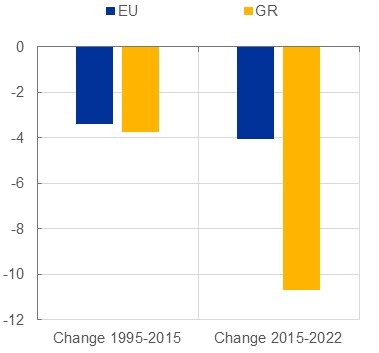
There are signs of a structural improvement in export capacity, supported by a decline in obstacles to trade and structural reforms. Our analysis shows that trade barriers between Greece and other EU countries had fallen by about the same amount as in the EU as a whole in the two decades until 2015 (Chart 3).[6] However, since 2015, they have declined by roughly twice as much, in part reflecting reforms implemented under the adjustment programmes. These included simplifying business licensing, streamlining customs procedures and port operations and reducing regulatory barriers, all of which lowered the cost and time needed to trade.
Chart 3
Greece has achieved significant reductions in barriers to trade with its EU partners
(reduction in estimated trade barriers, in percentage points)
Sources: OECD TiVA 2025 and ECB calculations.
Note: The chart is based on a gravity equation estimated as in Bernasconi et al. (2025) and shows the change in intra-EU trade barriers for the EU and Greece.
In addition, Greece is gradually establishing itself as a player, albeit a small one, in high-technology manufacturing exports.[7] Still, exports – now accounting for more than 35% of GDP compared with around 21% before the crisis – remain concentrated in sectors sensitive to geopolitical developments and global demand shocks, with about half coming from tourism, shipping and energy. Further progress in export diversification with a continued focus on high-technology products will make Greece’s export base more resilient to external shocks and support export growth. That promises to become a key driver for the further convergence of Greek living standards towards the euro area average.
To unlock growth potential and support the catching-up progress, Greece can benefit from policies and reforms that further strengthen competitiveness, investment and innovation. Greece has implemented major reforms to open up labour and product markets and boost competition. More flexible work arrangements, digitalised public services and streamlined business procedures, the Hellenic Cadastre, are some of the key achievements that have helped bring unemployment to record lows and attract investment. But the job isn’t finished. Stronger upskilling and reskilling opportunities, together with expanded childcare access to boost women’s workforce participation, can ease the strain of an ageing population. And as digital technologies, including AI, become central to economic performance, creating the right incentives for innovation and technology adoption is increasingly essential.
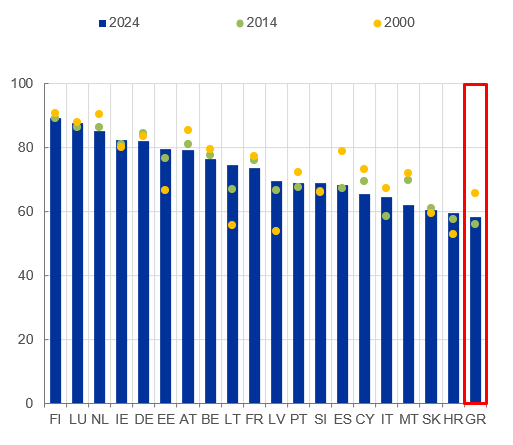
This is where institutional quality – from government effectiveness and regulatory quality to the rule of law and control of corruption – becomes crucial. Greece’s position on the institutional delivery index shows that, despite modest gains over the last decade, there is still significant room for improvement (Chart 4).[8] Institutions play a pivotal role in fostering a dynamic business environment, investment, innovation, and therefore productivity and competitiveness.[9] Recent ECB research also shows that better institutions can have a significant impact on the composition of investment. If Greece manages to lift its institutional quality to the euro area average, it could boost the share of private investment flowing into high‑tech industries by around five percentage points. And if it were to reach the level of the euro area’s top performers, that impact would roughly double – pushing high‑tech investment to about a quarter of all private investment, well above the euro area average.[10]
Chart 4
The quality of economic institutions remains a challenge
(institutional delivery index, score)
Source: World Bank Governance Indicators (2025).
Notes: Scores reflect the average of the four measurable governance indicators: rule of law, regulatory quality, government effectiveness and control of corruption. Higher values indicate better governance. A score of 100 would mean that a country is the global best performer in all four subcategories.
The reforms discussed above are all the more important as crisis legacies continue to burden Greece’s recovery. Public debt has been declining markedly every year since 2021. Most of it consists of debt to EU partners that was incurred during the financial support programmes.[11] These loans were provided at concessional interest rates and long maturities, which reduce annual financing needs and rollover risks and Greece has quietly built one of the strongest debt‑repayment stories in Europe. Further programme-related repayments to EU official creditors are ongoing, but the sheer size of what remains, at around 90% of GDP in 2025, means the journey is not yet over (Chart 5).
Chart 5
Greece is repaying its debt to official EU creditors rapidly, but a significant share remains outstanding
(status at end-2025; x-axis: loans in percentage of 2025 GDP)
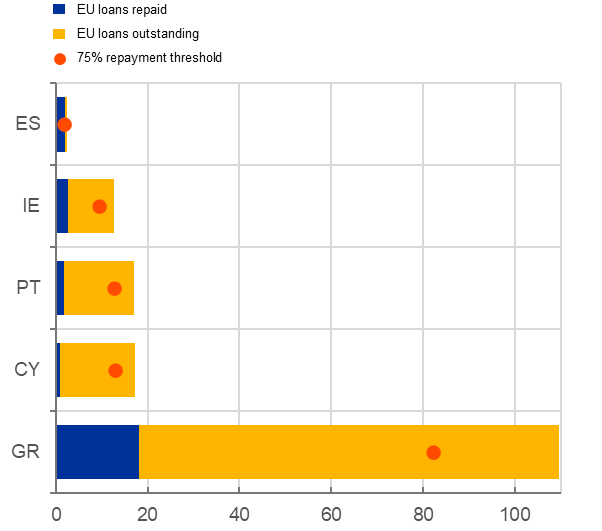
Sources: ESM, European Commission.
Notes: Spain is the only country that has by now surpassed the 75% repayment threshold. For Ireland, GNI* is used instead of GDP.
Conclusion
Greece’s recovery from its financial crisis has been a challenging and transformative journey. The country has achieved a remarkable rebound in economic activity and addressed several of its key crisis legacies such as banks’ NPLs, while its public debt has declined impressively. Greek banks have significantly improved their resilience.
But some crisis legacies remain. Though banks’ intermediary capacity has been largely restored, the pace of resolution of NPLs outside the banking system remains slow. This is due to obstacles to debt restructuring and enforcement, largely related to complicated and lengthy judicial procedures. Still high public debt, institutional quality weaknesses and lagging labour market participation and productivity also suggest that Greece's recovery is still a work in progress.
Ultimately, while Greece has made impressive strides forward, fully turning the page will require sustained reforms, a focus on sustainable growth, and careful management of external risks, especially in the current environment of geopolitical and trade uncertainty.
The views expressed in each blog entry are those of the author(s) and do not necessarily represent the views of the European Central Bank and the Eurosystem.
Check out The ECB Blog and subscribe for future posts.
For topics relating to banking supervision, why not have a look at The Supervision Blog?
With a contribution by Alessio Reghezza.
This blog post does not assess the role of the macroeconomic adjustment programmes or their implementation. Instead, it focuses on longer-term economic developments in Greece and takes stock of improvements and remaining challenges.
For a discussion on the substantial improvements over the last decade in the economic situation of countries which underwent adjustment programmes, see Filip, M.D., Masuch, K., Setzer, R. and Valenta, V. (2024), “Greece, Ireland, Portugal and Cyprus: Crisis and Recovery”, The ECB Blog, 3 December.
IMF (2025), World Economic Outlook, October.
See Haroutunian, S., Nerlich, C., Rodríguez-Vives, M. and Schauhoff, C. (2026), “Enhancing efficiency in public investment in times of fiscal constraint”, Economic Bulletin, Issue 2 (forthcoming), ECB.
See Bernasconi, R., Cordemans N., Gunnella V., Pongetti G. and Quaglietti L. (2025), “What is the untapped potential of the EU Single Market?”, Economic Bulletin, Issue 8, ECB.
Based on World Bank data on high-technology exports. As a share of total manufactured exports, high-tech increased from 8% in 2013 to 15% in 2024. For the EU, this share was 16% in 2013 and 20% in 2024.
See also Masuch, K., Moshammer, E. and Pierluigi, B. (2017), “Institutions, public debt, and growth in Europe”, Public sector economics, 41(2), pp. 159-205.
Filip, M.D., Momferatou, D. and Parraga Rodriguez, S. (2025), “European competitiveness: the role of institutions and the case for structural reforms”, Economic Bulletin, Issue 1, ECB.
Results use as a starting point the investment shares in 2021, based on EU KLEMS data. See Bothner J., Lopez-Garcia P., Momferatou D. and Setzer, R. (2026), “Why is Europe Lagging Behind in High Tech Sectors? The Role of Institutional and Regulatory Quality”, Working Paper, No 3185, ECB.
Greece concluded the third and final adjustment programme in 2018 and, after four subsequent years under enhanced surveillance, moved on to post-programme surveillance in 2022, joining Cyprus, Ireland, Portugal and Spain. Debt to EU partners refers to loans from the European Financial Stability Facility and the European Stability Mechanism (ESM). All former programme countries, including Greece, have now fully repaid the IMF.