


The ECB Survey of Professional Forecasters - Second quarter of 2026
Summary
In the ECB’s Survey of Professional Forecasters (SPF) for the second quarter of 2026, headline HICP inflation expectations were markedly revised upwards from the previous round for 2026 and, to a lesser extent, for 2027, while remaining unchanged for the longer term. Expectations for core inflation, as measured by the HICP excluding energy and food (HICPX), were also revised upwards in the near term.[1]
Headline inflation was expected to increase from 2.1% in 2025 to 2.7% in 2026 before declining to 2.1% in 2027 and 2.0% in 2028 (see Table 1). Longer-term HICP inflation expectations (for 2030) were unchanged at 2.0%. HICPX was expected to stand at 2.2% in 2026 and 2027, and at 2.1% in 2028, with an upward revision of 0.2 percentage points for 2026 and 2027 and an upward revision of 0.1 percentage points for 2028. A special question related to the war in the Middle East suggested limited expected indirect and second-round effects, which were concentrated in 2026 and 2027. Respondents expected real GDP growth of 1.0% in 2026, and 1.3% in 2027, 2028 and 2030. These figures imply a downward revision of 0.2 and 0.1 percentage points for 2026 and 2027 respectively, but expectations remain unchanged thereafter. Unemployment rate expectations were unchanged. For inflation, uncertainty increased and the balance of risks became slightly tilted to the upside.
Table 1
Results of the SPF in comparison with other expectations and projections
(annual percentage changes, unless otherwise indicated)
Survey horizon | ||||
|---|---|---|---|---|
2026 | 2027 | 2028 | Longer term1) | |
HICP inflation | ||||
Q2 2026 SPF | 2.7 | 2.1 | 2.0 | 2.0 |
Previous SPF (Q1 2026) | 1.8 | 2.0 | 2.1 | 2.0 |
ECB staff macroeconomic projections (March 2026) | 2.6 | 2.0 | 2.1 | - |
Consensus Economics (April 2026) | 2.1 | 1.9 | 1.9 | 1.9 |
HICP inflation excluding energy, food, alcohol and tobacco | ||||
Q2 2026 SPF | 2.2 | 2.2 | 2.1 | 2.0 |
Previous SPF (Q1 2026) | 2.0 | 2.0 | 2.0 | 2.0 |
ECB staff macroeconomic projections (March 2026) | 2.2 | 1.9 | 2.0 | - |
Consensus Economics (April 2026) | 2.1 | 2.0 | - | - |
Real GDP growth | ||||
Q2 2026 SPF | 1.0 | 1.3 | 1.3 | 1.3 |
Previous SPF (Q1 2026) | 1.2 | 1.4 | 1.3 | 1.3 |
ECB staff macroeconomic projections (March 2026) | 0.9 | 1.3 | 1.4 | - |
Consensus Economics (April 2026) | 1.2 | 1.4 | 1.4 | 1.3 |
Unemployment rate2) | ||||
Q2 2026 SPF | 6.3 | 6.2 | 6.1 | 6.1 |
Previous SPF (Q4 2025) | 6.3 | 6.2 | 6.1 | 6.1 |
ECB staff macroeconomic projections (March 2026) | 6.3 | 6.3 | 6.2 | - |
Consensus Economics (April 2026) | 6.2 | 6.1 | - | - |
Wage growth | ||||
Q2 2026 SPF | 3.3 | 3.1 | 2.9 | 2.8 |
Previous SPF (Q1 2026) | 3.0 | 2.9 | 2.8 | - |
ECB staff macroeconomic projections (March 2026) | 3.4 | 3.2 | 3.1 | - |
Consensus Economics (April 2026) | 2.9 | 2.8 | - | - |
1) Longer-term expectations refer to 2030.
2) As a percentage of the labour force.
Box 1
Assessment of the expected impacts of the war in the Middle East
In this round, SPF respondents were asked special questions relating to the impact of the war in the Middle East. First, they were asked to indicate, for each calendar year horizon from 2026 to 2030, the impact of the war on their baseline expectations for headline inflation, core inflation and wage growth, and whether it represented an upside, balanced or downside risk to those baseline projections.[2] Second, they were asked to assign probabilities to alternative scenarios around their own baseline forecast: a mild, adverse and a severe scenario. Third, they were asked how long they expected related disruptions to fuel prices, supply chains and other channels, to last.[3] Chart A (panel a) provides an overview of the expected impacts on core inflation and wage growth, in terms of baseline expectations.
Indirect and second-round effects arising from the Middle East conflict are expected to be contained, as suggested by the relatively limited impacts reported for baseline core inflation and wage growth forecasts. Forecasters also see these effects to be relatively short-lived and concentrated in 2026 and 2027. The impact of the war in the Middle East on core inflation was reported to amount to around 0.2 percentage points in 2026, with some positive but small effects persisting into 2028. The effect on wage growth was estimated to be more limited at around 0.1 percentage points, being slightly more prominent in 2027. These effects were considered to be more persistent than in the case of headline inflation, where qualitative answers suggested a more pronounced but more rapidly fading reaction. Respondents also reported that the war was seen mainly as an upside risk for inflation, as well as for wage growth.
Chart A
Estimated impacts of the war in the Middle East on core inflation and wage growth baseline forecasts, and probabilities attached to alternative scenarios
a) Impact of the war in the Middle East | b) Probabilities attached to the scenarios |
|---|---|
(left-hand scale: percentage points; right-hand-scale: percentages) | (percentages) |
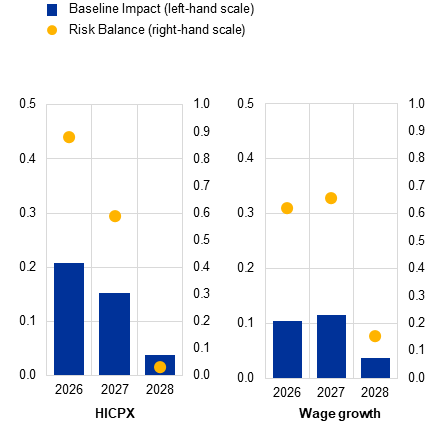 | 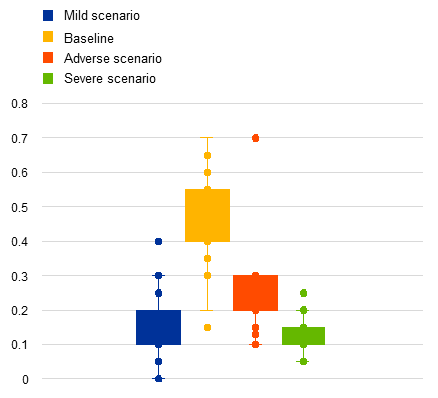 |
Notes: In panel a), the chart plots the estimated impact of the war in the Middle East on the baseline forecast for core inflation (left-hand scale) and wage growth (right-hand scale) (in blue), together with the risk balance (in yellow). In panel b), the boxplots show the distribution of probabilities assigned by respondents to scenarios relative to their own baseline forecast. The box denotes the interquartile range, the line the median, the “x” the mean, and the dots the individual responses.
For the second question, respondents attached the highest probability (around 50%) to their baseline forecast, around 25% to an adverse scenario, 10% to a severe scenario and around 15% to a mild scenario (Chart A, panel b). Respondents expected the conflict to last around two to three months on average, with longer supply disruptions of around six to nine months on average. Disagreement about the duration of the conflict was relatively limited (despite a few outliers) and was more pronounced in the case of expected supply disruptions.
1 Headline HICP inflation expectations revised upwards in the near term, while longer-term expectations remained close to 2%
SPF respondents’ headline inflation expectations were markedly revised upwards for 2026 and, to a lesser extent, for 2027, while remaining close to 2.0% for the longer term. HICP inflation was expected to stand at 2.7% in 2026 before decreasing to 2.1% in 2027 and further to 2.0% in 2028 and 2030. Compared with the previous round (conducted in the first quarter of 2026), revisions were concentrated in the near term, reflecting mainly the onset of the war in the Middle East and the associated energy price shock. Some respondents also mentioned possible indirect and second-round effects through wages, transport and food prices. At the same time, weak demand, the appreciation of the euro and the redirection of Chinese exports to the euro area were seen as dampening inflationary pressures. Compared with the March 2026 ECB staff macroeconomic projections, headline inflation expectations in this SPF round were in line for 2026, higher for 2027 and slightly lower for 2028 (Chart 1 and Table 1).
Chart 1
Inflation expectations: HICP inflation
(annual percentage changes)
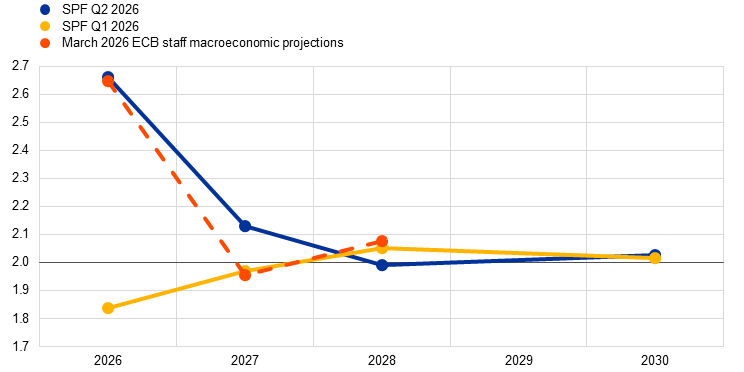
Chart 2
Inflation expectations: HICP inflation excluding energy and food
(annual percentage changes)
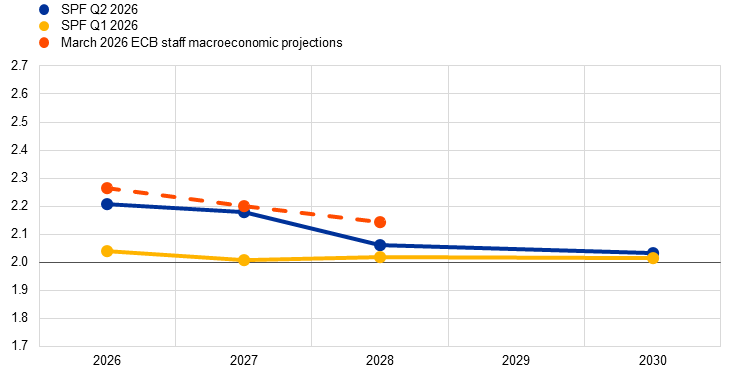
SPF expectations for inflation excluding energy and food (HICPX) were revised upwards for 2026 and 2027, while remaining close to 2% in 2028 and 2030. HICPX inflation expectations stood at 2.2% for 2026 and 2027, before declining to 2.1% in 2028 and 2.0% in 2030. Compared with the previous round, this implied an upward revision for the coming three years, while longer-term expectations remained at 2%. Based on respondents’ comments, the energy shock was expected to pass through to core inflation only partly, particularly through services and transport-related items, although views differed on the size and persistence of the effects. Tight labour markets and possible second-round effects via wages were cited as factors that could keep services inflation elevated, while still subdued goods price pressures were expected to help contain underlying inflation in the longer term. SPF forecasts for HICPX were broadly in line with the March 2026 ECB staff macroeconomic projections, i.e. slightly lower for 2026 and 2028 (Chart 2).
Chart 3
Term structure of inflation expectation
(annual percentage changes)
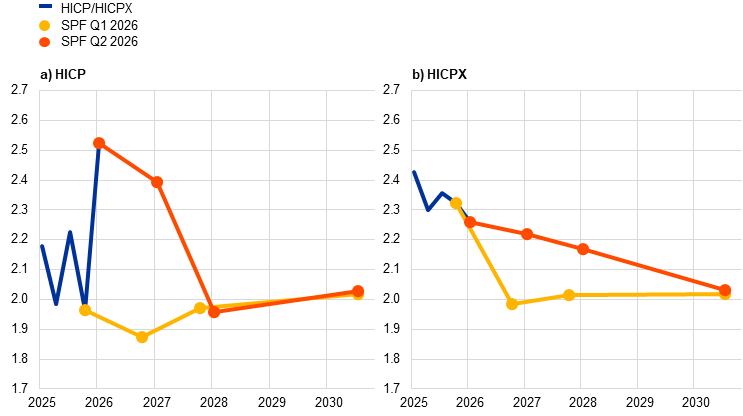
Note: The chart plots the term structure of inflation expectations: one-year ahead, two-years ahead and longer-term expectations.
The ‘term structure’ of both HICP and HICPX inflation expectations changed in the round conducted in the second quarter of 2026, reflecting higher near-term inflation (Chart 3). For headline HICP inflation, the rolling horizon expectations for 12 months ahead of the latest available data rose markedly compared with the previous rounds, before declining to around 2.0% at horizons of 24 months and beyond. For HICPX inflation, the term structure also shifted upwards, less sharply but with a less rapid return to 2%, with an upward revision visible 24 months ahead as well.
Chart 4
Main factors cited by respondents in qualitative comments on the inflation outlook and risks
(percentages)
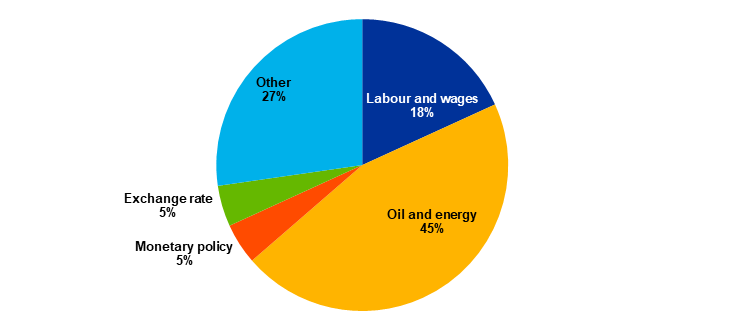
Notes: The qualitative answers of the forecasters are first decomposed into noun phrases, which are then mapped to various factors using a dictionary-based approach. Each response is then assigned to the factor occurring most frequently across its noun phrases. Where no factor can be identified, the response is classified as “Other”. The pie chart shows the share of responses assigned to each factor.
Oil and energy were the most cited factors in respondents’ qualitative remarks on the main drivers of changes in their baseline inflation outlook, the risks around that outlook and any alternative scenarios related to the war in the Middle East. According to the qualitative remarks, upside risks to inflation including geopolitical developments, especially the war in the Middle East and the risk of continued disruption around the Strait of Hormuz, the associated path of oil, gas and other commodity prices, possible supply chain bottlenecks and trade policy uncertainty were the main factors mentioned as sources of uncertainty (Chart 4). Labour and wages were the next most frequently cited factor, while monetary policy and the exchange rate were mentioned less often.
2 Longer-term inflation expectations remain well anchored
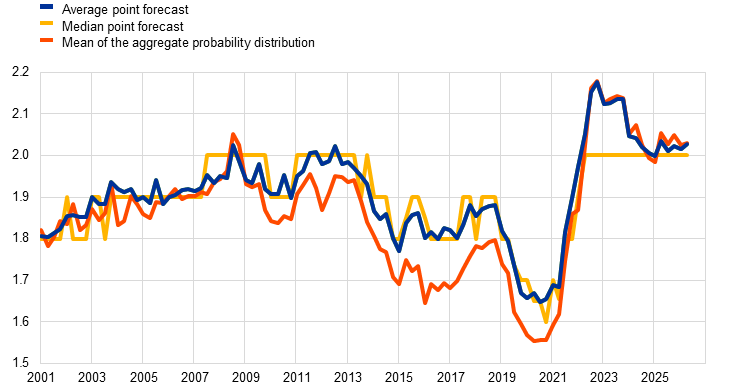
Longer-term inflation expectations were unchanged at 2.0% with most respondents continuing to see headline inflation at 2.0% in 2030.[4] The modal and median values of the distribution of individual point forecasts were also unchanged at 2.0% (Chart 5). For the tenth consecutive round, more than half of the respondents reported longer-term inflation expectations of 2.0%.
Chart 5
Longer-term inflation expectations
(annual percentage changes)
3 Real GDP growth expectations revised downwards for 2026 and 2027 owing to the expected negative impact of the war in the Middle East
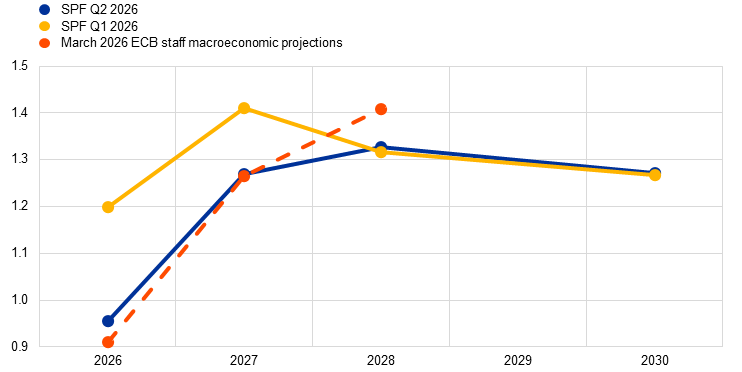
GDP growth expectations stood at 0.9% for 2026, 1.4% for 2027 and 1.3% for 2028 (Chart 6). Compared with the previous round, these figures imply downward revisions of 0.3 and 0.1 percentage points for 2026 and 2027 respectively, while the outlook for the later years remained broadly unchanged. These calendar year figures are in line with those in the March 2026 ECB staff macroeconomic projections for 2026 and 2027, and 0.1 percentage points lower for 2028. The longer-term growth expectations (referring to 2030) were unchanged at 1.3%.
Chart 6
Expectations for real GDP growth
(annual percentage changes)
The downward revisions to euro area growth expectations for 2026 and 2027 were in line with the expected negative impact of rising energy prices due to the war in the Middle East. The GDP outcome for the fourth quarter of 2025 was in line with the expectations in the previous round. The baseline paths differed somewhat across respondents, potentially reflecting differences in available information as some provided their forecasts before the announcement of a ceasefire on 8 April (which has again been in question since then). The respondents who provided qualitative comments mentioned the impact of temporary higher energy prices with differing durations, but in general did not include the effects of longer-term supply disruptions resulting from the destruction of energy infrastructure in the Middle East and a prolonged blockage of the Strait of Hormuz. Some respondents expect fiscal policy responses, including continued investment in defence and infrastructure, to mitigate the shock, but expect the capacity of public finances to be more limited now than at the start of the Russian invasion of Ukraine. Trade tensions continue to be mentioned as dampening the growth outlook. Two respondents mentioned a tightening of financial conditions.
The quarterly profile for the next quarters has shifted downwards (Chart 7). Following the realised growth rate of 0.2% quarter-on-quarter seen in the fourth quarter of 2025, which was in line with expectations in the SPF conducted in the first quarter of 2026, respondents expect a continuation of quarterly growth at this rate of 0.2% in the first quarter of 2026, weakening slightly in the second quarter before strengthening somewhat to 0.3% in the third and fourth quarters. The quarterly SPF growth expectations are 0.1 percentage points below the latest ECB projections for the first quarter of 2026 and broadly in line thereafter. Compared with the previous round, the share of SPF forecasters that expected at least one quarter of negative growth over the next four quarters increased to 7% from 4% in the previous round, and no one expected a technical recession (i.e. two consecutive quarters of negative growth) over the period.
Chart 7
Expected profile of quarter-on-quarter GDP growth
(quarter-on-quarter percentage changes)
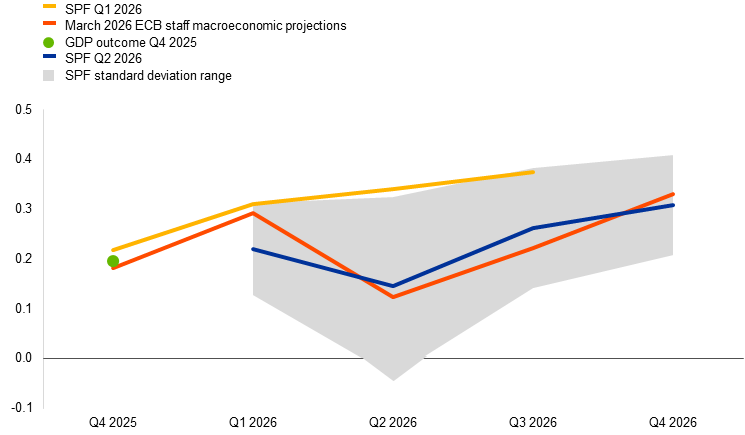
Notes: Seasonally adjusted data. The shaded area denotes one standard deviation around the mean of the individual SPF expectations in the survey round conducted in the second quarter of 2026.
Risks were assessed to be on the downside, related mostly to a further escalation of the war and an associated increase in uncertainty and inflation which would dampen private consumption and corporate investment. Furthermore, some respondents mentioned the risk that increasing supply bottlenecks for energy goods and other commodities would subdue growth and, in some cases, make certain industries in Europe unsustainable. Others referred to the risk of an intensification of global trade tensions and the related diversion of trade from China to Europe as a further downside risk to growth. Finally, two respondents mentioned that monetary tightening to mitigate the inflation impact could further dampen economic activity. Only few respondents mentioned potential upside risks, related to stronger-than-expected fiscal stimulus, productivity gains from AI and a quick recovery in global trade.
4 Joint revisions in inflation and growth expectations point to an inflationary and growth-dampening shock of limited duration
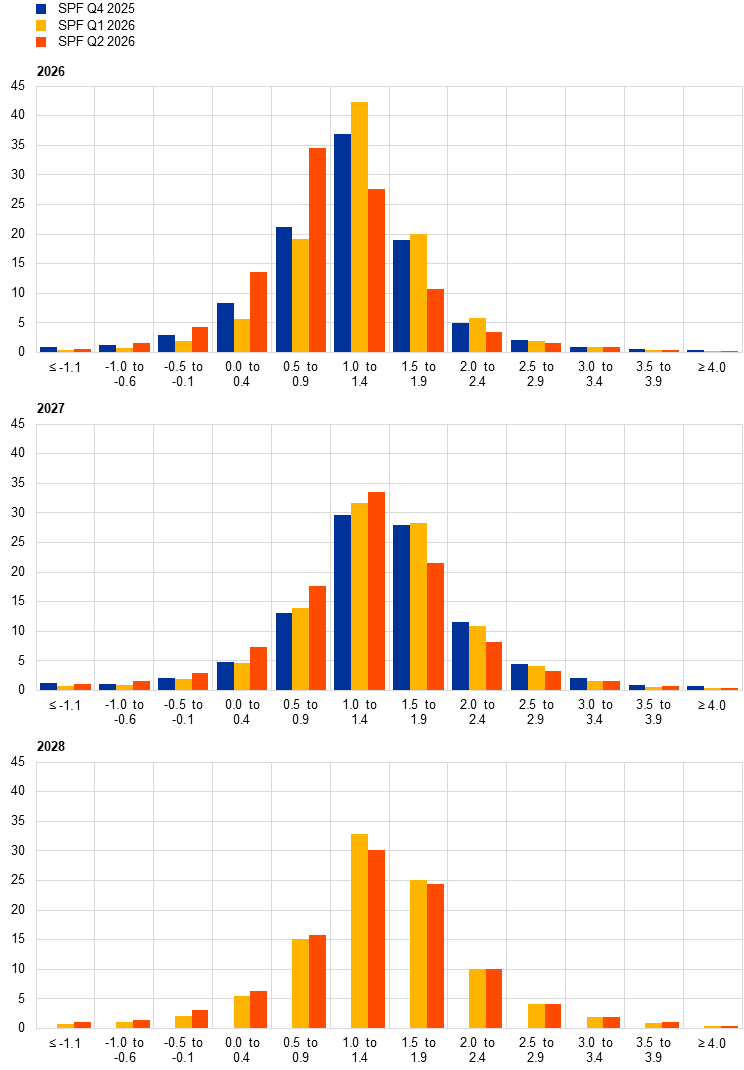
SPF respondents revised their near-term inflation expectations upwards and their near-term growth expectations downwards, but these revisions are smaller than those made during Russia’s war on Ukraine (Charts 8 and 9). Taken together, the charts suggest that both Russia’s war on Ukraine and the recent conflict in the Middle East were perceived as inflationary and growth-dampening shocks, with inflation expectations shifting higher and growth expectations moving lower. That said, the most recent episode appears to have been more contained. It is worth noting, however, that in 2022, the euro area was still benefiting from strong pent-up demand following the post-pandemic reopening. This is also supported by Charts A1 and A4 in the Annex, which show the distribution of one-year-ahead inflation expectations shifting to the right and that of one-year-ahead GDP growth shifting to the left, consistent with a supply shock that raises inflation while weighing on growth. Forecasters also appear to expect the shock to fade relatively quickly, with more notable effects in 2026 than in 2027.
Chart 8
Inflation and GDP growth expectations around one year ahead
(annual percentage changes)
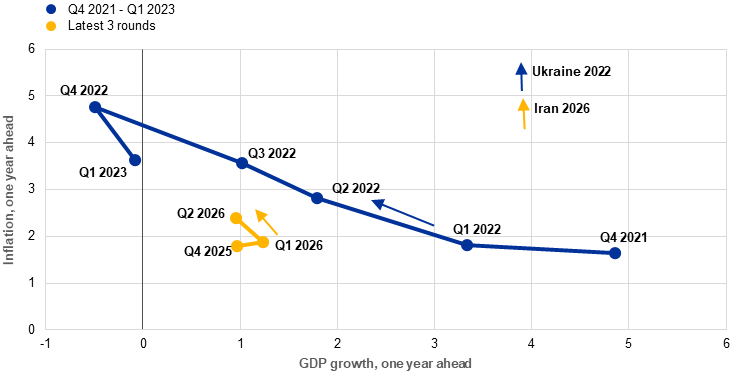
Chart 9
Inflation and GDP growth expectations around two years ahead
(annual percentage changes)
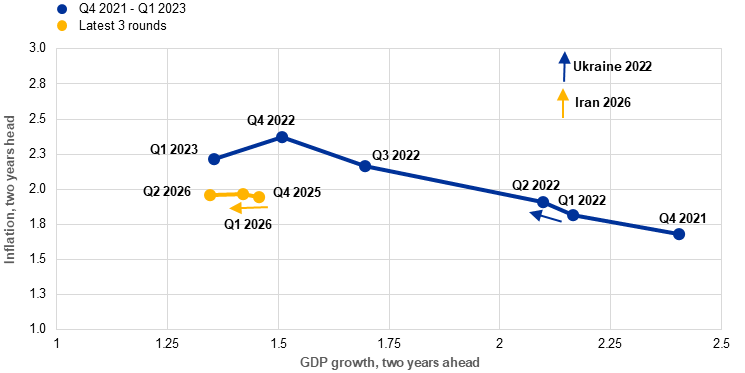
5 Unemployment rate expectations mostly unchanged
The average point forecast for the unemployment rate was 6.3% for 2026, 6.2% for 2027 and 6.1% for 2028. The expected trajectory of the unemployment rate was essentially unchanged (Chart 10). The SPF expectations are in line with the March 2026 ECB staff macroeconomic projections for this year, and less than 0.1 percentage points lower for 2027 and 2028. The long-term unemployment rate expectation for 2030 was 6.1%, slightly revised downward at the second decimal from the previous round.
Chart 10
Expectations for the unemployment rate
(percentages of the labour force)
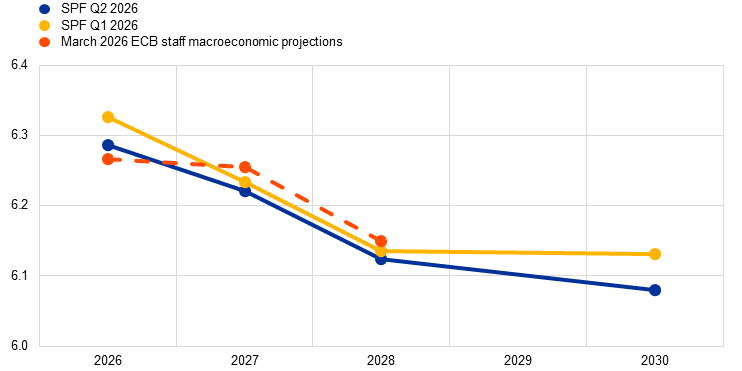
Forecasters generally expect the euro area labour market to remain resilient, with only limited and temporary effects from the Middle East conflict. Most respondents highlight that structural forces – demographics, labour hoarding and persistent shortages – continue to support employment, even as weaker growth and rising uncertainty led some to revise unemployment expectations slightly upward. Risks remain two sided: faster AI-driven reallocation, higher production costs and a more persistent conflict could push unemployment higher, while strong labour demand, government support and firms’ preference to cut hours rather than jobs could limit the impact. Overall, unemployment is still projected to stay close to current levels in the coming years.
6 Expectations for other variables
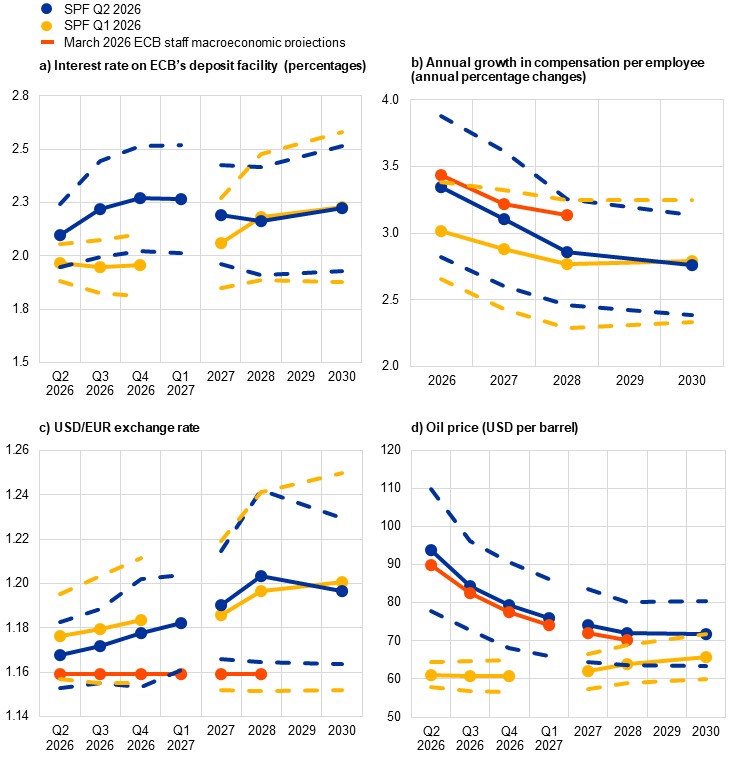
Regarding expectations for the ECB’s DFR (deposit facility rate), the near-term distribution shifted upwards compared with the previous round (see Chart 11, panel a). While virtually no respondent had expected a rate of 2.25% or higher in the previous SPF round, this share rose to around one-third for the second quarter of 2026, over one-half for the third quarter of 2026 and almost two-thirds for fourth quarter of 2026 in the current round. As such, despite the modal expectations staying at 2%, the average DFR expectations got closer to 2.25% for the remainder of 2026 and for 2027. For 2028 and 2030, the modal expectation again remained at 2.0%, while around half of respondents for 2028 and close to 60% for 2030 expected the DFR to be 2.25% or higher. Compared to the previous round, expectations for 2030 stayed roughly at the same level.
Nominal wage growth was revised up for 2026 and 2027 and was expected to decline gradually over the forecast horizon. Expectations for the annual growth in compensation per employee stood at 3.3% in 2026, 3.1% in 2027, 2.9% in 2028 and just below 2.8% in 2030 (Chart 11, panel b). Compared with the previous round, the current profile shifted up by 0.3 percentage points for 2026, by 0.2 percentage points for 2027 and 0.1 percentage points for 2028. These wage growth expectations are 0.1 percentage points lower than the March 2026 ECB staff macroeconomic projections for 2026 and 2027, and 0.2 percentage points lower for 2028.
The forecasters also expected the euro to appreciate very slightly against the dollar from 1.17 in the first quarter of 2026 to 1.18 in the first quarter of 2027, and further to 1.20 in 2028 and 2030. For 2026 expectations have shifted downwards slightly compared to the previous survey but continue implying a slight further appreciation in the coming years and are broadly similar for 2027-2030. They are higher than the random walk assumption of 1.16 embedded in the March 2026 MPE (Chart 11, panel c).
USD oil prices were expected to stand at around USD 94 per barrel in in the second quarter of 2026, implying a sharp increase from the previous round. The expected level of oil prices in USD was revised up markedly over the whole horizon, with the largest upward revision in the near term, and a gradual decline thereafter (Chart 11, panel d). Compared with the March 2026 ECB staff macroeconomic projections, the level was slightly higher across all horizons.
Chart 11
Expectations for other variables
Annex
Chart A1
Aggregate probability distributions for expected inflation in 2026, 2027 and 2028
(x-axis: HICP inflation expectations, annual percentage changes; y-axis: probability, percentages)
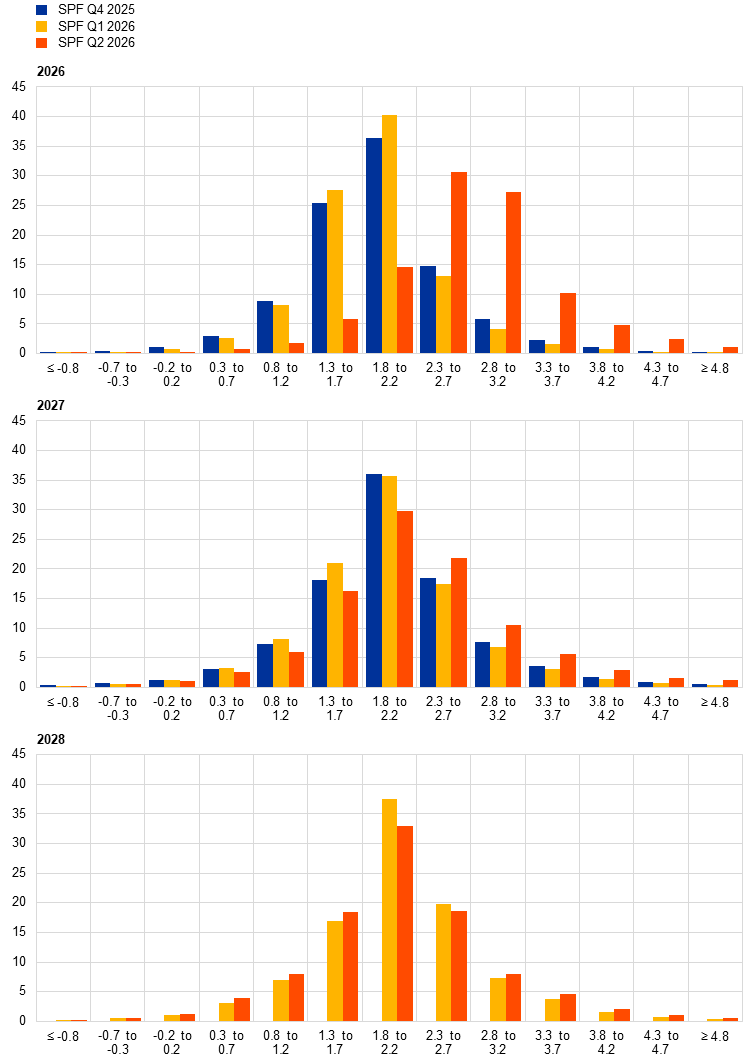
Notes: The SPF asks respondents to report their point forecasts and to separately assign probabilities to different ranges of outcomes. This chart shows the average probabilities assigned to different ranges of inflation outcomes in 2026, 2027 and 2028.
Chart A2
Distribution of point expectations for HICP inflation in the longer term
(x-axis: longer-term HICP inflation expectations, annual percentage changes; y-axis: percentages of respondents)
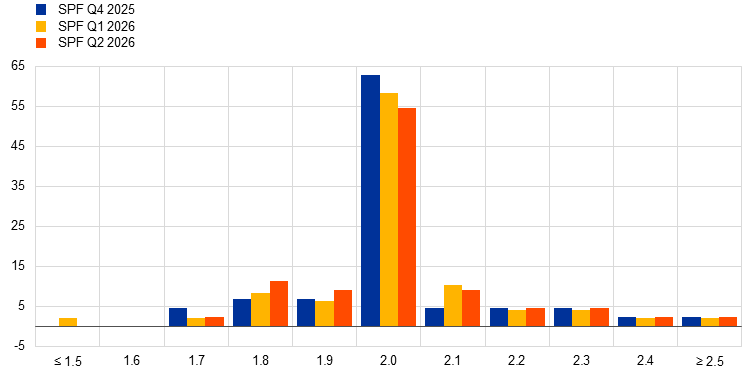
Notes: The SPF asks respondents to report their point forecasts and to separately assign probabilities to different ranges of outcomes. This chart shows the spread of point forecast responses. Longer-term expectations refer to 2030.
Chart A3
Aggregate probability distribution for longer-term inflation expectations
(x-axis: HICP inflation expectations, annual percentage changes; y-axis: probability, percentages)
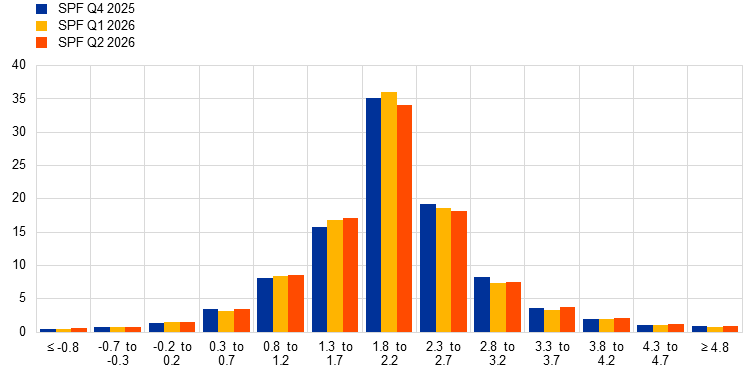
Notes: The SPF asks respondents to report their point forecasts and to separately assign probabilities to different ranges of outcomes. This chart shows the average probabilities assigned to different ranges of inflation outcomes in the longer term. Longer-term expectations refer to 2030.
Chart A4
Aggregate probability distributions for GDP growth expectations for 2026, 2027 and 2028
(x-axis: real GDP growth expectations, annual percentage changes; y-axis: probability, percentages)
Notes: The SPF asks respondents to report their point forecasts and to separately assign probabilities to different ranges of outcomes. This chart shows the average probabilities assigned to different ranges of real GDP growth outcomes in 2026, 2027 and 2028.
Chart A5
Aggregate probability distributions for longer-term GDP growth expectations
(x-axis: real GDP growth expectations, annual percentage changes; y-axis: probability, percentages)
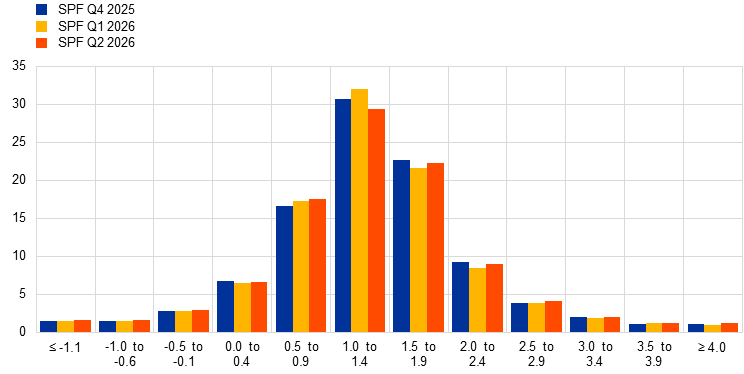
Notes: The SPF asks respondents to report their point forecasts and to separately assign probabilities to different ranges of outcomes. This chart shows the average probabilities assigned to different ranges of real GDP growth outcomes in the longer term. Longer-term expectations refer to 2030.
Chart A6
Aggregate probability distributions for the unemployment rate in 2026, 2027 and 2028
(x-axis: unemployment rate expectations, percentages of the labour force; y-axis: probability, percentages)
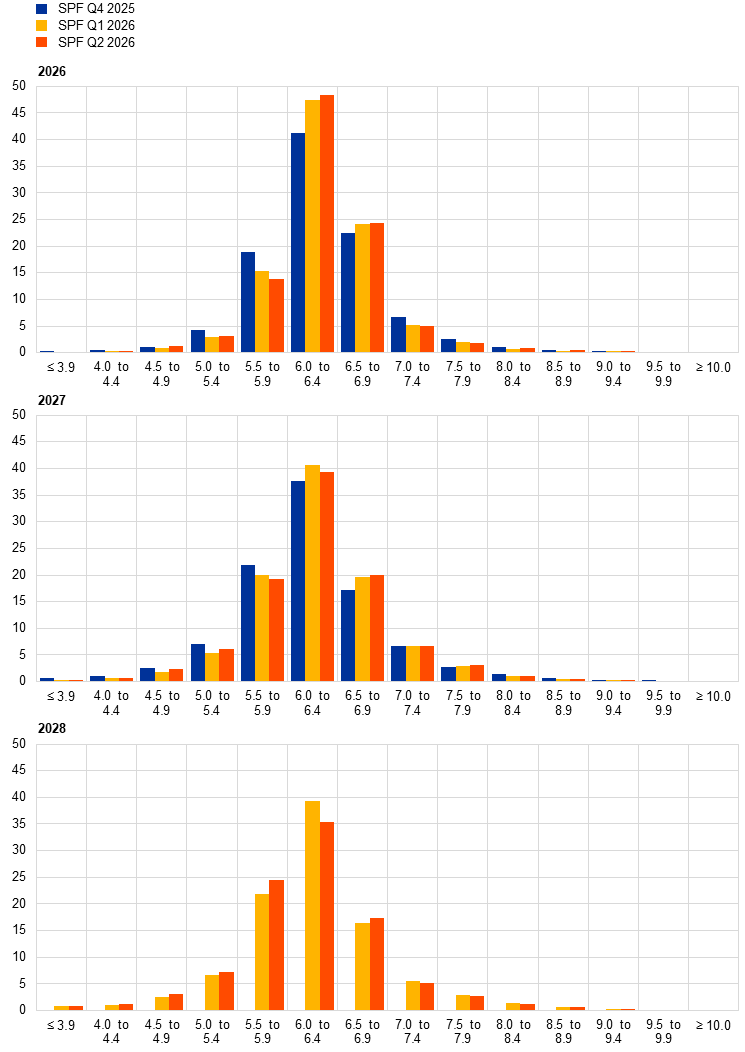
Notes: The SPF asks respondents to report their point forecasts and to separately assign probabilities to different ranges of outcomes. This chart shows the average probabilities assigned to different ranges of unemployment rate outcomes for 2026, 2027 and 2028.
Chart A7
Aggregate probability distribution for the unemployment rate in the longer term
(x-axis: unemployment rate expectations, percentages of the labour force; y-axis: probability, percentages)
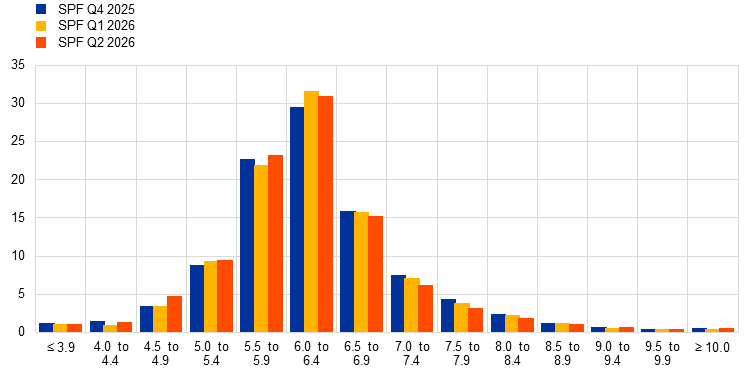
Notes: The SPF asks respondents to report their point forecasts and to separately assign probabilities to different ranges of outcomes. This chart shows the average probabilities assigned to different ranges of unemployment rate outcomes in the longer term. Longer-term expectations refer to 2030.
© European Central Bank, 2026
Postal address 60640 Frankfurt am Main, Germany
Telephone +49 69 1344 0
Website www.ecb.europa.eu
All rights reserved. Reproduction for educational and non-commercial purposes is permitted provided that the source is acknowledged.
For specific terminology please refer to the ECB glossary (available in English only).
PDF ISBN 978-92-899-7653-4, ISSN 2363-3670, doi:10.2866/9661670, QB-01-26-047-EN-N
HTML ISBN 978-92-899-7652-7, ISSN 2363-3670, doi:10.2866/0194172, QB-01-26-047-EN-Q
The survey requested expectations for the HICP inflation rate (overall and excluding energy and food), the real GDP growth rate and the unemployment rate in the euro area for 2026, 2027, 2028 and 2030 (all annual averages), as well as one and two years ahead of the latest available data point (year-on-year rates for inflation and GDP growth). Participants were provided with a common set of the latest available data for annual HICP inflation (March 2026: overall inflation, 2.5%; core inflation, 2.3%), annual GDP growth (fourth quarter of 2025, 1.2%) and unemployment (February 2026, 6.2%).
Respondents could choose seven responses: 0 denoting < |0.1|; + ≈ 0.1 p.p.; ++ = 0.2 to 0.3 p.p.; +++ ≥ 0.4 p.p.; - ≈ -0.1 p.p.; - - = -0.2 to -0.3 p.p.; - - ≤ -0.4 p.p. For the question on risks, respondents were asked to select up/balanced/down depending on whether they considered that the factor represented an upside/balanced/downside risk to their baseline expectations.
The response rate to these was around 80% (45 out of 56) for Special Question 1 and 60% for Special Questions 2 and 3. This compares very favourably with response rates for previous special questions. This number should also be large enough to minimise sampling error as highlighted in the report published by the ESCB Expert Group on Inflation Expectations in 2021.
Of a balanced panel of 41 respondents who also replied in the survey in the first quarter of 2026, three-quarters (31) left their long-term inflation expectations unchanged, three respondents revised them downwards and seven upwards. The portion reporting 2.0% decreased slightly to 55% (from 58% previously).
-
4 May 2026