


- PRESS RELEASE
Euro area monthly balance of payments: January 2026
20 March 2026
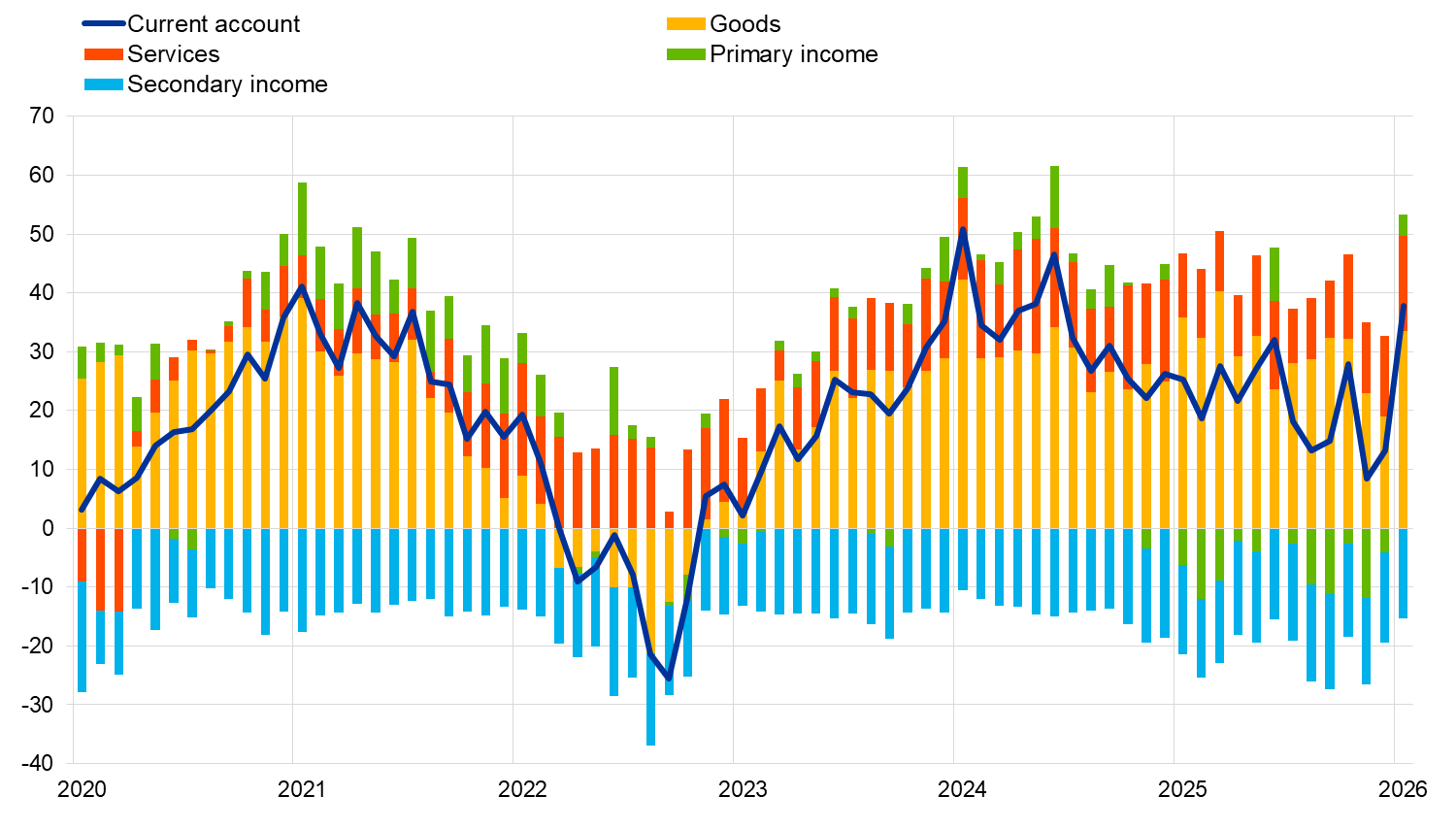
- Current account recorded €38 billion surplus in January 2026, up from €13 billion in previous month
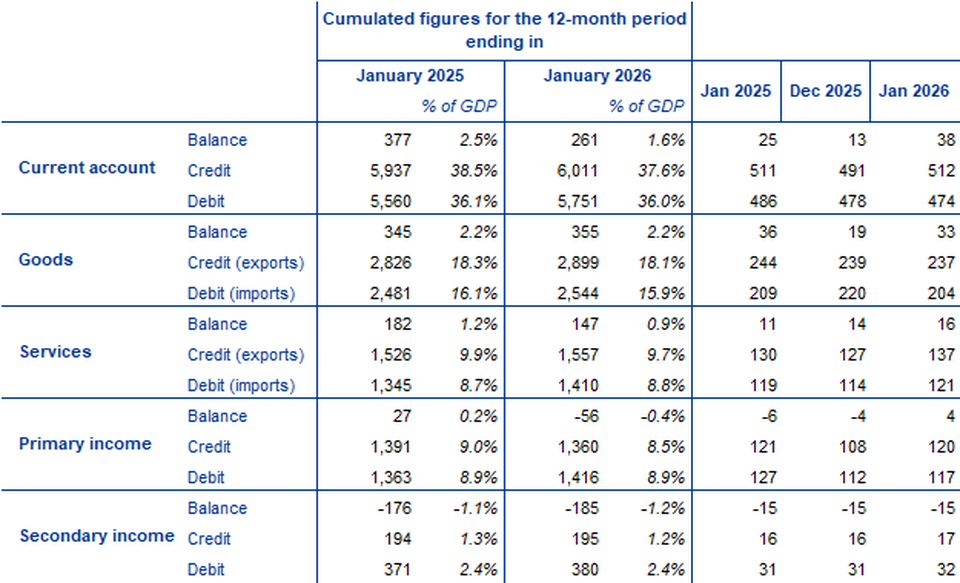
- Current account surplus amounted to €261 billion (1.6% of euro area GDP) in the 12 months to January 2026, down from €377 billion (2.5%) one year earlier
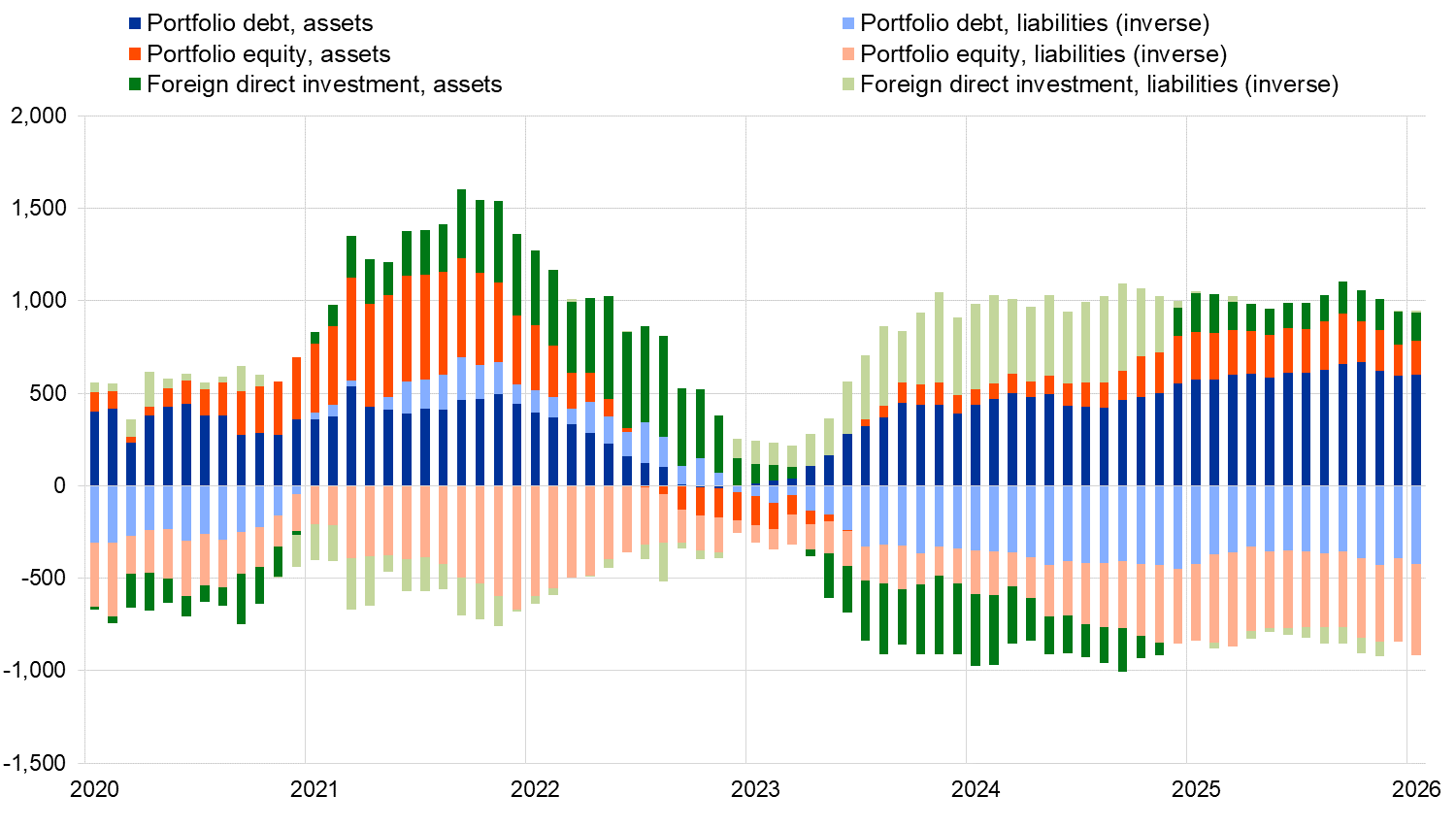
- In financial account, euro area residents’ net acquisitions of non-euro area portfolio investment securities totalled €786 billion and non-residents’ net acquisitions of euro area portfolio investment securities totalled €914 billion in the 12 months to January 2026
Chart 1
Euro area current account balance
(EUR billions unless otherwise indicated; working day and seasonally adjusted data)
Source: ECB.
The current account of the euro area recorded a surplus of €38 billion in January 2026, an increase of €25 billion from the previous month (Chart 1 and Table 1). Surpluses were recorded for goods (€33 billion), services (€16 billion) and primary income (€4 billion). These were partly offset by a deficit for secondary income (€15 billion).
Table 1
Current account of the euro area
Source: ECB.
Note: Discrepancies between totals and their components may be due to rounding.
In the 12 months to January 2026, the current account recorded a surplus of €261 billion (1.6% of euro area GDP), compared with a surplus of €377 billion (2.5% of euro area GDP) one year earlier. This decrease was mainly driven by a switch from a surplus (€27 billion) to a deficit (€56 billion) for primary income and, to a lesser extent, by a reduction in the surplus for services (down from €182 billion to €147 billion) and a larger deficit for secondary income (up from €176 billion to €185 billion). These developments were partly offset by a larger surplus for goods (up from €345 billion to €355 billion).
Chart 2
Selected items of the euro area financial account
(EUR billions; 12-month cumulated data)
Source: ECB.
Notes: For assets, a positive (negative) number indicates net purchases (sales) of non-euro area instruments by euro area investors. For liabilities, a positive (negative) number indicates net sales (purchases) of euro area instruments by non-euro area investors.
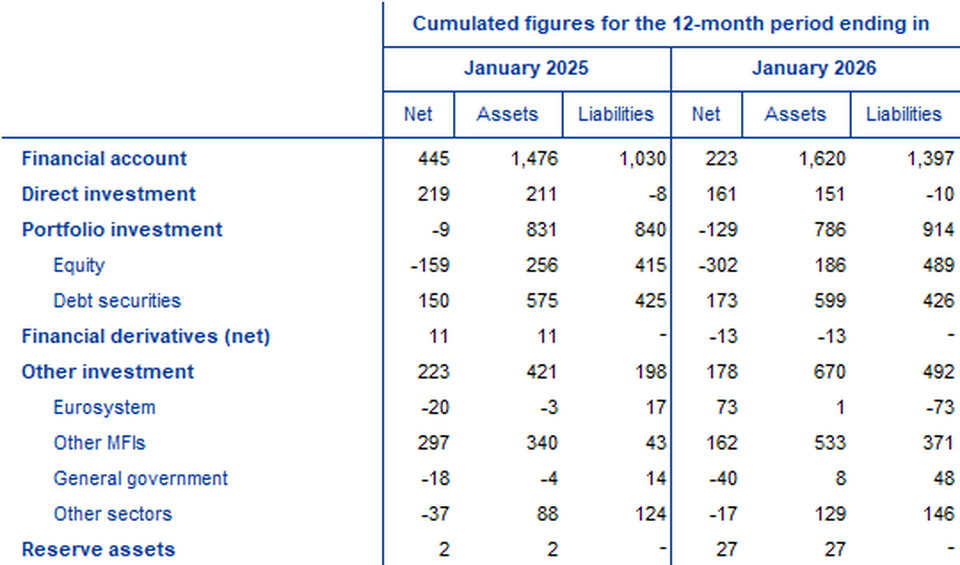
In direct investment, euro area residents made net investments of €151 billion in non-euro area assets in the 12 months to January 2026, decreasing from net investments of €211 billion one year earlier (Chart 2 and Table 2). Non-residents disinvested €10 billion in net terms from euro area assets in the 12 months to January 2026, following net disinvestments of €8 billion one year earlier.
In portfolio investment, euro area residents’ net purchases of non-euro area equity decreased to €186 billion in the 12 months to January 2026, down from €256 billion one year earlier. Over the same period, net purchases of non-euro area debt securities by euro-area residents increased to €599 billion, up from €575 billion one year earlier. Non-residents’ net purchases of euro area equity increased to €489 billion in the 12 months to January 2026, up from €415 billion one year earlier. Over the same period, non-residents made net purchases of euro area debt securities amounting to €426 billion, following net purchases of €425 billion one year earlier.
Table 2
Financial account of the euro area
Source: ECB.
Notes: Decreases in assets and liabilities are shown with a minus sign. Net financial derivatives are reported under assets. “MFIs” stands for monetary financial institutions. Discrepancies between totals and their components may be due to rounding.
In other investment, euro area residents recorded net acquisitions of non-euro area assets amounting to €670 billion in the 12 months to January 2026 (following net acquisitions of €421 billion one year earlier), while their net incurrence of liabilities increased to €492 billion (up from €198 billion one year earlier).
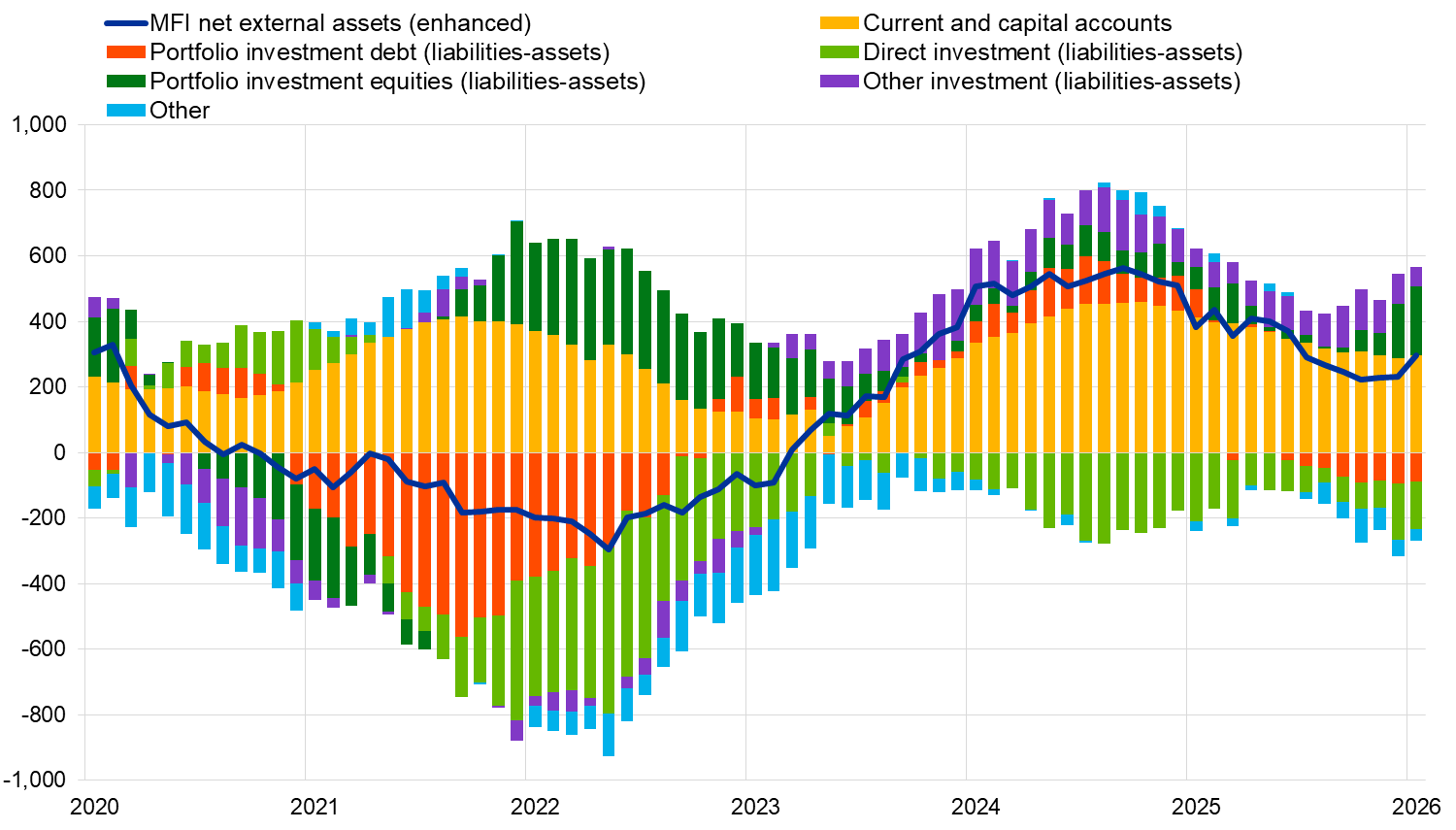
Chart 3
Monetary presentation of the balance of payments
(EUR billions; 12-month cumulated data)
Source: ECB.
Notes: “MFI net external assets (enhanced)” incorporates an adjustment to the MFI net external assets (as reported in the consolidated MFI balance sheet items statistics) based on information on MFI long-term liabilities held by non-residents, available in b.o.p. statistics. B.o.p. transactions refer only to transactions of non-MFI residents of the euro area. Financial transactions are shown as liabilities net of assets. “Other” includes financial derivatives and statistical discrepancies.
The monetary presentation of the balance of payments (Chart 3) shows that the net external assets (enhanced) of euro area MFIs increased by €295 billion in the 12 months to January 2026. This increase was driven by the current and capital accounts surplus and euro area non-MFIs’ net inflows in portfolio investment equity and other investment. These developments were partly offset by euro area non-MFIs’ net outflows in direct investment, portfolio investment debt and other flows.
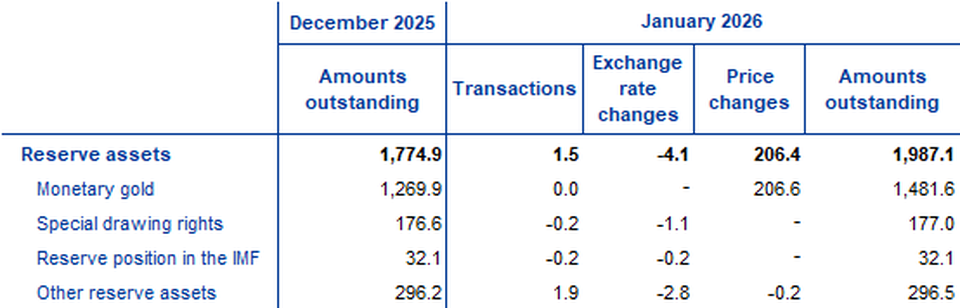
In January 2026 the Eurosystem’s stock of reserve assets increased to €1,987.1 billion up from €1,774.9 billion in the previous month (Table 3). This increase was mainly driven by positive price changes (€206.4 billion), explained by the increase in the price of gold, and, to a lesser extent, by net acquisitions of assets (€1.5 billion) which were partly offset by negative exchange rate changes (€4.1 billion).
Table 3
Reserve assets of the euro area
Source: ECB.
Notes: “Other reserve assets” comprises currency and deposits, securities, financial derivatives (net) and other claims. Discrepancies between totals and their components may be due to rounding. “Other volume changes”, which mainly reflects reclassifications and data enhancements, is not shown.
The inclusion of Bulgaria in euro area external statistics
When Bulgaria adopted the euro on 1 January 2026, its economic agents became euro area residents. This press release shows, for the first time, time series for the balance of payments of the enlarged euro area, starting from the reference period January 2013. In addition, quarterly euro area international investment position statistics have also been recalculated to reflect the new composition of the euro area (starting from reference period first quarter of 2013).
The changes to euro area external statistics due to the enlargement involve: (i) including transactions and positions between residents in Bulgaria and non-euro area residents; and (ii) excluding transactions and positions between euro area residents and residents in Bulgaria. Overall, Bulgaria’s accession has resulted in very limited changes to the aggregate euro area figures.
Data revisions
This press release incorporates revisions to the data since January 2013, reflecting the inclusion of Bulgaria in the euro area aggregates. These revisions did not significantly alter the figures previously published.
Next releases:
- Quarterly balance of payments: 09 April 2026 (reference data up to the fourth quarter of 2025)
- Monthly balance of payments: 17 April 2026 (reference data up to February 2026)
For media queries, please contact Benoît Deeg, tel.: +49 172 1683704.
Notes
- Current account data are always seasonally and working day-adjusted, unless otherwise indicated, whereas capital and financial account data are neither seasonally nor working day-adjusted.
- Hyperlinks in this press release lead to data that may change with subsequent releases as a result of revisions.
Evropská centrální banka
Generální ředitelství pro komunikaci
- Sonnemannstrasse 20
- 60314 Frankfurt am Main, Německo
- +49 69 1344 7455
- media@ecb.europa.eu
Reprodukce je povolena pouze s uvedením zdroje.
Kontakty pro média-
20 March 2026