


- INTERVIEW
Interview with ELLE Magazine
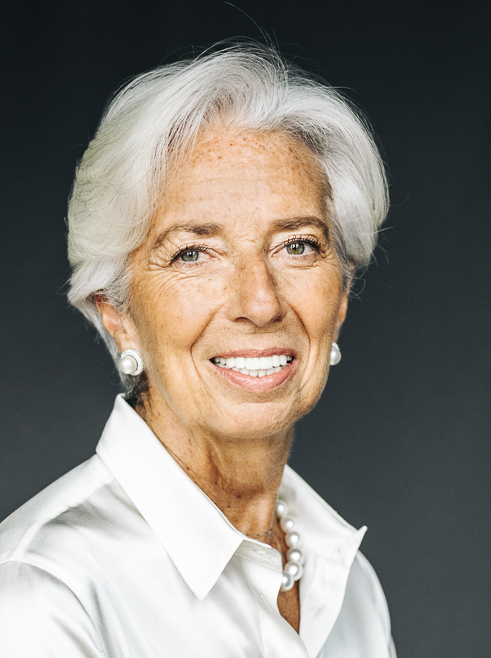
Interview with Christine Lagarde, President of the ECB, conducted by Benedetta Poletti on 12 February 2026
8 March 2026
Madame Lagarde, you were the first woman to be made partner at a major multinational law firm. You were also the first woman to serve as Economy Minister in a G7 country, the first to lead the International Monetary Fund, the first here at the ECB. Your hope is not to be the last, but to make way for others, is that right?
Yes. I have broken a few glass ceilings along the way, and I hope that thanks to that, other women understand they can too. I feel a special responsibility. There are moments in life when you ask yourself, “Why am I doing this? Why am I pushing so hard? I could choose something easier now, less demanding.” But I have to keep going for those young women who admire me and say, “If she is strong enough, I’ll be just as strong. If she can do it, so can I.” And in some roles, another woman has already succeeded me – Kristalina Georgieva at the IMF, for example. Here, I’m not so sure. We shall see.
Do you believe we are living through a crucial moment for Europe – with you, with Ursula von der Leyen, President of the European Commission, and with Roberta Metsola, President of the European Parliament, leading the main institutions?
That crucial period began a few years ago. But now we are at risk of going backwards. I see it with diversity; in many places that word is losing importance, slipping into the background. And I see it with climate change, too. Europe bears the responsibility to defend these values and uphold these principles.
So it’s a question of values?
Values, principles and resistance. It is our duty to resist any backward steps. And that takes courage, by the way. That takes strength.
You know ELLE’s mission has always been to empower women and support their independence, including economically. You have a similar goal.
Financial education means understanding what you are doing with your money and what your money can do for you. And studies have shown that women do not feel as bold as men in this area, or that they possess the same level of expertise. That is a problem, for the women and for society. For women, because they lose resources. And for society, because better-invested wealth boosts economic activity, jobs and wellbeing. So financial education is a win-win. When I led the IMF, I visited centres that supported victims of gender-based violence and realised how devastating it was for them not to have the economic independence needed to close that door and begin a new life. Even today, in developed countries, there are women who work but do not control their income because their partner manages it. That is not fair. To be truly independent, women need to have complete responsibility for managing, spending, saving and investing their own money.
The ECB is launching a very ambitious app for this purpose…
It’s an app that anyone can download. Participants are invited to join the EuroSteps step count challenge, and along the way they will receive notifications with practical and easy to understand information to help them learn more about managing money and making financial decisions. Let’s create a movement together. Steps taken during April are aggregated by country. French women walk in France, Italian women in Italy, Spanish women in Spain, and the Member States compete to see who walks the furthest for financial education.
I love it. We’ll encourage our readers to download it. And speaking of money, it has changed dramatically. One of your major initiatives is the digital euro. What is its goal?
It is, essentially, a virtual banknote. Physical cash will still exist because some people love it – I do, too. I love cash, I always carry some. I think it connects us, it’s part of our identity. But more and more people pay digitally, and that system needs to be backed by the central bank. We want it to be easy, fast, inexpensive and accessible in the countries that use the euro. And the best part is that the digital “highway” it will travel on will be open to commercial banks, which will be able to use this infrastructure free of charge to innovate and grow their services across Europe. It’s a strong way to consolidate a European solution.
Speaking of digital tools, at a time when AI is redefining the workplace, what defines strong, credible leadership? And what role do women play?
Beyond technological transformation, women have always been able to multitask. We can be thinking about picking up the children from school while presenting a PowerPoint to our boss, and also realise there may not be enough food in the fridge for dinner. That’s our life, isn’t it? That talent for closing one drawer here, opening another there. Some men can do it too, but not with the same frequency or volume. That flexibility and capacity to adapt are valuable in an environment where constant change is the only certainty.
That flexibility matters especially now, when the only certainty is constant change.
Yes. We have to be prepared for it. Sometimes we’re a bit conservative, risk-averse. But our bodies change too, don’t they?
You are the best example of that. You have started again several times – in your 40s, 50s and 60s. Is that courage to leave the comfort zone essential for professional growth?
I strongly believe that it is. At first, I wanted to be a senior civil servant, and fortunately I failed! I failed spectacularly. Then I became a lawyer. After that I led the largest international law firm in the world. I was Minister for Foreign Trade, then Minister for the Economy. And I’m glad, because every change meant learning something new. Each time there was a new horizon, a new objective. It keeps you grounded, because you must start from scratch and think, “I know nothing about this, and everyone around me is much better prepared than I am”.
You have said wage inequality between men and women – the gender pay gap – still angers you. Has the situation improved in recent years?
A little, but the difference between average salaries is still more than 10 percentage points. And it is linked to motherhood, to part-time versus full-time work, and to pensions.
Is ageism still a barrier to leadership, even at the highest levels?
We tend to see things from our own personal perspective. Age, for me, has not been a problem. Yet. I’m only 70, so we’ll see. Motherhood does affect professional trajectories. There is a certain period during which women can have children; that means less availability, more organisation. It’s difficult. And I think society should do more for families with children. The second complicated moment is not so much during working life, but later. Women live longer than men, but they are also more economically vulnerable in old age. We often choose part-time work, or stop working when children are born. All of that reduces pension entitlements. And you see many women pensioners with fewer resources because of that inequality.
If you could speak to Christine Lagarde as a little girl, what advice would you give her?
I would say, “Dare”.
You once learned a phrase from synchronised swimming, “Smile despite maximum effort”. What has that sport given you?
Independence, team spirit, travelling at a young age… the value of effort, discipline. A lot of discipline.
You have worked in very male-dominated sectors. Was sexism ever a problem?
Yes, several times – especially when I was young and a lawyer. Everyone assumed I was the secretary.
Has that changed? What do you think?
Yes, because when you are 1.80 metres tall and at 70 you have done what I have done, not many people dare to question you. But I always pay attention to whether other women are in the room and not given the floor, or whether, when they speak, men start chatting or looking at their phones. I don’t like that. Respect matters.
Women are still asked far more often how they balance professional and personal life. Does that asymmetry bother you?
It should be asked of men as well. And they should contribute equally. The statistical evidence shows they don’t: women do at least 30% more domestic work than men.
I have four children and I love my work. But sometimes I feel guilty for not being home enough. Have you ever…?
Never, never feel guilty! No, no, no. I did live with some guilt for a time, because you can’t attend school events, you’re not at every parents’ meeting, you’re not always available. But you know what? When time passes – my children are now 40 and 38 – if I ask them today, “Did that hurt you?”, they answer, “What are you talking about? On the contrary, we are proud of what you were achieving”. So don’t feel bad. And the more guilt you carry, the less happy you are when you are with them, because you’re constantly thinking, “I should have arrived earlier. I should have taken them to the pool instead of my partner”. Don’t do that to yourself.
When your mandate ends in October 2027, after such an extraordinary professional journey, what dream will you still want to fulfil?
I have two dreams. First, the day I stop, I want to spend two months in a place I love – a lagoon. I’ll try to protect its corals, contribute to its environment; it’s something small yet valuable. Second, I’ll start taking piano lessons again.
Did you used to play the piano?
A little. Not very well. But you always need dreams – and you must make sure they’re big enough that you don’t lose sight of them. Mine now is to play the piano again. And of course, to enjoy my grandchildren.
Európai Központi Bank
Kommunikációs Főigazgatóság
- Sonnemannstrasse 20
- 60314 Frankfurt am Main, Németország
- +49 69 1344 7455
- media@ecb.europa.eu
A sokszorosítás a forrás megnevezésével engedélyezett.
Médiakapcsolatok