





Assessing cross-border integration of equity markets in the euro area: evidence from a gravity model
Published as part of the ECB Economic Bulletin, Issue 3/2026.
Despite some progress on integration, euro area financial markets remain fragmented. The EU savings and investments union aims to remove barriers to cross-border capital flows, unlocking investment, lowering the cost of capital and strengthening resilience. However, the scale of remaining frictions is difficult to quantify. This box addresses this gap by applying a structural gravity model to bilateral euro area equity holdings, providing estimates of the changes in financial frictions in equity markets over the past decade.
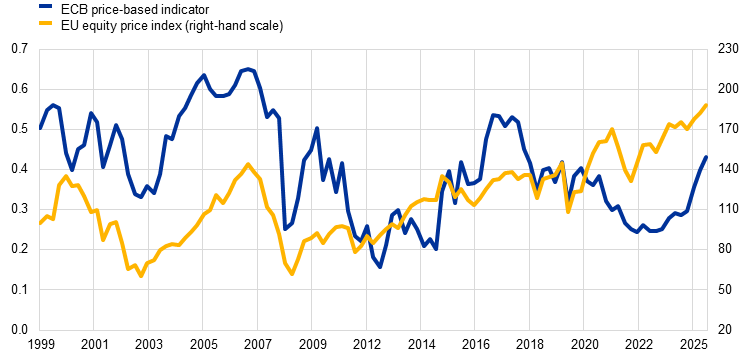
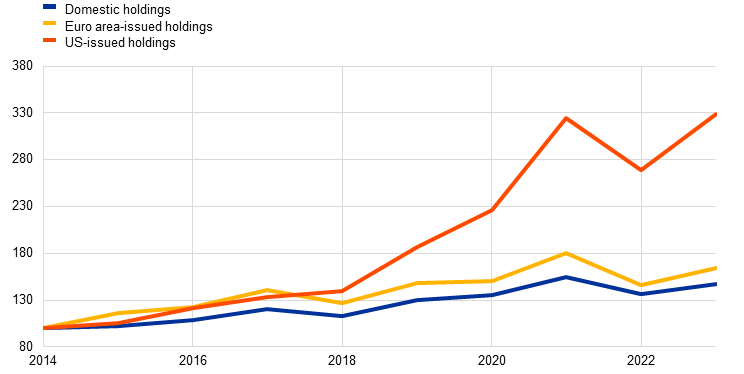
Descriptive indicators signal persistent fragmentation of euro area equity markets. For example, price indicators suggest that market integration remains below its peak in 2018, which was lower than historical highs reached a decade earlier (European Central Bank (ECB), 2026) (Chart A, panel a).[1] This has occurred alongside rising stock valuations, suggesting that stronger market performance has not translated into greater financial integration. At the same time, quantity-based indicators point to a modest increase in intra-euro area cross-border investment, although it has risen by less than euro area investor holdings of US equity (Chart A, panel b).
Chart A
Measures of euro area equity market integration
a) ECB price-based indicator of equity market integration
(left-hand scale: price-based indicator; right-hand scale: index: 1999 = 100)
b) Recent changes in the quantity of equity holdings by issuer
(index: 2014 = 100)
Sources: ECB (2026), LSEG, Beck et al. (2026) and ECB calculations.
Notes: Panel a): the blue line shows the equity market sub-index of the ECB’s price-based financial integration composite indicator (0 = no integration; 1 = full integration), which is based on price dispersion. The yellow line shows changes in the EU equity price index relative to 1999. Panel b): domestic holdings refer to positions where the holder and issuer are in the same euro area country. Euro area-issued holdings denote securities issued in a euro area country other than the country of the holder, and US-issued holdings are securities held by euro area investors and issued in the United States. The instruments considered are listed equities and investment fund shares. They are classified by issuer nationality, looking through investment fund holdings.
Gravity models can complement descriptive indicators, which provide useful snapshots of financial integration but do not fully capture the structural factors shaping cross-border equity flows. Gravity models offer a structural model-based framework which controls for country-specific factors and time-invariant bilateral frictions. Their main advantage lies in isolating structural frictions based on fundamentals, although they might be less informative about market efficiency or risk-pricing than price-based indicators. Gravity models explain bilateral economic interactions as increasing with economic size and decreasing with geographical distance and other factors. While such models were originally developed for international trade, the same intuition can apply to financial markets: cross-border investment is higher between economically important countries and countries where informational, institutional or geographical barriers are lower.[2] Indeed, empirical evidence shows that geographical proximity, trade ties and shared regulatory frameworks promote cross-border financial flows, while persistent frictions sustain home bias.[3]
Gravity models enable a structural quantification of the aggregate barriers to cross-border equity investment. They allow an assessment of how intra-euro area integration has evolved relative to extra-euro area linkages and to what extent frictions continue to weigh on cross-border portfolios.[4] The analysis uses restatements of the portfolio investment positions of euro area countries, as included in the dataset of Beck et al. (2026).[5] Estimated frictions are expressed as “tax-equivalents”, i.e. the tax rate yielding the same effect as observed frictions, thus enabling comparisons across countries and over time, and between euro area countries and the United States.[6] As the dataset begins in 2014, changes in the degree of integration are expressed relative to that year.
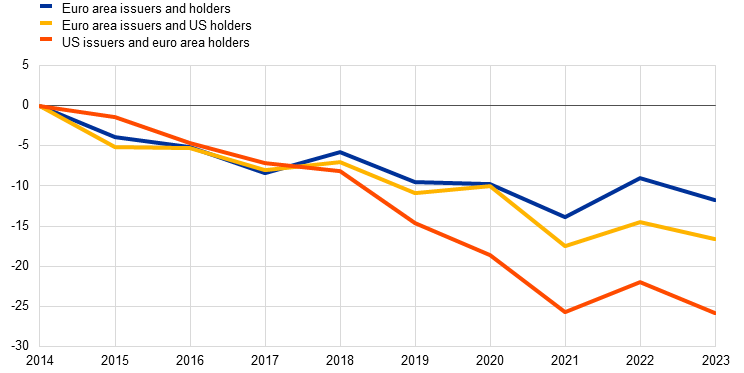
Frictions within the euro area have eased less than those between the euro area and the United States. Chart B shows that intra-euro area frictions have declined overall since 2014 by a tax-equivalent amount of around 12 percentage points. Frictions affecting equity holdings between the euro area and the United States fell more significantly, by around 25 percentage points. This difference suggests a faster pace of integration of euro area equity markets with the United States over this period. Interpreted through the tax-equivalent lens, estimates indicate that frictions faced by euro area investors when holding US equities have fallen far more swiftly than those for cross-border holdings within the euro area. While the estimates do not allow us to assess the extent of integration prior to 2014, the European Commission and authors in the literature consistently find that EU capital markets remain fragmented, with only limited progress in integration.[7]
Chart B
Estimated changes in frictions affecting euro area equity market integration
(percentage changes)
Source: ECB calculations.
Notes: The chart is based on a gravity estimation and shows the change over time in frictions between issuers and holders for three groups: issuers and holders in different euro area countries, euro area issuers and US holders, and US issuers and euro area holders. Regression coefficients are converted into tax-equivalents using an elasticity of -3.86, in line with Head and Mayer (2021). Each point is obtained by differencing with respect to 2014 domestic equity holdings. Estimates are significant at the 95% level.
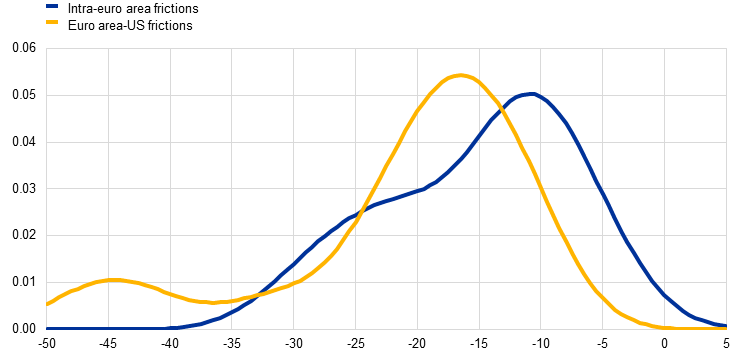
Country-level results confirm that equity market integration has progressed more strongly between the euro area and the United States than within the euro area. The distribution of friction changes across euro area countries for 2014-23 shows that barriers affecting euro area-US equity holdings declined more markedly on average than intra-euro area barriers. Additionally, reductions were more widely dispersed for euro area-US integration, with a heavier left tail pointing to a subset of countries achieving markedly stronger extra-euro area integration (Chart C). The contrast between the two distributions highlights the relative underperformance of intra-euro area integration.
Chart C
Distribution of changes in equity market frictions across euro area countries
(density)
Source: ECB calculations.
Notes: The chart shows kernel density estimates of changes in equity market frictions across euro area countries, expressed in tax-equivalent terms. Each curve represents the distribution of country-level changes over 2014-23, with more negative values indicating larger reductions in frictions. The horizontal axis shows the magnitude of changes, and the vertical axis the estimated density (the area under each curve sums to one). A leftward shift indicates stronger overall reductions (greater integration), while wider dispersion or heavier tails reflects greater cross-country variation.
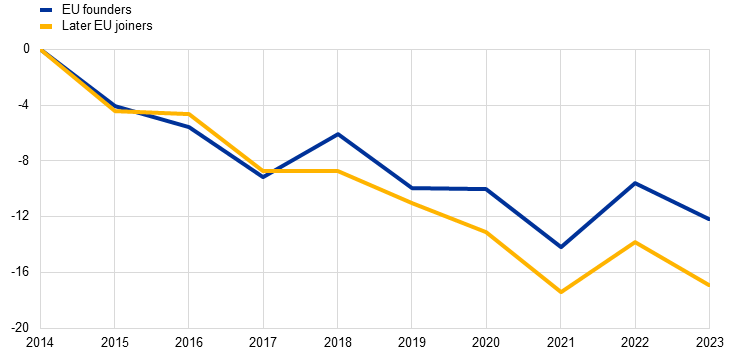
Countries that joined the EU later recorded larger reductions in intra-euro area frictions in recent years. A decomposition by country group shows that later entrants to the EU achieved larger, albeit more volatile, reductions in frictions, while the six founding EU Member States experienced a more moderate decline (Chart D). The more pronounced decline among later joiners, particularly in the post-COVID-19 pandemic period, may reflect a combination of catch-up dynamics and structural changes. These economies may have started with larger initial frictions, with greater scope for convergence, while the six founding Member States may have achieved a higher level of integration already prior to 2014. Additionally, the post-pandemic environment – marked by increased digitalisation of financial services and by policy support at the EU level – may have helped reduce informational and transaction barriers.
Chart D
Estimated changes in frictions affecting intra-euro area equity market integration for selected groups of euro area countries
(percentage changes)
Source: ECB calculations.
Notes: The chart is based on a gravity estimation and shows the change in frictions for different groups of euro area countries, i.e. the six founding members of the EU and countries which joined the EU at a later date. Regression coefficients are converted into tax-equivalents using an elasticity of -3.86, in line with Head and Mayer (2021). Each point is obtained by differencing with respect to 2014 domestic equity holdings.
Overall, these findings show that little progress has been made in the integration of European equity markets. Achieving the objectives of the savings and investments union will require further efforts to reduce fragmentation, including greater supervisory and regulatory harmonisation and deeper integration of trading and post-trading infrastructures to enhance liquidity, support cross-border investment and strengthen Europe’s capacity to finance strategic investment.
References
Arampatzi, A., Christie, R., Evrard, J., Parisi, L., Rouveyrol, C., van Overbeek, F. (2025), “Capital markets union: a deep dive – five measures to foster a single market for capital”, Occasional Paper Series, No 369, ECB, revised May 2025.
Beck, R., Coppola, A., Lewis, A., Maggiori, M., Schmitz, M. and Schreger, J. (2026), The Geography of Capital Allocation in the Euro Area, working paper.
Draghi, M. (2024), The future of European competitiveness, September.
European Central Bank (ECB) (2026), Financial integration and structure in the euro area – statistical annex, April.
European Commission (2025), “Savings and Investments Union – A Strategy to Foster Citizens’ Wealth and Economic Competitiveness in the EU”, Communication from the Commission to the European Parliament, the European Council, the Council, the European Central Bank, the European Economic and Social Committee and the Committee of the Regions, COM(2025) 124 final, Brussels,19 March.
Head, K. and Mayer, T. (2021), “The United States of Europe: A Gravity Model Evaluation of the Four Freedoms”, Journal of Economic Perspectives, Vol. 35, No 2, spring, pp. 23-48.
Lane, P.R. and Milesi-Ferretti, G.M. (2008), “International Investment Patterns”, The Review of Economics and Statistics, Vol. 90, No 3, August, pp. 538-549.
Larch, M., Shikher, S. and Yotov, Y.V. (2025), “Estimating Gravity Equations: Theory Implications, Econometric Developments, and Practical Recommendations”, Working Papers, 2025001, Center for Global Policy Analysis, LeBow College of Business, Drexel University.
Okawa, Y. and van Wincoop, E. (2012), “Gravity in International Finance”, Journal of International Economics, Vol. 87, No 2, July, pp. 205-215.
Portes, R. and Rey, H. (2005), “The determinants of cross-border equity flows”, Journal of International Economics, Vol. 65, No 2, March, pp. 269-296.
Price indicators capture convergence in asset prices, returns or yields, adjusted for risk and liquidity. Quantity indicators focus on the scale of cross-border financial activity, relying on data on holdings, portfolio flows or exposures. See also ECB (2026).
Geographical distance can imply information asymmetries, higher monitoring and transaction costs, and unfamiliarity with foreign markets, all of which can discourage cross-border investment.
See Portes and Rey (2005), Lane and Milesi-Ferretti (2008) and Okawa and van Wincoop (2012).
We estimate a gravity model of bilateral equity holdings, assessing the role of standard factors (distance, common language, legal origin) and controlling for country characteristics, relative stock market valuations and trade flows. We include dummy variables to compare integration over time within the euro area and between the euro area and the United States. The sample covers 2014-23 and captures changes in cross-border equity market frictions relative to domestic holdings. The estimation uses the Poisson pseudo-maximum likelihood estimator, following the state-of-the-art gravity literature. See Larch, Shikher and Yotov (2025).
This dataset contains estimated restatements of the IMF Coordinated Portfolio Investment Survey data for euro area countries, based on the ECB’s securities holdings statistics. It looks through the investment fund holdings of euro area investors and assigns each security to the country of the ultimate parent company of its issuer. It also corrects for the holdings of non-euro area residents via euro area investment funds. These data were obtained from www.globalcapitalallocation.com.
See Head and Mayer (2021).
See European Commission (2025), Draghi (2024) and Arampatzi et al. (2025).