




- THE ECB BLOG
Digital euro: an opportunity for banks
The digital euro brings central bank money into the digital age. It is a strategic investment in European autonomy, monetary sovereignty and financial resilience. It also serves as a springboard for innovative digitalisation strategies in retail payments and strengthens bank business models in the face of growing competition. We aim to continue working closely with the banking industry to make the digital euro a joint success, while preserving financial stability.
If you think of currency and payments as the lifeblood of a modern economy, flowing through a complex arterial system of purchases, investments and trades, then central bank money would be the white blood cells – a vitally important component that anchors the entire payment system and maintains its health, resilience and stability.
The Eurosystem has a duty to keep central bank money fit for purpose. If central bank money does not adapt to meet the challenges posed by evolving technologies and preferences, the Eurosystem will not deliver on its mandate, and the health of the payment system and our economy as a whole would be at risk of becoming less stable.
In an increasingly digitalised world, our economies will only be as competitive, autonomous and resilient as the payment systems that underpin them. This is increasingly important in the current geopolitical environment, where we see the importance of European strategic autonomy in critical infrastructure growing by the day.
The digital euro is Europe’s best investment in strategic autonomy in payments, monetary sovereignty and societal inclusivity.
Banks have a crucial part to play in future-proofing the European payment landscape. That is why the Eurosystem has put them at the heart of the digital euro’s design since the start of the project.
ECB Banking Supervision has been involved in the Eurosystem’s digital euro project from the beginning. This ensures that its in-depth expertise on bank business models, liquidity and overall financial stability is leveraged in order to shape a digital euro that is fit for purpose for achieving public objectives, without placing an excessive burden on banks.
In an open and constructive dialogue with all stakeholders, we listen carefully to everyone’s views and concerns.
Let’s explore some of the key concerns raised by the banking industry and discuss how the digital euro has been thoughtfully designed to serve not as a threat, but as an opportunity for banks in the area of retail payments.
A springboard for innovative digitalisation strategies in retail payments
Some worry that the digital euro may lead to central banks competing with commercial banks. The opposite is true. The digital euro provides opportunities for banks to strengthen their position in a digitalised economy, where innovation is the key to staying competitive.
Bank business models must be ready to meet the future head-on, matching the challenges faced and making the most of the opportunities that a rapidly changing world will bring. Digitalisation is already transforming financial services. As part of its supervisory priorities, ECB Banking Supervision encourages banks to make sound use of technological innovation to improve their offering and strengthen competitiveness.[1]
Digitalisation is used by the non-bank financial sector to offer innovative payment services drawing on the apps, platforms and services that people already use. These developments are making rapid progress and could challenge traditional business models if banks fail to adapt effectively. The digital euro offers an opportunity for banks to adapt and thrive in this ever-evolving competitive landscape.
To begin with, banks will manage digital euro accounts, enabling them to maintain their existing business models by preserving strong, long-term customer relationships. This in turn will allow banks to retain access to the data required to assess customers’ creditworthiness and financial needs, which is important if they are to continue financing the economy.
The digital euro would be a payment solution that customers can use anywhere in the euro area, anytime and for any type of payment.[2] Moreover, it would serve as a common payment infrastructure on which banks could build to innovate. Importantly, banks will be able to generate revenue streams for both basic and innovative services
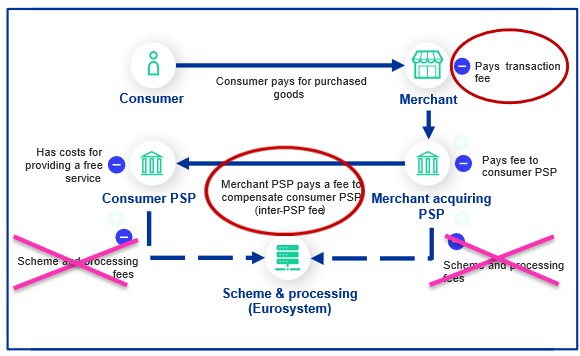
First, the compensation model included in the Regulation on the establishment of the digital euro proposed by the European Commission ensures that banks will be adequately compensated for the services they offer (Chart 1).The Eurosystem will not charge scheme and processing fees, thereby reducing the overall costs for banks and the system as a whole.
Chart 1
Compensation model in a four-party scheme versus the digital euro compensation model
Source: Cipollone, P. (2026), Digital euro – AIB Executive Committee Meeting, 18 February.
Note: the scheme and processing fees (crossed out with a pink cross) are the difference between the compensation model in a four-party scheme (where they are included) and the digital euro compensation model (where they are not included).
Second, banks can take advantage of the digital euro’s platform and focus their efforts on building value‑added services for retail customers – services that can generate new revenue streams and strengthen their competitive edge for client segments that are becoming less sticky and more difficult to retain.
For example, last year a number of pioneering payment service providers, including banks, participated in the digital euro innovation platform to test how the digital euro could foster innovation.[3] This matters because today some innovative services are offered by non-banks, and the digital euro will help banks compete with these players by providing a European infrastructure that will enable them to develop innovative payment solutions that they can offer on a European scale.
One key benefit identified by the innovation platform is conditional payments, i.e. payments that are executed automatically when predefined conditions are met.[4]
Using the digital euro’s payment service to provide the technical backbone, and benefiting from its unparalleled acceptance network, providers could offer conditional payments throughout the euro area that go far beyond what is available today.
Imagine buying a train ticket from Frankfurt to Brussels. You are already waiting on the platform when the train is cancelled at short notice. With conditional payments, the money to pay for your ticket would only be taken if the train actually runs, as opposed to having paid for your ticket upfront and then having to fill out lengthy forms to receive a refund at a later date once the ticket has been cancelled.
The digital euro as an opportunity to strengthen bank business models
Some worry that the digital euro may take business away from banks, ultimately undermining their profitability.
To remove any such concern, through the Euro Retail Payments Board in which all stakeholders including banks are represented, the Eurosystem held a series of in-depth discussions and workshops to explore how the digital euro could fit into the payment ecosystem. Through this collaboration, and with further engagement with ECB Banking Supervision business model experts, we have identified a clear opportunity to future‑proof bank business models in retail payment services.[5]
As part of the fit into the payment ecosystem, we also identified two promising avenues for further strengthening banks’ business models: co-badging with domestic schemes and establishing common European standards.
First, the digital euro can complement existing domestic European payment schemes through co-badging on physical cards. By co-badging with the digital euro, debit cards offered by European banks could be used all across Europe without needing to fall back on international card schemes for use cases not covered by the domestic scheme.
At the same time, 13 out of the 21 euro area countries depend entirely on international card schemes or mobile solutions for in-store payments, and over half of all euro area countries have no domestic solution for e-commerce payments that is widely accepted. This gap is currently filled by fee-heavy non-European card schemes accounting for two-thirds of card transactions. This reliance is both bad for Europe’s strategic autonomy and often costly for banks.
Second, building on the digital euro’s status as legal tender, banks can use its infrastructure to provide their account-to-account payment solutions with instant reach throughout the euro area.[6] Think about the USB-C cable we use for charging our phones. Previously, we had a mix of different cables, one for each device, creating inefficiencies and limited compatibility. Standardised adoption of USB-C changed that by introducing a common, universal port. The digital euro would play a similar role for payments in Europe.
This approach will strengthen the competitive position of digital wallets offered by European banks, enabling them to provide clients with a versatile solution that works seamlessly in all use cases. With a single wallet, bank’s customers will be able to make payments anywhere and banks will retain the full interchange fee without having to rely on X-Pays – payment solutions offered by big tech firms –, which often charge significant fees to banks.
By this summer, the Eurosystem expects to announce the European standards for the digital euro and then work closely with market participants to help them embed these standards into payment terminals as quickly as possible. However, these standards can only be finalised once the legislation has been adopted, which will provide the certainty needed for their broad deployment across the euro area.
This legal certainty will enable private payment initiatives to start using the digital euro’s front-end infrastructure even before the digital euro is issued. As merchants upgrade their payment terminals, new devices can be made digital euro ready, allowing European banks to expand the reach and range of use cases of their private solutions even before the ECB issues the first digital euro.
Risks to financial stability and costs are contained
Some also worry that the digital euro could put financial stability at risk, and some banks may still be concerned about investment costs.
Identifying and assessing risk is a task that ECB Banking Supervision performs daily. Banking supervisors looked carefully – jointly with their Eurosystem colleagues – at whether the digital euro may pose risks to banks’ liquidity positions through deposit outflows and financial stability more broadly.
The analysis published last year[7], based on banks’ own data, confirms that the digital euro would not harm financial stability. First and foremost because, just like cash, the digital euro will not be remunerated. Second, a reverse waterfall functionality reduces the need to keep high digital euro holdings in the first place.[8] Third, there will be limits to the amount of digital euro individuals can hold, while corporates will not be allowed to have any holdings; this will avoid any destabilising deposit outflows, particularly during crises.
Our analysis shows that, across different holding limits, the impact on deposits, liquidity and profitability is limited during normal times. And even in a severe stress scenario, the impact is manageable[9] and smaller in magnitude than, for example, in the liquidity stress test ECB Banking Supervision conducted back in 2019.[10]
The digital euro clearly does not put bank liquidity positions and financial stability at risk.
When it comes to costs, the Eurosystem is committed to keeping development and operating costs of the digital euro as low as possible, while delivering a digital euro that brings value to consumers and merchants. Banks have thus been invited to present their views on potential cost drivers and mitigants.
Drawing on the analysis provided by some banks, the ECB identified potential savings from synergies and cost mutualisation. This analysis showed that total investment costs for banks could range from €4 billion to €5.8 billion, or from €1 billion to €1.44 billion annually over four years. This is about one-sixth to one-fifth of the costs mentioned by some external studies.[11]
Overall, the annual costs over four years correspond to approximately 3.4% of significant banks’ annual IT upgrade budgets. Investment costs may be even lower in reality, as the analysis does not yet factor in internal synergies within banks.
Finally, when considering costs and implications, it is crucial to account for the counterfactual.
Banks currently already lose fees through international card schemes. With big tech mobile payment solutions, banks lose fees and data and, in some instances, even make losses. With stablecoins, they may lose fees, data and stable retail deposits.
Compared with the risk of losing business, data and deposits to stablecoins, the digital euro enables banks to deliver payment services that meet the evolving needs of their clients in the digital age and ensures that banks are fairly compensated, pay fewer fees and keep retail deposits as an important funding source.
Maintaining close dialogue with banks remains critical
Transparency and collaboration with banks has been a cornerstone of the digital euro project since its inception, particularly in the Euro Retail Payments Board and many bilateral meetings with banks. This close dialogue continues to be essential for exchanging views, discussing opportunities and concerns and ensuring a level playing field among smaller and larger banks.
In the current phase, the Eurosystem aims to take the next step by enhancing collaboration with banks as part of a pilot exercise planned for 2027.
The pilot will test and validate the functionality of digital euro infrastructure in real-life conditions and gather evidence to inform future implementation decisions.[12] Participation in the pilot will offer European banks an opportunity to actively contribute to shaping the future of payments in Europe, and to engage directly with the Eurosystem’s operational and technical teams.
Participating banks will be well placed to suggest ways to optimise implementation choices such as integration approaches, use of existing components and partners, and internal versus external development, all of which can help manage costs, compliance and capacity needs.
The Eurosystem will continue to listen, to adjust where needed and to work hand-in-hand with banks as we develop the digital euro. We are determined to make it a shared success.
The digital euro is necessary for maintaining the healthy, reliable flow of payments through the intricate circulatory system that is our economy. It can bring opportunities for Europe’s banks and the people and businesses that rely on them. And – as underlined by the ongoing global uncertainty – the digital euro is of critical importance for European strategic autonomy and resilience.
Check out The ECB Blog and subscribe for future posts.
For topics relating to banking supervision, why not have a look at The Supervision Blog?
European Central Bank (2025), Supervisory priorities 2026-28; European Central Bank (2021), ECB Banking Supervision: SSM Supervisory Priorities for 2022-2024; and Donnery, S. (2026), Supervisory priorities 2026-28: charting a course through turbulent waters, The Supervision Blog, ECB, January.
The digital euro will be legal tender, which ensures that it will have to be accepted by all merchants that accept digital payments, throughout the euro area. The digital euro will be available to pay at the point of sale, from person to person or in e-commerce.
European Central Bank (2026), Digital euro innovation platform; and European Central Bank (2025), Digital euro innovation platform Outcome report: pioneers and visionaries workstreams, September.
Conditional payments are transactions that are automatically executed when predefined conditions are met. For example, when buying a product online, the payment would be completed once the buyer confirms that the package has been delivered. Conditional payments are not the same as programmable money, nor would the digital euro ever be programmable money. Programmable money is money that can only be used to purchase specific goods or services or that can only be spent within a certain time frame or geographical area. For further details on conditional payment, please see Box 1 in ibid.
European Central Bank (2025), Fit of the digital euro in the payment ecosystem report, October.
European Central Bank (2025), Fit of the digital euro in the payment ecosystem – Report on the dedicated Euro Retail Payments Board (ERPB) technical workstream, October.
ECB (2025), Technical data on the financial stability impact of the digital euro, October.
Reverse waterfall means that if your balance is insufficient when you make a payment, the shortfall is automatically taken from a linked commercial bank account or card.
For instance, even under a highly unlikely and extremely conservative “flight-to-safety” stress scenario, regulatory liquidity metrics, such as the liquidity coverage ratio on aggregate remain well above 100%. For more details, see European Central Bank (2019), Sensitivity Analysis of Liquidity Risk – Stress Test 2019 Final Results, 7 October.
For more details, see European Central Bank (2019), Sensitivity Analysis of Liquidity Risk – Stress Test 2019 Final Results, 7 October.
European Central Bank (2025), A view on recent assessments of digital euro investment costs for the euro area banking sector, October.
European Central Bank (2026), “Call for payment service providers to participate in digital euro pilot now open”, 5 March.