


- SPEECH
Deepening financial integration to support Europe’s prosperity
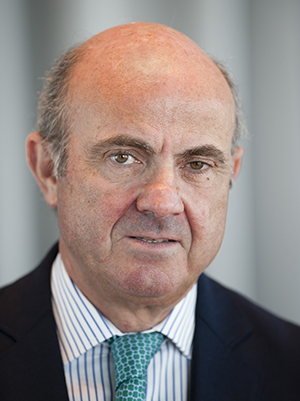
Keynote speech by Luis de Guindos, Vice-President of the ECB, at the joint conference of the European Commission and the European Central Bank on European Financial Integration
Frankfurt am Main, 7 May 2026
It is an honour to speak to you today on a topic that lies at the core of Europe’s economic resilience and future growth: financial integration. In an era of geopolitical fragmentation, technological change and economic uncertainty, ensuring that the European Union’s financial system is robust and competitive is not just an economic imperative – it is a strategic necessity.
With a well‑integrated financial system, the EU can weather external shocks, foster sustainable growth and strengthen its position in an increasingly competitive global landscape, while also allowing businesses to access capital more easily, facilitating cross‑border investment and providing Europeans with better financial products and services. In short, financial integration is crucial to the prosperity, stability and competitiveness of the Economic and Monetary Union.
The savings and investments union is at the heart of this vision, reflecting the essence of the EU project itself: unity, cooperation and shared prosperity.
Today, I would like to begin by taking stock of the progress that has been made in financial integration, before highlighting the reforms – particularly of market integration and supervision – that are now within our reach. I will then outline how we can simplify and strengthen our regulatory framework to support a truly competitive and resilient European financial system.
Key developments in financial integration
Over the past few years, financial integration in the euro area has advanced significantly, cementing its role as a cornerstone of the EU’s economic architecture. ECB indicators show that financial integration is now above the average level seen since the creation of Economic and Monetary Union. The progress reflects two improvements: first, a lower dispersion in euro area asset price and yield differentials across bond, equity, banking and money markets. And second, a higher degree of capital allocation and portfolio diversification within the euro area, with cross-border debt activity standing out as a key driver. These positive developments have not only deepened integration but also strengthened the resilience of these markets.
Despite significant progress, the full potential of a deeply integrated financial system has still not been unlocked. Cross-border financing in areas like bank lending and equity markets remains at relatively low levels. For example, cross-border corporate lending within the euro area accounts for just 14% of total corporate lending[1], with equity market integration showing troubling signs of decline since 2022. Foreign direct investment within the euro area has fallen to a historical low, shining a light on the structural barriers that still hinder seamless capital flows.
These contrasting trends underline the need for targeted policy interventions to address structural barriers and boost integration in underperforming areas. Equity markets, in particular, warrant immediate attention due to their critical role in fostering innovation, supporting entrepreneurship and diversifying funding sources for European businesses.
The principle that “capital follows the real economy” underscores the relationship between economic growth and financial integration. To fully reap the benefits of a unified financial system, EU policy initiatives, Single Market reforms and the savings and investments union must advance together. If we coordinate our efforts, we can build a resilient and unified financial ecosystem that supports European growth and strengthens the EU’s global competitiveness.
Looking ahead – further integrating capital markets
We now have a key opportunity to further deepen integration. The market integration and supervision package – if adopted – would lay the institutional foundations for a truly integrated market capable of mobilising investment at the scale Europe needs.[2] There are three features of the package that I want to highlight.
First, a genuine single rulebook for capital markets. This means further harmonising rules and transforming provisions from directives into regulations that are directly applicable across EU Member States. A single rulebook strengthens the level playing field, reduces legal uncertainty and fosters greater consistency.
Second, support for a tokenised financial ecosystem. By adapting the distributed ledger technology (DLT) pilot regime, we can facilitate innovation in digital financial services while preserving robust regulatory oversight. Europe should be a place where new technologies can scale up safely and efficiently.
Third, a more European supervisory framework. Stronger, more consistent supervision at EU level will enhance the resilience of the system and remove the barriers that still limit cross‑border capital market integration.
Taken together, these measures are much more than mere technical adjustments. They build the foundations for deeper financial integration and a more dynamic capital market, thereby boosting the EU’s competitiveness and strategic autonomy. In today’s global environment, it is crucial that this package is implemented swiftly.
Simplification, integration and competitiveness of the banking sector
If European firms are to thrive globally, they need the support of competitive and resilient banks. The euro area banking sector is a cornerstone for Europe’s financial stability and economic growth. Competitiveness must go hand in hand with resilience: both can be achieved by simplifying processes, fostering integration and enabling economies of scale.[3]
Well-integrated markets and increased cross-border consolidation enable banks to diversify, strengthen their business models and better support the real economy, especially during times of stress. While reforms since the global financial crisis have bolstered banks’ resilience, national barriers and market fragmentation are obstacles to fully unlocking the benefits of the Single Market.
The crucial step towards strengthening Europe’s competitiveness and deepening financial integration is the completion of a truly single banking market where capital and liquidity can move across borders and all deposits are protected equally. To this end, the banking union should be regarded as a single European jurisdiction by all relevant competent and designated authorities.
Moreover, the finalisation of a fully-fledged European deposit insurance scheme (EDIS) is a pivotal step in advancing the banking union. A robust EDIS will protect deposits equally, enhance financial stability and facilitate cross-border transactions, fostering a truly unified and resilient financial system. In the same vein, allowing capital and liquidity to flow freely within cross-border banking groups in the banking union would enable resources to be promptly and efficiently transferred within groups, especially in times of stress.
Progress on these priorities is essential to reduce fragmentation and create a unified and efficient financial ecosystem that supports Europe’s long-term economic growth and prosperity.
A more coherent regulatory framework
Deeper financial integration must be built on a foundation of resilience. A sound regulatory framework that ensures the stability of the financial sector is essential for long-term growth, and it can be achieved through simpler and more harmonised rules.
The EU’s regulatory framework is currently still fragmented across Member States, creating inefficiencies and inconsistencies that undermine resilience and competitiveness. This fragmentation restricts the financial sector’s ability to support the real economy and limits Europe’s potential to act as a unified financial centre. Simplified, harmonised rules are therefore essential to unlock the full benefits of integration. Recognising this need, in December 2025 the Governing Council endorsed a set of recommendations aimed at simplifying the regulatory, supervisory and reporting frameworks for banks.
Another critical area requiring attention is the growing regulatory gap between banks and non-bank financial institutions. As EU capital markets expand and become increasingly interconnected across borders, the prudential framework must also evolve so that emerging risks to financial stability can be detected and addressed. Adjusting the EU macroprudential framework by developing a complementary macroprudential approach for non-banks alongside microprudential oversight is essential.
But harmonisation must go beyond prudential rules. Reducing non-prudential barriers – such as disparities in insolvency laws, tax systems and corporate laws – will further streamline operations and remove obstacles to cross-border activity. These measures are critical to fostering a competitive and resilient financial ecosystem that can finance innovation and growth effectively.
By addressing these regulatory gaps and inefficiencies, Europe can create a robust framework that supports financial stability while promoting integration and competitiveness. A united, simplified approach will allow the EU to position itself as a global financial centre, reinforcing its strategic autonomy and its ability to adapt to emerging challenges.
Conclusion
By advancing the savings and investments union, considering the banking union as a single European jurisdiction, finalising EDIS and simplifying our regulatory framework, we can create a dynamic and competitive financial system that supports sustainable growth. Therefore, I call on policymakers and market participants to work together to ensure that Europe remains resilient and unified.
Thank you.
Data as of the fourth quarter of 2025. See ECB (2026), Eurosystem response to the EU Commission’s targeted consultation on the competitiveness of the EU banking sector, April.
See the ECB Opinion of 9 April 2026 on proposals as regards the further development of capital market integration and supervision within the Union.
See ECB (2026), op. cit.
Euroopan keskuspankki
Viestinnän pääosasto
- Sonnemannstrasse 20
- 60314 Frankfurt am Main, Germany
- +49 69 1344 7455
- media@ecb.europa.eu.
Kopiointi on sallittu, kunhan lähde mainitaan.
Yhteystiedot medialle