


Feedback on the input provided by the European Parliament as part of its resolution on the ECB’s Annual Report 2024
This feedback statement responds to the issues raised and requests made by the European Parliament in its resolution of 10 February 2026 on the ECB’s Annual Report 2024.[1] It is being published on the occasion of the ECB’s Annual Report 2025 being presented to the European Parliament. The statement explains the ECB’s policies related to calls made to the ECB in the resolution and is structured by topic.[2] The ECB has published such feedback statements since 2016, following a suggestion by the European Parliament.
1 Monetary policy
1.1 Monetary policy communication
The European Parliament resolution invites the ECB to make efforts to enhance instruments that improve transparency, such as benchmarks, insights into its model-based assumptions and the Governing Council’s assessments of inflation developments. [paragraph 5]
The ECB is continuously strengthening the communication around its monetary policy decisions and adapting it to diverse audiences and the evolving communication landscape. The importance of effective communication was underlined again in the 2025 strategy assessment. There are a number of key vehicles for explaining ECB policy assessments and decisions. They include the press conference at which the President explains the Governing Council’s latest monetary policy decisions, the monetary policy statement, the accounts of Governing Council meetings, the articles presenting the staff projections, the Economic Bulletin and the ECB Annual Report. As regards the models employed in the process of preparing monetary policy decisions, information on their structure and the input is available on the ECB’s website.[3] In addition, recent communications initiatives include The ECB Blog, The ECB Podcast, and Espresso Economics on YouTube, which aim to reach broader audiences using relatable examples and clear language. These outlets provide information on the ECB’s work in different levels of detail for different audiences. The publications are complemented by extensive datasets made available on the ECB’s website, for instance datasets on purchases and holdings of asset purchases.
1.2 Assessment of high inflation
The European Parliament resolution expresses concern at the high levels of inflation in the years following the COVID-19 pandemic, instigated by supply shocks. It notes that a timely return to price stability in this period would have been warranted through ECB decisions and invites the ECB to thoroughly assess the causes of these high levels of inflation in its annual report, along with a set of policy recommendations to draw the right conclusions from any future inflationary crises. [paragraph 9]
The ECB extensively analysed the causes of and drew the policy lessons from the 2022-23 high‑inflation episode as part of its 2025 strategy assessment. The assessment included both the policy implications of this episode and the lessons from the prolonged period of below-target inflation that preceded it, so as to inform the ECB’s future monetary policy strategy. The high inflation episode reflected a series of shocks caused by pandemic-induced supply chain disruptions, Russia’s unjustifiable invasion of Ukraine and the ensuing energy crisis as well as the reopening of the economy after the pandemic. In response, starting in July 2022, the ECB raised interest rates 450 basis points, while ending net asset purchases and also, later, ending reinvestments of maturing securities under the asset purchase programme (APP) and pandemic emergency purchase programme (PEPP). The relevant conclusions of the strategy assessment are that appropriately forceful or persistent monetary policy action is needed in response to large, sustained deviations of inflation from the target, including both upward and downward deviations, to avoid inflation expectations becoming de-anchored and inflation deviations from the target becoming entrenched. Moreover, the assessment concluded that the choice, design and implementation of monetary policy tools should be sufficiently flexible to enable an agile response to changes in the inflation environment. Also, when taking monetary policy decisions, the Governing Council will take into account not only the most likely path of inflation and the economy, but also the surrounding risks and uncertainty, including through the appropriate use of scenarios and sensitivity analyses. The ECB has published additional material analysing the causes, dynamics and impacts of this period of above-target inflation.[4] Among other tools, counterfactual analysis has shown that a faster and more aggressive tightening would have had only a limited impact on the inflation pattern, at a material cost to economic activity.[5] Given the public availability of the extensive analyses and as the purpose of the ECB Annual Report is to report on the ECB’s activities in a given year, the 2025 ECB Annual Report would not have been a suitable vehicle for this material.
1.3 The ECB’s inflation target and monetary policy strategy
The European Parliament resolution invites the ECB to assess the appropriateness of its symmetric target, also taking qualitative factors into account. It notes the 2025 monetary policy strategy assessment and encourages the ECB to periodically conduct such assessments. [paragraph 13]
The ECB adopted a symmetric 2% medium-term inflation target in 2021, which has served its purpose well during recent years. The 2025 strategy assessment reconfirmed the commitment to the symmetric 2% inflation target. Clarity on the target has been essential for both re-anchoring inflation expectations while coming out of the low inflation period and keeping inflation expectations well anchored at the target during the inflation surge. The clear quantitative target has various benefits. One is that consumers and firms who are aware of the symmetric 2% inflation target ascribe more credibility to the ECB fulfilling its price stability objective and have inflation expectations more aligned with the inflation target, as demonstrated for example by Ehrmann, Georgarakos and Kenny (2023).[6] When assessing the appropriate monetary policy response to a deviation of inflation from the target, the Governing Council takes into account the origin, magnitude and persistence of the deviation. The ECB intends to assess periodically the appropriateness of its monetary policy strategy, with the next assessment expected in 2030.
1.4 The ECB’s balance sheet and asset purchases
The European Parliament resolution stresses that the ECB’s asset purchase programmes are unconventional monetary policy tools that have side effects. It notes in particular that asset purchase programmes can distort price signals and that the ECB started shrinking its balance sheet only very gradually. It supports the ECB in further diminishing its direct role in purchasing securities and encourages the ECB to gradually phase out its government bond purchasing programmes. [paragraph 14]
Asset purchase programmes were introduced to fulfil the ECB’s primary objective of price stability in a context of prolonged below-target inflation and policy rates close to their lower bound. These programmes were deployed as part of the ECB’s non-standard toolkit in order to preserve the transmission of monetary policy and steer inflation back to our 2% target when conventional policy rates had approached their effective lower bound. Asset purchases were also instrumental in stabilising the financial markets in periods of stress. The end of reinvestments of principal payments from maturing securities results in a gradual and predictable reduction in the purchase programme bond holdings, designed to preserve smooth market functioning.[7]
The Eurosystem balance sheet continues to decline at a measured and predictable pace, as can be seen from Chart 1. Reinvestments ceased under the APP at the end of June 2023 and under the PEPP at the end of 2024. Accordingly, 2025 marked the first year since the start of the programmes in which the Eurosystem did not conduct any monetary policy-related asset purchases. The reduction in the APP and PEPP portfolios has been absorbed smoothly by the market. Indeed, as the Eurosystem has gradually reduced its holdings of securities, other investors, including households, banks, pension funds and insurance corporations, have increased their holdings. The 2025 strategy assessment reiterated that the ECB’s primary monetary policy instrument is its set of policy rates. At the same time, it also confirmed that the Governing Council may employ other instruments, as appropriate, to steer the monetary policy stance when the policy rates are close to the lower bound or to preserve the smooth functioning of monetary policy transmission. The ECB regularly monitors side effects and implications of its monetary policy tools for market functioning and also performs proportionality assessments when deploying or adjusting additional monetary policy instruments.
Chart 1
Evolution of the Eurosystem monetary policy assets
(EUR billions)
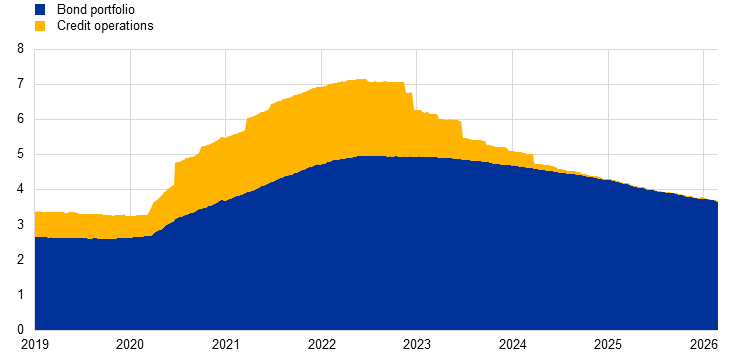
Notes: The “bond portfolio” series represents the Eurosystem’s holdings of assets for monetary policy purposes as purchased under the various purchase programmes, including the Securities Markets Programme (SMP), PEPP and APP. The “credit operations” series represents amounts borrowed by banks under all Eurosystem refinancing operations other than the marginal lending facility.
1.5 Monetary policy transmission
The European Parliament resolution expresses regret that the ECB’s short-term lending schemes have largely displaced the private interbank funding market since the financial crisis of 2008. It calls on the ECB to avoid paying banks deposit rates that are above market rates, as this runs counter to the principle of an open market economy with free competition, and to remove any obstacle hindering the recovery of short-term unsecured interbank markets. [paragraph 15]
Money market activity is increasing as excess liquidity declines, while levels of borrowing from the central bank remain low. Both the volume and maturity of Eurosystem refinancing operations declined between 2022 and 2025, after having increased in the wake of the crises hitting the euro area when the Eurosystem introduced targeted longer-term refinancing operations (TLTROs). These offered favourable conditions for banks and provided incentives for lending to the real economy, supporting the transmission of accommodative monetary policy during the crises. As excess liquidity has declined due to the gradual reduction in the APP and PEPP portfolios as well as the limited take-up of standard refinancing operations, money market activity has increased again.[8]
The smooth transmission of monetary policy relies on the ECB steering short-term money market rates effectively. The remuneration of the deposits that banks hold with the Eurosystem provides an anchor point for short-term money market rates, allowing these to be steered in line with the monetary policy stance. Under excess liquidity, the money market rates are expected to be in the vicinity of the ECB deposit facility rate (DFR). Money markets are also affected by structural factors unrelated to monetary policy. In the unsecured market, short-term rates can fall below the DFR because non-banks and non-euro area banks without access to the ECB’s deposit facility are also active market participants.[9] At the same time, the spread between unsecured short-term market rates and the DFR has been slowly but consistently declining, as excess liquidity decreases. Excess liquidity is expected to decline further. As for secured short-term market rates, they are now on average at the level of the DFR.
1.6 Market neutrality, market functioning and efficient allocation of resources
The European Parliament resolution notes that the concept of market neutrality is related to the principle of “an open market economy with free competition”. It invites the ECB, while respecting its independence, to address market failures and ensure the efficient allocation of resources over a long-term horizon, while remaining as apolitical as possible and respecting market neutrality, and highlights that such decisions must not be made at the expense of achieving the ECB’s mandate. [paragraph 23]
The ECB is committed to the principle of “an open market economy with free competition, favouring an efficient allocation of resources” as enshrined in Article 127(1) of the Treaty on the Functioning of the European Union. Efficient, well-functioning financial markets are fundamental to ensuring the optimal allocation of resources in a market economy. The smooth functioning of financial markets – especially money markets and bond markets – is essential for the orderly transmission of monetary policy measures to the wider economy. Adherence to the principle of an open market economy does not imply a prohibition on influencing market processes, but rather establishes the framework under which the ECB can intervene in a proportionate manner and in line with its mandate.
Market neutrality helps ensure that the ECB’s actions align with the principle of an open market economy. The ECB is committed to avoiding undue disruptions to market functioning or competition. Market neutrality has been a cornerstone of the design of the ECB’s asset purchase programmes. Specifically, market neutrality aimed to preserve price discovery mechanisms by avoiding both significant distortions along the yield curve and disruptions to market liquidity or collateral availability resulting from ECB purchases. The ECB can justifiably depart from market neutrality when necessary to achieve its objectives or manage risks, provided such actions align with other Treaty principles and adhere to the principle of proportionality. The ECB has risk control frameworks to protect its balance sheet from the financial risks arising from outright purchases of assets in the pursuit of its monetary policy objective. These frameworks include credit assessment and due diligence procedures that could – subject to the principle of proportionality – lead to the limiting or suspension of purchases of certain securities, potentially resulting in a deviation from market neutrality. Such frameworks underscore the ECB’s prudent approach to pursuing its monetary policy objective of price stability while mitigating risks and upholding Treaty principles in doing so.
In the ECB’s 2021 climate roadmap, the Governing Council announced its decision to tilt corporate bond holdings, through the reinvestments, towards issuers with stronger climate performance. This adjustment was implemented as from October 2022. It aimed to address the inherent carbon bias in the portfolio, mitigate climate-related financial risks on the Eurosystem balance sheet, and integrate the secondary objective of supporting the general economic policies of the EU – in this case the broader climate goals – into ECB monetary policy. These climate-related measures led to a significant reduction in the carbon intensity of corporate bond purchase flows. The Eurosystem ceased reinvestments of corporate sector securities under the asset purchase programme at the end of June 2023 and under the PEPP at the end of 2024.
2 Financial stability and market infrastructure
2.1 Crypto-asset monitoring
The European Parliament resolution calls on the ECB to intensify the monitoring of crypto-assets, such as stablecoins. [paragraph 29]
The ECB is closely monitoring the risks to financial stability posed by crypto-assets and in particular stablecoins, as well as their impact on monetary policy transmission and the smooth functioning of payment systems. Analytical work and surveillance in this area are continuously being expanded to reflect market developments and the evolving regulatory framework. For example, over the course of 2025 and early 2026, the ECB published several articles on how crypto-assets and stablecoins could affect financial stability or monetary policy.[10] The ECB also worked with national competent authorities on furthering analytical and monitoring capabilities and contributed to the related work by the European Systemic Risk Board on crypto-assets, including stablecoins.[11] Given the global nature and cross-border reach of crypto-assets, the ECB continues to contribute to the work related to crypto-assets and tokenisation in international fora, for example through its participation in the Financial Stability Board, the Basel Committee on Banking Supervision, the Committee on Payments and Market Infrastructure, the Committee on the Global Financial System and the Markets Committee. This work includes monitoring and assessing: the risks of crypto-assets and their service providers, including risks arising from providers’ links to the financial sector; the broader implications for the financial system; and the implementation and further development of international standards to address their risks. The ECB has also extended its monitoring of developments in broader tokenisation markets beyond crypto-assets and stablecoins, to also include tokenised deposits or tokenised bonds.[12] This has been done in particular as part of the work under the ECB’s Appia initiative to co-design – with public and private sector stakeholders – an integrated, innovative and competitive European tokenised financial system.[13] The ECB stands ready to provide the Commission and the co-legislators with further insights and policy input from its analysis and internal monitoring as appropriate and as it did in 2025.[14]
2.2 Operational resilience and oversight of TARGET[15] Services
The European Parliament resolution expresses concern about the temporary outage of the ECB’s real-time gross settlement system T2 and T2S in February 2025 and invites the ECB to closely monitor and ensure the proper functioning of the settlement systems. [paragraph 32]
The Eurosystem pursues three complementary approaches to promoting the safety and efficiency of financial market infrastructures. These are: (i) owning and operating financial market infrastructures (“operation function”); (ii) conducting oversight activities (“oversight function”); and (iii) acting as a catalyst (“catalyst function”). The TARGET Services are financial market infrastructure services developed and operated by the Eurosystem which ensure the free flow of cash, securities and collateral across Europe. In this context, the Eurosystem’s oversight function – which is organisationally separate from the operation function – conducts regular assessments to validate the compliance of the TARGET Services with the applicable oversight principles and legal provisions. If it identifies instances of non-compliance, it issues oversight recommendations to induce change. In this role, the oversight function regularly interacts with the Eurosystem’s operation function for TARGET Services to request the information necessary to formulate its independent view.
The Eurosystem’s TARGET Services operation function responded to the major incident in February 2025 affecting T2 and T2S by conducting a comprehensive post-incident review covering root causes, operational impact and remediation measures. The findings were consolidated in a post-mortem report published on the ECB’s website in November 2025 and shared with the European Parliament's Committee on Economic and Monetary Affairs. The implementation of the review’s findings is well under way: time-critical measures have already been completed, while the remaining actions are being executed in accordance with the agreed action plan, with a view to further strengthening operational resilience and crisis management arrangements. More broadly, TARGET Services operate under a robust risk management and cyber resilience framework encompassing business continuity, contingency and crisis management arrangements, alongside redundancy, continuous monitoring and regular testing.
In addition, the Eurosystem’s TARGET Services oversight function conducted a detailed oversight assessment on this major incident. Recommendations were issued in relation to root cause identification, the efficiency of the recovery procedure, testing activities and contingency solutions. The TARGET Services operation function is in the process of addressing these recommendations with a high priority. Finally, in response to the evolving threat landscape, the Eurosystem has updated its Cyber Resilience Strategy, aligning the TIBER-EU framework[16] with the requirements of the Digital Operational Resilience Act (DORA)[17], thereby assisting authorities in implementing and running threat-led penetration testing to check how operators are protecting their systems from cyber-attacks.
3 ECB governance and communication
3.1 Institutional governance
The European Parliament resolution calls on the ECB to foster open and constructive internal dialogue. It also calls for the further enhancement of staff representation frameworks and the ECB’s internal whistleblowing framework. [paragraph 37]
The ECB has a comprehensive staff representation framework that fosters meaningful dialogue and engagement with staff representatives. The ECB staff representation framework provides staff representatives with ample means to contribute (e.g. through a consultation process), to interact and collaborate (e.g. in regular meetings with all levels of ECB staff and management), and to communicate (e.g. through initiative letters, emails and the ECB’s intranet) in order to voice their opinions and represent the views of staff. These views are considered by the ECB’s decision-making bodies, ensuring ECB staff can provide input into decisions on employment policies and matters that concern them.
In line with the plans outlined in the ECB’s response to last year’s European Parliament resolution, in 2025 the ECB undertook a comprehensive review of its reporting, investigation and disciplinary rules. The review was based on experience gained since 2020, when the framework was revised considerably. In December 2025 the ECB’s Executive Board adopted a modernised framework, introducing a number of enhancements, including improvements to its whistleblowing framework. The revised rules clarify the reporting channels and significantly streamline investigations into misconduct cases, which will now be supported by a single dedicated unit. Furthermore, greater emphasis is now placed on assisting staff involved in such processes, including through advice and counselling, as well as strengthened proactive protection in the event that any risk of retaliation has been identified. Furthermore, subject to specific conditions, the revised framework strengthens safeguards for staff who publicly report misconduct that affects the public interest.
3.2 Interaction with national parliaments
The European Parliament resolution invites the European System of Central Banks (ESCB) to continue and strengthen its dialogues with national parliaments, which it believes would strengthen the legitimacy and policies of the ESCB. [paragraph 39]
Although national parliaments primarily interact with their respective Eurosystem national central banks, the ECB may also engage with them directly on an ad hoc basis where relevant. The scope and modalities of interactions between national central banks and parliaments vary across Member States. Each Member State’s specific constitutional arrangements, statutory provisions and broader institutional architecture influence how, when and in what format national central banks interact with national parliaments. While the ECB is primarily accountable to the European Parliament, it may, on occasion, receive delegations from national parliaments to discuss issues of euro area-wide relevance. These exchanges take place at the request of the national parliament and aim to ensure a balanced level of engagement across the parliaments of all euro area countries. Member States whose national central banks are part of the ESCB but not the Eurosystem conduct their monetary policy autonomously and the ECB generally does not engage with their national parliaments on its monetary policy.
The text of the European Parliament resolution on the ECB’s Annual Report 2024 is available on the Parliament’s website.
The cut-off date for the preparation of this feedback statement was 30 March 2026.
See “A guide to the Eurosystem/ECB staff macroeconomic projection exercises“, ECB, July 2016; “The ECB-Multi Country Model. A semi-structural model for forecasting and policy analysis for the largest euro area countries“, Working Paper Series, No 3119, ECB, 2025; and the latest projections article, which includes information on the inputs to the projection exercise.
This includes the two ECB occasional papers with underlying analysis supporting the strategy assessment: Kamps, C. et al., “Report on monetary policy tools, strategy and communication”, Occasional Paper Series, No 372, ECB, 2025; and Nickel, C. et al., “A strategic view on the economic and inflation environment in the euro area”, Occasional Paper Series, No 371, ECB, 2025.
See page 77 of Kamps, C. et al., “Report on monetary policy tools, strategy and communication”, Occasional Paper Series, No 372, ECB, 2025.
See Ehrmann, M., Georgarakos, D. and Kenny, G. “Credibility gains from communicating with the public: evidence from the ECB’s new monetary policy strategy”, Working Paper Series, No 2785, ECB, 2023.
See Ferrara, F.M., Hudepohl, T., Karl, P., Linzert, T., Nguyen, B. and Vaz Cruz, L., “Who buys bonds now? How markets deal with a smaller Eurosystem balance sheet”, The ECB Blog, ECB, 22 March 2024.
See also the “Euro money market study 2024”, ECB, 2024.
Further information on this can be found in Section 2.1 of the “€STR Annual Methodology Review”, ECB, 2022.
See the special feature by Aerts, S. et al. entitled “Just another crypto boom? Mind the blind spots”, Financial Stability Review, ECB, May 2025; and the box by Aerts, S., Lambert, C. and Reinhold, E. entitled “Stablecoins on the rise: still small in the euro area, but spillover risks loom”, Financial Stability Review, ECB, November 2025; as well as Altavilla, C., Boucinha, M., Burlon, L., Adalid, R., Fortes, R. and Maruhn, F., “Stablecoins and monetary policy transmission”, Working Paper Series, No. 3199, ECB, 2026 and Born et al., “Euro stablecoins and their potential effect on sovereign bond markets”, Macroprudential Bulletin, Issue 33, ECB, April 2026.
See Abassi et al., “Crypto-Asset Monitoring Expert Group (CAMEG) 2025 Conference – Book of abstracts”, Occasional Paper Series, No 382, ECB, 2025; “Crypto-assets and decentralised finance”, ESRB, October 2025
See Banu, E. et al. (2026), “Towards an efficient and integrated digital capital market in Europe: the role of tokenisation and the Eurosystem’s policy response”, Macroprudential Bulletin, Issue 33, ECB, April; Born, A. et al. (2026), “Tokenised bonds: assessing efficiency and liquidity in a nascent market”, Macroprudential Bulletin, Issue 33, ECB, April 2026, Born, A. et al. “Tokenised money market funds: new technology, familiar risks?”, Macroprudential Bulletin, Issue 33, ECB, April 2006.
See the ECB’s web page entitled “Appia – paving the way for a future-ready, integrated financial ecosystem leveraging tokenisation and DLT”.
For example, the “ESCB reply to the European Commission’s targeted consultation on integration of EU capital markets”, ESCB, June 2025, highlighted how the risks from significant crypto-asset services providers in the EU could be addressed through centralised supervision.
The Trans-European Automated Real-time Gross settlement Express Transfer system.
The framework for Threat Intelligence led Ethical Red Teaming, also known as threat-led penetration testing (TLPT). See “Revised Eurosystem cyber resilience strategy”, MIP News, ECB, October 2024.
Regulation (EU) 2022/2554 of the European Parliament and of the Council of 14 December 2022 on digital operational resilience for the financial sector and amending Regulations (EC) No 1060/2009, (EU) No 648/2012, (EU) No 600/2014, (EU) No 909/2014 and (EU) 2016/1011 (OJ L 333, 27.12.2022, pp. 1).