





Published as part of the Financial Integration and Structure in the Euro Area 2026
One objective of the savings and investments union (SIU) agenda is to increase retail participation in EU capital markets with a view to raising returns for savers and deepening capital markets. Taxation policies can affect both the allocation of savings across borders and savers’ investment decisions. Currently, inefficient procedures regarding withholding taxes (WHT) create frictions that act as a barrier to cross-border investment throughout the EU, contributing to home bias and limiting the efficient allocation of capital across the bloc. Addressing this issue is key to fostering deeper financial integration and more effective allocation of savings in the EU. In addition, public policies, such as introducing savings and investment accounts that are transparent and easy to use, can address some of the barriers to increased retail participation in capital markets, while providing benefits for savers and the financing of European firms. Granting capital gains tax relief may provide some incentive to shift savings towards capital markets. The literature, on the other hand, indicates that the impact is likely to be modest, reflecting the persistent strong preference of households for deposits, despite the substantial difference in yields between low-return deposits and higher-return equity investments. There are a variety of reasons for this, including the level of financial literacy, access to adequate information and the structure of pension systems. Understanding these dynamics highlights that, besides the level of tax rates, it is crucial to consider the method of taxation in order to assess the design of potential tax incentives.
Tax processes in the case of cross-border investment remain a key barrier for the integration of capital markets across the EU. Many EU Member States levy taxes on dividends and interest paid to cross-border investors, who must also pay income tax on capital income from abroad in their country of residence, leading to double taxation. Since taxation remains a national competence, bilateral treaties are used to limit double taxation. These treaties envisage two ways of addressing the issue: (i) refunds, whereby investors can claim a reimbursement to the level of the withholding tax laid down in the applicable double tax agreement; and (ii) relief at source, whereby the reduced rate or exemption is applied directly when the dividend or interest is paid. In some EU countries, domestic WHT rates for cross-border dividend or interest payments align with rates in double tax treaties (DTTs), eliminating the need for refunds. However, a large number of countries (Belgium, Denmark, Germany, Ireland, Spain, France, Italy, Austria, Poland, Portugal, Slovenia, Finland and Sweden) have higher domestic WHT rates for cross-border dividends than those in DTTs.[1] In addition, WHT relief procedures differ greatly across Member States, making them lengthy, costly and prone to fraud.[2] The complete elimination of double taxation would ultimately be subject to the tax legislation of the Member State where the income recipient is resident.
Addressing inefficient double taxation within the EU could enhance the allocation of savings across Member States. The academic literature generally finds that withholding taxes can have a negative impact on investment.[3] By reducing the after-tax return on investments, withholding taxes may discourage both domestic and foreign investors, leading to lower capital flows and diminished market efficiency.[4] Additionally, even when procedures exist to recuperate amounts that are unduly taxed, they can increase compliance costs and complexity for taxpayers, potentially deterring economic activity and investment decisions.[5] This suggests that existing refund systems should at least be simplified, or ideally replaced by relief at source system.[6] The Faster and Safer Tax Relief of Excess Withholding Taxes (FASTER) Directive[7] will help to streamline and harmonise withholding tax relief procedures across the EU, reducing complexity and processing times. In its impact assessment underlying the proposal in 2022,[8] the European Commission estimated the cost of inefficient WHT procedures to amount to €6.62 billion per year for investors. This total includes foregone tax relief as investors fail to claim refunds due to complex processes or insufficient information, opportunity costs stemming from inefficient procedures and incurred costs in refund procedures. The Directive agreed by co-legislators does not, however, require Member States to introduce a relief at source system.[9] It also does not change the fact that taxation of cross-border investments within the EU still varies and that investing in another EU country remains more costly than investing at home, which ultimately has a negative impact on the integration of capital markets and the cross-border allocation of savings. Furthermore, with reference to digital tax residence certificate, the Directive leaves discretionary power to EU countries administration. Some non-EU countries offer a relief at source system which spares investors from reclaiming taxes where a DTT is in place. This means that WHT procedures across EU countries can be more complicated and less efficient than those in other jurisdictions such as the United States, the United Kingdom or China.[10] Policies to incentivise retail participation in capital markets should therefore be advanced in parallel with addressing these distortions to facilitate investment within Europe. Furthermore, inefficient WHT procedures continue to be a major barrier for collateral management and mobility in particular – impeding the cross-border functioning of EU capital markets.[11]
Introducing savings and investment accounts (SIAs) is one way to both promote the development of capital markets and increase retail participation in those markets.[12] SIAs are simplified, user-friendly and often tax-advantaged investment platforms or products introduced under government programmes and provided by financial intermediaries, enabling individuals to invest in financial instruments such as shares, bonds and investment funds.[13] Sweden’s Investeringssparkonto (ISK) investment savings account is often cited as a blueprint for national initiatives aimed at increasing retail participation. The ISK is designed as a simple and flexible account (e.g. there are no deposit limits, no minimum holding period and virtually no restrictions on allocation of investments), making it attractive to access and use. It has the highest take-up rate in the EU (45%).[14] By lowering some of the barriers to retail participation, the accounts aim to increase savers’ experience of investing in capital markets and improve financial literacy.
Taxation is one of the many policies that affect the level and allocation of household savings. The institutional and social policies of a given country – including pension schemes, welfare services and social insurance – as well as personal events such as inter-generational transfers are key determinants of the saving rate.[15] In addition, the specific tax treatment of financial products can play a role in savers’ allocation, leading to calls for beneficial tax treatment for SIAs. Despite the large difference in yields between deposit rates and equity returns, however, deposits remain a popular destination for savings in the euro area. Analysis of a recent ECB survey[16] indicates that households mainly save due to precautionary reasons, Ricardian motives[17] (linked to concerns about income risk, government benefits and taxes) and savings by habit, while saving for future returns through intertemporal substitution is less important. In this context, understanding how taxation can provide incentives for increased capital market participation is key.
Countries can tax investment income under the same or a different approach to labour income, with saving accounts falling typically under preferential regimes than regular investments. Taxation of personal income generally follows one of two broad approaches: (i) under a comprehensive income tax approach, labour and capital income are taxed together at progressive rates; and (ii) under a flat rate capital income tax approach, labour and capital income are taxed separately, with capital taxed at a flat rate.[18] Exceptions in the EU include the Netherlands, which follows a deemed-return approach (a presumptive return on savings is taxed rather than the actual return).[19] Ten out of 27 EU countries already have in place some form of tax-favoured savings and investment accounts, with four of these having a retirement focus.[20]
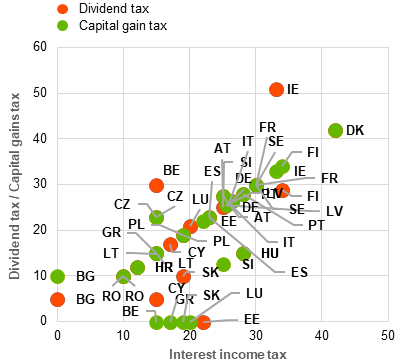
The levels of taxation of investment products vary across the EU. Currently, interest on bank deposits, investment fund gains, dividends and capital gains are taxed at the same level in most Member States (Chart A, panel a). Some jurisdictions have progressive taxes (Spain) or specific exemptions for lower amounts of bank deposits (Belgium, Denmark), securities (Denmark), government bonds (Italy), EU securities holdings (Bulgaria) or non-domestic securities holdings (Cyprus). Several European countries, including Belgium (until 1 January 2026), the Czech Republic, Luxembourg, Slovakia and Slovenia, do not impose capital gains taxes on the sale of long-term shareholdings, in some cases subject to specific caps or conditions. Among the countries that do levy a capital gains tax, Greece and Hungary have the lowest rates at 15%.
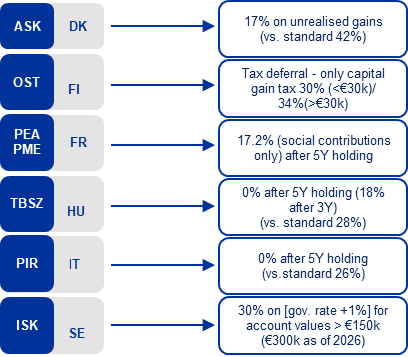
The success of dedicated savings and investment accounts can be fostered by several factors. Countries like France, Hungary and Italy offer exemptions from investment income tax if the investment in the respective savings accounts is held for at least five years (Chart A, panel b). The attractiveness of the Swedish ISK stems from both the reduced tax rate and its simplicity: instead of taxing realised dividends/capital gains, it applies a simple annual tax based on the account value. Sweden also introduced a tax-free base level of SEK 150,000 in 2025 (rising to SEK 300,000 from 2026), with a flat annual tax based on the Swedish government borrowing rate which applies to holdings above the base level.[21] The ISK is part of a broader context, including a highly developed system for long-term savings supported by a large funded pension system, and a high level of financial literacy fostered by an early exposure to capital markets. It also highlights that policies aimed at increasing retail participation are likely to take time to build savers’ experience, trust and should offer simple, diversified and low-cost products to accommodate savers’ preferences, risk tolerance and diversification of portfolios over extended periods.
Chart A
Tax rates on interest income vs dividends and capital gains
a) Interest income compared to tax rates of dividend income and capital gains | b) Tax rates for existing SIAs |
|---|---|
(Dec. 2025, percentages) | |
 |  |
Sources: PricewaterhouseCoopers and Tax Foundation.
Notes: In panel a), the labels in bold are associated with the capital gains tax and the others with the dividend tax; countries with the same rate of dividend tax and capital gains tax have overlapping labels, so they only appear once in the chart. Spain has progressive income bands for all types of investments (by income band, the tax level can be ~19/21/23/27/30%) and the chart presents the mid-point of 23%. Capital gains are subject to Luxembourg progressive income tax rates (0% to 45.78), provided the holding period is less than six months, the chart showing the value 0%. In Slovakia, shares are exempt from capital gains tax if they were held for more than one year and are not considered part of the taxpayer’s business assets. In Slovenia, a capital gains rate of 0% is applied if the asset was held for more than 15 years; a rate of up to 25% is applied for periods less than 15 years. The chart shows a mid-point of 12.5%. In France, exceptional surtax on high income and differential contribution on high incomes are applicable in addition to the 30% income tax.
The following abbreviations are used in panel b) Aktiesparekonto (ASK), Osakesäästötili (OST), Plan d’Epargne Actions (PEA) and PEA-PME dedicated to SME companies, Tartós Befektetési Számla (TBSZ), Piani Individuali di Risparmio (PIR), Investeringssparkonto (ISK).
Besides the level of taxation, the method of taxation can also affect capital market participation and lead to different impacts in terms of foregone tax revenue or the costs associated with incentives provided. Countries with some of the highest levels of tax (Chart A, panel a) have highly developed capital markets (Ireland, Denmark, Sweden), while countries with low tax levels tend to be those with less sophisticated markets. Similarly, there does not seem to be a correlation between having a more beneficial tax rate for dividends or capital gains relative to bank deposits (Bulgaria, the Czech Republic, Belgium, Ireland) and the level of capital market development. To attract new retail investors to capital markets, savings products must be simple, accessible and affordable. Incentives such as tax advantages, if used, should be tailored to encourage new savers rather than benefiting existing investors. Therefore, it is worth also looking at the method of taxation to foster capital market participation and financial literacy. Elements such as tax exemptions and deferrals can act as incentives, but the transmission channel to retail participation can be quite different depending on the method and needs to be balanced with the fiscal implications.
- Tax allowances reduce the taxable income base by a set amount (e.g. deductible contributions to a savings product) before the marginal tax rate is applied. They have a stronger impact on the participation of higher-income individuals to capital markets, who typically face higher tax rates. The implementation of this method can, however, become too complex for cross-border taxpayers, since it requires alignment of overall personal income and overall tax rates which may differ across countries. It may also result ineffective to increase the participation of low earners, who may already benefit from preferential tax income brackets.
- Tax exemptions mean that the income generated by the savings and investment account (interest or dividend returns, or capital gains) is not taxed. This method can be highly effective in increasing broad retail participation if designed in a simple manner, but are typically capped to contain their fiscal impact. Forgoing tax on large investment returns may not be sustainable for the public purse.
- Tax deferrals delay taxation until funds are withdrawn and/or returns are distributed. They are powerful ways of incentivising long-term investments and have often been used to incentivise pension savings. Limits need to be imposed to avoid that investors roll assets from one deferred tax to another (or switch providers/countries) and never face a taxable withdrawal.
- Uniform flat tax is a tax applied in a standardised way either to the income generated or to the value of assets held in the account. This approach is simple to follow, ensures market neutrality and reduces arbitrage. While it can increase participation to some extent, it is also less targeted and therefore has a potentially larger fiscal impact.
In the case of interest payments, the number of countries having a higher domestic rate compared with the conventional rate is lower, as the majority of countries exempt cross-border interest payments under their domestic rules. See “New EU system for the avoidance of double taxation and prevention of tax abuse in the field of withholding taxes (WHT)”, Commission Staff Working Document – Impact Assessment Report, European Commission, 2023.
For an illustration of the costs and cumbersome processes linked to WHT refund procedures, see “Withholding taxes on dividends in the European Union: An uphill battle for individual shareholders”, Better Finance/DSW, May 2023.
See Chan, K., Covrig, V. and Ng, L., “What Determines the Domestic Bias and Foreign Bias? Evidence from Mutual Fund Equity Allocations Worldwide”, The Journal of Finance, Vol. 60, Issue 3, 2005, pp. 1495-1534; based on a sample of mutual funds from 26 developed and developing countries, the authors find that countries with higher withholding taxes receive less foreign equity investment. Similar evidence can be found in Pellegrino, B., Spolaore, E. and Wacziarg, R., “Barriers to Global Capital Allocation”, The Quarterly Journal of Economics, Vol. 140, Issue 4, 2005, pp. 2067-3131; using a new bilateral tax dataset and a general equilibrium model of portfolio choice, the authors show that capital-income tax wedges (including withholding taxes) are negatively associated with bilateral portfolio positions.
See Fatica, S. et al., “Economic Effects of Simplified Procedures for Claiming Cross-Border Withholding Taxes”, JRC Working Papers in Taxation and Structural Reforms, No 09/2023, European Commission, 2023. Using EU foreign portfolio investment (FPI) data for 83 countries (2013-20), the authors find that higher non-refundable withholding taxes reduce bilateral equity and debt FPI stocks; for example, a 10 percentage point cut in non-refundable withholding taxes increases the FPI stock of equity holdings by 8.2%.
Jacob, M. and Todtenhaupt, M., Withholding Taxes, Compliance Cost and Foreign Portfolio Investment, 30 March 2020. The authors examine the effect of compliance frictions in reclaiming foreign withholding tax overpayments and find that simplifying the reclaim process through a relief at source mechanism could increase foreign portfolio investments by about 7.6%.
See AMI-SeCo’s response to the public consultation on withholding tax procedures, June 2022, calling for a robust, common framework for WHT relief at source based on fully harmonised definitions, procedures and reporting/information exchange.
Council Directive (EU) 2025/50 of 10 December 2024 on faster and safer relief of excess withholding taxes (OJ L, 2025/50, 10.1.2025). Member States will have to transpose the directive into national legislation by 31 December 2028, and the new rules will only become applicable from 1 January 2030.
See “New EU system for the avoidance of double taxation and prevention of tax abuse in the field of withholding taxes (WHT)”, Commission Staff Working Document – Impact Assessment Report, European Commission, 2023.
Several EU countries, such as Denmark, Germany, Spain and Austria, do not have a relief at source system.
The United States, the United Kingdom and China offer relief at source for withholding taxes on income from capital investments under certain double tax agreements which are bilaterally negotiated (see Double taxation Conventions on the European Commission’s website). A survey by Better Finance/DSW found that Switzerland, the United States, Norway and the United Kingdom are perceived as the most “investor”-friendly destinations for investment thanks to smooth procedures – ahead of EU countries.
See The AMI-SeCo’s observations and recommendations on the proposal on Faster and Safer Relief of Excess Withholding Taxes, 17 November 2023.
The Commission recommends Member States to set up SIAs with the following characteristics: low costs, portability across the EU, ease of asset transfers across providers, streamlined tax processes and possible tax advantages. See Commission Recommendation on Increasing the Availability of Savings and Investment Accounts with Simplified and Advantageous Tax Treatment.
These differ from retirement accounts, which function similarly but generally restrict withdrawal of savings until retirement and include specific tax treatments for the objective of increasing pension savings.
See Bierbaum, M., “Designing savings and investment accounts in the EU”, New Financial, May 2025. See figure 3 of the report on p. 7. Take-up is computed as the number of people with a savings and investment account as a share of the national population aged 15+. See point 5 of the summary of the report for the main success factors behind the Swedish ISK.
For a review of the determinants of savings, see Boadway, R. and Wildasin, D., “Taxation and Savings: A Survey”, Fiscal Studies, Vol. 15, No 3, 1994, pp. 19-63.
See Dimou, M., Flaccadoro, M. and Gareis, J., “The household saving rate revisited: recent dynamics and underlying drivers”, Economic Bulletin, Issue 8, ECB, 2025.
Ricardian saving, derived from Ricardian Equivalence, is the theory that rational, forward-looking households save more today to offset future tax increases needed to pay off government debt, meaning government borrowing has little effect on aggregate demand; see Barro, R.J., “Are Government Bonds Net Wealth?”, Journal of Political Economy, Vol. 82, No (6), 1974, pp. 1095-1117.
See “Taxation of Household Savings”, OECD Tax Policy Studies, No 25, OECD, 2018.
Under the deemed-return approach, the Dutch Tax Administration assumes that the assets of a taxpayer generate a fixed, legal percentage of return, not based on actual earnings, but only on the type of asset. The system has been updated in 2026 to align more closely with market rates and property rights (taxpayers can now report their actual return if it is lower than the deemed return), but it still relies on assumptions. Assets are divided into three categories, each with its own assumed return rates: bank savings are assumed to have a low return (1.44% in 2025, projected similar for 2026), while capital investments are assumed to have a higher, fixed return (5.88% in 2025, 6% in 2026).
See Bierbaum, M., op. cit. According to the Commission staff working document underpinning the proposal, Poland has also announced plans to introduce an SIA framework from 2026.
Unlike ordinary securities accounts, ISKs are taxed at a lower annual standardised rate rather than as capital gains. This tax applies to assets above a certain threshold (SEK 150,000, or around €13,000) and is calculated as 30% of the government borrowing rate plus 1%, amounting to 0.888% in 2025. The tax is based on the average market value of assets above the threshold across four quarters. Taxes are generally lower than the standard Swedish capital gains tax of 30%, making ISKs favourable for individuals. Dividends on qualifying investments are tax-free, and portfolio reallocations have no tax consequences since sales are untaxed. However, capital losses cannot be deducted. The tax-free allowance will increase to SEK 300,000 (~€26,000) in 2026.