




Published as part of the ECB Economic Bulletin, Issue 3/2026.
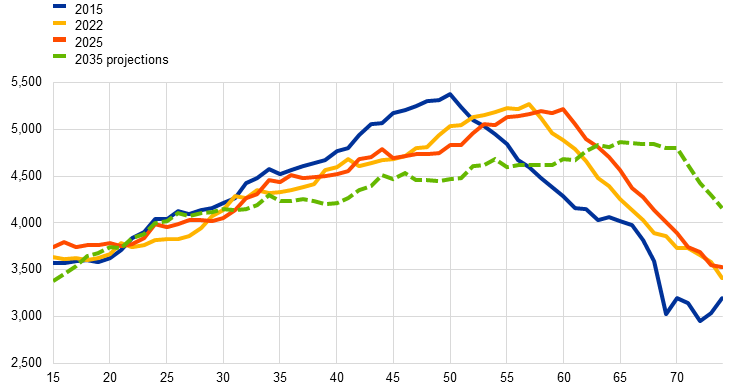
The euro area is undergoing sizeable demographic changes that are visible even in the shorter run, with significant implications for employment. Demographic changes do not just affect the economy in the long term, they can also influence short-term labour market developments. Ageing leads to noticeable changes in age distribution, even over relatively short periods of time (Chart A). Employment rates vary across age groups, with those among older people being lower on average. This means that, in an ageing economy, compositional shifts within the working-age population mechanically affect aggregate employment rates.[1] At the same time, changes in statutory retirement ages, rising life expectancy and improving health at later stages of life increase labour market attachment.[2]
Chart A
Working-age population (15-74 years) in the euro area, by age and year
(thousands)
Sources: Eurostat and ECB staff calculations.
Note: The projections for 2035 are derived from the EUROPOP2023 projections.
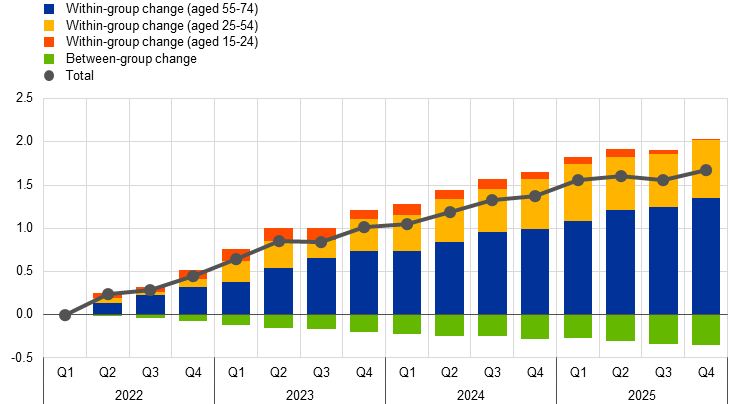
Older workers have contributed significantly to employment growth in recent years, while the pure negative compositional effect of ageing has been small. Since the first quarter of 2022 the total employment rate in the euro area has increased by 1.7 percentage points, up from 60.3% to approximately 62% in the last quarter of 2025. To better understand the contribution of older workers to this growth, we decompose the total change into different contributions: (i) to isolate the contribution to changes in the employment rate from different age groups, we use the actual employment rate of a given age group and fix population shares and the employment rate of other groups at the levels observed in the first quarter of 2022 (Chart B; blue, orange and red bars); and (ii) to cover the effects of changes in age composition, we allow for changes in population weights (i.e. the size of an age group in the total population) but keep employment rates for each age group constant (Chart B; green bars). The analysis reveals that, despite representing only 34% of the working-age population in 2022, individuals aged 55-74 have contributed 1.4 percentage points to the total increase in the employment rate (compared with a zero contribution from individuals aged 15-24 and a smaller contribution of 0.7 percentage points from individuals aged 25-54). Moreover, the results show that the pure compositional effect of ageing was relatively modest from the first quarter of 2022 until the end of 2025, amounting to a contribution of only ‑0.4 percentage points.
Chart B
Cumulative change in the euro area employment rate
(percentages, percentage points)
Sources: EU Labour Force Survey (EU-LFS) and ECB staff calculations.
Notes: The between-group changes are derived from keeping employment rates for each age group constant but allowing for changes in population weights. For the within-group changes, both the population weights and employment rates of other groups are kept constant. The latest observations are for the fourth quarter of 2025.
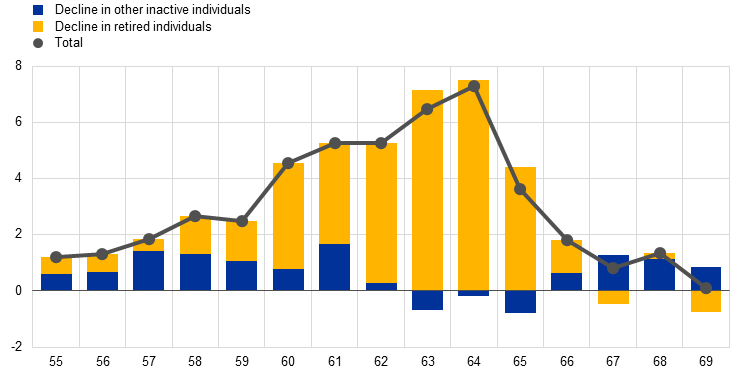
The current trend towards later retirement than in previous generations has been a key driver of employment growth. More than 90% of the increase in the employment rate among older workers has been driven by the rising participation rate in that group, rather than by a higher share of active individuals in employment.[3] Using micro data from the EU Labour Force Survey, we can break down changes in the labour force participation rate by reason for inactivity. The recent rise in participation in the labour force reflected a decline in the share of retired individuals, particularly among workers aged 60-65 (Chart C). Information on employment transitions from the EU Labour Force Survey and the ECB Consumer Expectations Survey confirms that the decline in the share of retired individuals was driven by lower transitions into retirement, rather than by more people moving from inactivity back into employment.
Chart C
Change in the euro area labour force participation rate from the fourth quarter of 2021 to the fourth quarter of 2024
(percentages, percentage points)
Sources: EU Labour Force Survey (EU-LFS) and ECB staff calculations.
Note: Austria, Greece, Ireland, the Netherlands and Slovakia are excluded, since there are no data available for those countries.
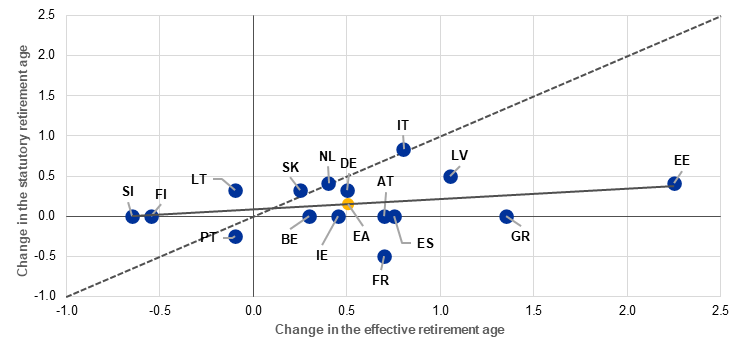
Recent changes in effective retirement ages can be only partly explained by changes in statutory retirement ages. The average effective age of exiting the labour market rose in almost all euro area countries from 2022 to 2024, with a sizeable average increase of around 0.5 years. However, in most euro area economies, this increase in the effective retirement age was higher than the rise in the statutory retirement age (Chart D): a one-year increase in the effective retirement age was associated with an increase of just 0.1 years in the statutory retirement age (slope of the fitted line in Chart D), with this increase not being statistically significant.[4] This suggests that recent changes in statutory retirement ages appear to have played only a limited role in driving later retirements.
Chart D
Changes in effective and statutory retirement ages across countries from 2022 to 2024
(years)
Sources: OECD (2023), OECD (2025) and ECB staff calculations.
Notes: The effective retirement age refers to the average age of exiting the labour market. The statutory retirement age is the average normal retirement age for an individual with a full career who entered the labour market at the age of 22. The yellow dot shows the unweighted average across the euro area countries. There are no data available for Croatia, Cyprus, Luxembourg, Malta or Bulgaria.
Rising retirement ages are expected to continue supporting employment growth in the coming years. The later retirement of workers appears to be a structural, long-term trend.[5] The share of retired individuals in the total population shows little sensitivity to the economic cycle, but declined steadily from 2006 to 2024 (Chart E). However, the timing of this decline varies across age groups. Among individuals aged 55-59, retirement rates fell sharply in the early 2000s and seem to have stabilised at below 10%. For those aged 60-65, the decline began later and is ongoing, with average rates still at around 40%. A comparison with other advanced economies suggests that there is indeed scope for further increases in employment rates among older workers. For instance, in Japan, a country that has experienced an extreme ageing process, employment rates among workers aged 60-64 and 65-69 stood at roughly 74% and 54% respectively in 2024, compared with significantly lower rates in the euro area, at 53% and 19% respectively. Looking ahead, this suggests that overall retirement ages will continue to rise, in line with the projections presented in the European Commission’s 2024 Ageing Report. The pace, however, will depend on changes in statutory retirement ages and health developments.
Chart E
The share of retired individuals in the euro area, by age
(percentages)
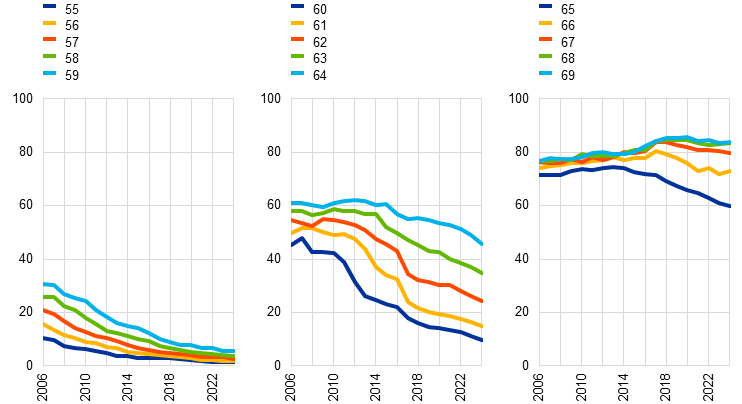
Sources: EU Labour Force Survey (EU-LFS) and ECB staff calculations.
Notes: Austria, Germany (until 2016), Greece, Ireland, the Netherlands and Slovakia are excluded since there are no data available. Retirement shares are relative to the age-specific population. The latest observations are for 2024.
References
Arce, Ó. and Sondermann, D. (2026), “Low unemployment, plenty of labour: what does it imply for wage pressures?”, The ECB Blog, ECB, 9 March.
Berson, C. and Botelho, V. (2023), “Record labour participation: workforce gets older, better educated and more female”, The ECB Blog, ECB, 8 November.
Bodnár, K. and Nerlich, C. (2020), “Drivers of rising labour force participation – the role of pension reforms”, Economic Bulletin, Issue 5, ECB.
Consolo, A., Dias da Silva, A., Furbach, N. and Gomez-Salvador, R. (2026), “Drivers of the labour force in the euro area”, Economic Bulletin, Issue 3, ECB.
European Commission (2024), “2024 Ageing Report. Economic and Budgetary Projections for the EU Member States (2022-2070)”, Institutional Papers, No 279, European Commission, April.
Organisation for Economic Co-operation and Development (OECD) (2023), “Pensions at a Glance 2023”, OECD, 13 December.
Organisation for Economic Co-operation and Development (OECD) (2025), “Pensions at a Glance 2025”, OECD, 27 November.
The employment rate is defined as the share of employed individuals in the total population.
See, for example, Arce and Sondermann (2026), Berson and Botelho (2023) and Consolo et al. (2026).
The employment rate can be decomposed into the participation rate (the share of individuals in the total population who are active, i.e. either employed or actively seeking work) and the share of employed people among the pool of active individuals.
When analysing data from 2000 to 2019, the slope coefficient rises to around 0.5, which is statistically significant at the 5% level. This suggests that, also in the long run, changes in statutory retirement ages can only partly explain increases in effective retirement ages.
See Bodnár and Nerlich (2020).