


Financial integration and structure in the euro area
Preface
This is the fourth edition of the biennial report published by the European Central Bank (ECB) on financial integration and structure in the euro area (FISEA). As detailed in the first edition, which was released in March 2020, the report focuses on structural developments in the financial system of the euro area and, in some cases, of the European Union (EU), as well as on related policy issues.[1]
It covers (i) developments in financial integration across euro area countries, (ii) changes in financial structure (the mix of financial markets and intermediaries), and (iii) financial development or modernisation (through innovations in the financial system, for example). The preface to the 2020 report defined these three concepts and explained how they relate to Eurosystem tasks and functions.
This report focuses on issues that are relevant for policy discussions on the European banking union, the European capital markets union, the European savings and investments union and the financial aspects of deepening Economic and Monetary Union.
The report is divided into two main chapters.
The first chapter provides analytical material, with a focus on the main trends in financial integration, structure and development, based on a review of the standard set of ECB indicators on financial integration and structure. The indicators and their descriptions are included in an online statistical annex.
The second chapter identifies policy priorities in the light of ongoing policy debates.
The report also includes boxes that examine the following six topics in greater depth.
- Integrated supervision as a pillar of European capital markets
- A harmonised tax area within the EU?
- Euro area household savings allocation and the role of taxation
- Exploring the investor landscape for venture capital
- The role of the Eurosystem in the scaling-up of a tokenised financial ecosystem
- Closing the gap? Gauging the development and integration of Europe’s capital markets
The cut-off date for data used in this edition of the report was 9 April 2026.
Executive summary
The euro area has seen significant progress in financial integration since late 2022, with several indicators surpassing the historical averages calculated over the period from the start of the Economic and Monetary Union (EMU) to today. This development is reflected in both price-based and quantity-based indicators, which show broad advances across bond, equity and banking markets. The improvement has been driven by key factors including a reduction in the risk premia associated with potential euro area disintegration and EU-level policy initiatives such as the Next Generation EU (NGEU) programme.
While financial integration has strengthened, external financing flows have weakened due to rising borrowing costs and cautious corporate sentiment. Companies, households and governments have increasingly relied on deleveraging and internal funds or preferred safer, short-term debt instruments for their financing. Nonetheless, cross-border intra-euro area financing providers have played a larger role in capital markets, showcasing enhanced intra-euro area integration.
The prominence and role of non-bank financial intermediaries (NBFIs) – specifically investment funds and insurers – in financing the real economy has grown further and has facilitated cross-border risk-sharing. Increased interconnectedness between banks and NBFIs via loan and investment fund share exposures has further diversified the financial system.
The quality and resilience of financial integration have improved. This is particularly true of debt markets, which have benefited from stronger cross-border growth compared with equities. By contrast, equity market integration has declined since 2022, with intra-euro area foreign direct investment dropping to historically low levels. These trends highlight the need for policies that address structural barriers to equity market integration while preserving the resilience of cross-border financing mechanisms.
The European Commission launched the savings and investments union (SIU) initiative in March 2025 with a view to reinvigorating policy efforts to address long-standing inefficiencies in the EU’s financial system. Building on the foundation laid by the capital markets union, the SIU initiative aims to unlock the EU’s economic potential by channelling financial savings more effectively into productive investments. Despite the EU’s economic promise, suboptimal allocation of savings to investments, driven by structural barriers and fragmented markets, has hindered growth and competitiveness. The SIU therefore sets out a road map to transform the financial landscape for institutions, citizens and businesses.
The report goes on to examine selected topics that relate to the SIU priority areas: supervision of financial markets, taxation, retail participation in equity markets, pension systems, the role of private markets (including venture capital) and post-trading infrastructure. These priorities are interconnected and each contributes to the broader goal of fostering economic growth and increasing wealth across the EU.
Financial supervision in the EU is fragmented across Member States, resulting in material differences in supervisory practices and enforcement outcomes. This makes it harder for market participants to carry out cross-border activities, creates a non-level playing field and increases the risk of regulatory arbitrage. The complexities of the current supervisory set-up support the case for targeted reforms to centralise supervision of large cross-border firms and inherently cross-border financial sectors at EU level, while acknowledging market specificities. Integrated supervision of EU capital markets and further progress on supervisory convergence are necessary steps to removing existing barriers to capital market integration, which should go hand in hand with the adoption of EU regulations.
More harmonised corporate tax rules across the EU could facilitate cross-border business activities, including those carried out by financial institutions. The Commission has made proposals to increase harmonisation of corporate taxation, but progress has been slow. Complex and inefficient procedures for refunding withholding taxes paid abroad act as a barrier to cross-border saving and investing within the EU. While the EU’s Faster and Safer Tax Relief of Excess Withholding Taxes (FASTER) Directive[2] will help to streamline and harmonise withholding tax relief procedures, cross-border investment within the EU remains more costly than domestic investment, which hinders capital market integration and the efficient allocation of savings across borders.
Euro area households hold a relatively large share of their financial assets in the form of bank deposits, while listed equity plays a smaller role. Holding a higher share of euro area equity could generate higher returns for households and improve financing opportunities for enterprises, thereby supporting the euro area economy as a whole. The introduction of savings and investment accounts, which financial institutions offer to households via government programmes, could encourage households to participate more in equity and other capital markets. Capital gains tax relief for these accounts could support a shift toward capital markets, but evidence suggests the impact may be modest due to households’ strong preference for deposits, which is driven by factors such as financial literacy, access to information and pension systems. This shows it is essential to consider not only tax rates but also the method of taxation when designing effective tax incentives.
Most state pensions in Europe operate on a pay-as-you-go basis without accumulating capital market assets. By contrast, occupational and private pensions are pre-funded, investing significant resources in – and thereby contributing to – the development of capital markets. Channelling pension-related savings into EU capital markets would be a vital way of addressing demographic and strategic challenges. On 20 November 2025 the Commission adopted its supplementary pensions package, which sets out targeted measures to strengthen supplementary pensions and improve transparency and efficiency in pension systems. The Commission has emphasised that these measures are intended to complement, not replace, public pensions, which remain the foundation of pension systems in all Member States.
Private markets focus on more innovative sectors and tend to finance companies that lack the scale to issue securities in public equity or corporate bond markets. Corporates financed via private markets generally have higher levels of productivity but worse risk metrics. Risk monitoring is therefore important, and transparency in private markets should be improved. At the same time, further growth of private markets could benefit the financing of small and medium-sized enterprises, thereby helping to advance the objectives of the SIU. The venture capital investor landscape in Europe is dominated by public institutions. Increasing the involvement of institutional investors would make it possible for larger venture capital funds to finance the needs of late-stage companies that otherwise seek funding outside the EU. Overall, the broader innovation financing ecosystem in Europe would benefit from policies addressing fragmentation within the Single Market and improving exit opportunities for firms in Europe.
Substantial efforts have been made to improve the integration of the post-trading landscape in the EU. However, persistent fragmentation makes European financial markets a less attractive prospect for investors. On 4 December 2025 the Commission adopted its market integration package, which includes important measures to deepen integration in the post-trade landscape. The persistent fragmentation of issuance practices, the regulatory framework, national laws and tax rules must be addressed in order to fully integrate the EU securities issuance and post-trade landscape.
1 Financial integration and structure developments
1.1 Financial integration developments
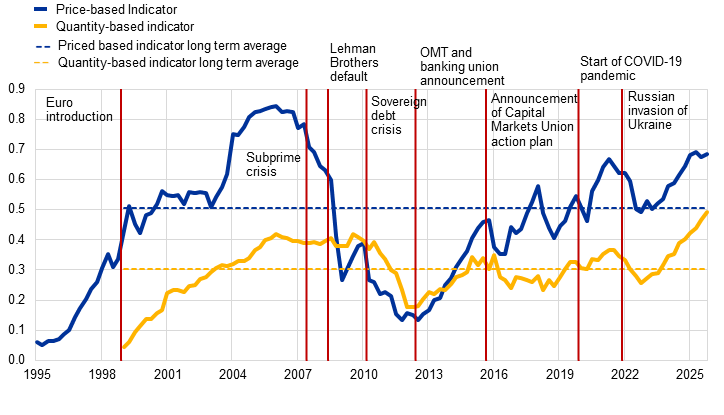
Financial integration, as measured by both price-based and quantity-based composite indicators, increased significantly between the end of 2022 and the fourth quarter of 2025,[3] reaching levels well above the average since the start of Economic and Monetary Union (Chart 1.1). Price-based indicators, in particular, showed a clear and substantial increase over this period, with this trend being even more pronounced in the sub-indices. Importantly, the improvement was broadly uniform across bond, equity and banking markets, suggesting that equity market valuations did not play a dominant role (Statistical Annex (SA), Financial Integration (FI), Chart 1, S1-S4).[4] However, some heterogeneity remains, as the money market sub-index – covering the unsecured segment only – exhibited some volatility and did not follow the same upward trend.
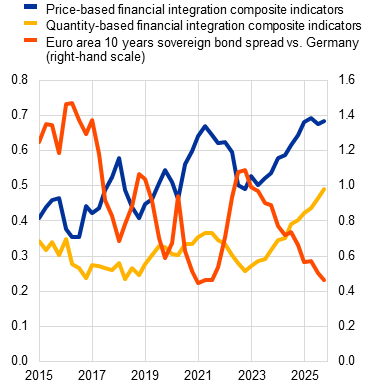
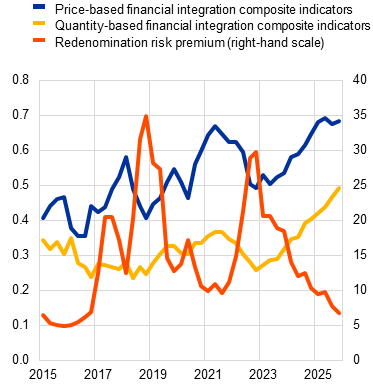
Quantity-based measures also increased significantly over the review period, confirming the substantial improvements in financial integration. The reduction in risk premia associated with euro area disintegration was a key driver of this development and helped sustain it (Chart 1.2).
The Next Generation EU (NGEU) programme has the potential to substantially improve economic convergence and thus support market integration.[5] While the NGEU programme has significant potential to enable a long-term shift toward deeper convergence, its ultimate impact hinges on the effective and timely execution of national recovery and resilience plans, many of which have been hampered by widespread delays.
Chart 1.1
Price-based and quantity-based financial integration composite indicators
(Q1 1995-Q4 2025; price-based indicator, quantity-based indicator)
Source: ECB and ECB calculations.
Notes: The price-based composite indicator aggregates ten indicators for money, bond, equity and retail banking markets. The quantity-based composite indicator aggregates five indicators for the same market segments except retail banking. The indicators are bounded between zero (full fragmentation) and one (full integration). Increases in the indicators signal greater financial integration. From January 2018 the behaviour of the price-based indicator may have changed due to the transition from the euro overnight index average (EONIA) to the euro short-term rate (€STR) in the money market component. OMT stands for Outright Monetary Transactions. For a detailed description of the indicators and their input data, see the Statistical Annex to this report and Hoffmann, P., Kremer, M. and Zaharia, S., “Financial integration in Europe through the lens of composite indicators”, Working Paper Series, No 2319, ECB, September 2019.
Chart 1.2
Composite indicators and standard deviation of risk premia
a) Ten-year government benchmark bond spreads | b) Redenomination risk premia |
|---|---|
(Q1 2015-Q4 2025; price/quantity‑based indicator, percentage points) | (Q1 2015-Q4 2025; price/quantity‑based indicator, basis points) |
 |  |
Sources: LSEG, ICE and ECB, Thomson Reuters and Credit Market Analysis Ltd (CMA) and ECB calculations.
Notes: For a detailed description of the composite indicators and their input data, see the Statistical Annex to this report and Hoffmann, P., Kremer, M. and Zaharia, S., “Financial integration in Europe through the lens of composite indicators”, Working Paper Series, No 2319, ECB, September 2019. Panel a: ten-year government benchmark bonds do not exist for Estonia, Latvia or Luxembourg. Panel b: redenomination risk premia are estimated as the differences between US dollar-denominated credit default swap premia under the 2014 definitions of the International Swaps and Derivatives Association (2014 ISDA) and credit default swap premia under the 2003 definitions (2003 ISDA), also known as the ISDA basis. The premium is expressed in basis points of the notional amount of protection bought. The 2014 ISDA documentation includes default of the sovereign and currency redenomination as triggering credit events, while the 2003 ISDA documentation only includes default. Both have a maturity of five years.
1.1.1 Money markets
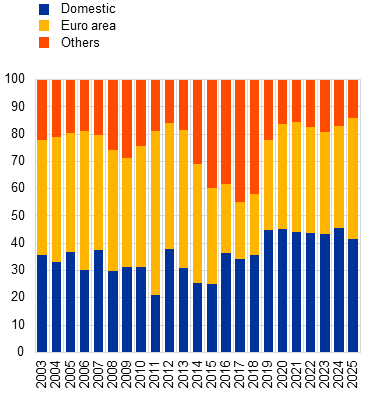
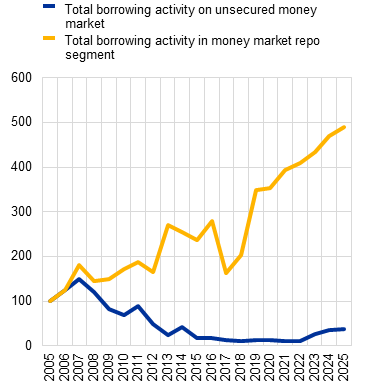
The integration of money markets deepened further across all segments during the review period. Cross-border money market activity increased significantly, driven by shifts in lending and borrowing dynamics. The geographical distribution of secured and unsecured transactions demonstrated a sharp rise in trades involving non-domestic counterparties in 2025, while domestic trading activity saw a notable decline (Chart 1.3, panel a).
Structural factors significantly bolstered cross-border secured lending. Improved sovereign creditworthiness, stronger banking profiles and the widespread adoption of central counterparties (CCPs) were key drivers of cross-border secured lending. As the creditworthiness of euro area sovereigns increased, their government securities gained broader acceptance as collateral, encouraging more repurchase agreements (repos) with non-domestic counterparties. Similarly, the strengthened credit profiles of European banks reduced counterparty risk and boosted confidence in cross-border transactions. The growing reliance on CCPs further facilitated this shift by mitigating bilateral credit risk, improving balance sheet efficiency and attracting non-domestic participants. Together, these developments spurred a transition from domestic bilateral markets to cross-border, centrally cleared platforms.
Liquidity needs and redistribution drove cross-border borrowing. Following the final repayments of the third series of targeted longer-term refinancing operations by the end of 2024, the uneven distribution of excess liquidity and market funding adjustments prompted institutions to seek funding beyond domestic markets. As some domestic liquidity buffers diminished, institutions also faced challenges in meeting regulatory requirements such as the liquidity coverage ratio. This led to a moderate increase in demand for secured funding via repos and a renewed reliance on unsecured borrowing to address residual liquidity needs (Chart 1.3, panel b). The resulting cross-border redistribution of liquidity underscored the growing importance of market-based mechanisms in an environment of declining excess liquidity.
An expanded collateral supply sustained low rate dispersion. The narrowing of repo rate dispersion observed in 2023 persisted, reflecting a more integrated and efficient market structure. This was supported by an expanded supply of eligible collateral, driven by higher euro area sovereign bond issuance and the Eurosystem’s reduced market footprint. Structural changes, including quantitative tightening and the run-off of asset purchase programme and pandemic emergency purchase programme portfolios, further boosted the availability of high-quality collateral. As the Eurosystem’s holdings declined, the free float (i.e. the portion of bonds available for trading) of sovereign bonds expanded, facilitating higher turnover and maintaining low rate dispersion in repo markets, even for transactions involving collateral from different euro area countries.
Chart 1.3
Trends in cross-exposures among sectors of the euro area financial system, by instrument type and holder sector
a) Geographical counterparty breakdown for secured and unsecured borrowing transactions | b) Borrowing activity in euro area unsecured and secured markets |
|---|---|
(2003-25; percentages of total transactions) | (2005-25; indices = 100 on 2005, average daily turnover) |
 |  |
Source: ECB (MMS until end-2015, then MMSR).
Notes: Data from 2016 are taken from the MMSR for those reporting banks that were also part of the Money Market Survey panel. Panel a: Figures are shown as a percentage of total transactions for the second quarter for each year, except for 2016 when third quarter data were taken following the transition to MMSR data.
1.1.2 Securities markets
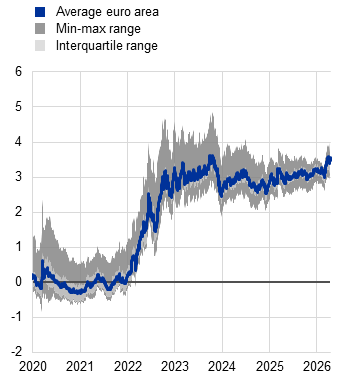
The dispersion of euro area ten-year sovereign bond yields stabilised during the review period (Chart 1.4, panel a). Although dispersion widened in 2022 amid policy rate hikes and repricing of sovereign risk, it subsequently stabilised, with the recent range remaining below its long-term historical average (SA, FI, Chart 11, S18). This stabilisation was supported by lower volatility, improved risk sentiment and stronger growth prospects – particularly in non-core countries, where improved fundamentals contributed to several credit-rating upgrades. In addition, upward pressure on German sovereign bond yields amid fiscal expansion contributed to narrower sovereign bond yield spreads, which are now close to multi-year lows. During the war in the Middle East, euro area sovereign bond yields have come under some upward pressures, though this impact has been relatively contained.
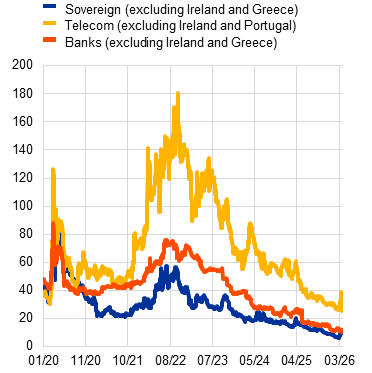
Credit default swap (CDS) premia also normalised, declining to levels below those prevailing before Russia’s invasion of Ukraine (Chart 1.4, panel b). The compression in CDS premia was supported by historically low market volatility across asset classes, alongside reduced uncertainty around monetary policy in the euro area as inflation declined towards target and amid well-anchored market-based inflation expectations.
Chart 1.4
Risk premia developments
a) Dispersion in euro area ten-year sovereign bond yields | b) Dispersion in five-year CDS premia across the euro area |
|---|---|
(01 Jan. 2020-14 Apr. 2026; percentages) | (1 Jan. 2020-25 Mar. 2026; basis points) |
 |  |
Sources: Refinitiv, ECB (FM) and ECB calculations.
Notes: Panel a: the shaded areas represent the minimum-maximum range and the interquartile range of benchmark bond yields for the euro area countries. he yields for Estonia, Greece, Cyprus, Latvia, Lithuania, Malta, Slovenia, Slovakia, Croatia and Bulgaria are excluded. Panel b: The indicators are simple standard deviations of the country averages. The sovereign and bank CDS premia data do not include Ireland and Greece, given the very high premia for these countries. Ireland and Portugal are excluded from the telecommunications data owing to the very high CDS premia of their telecommunications companies. “Sovereigns” include Germany, Spain, France, Italy, the Netherlands, Austria and Portugal. “Banks” include ABN AMRO (NL), Banca Monte dei Paschi di Siena (IT), Banca Popolare di Milano (IT), Banco Comercial Português (PT), Banco Sabadell (ES), Novo Banco SA (PT), Banco Santander Central Hispano (ES), Erste Bank der österreichischen Sparkassen (AT), HypoVereinbank (DE), BNP Paribas (FR), Deutsche Bank (DE), Commerzbank (DE), Crédit Agricole (FR), Dexia Group (BE), Fortis NL (NL), Intesa Sanpaolo SPA (IT), Mediobanca (IT), Natixis (FR), Nordea Bank (FI), Société Générale (FR) and UniCredito Italiano (IT). “Telecoms” include Deutsche Telekom (DE), Orange (FR), Hellenic Telecommunications Organization (GR), KPN (NL), Telecom Italia (IT), Telefónica (ES) and Telekom Austria (AT).
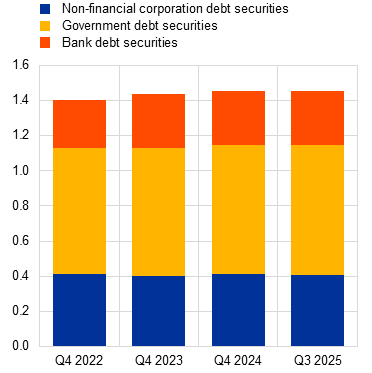
The composition of debt securities evolved as the total stock increased (Chart 1.5, panel a). Government-issued securities outstanding recorded a slight decline, bank-issued securities saw a moderate increase, and those issued by the non-financial corporation (NFC) sector registered a minor reduction.
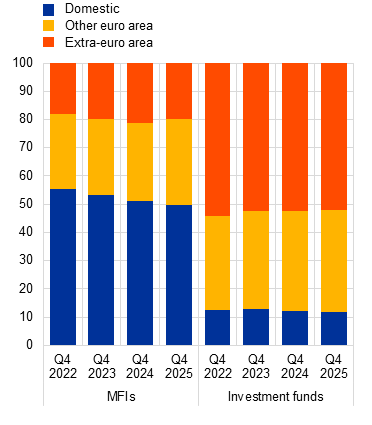
The share of monetary financial institution (MFI) bond holdings that are non-domestic reached its highest level since 2010 (Chart 1.5, panel b). As central bank balance sheet normalisation progressed and the Eurosystem reduced its footprint in euro area bond markets, a larger share of net issuance had to be absorbed by alternative investors. Against this backdrop, MFIs stepped in and increased their holdings of euro area sovereign bonds and, interestingly, also the share of their non-domestic sovereign bond holdings. The improving fundamentals of non-core countries in particular, which was reflected in historically narrow sovereign bond yield spreads, may have sustained this development. In the specific case of banks, the share of non-domestic European government bond holdings within their buffers of high-quality liquid assets increased, along with holdings of non-domestic debt more generally. This development is helping to reduce the sovereign-bank nexus, which is in turn fostering the smooth transmission of monetary policy in the euro area.
Investment funds similarly increased their share of non-domestic (other euro area) debt holdings (Chart 1.5, panel b). Similar drivers to those mentioned in the previous paragraph were likely at play, such as the improved macroeconomic outlook for non-core countries, reduced fragmentation risk and stable market functioning.
Chart 1.5
Debt securities markets
a) Debt securities outstanding, by issuer sector | b) Holdings of debt securities, by issuer domicile |
|---|---|
(Q4 2022-Q3 2025; ratio to nominal GDP) | (Q4 2022-Q4 2025; percentages of total holdings of debt securities) |
 |  |
Source: ECB.
Notes: Panel b: MFIs stands for monetary financial institutions. Debt securities exclude shares and include money market paper held by investment funds located in the euro area. A complete list of investment funds is available from the ECB website.
1.1.3 Banking markets
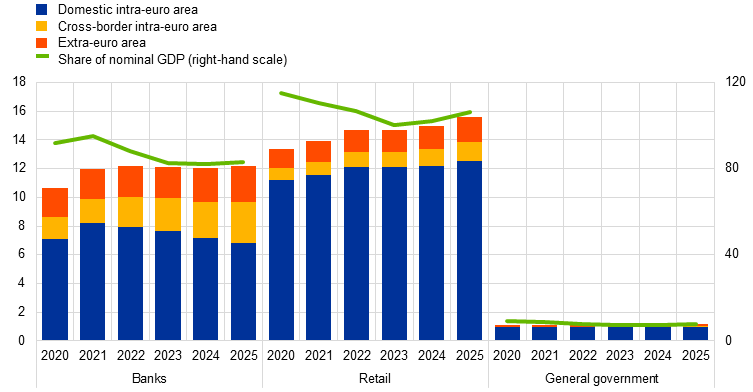
Banks remain the largest suppliers of loans to the euro area economy, accounting for approximately 43% of the total stock of loans outstanding as of the third quarter of 2025 (SA, Chart 5, ST51).[6] Both retail and interbank loans declined relative to nominal GDP over the review period (Chart 1.6). Interbank lending stabilised at around €12 trillion from 2021, with notable increases in both intra-euro area cross-border and extra-euro area interbank lending. Retail bank lending grew by €0.3 trillion, up from €14.6 trillion at the end of 2022, with intra-euro area cross-border and extra-euro area loans as a share of total retail bank loans increasing by 0.7 and 0.5 percentage points to 7.8% and 10.7% respectively by the end of 2024.[7] Outstanding bank loans to governments have remained stable at around €1.1 trillion for the past decade, reflecting the relatively minor role of bank lending in government financing as governments primarily rely on debt securities issuance. Cross-border extra-euro area bank loans to governments continue to account for a larger share than cross-border intra-euro area loans.
Chart 1.6
Stock of bank loans in the euro area, by counterparty type and domicile
(2020-25; left-hand scale: € trillions, right-hand scale: percentages)
Sources: ECB (BSI, MNA) and ECB calculations.
Note: The figures shown correspond to end-of-year data.
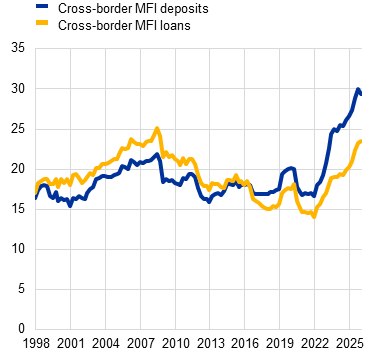
Cross-border interbank lending picked up significantly after the start of the monetary policy tightening cycle, reflecting the redistribution of shrinking liquidity and the increased cost of funding that typically accompanies tighter monetary conditions. The share of cross-border lending in the total outstanding interbank loans in the euro area rose substantially from around 14% at the beginning of 2022 to 23% at the end of 2025 (Chart 1.7, panel a). Meanwhile, the share of bank deposits from non-domestic euro area banks also increased, accounting for 29% of all MFI deposits in 2025. These developments reveal that repo and unsecured money markets are becoming more active again, as the ECB normalises its balance sheet and excess liquidity is redistributed across countries. Overall, the activities suggest stronger financial integration between euro area MFIs and less fragmentation in interbank markets, which is facilitated by the increasing size of this market.
Chart 1.7
Euro area interbank lending, by domicile of counterparty, and CDS spreads of euro area banks
a) Share of outstanding loans and deposits between euro area MFIs, by domicile of counterparty | b) CDS spreads and standard deviation of the CDS spreads of euro area banks |
|---|---|
(Q1 1998-Q4 2025; percentages of total lending and deposits excluding the Eurosystem) | (2 Jan. 2002-16 Apr. 2026; basis points) |
 |  |
Sources: Bloomberg Finance L.P., LSEG and ICE, Credit Market Analysis Ltd. (CMA) and ECB calculations.
Notes: Panel a: underlying data refer to the national aggregated MFI balance sheet data reported on a non-consolidated basis to the ECB at monthly and quarterly frequencies. These data cover the MFI sector excluding the Eurosystem and include data on money market funds (MMFs). Consequently, as MMFs typically invest in inter-MFI deposits and short-term securities, the indicators providing data for these assets are, to some extent, affected by MMFs’ balance sheet items. Balance sheet positions with foreign counterparties include those with foreign branches and subsidiaries. Underlying data include the UK figures up to 31 December 2019. Panel b: based on CDS data available for banks in the EONIA panel. A rolling window of 60 days is applied in calculating standard deviation.
The share of cross-border lending in total bank lending to non-MFIs increased, albeit at a moderate pace (SA, FI, Chart 17). Banks increased the share of loans extended to corporates and households in euro area countries outside the bank’s domestic market. This trend started in 2019 and continued in line with previous years. Meanwhile, the share of domestic lending declined. While this indicates that domestic borders are gradually becoming more permeable, domestic lending still accounts for more than 80% of total loan volumes, while only around 8% of loans are extended to counterparties in other euro area countries.
Loan growth has varied significantly across euro area countries since the COVID-19 pandemic and remains mixed (SA, FI, Chart 22). While banks in some countries only started to expand their loan portfolios again in late 2025, following years of negative growth, others recorded substantial growth throughout the post-pandemic period. As such, loan growth rates ranged between -0.6% and 11.6% in February 2026. This stark dispersion highlights variation in economic growth trajectories, differences in loan demand and supply, and uneven monetary policy pass-through across euro area countries.
The range of lending rates to households is currently rather narrow by historical standards, as euro area households have become more resilient (SA, FI, Chart 28). Consumer credit loans, in particular, are now priced more uniformly, a trend that has persisted for the past decade. However, differences in fixed-rate mortgage rates have increased again slightly since the start of the easing cycle, which is likely due to differences in the exact length of the interest rate fixation periods and benchmark rates. Overall, the increased resilience of euro area households, underpinned by lower debt/disposable income ratios, lower unemployment rates and high savings, and competition among banks have contributed to the convergence in loan pricing.
The dispersion of euro area bank deposit rates has increased substantially, which demonstrates that deposit markets remain highly fragmented (SA, FI, Chart 25). While regulatory factors (such as the Livret A product in France) and deposit book maturity structures play a role, differences in deposit rates also reflect the degree of deposit competition in a given country and banks’ own funding positions. For example, banks that rely to a larger extent on market-based funding have increased their deposit rates more, as deposit funding has become substantially cheaper than market-based financing with the exit from the negative interest rate environment. By contrast, some banks do not seem to compete in deposit markets at all given their ample funding liquidity positions, as evidenced by the lowest quartile of the rate distribution being far below levels seen during comparable interest rate periods. The variation in deposit rates therefore remains linked to an uneven distribution of deposit funding across countries. It also highlights that cross-border deposit-taking is still very unusual given the high degree of fragmentation in this market.
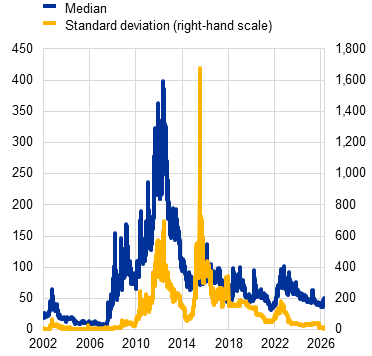
Cross-country dispersion in bank CDS spreads has declined markedly, reflecting a general improvement and convergence in euro area banking sector fundamentals (Chart 1.7, panel b). While the median CDS spread of euro area banks ranged between 200 and 400 basis points in 2012, it has steadily declined to around 50 basis points for much of the post-pandemic period. The dispersion across banks mirrors this trend and is now at historical lows. These developments can be attributed to improved and converging fundamentals for euro area banks, owing to enhanced regulation, increased resilience (e.g. in terms of capital headroom and non-performing loan (NPL) ratios) and the highest profitability recorded since the global financial crisis.
1.2 Financial structure and development
1.2.1 The financing requirements of the euro area economy
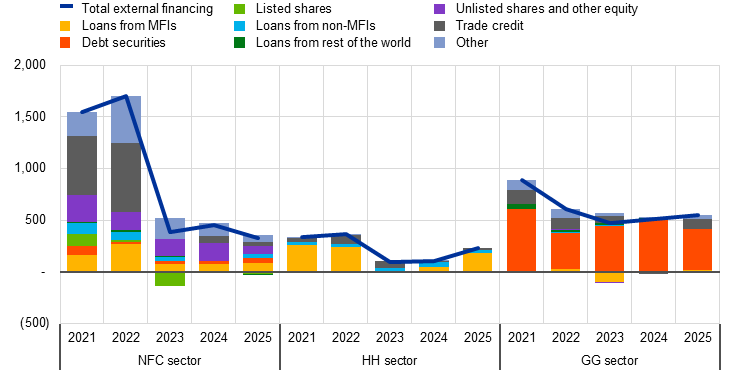
Due to ongoing economic uncertainties, tighter monetary policy and rising borrowing costs, the euro area economy has struggled to attract external funding since 2023 (SA, FS, Chart 3, ST48). Total external financing declined significantly across all sectors – NFCs, households and governments (Chart 1.8). Firms and households increasingly relied on internal resources, while governments moderated their borrowing activity amid fiscal consolidation efforts.
External financing for NFCs remained weak throughout the review period, influenced by cautious corporate strategies, subdued investment activity and challenging macroeconomic conditions. Declining business margins, tight credit standards and elevated interest rates limited financing opportunities, prompting firms to focus on deleveraging and internal funds. Debt issuance was modest, with firms shifting toward safer, short-term debt instruments owing to elevated borrowing costs and cautious investor sentiment. Borrowing from both MFIs and non-MFIs was subdued, as tight credit conditions and reduced investment opportunities led firms to scale back borrowing and rely more heavily on internal resources.
Equity issuance, both listed and unlisted, declined amid valuation losses, weak corporate profitability and low investor sentiment. Initial public offering activity was particularly weak, while intragroup equity flows also contracted. Trade credit flows showed resilience but moderated overall, reflecting weaker demand and supply chain disruptions. In response, firms increasingly utilised cash buffers to manage working capital needs, underscoring a preference for internal financing strategies against an uncertain economic backdrop.
Household financing requirements declined over the review period, as elevated interest rates and cautious consumer sentiment curbed borrowing activity. Household borrowing growth slowed significantly as high interest rates discouraged borrowing, while declining inflation supported real income growth. Fiscal consolidation and persistent uncertainty reinforced cautious household behaviour, limiting external financing demand.
The general government sector moderated borrowing activity during the review period, reflecting fiscal consolidation efforts and robust investor demand for euro-denominated debt securities. Fiscal consolidation, moderated investment growth and persistent demand for euro-denominated debt securities from external investors were the main drivers shaping government financing trends. Governments continued to issue debt securities, benefiting from strong investor demand for safe assets amid global uncertainty. Increased yields made euro area debt attractive to non-euro area investors. Government net borrowing as a percentage of GDP steadily declined, driven by slower growth in investment and revenue. Investments financed under the NGEU programme underpinned elevated government investment growth.
Chart 1.8
External financing flows of euro area NFCs, households and general governments, by instrument
(Q4 2021-Q4 2025; € billions)
Source: ECB (QSA) and ECB calculations.
Notes: MFIs stands for monetary financial institutions. Non-MFIs include other financial institutions as well as insurance corporations and pension funds. “Other” is the difference between the total and the instruments included in the figure and includes intercompany loans and the rebalancing between non-financial and financial accounts data. Figures shown represent the sum of flows over the last four quarters at the end of the fourth quarter for 2020-24, at the end of the fourth quarter of 2025 for all sectors except general government (GG), and at the end of the third quarter for 2025 for GG. NFC stands for non-financial corporation; HH stands for household; GG stands for general government.
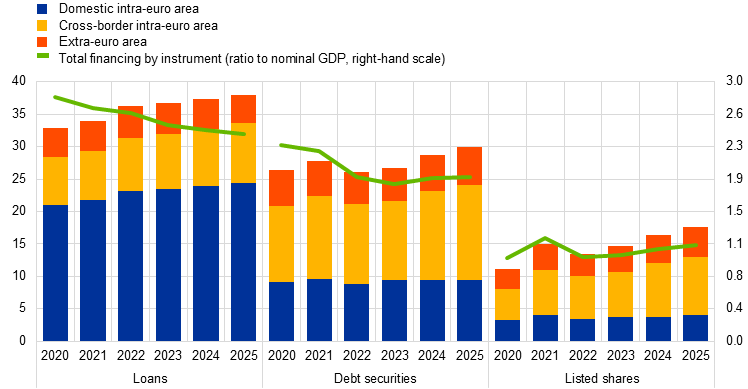
Non-domestic intra- and extra-euro area financing providers played an increasingly prominent role during the review period, particularly for marketable debt instruments (Chart 1.9). Cross-border intra-euro area providers expanded their share in financing both debt securities and listed shares, partially offsetting a decline in the role of domestic providers. By contrast, the relative shares of domestic, cross-border intra-euro area and extra-euro area providers in loan financing remained broadly stable, indicating that changes in the financing landscape are more pronounced for capital market instruments than for traditional loan-based financing.
Chart 1.9
Euro area external financing, by instrument and domicile of financing provider
(2020-25; left-hand scale: € trillions, right-hand scale: ratio)
Sources: ECB (QSA, MNA) and ECB calculations.
Notes: The figures shown correspond to end-of-year data, except for the domestic intra-euro area category, which refers to the second quarter of 2025.
1.2.2 Financial sector developments
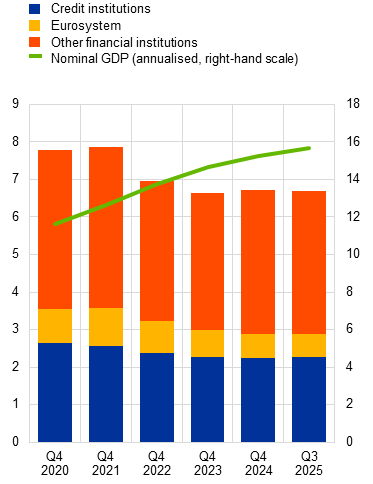
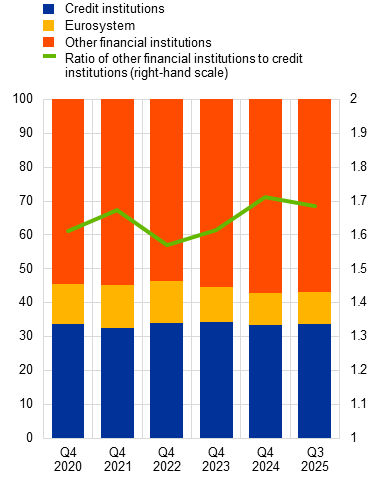
The financial assets of the euro area’s financial sector declined slightly as a share of nominal GDP from 2022 to 2023 and remained broadly stable subsequently (Chart 1.10, panel a). This trend reflects the impact of the ECB’s monetary policy.[8] Within the financial sector, the relative weight of banks, central banks and non-banks in total financial assets has undergone notable changes. Central banks have reduced their share, largely driven by quantitative tightening measures, while non-banks have increased their share. Broadly speaking, the decrease in the share of central banks has been approximately offset by the rise in the share of non-banks.
The ratio of financial assets held by other financial institutions (OFIs) to financial assets held by credit institutions has shown notable fluctuations over time (Chart 1.10, panel b, green line). A key factor driving these changes has been the rapid growth of non-bank financial intermediaries, particularly investment funds, which benefited from strong market valuation gains during 2023-24. These gains significantly boosted the size of investment fund balance sheets, increasing the share of OFIs. By contrast, the period from late 2024 into 2025 was marked by heightened market volatility and asset repricing, which reduced the financial assets of investment funds and other OFIs, while improving credit conditions and stronger loan demand supported an expansion of banks’ balance sheets. Insurance corporations and pension funds were affected more moderately, benefiting from higher reinvestment yields but also facing valuation pressures that kept their asset growth comparatively subdued (see also Chart 1.13).
Chart 1.10
Total assets of the euro area financial sector
a) In absolute terms, by sector | b) In relative terms, by sector |
|---|---|
(Q4 2020-Q3 2025; left-hand scale: ratio to nominal GDP, right-hand scale: € trillions) | (Q4 2020-Q3 2025; left-hand scale: percentages, right-hand scale: ratio) |
 |  |
Sources: ECB (QSA, BSI, MNA, FVC), Eurostat, and ECB calculations.
1.2.3 Banking sector
The profitability of the euro area banking sector stabilised at elevated levels (SA, FS, Chart 21, ST5). Following the normalisation of monetary policy, the profitability of euro area banks stabilised at high levels. A steep yield curve supported the interest margins of banks, while net fee and commission income followed a steady growth trajectory. Low impairment levels further bolstered profitability.
NPLs stabilised at low levels and showed mixed dynamics (SA, FS, Chart 23, ST7). Aggregate NPL ratios remained broadly stable at low levels, albeit with notable differences across countries and asset classes. Banks in jurisdictions with historically high NPL levels continued to reduce legacy NPLs through disposals and sales. By contrast, banks in countries with historically lower NPL ratios reported net increases. At the asset class level, higher NPLs were observed for commercial real estate, small and medium-sized enterprises and consumer credit.
Evidence on banking sector consolidation highlights both progress and challenges (Chart 1.11). Banking sector consolidation presents a mixed picture. While the number of mergers and acquisitions (M&As) has increased in recent years, it remains slightly below the post-global financial crisis (GFC) average, with 15 deals recorded in 2025. However, the total assets of target banks have risen significantly, nearly doubling the post-GFC average. Cross-border M&A activity has been particularly significant, with target assets exceeding their post-GFC average since 2023.
Despite these developments, overall M&A activity remains subdued, as demonstrated by several failed transactions. These primarily involved domestic public takeover or exchange offers aimed at strengthening home-market positions. Many of these deals failed due to insufficient shareholder support or bidder withdrawal, often in response to regulatory or governance constraints.
Chart 1.11
Total assets of target banks in the euro area
(1999-2025; € billions)
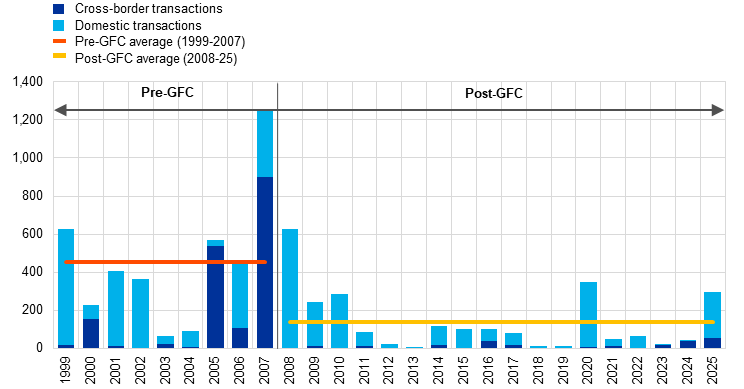
Sources: Dealogic, Moody’s, ECB (supervisory data) and ECB calculations..
Notes: Relevant M&A transactions exclude the acquisition of assets, repurchases, privatisations, leveraged buyouts, joint ventures and restructurings. They meet the following criteria: (1) the acquired stake is above 10%, corresponding to a qualifying holding; (2) the initial stake is below or equal to 50%; and (3) the final stake is above 50%. In cases where multiple banks are involved in a deal as target and/or acquirer, at least one of the targets and/or acquirers have to be domiciled within the euro area. The transactions are reported by the year in which they were announced. The periods before and after the global financial crisis (GFC) are defined as 1999-2007 and 2008-2025 respectively.
1.2.4 Non-banking sector
The total assets of the euro area non-bank financial sector had increased to €58.7 trillion by mid-2025, up by €7 trillion or 14% since the end of 2022. This development was driven primarily by growth in the total assets of primarily investment funds, but also of insurance companies and pension funds (Chart 1.12, panel a). As a result, the size of these sectors increased relative to that of OFIs, i.e. financial auxiliaries, captive financial institutions and money lenders, financial vehicle corporations and other OFIs (Chart 1.12, panel b). Similarly, there was a slight increase in non-banks’ share of total financial sector assets between 2022 and mid-2025.
Chart 1.12
Total assets of the euro area non-bank financial sector
a) In absolute terms, by sector | b) In relative terms, by sector |
|---|---|
(Q4 2020-Q4 2025; left-hand scale: € trillions, right-hand scale: percentages) | (Q4 2020-Q4 2025; percentages) |
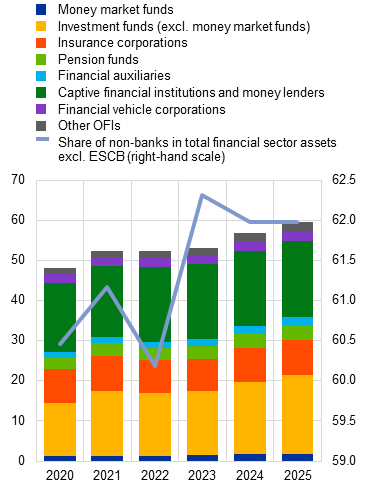 | 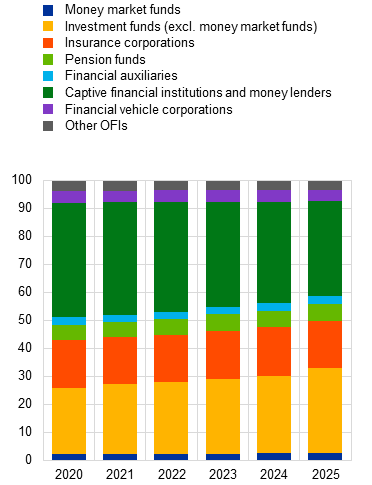 |
Sources: Eurostat, ECB (QSA, BSI, IVF, PFBR, ICB) and ECB calculations.
Notes: ESCB stands for European System of Central Banks; OFIs stands for other financial institutions. The figures shown correspond to end-of-year data.
Not only did the balance sheet size of the main non-bank financial sub-sectors increase between 2020 and 2025, but its composition also changed (Chart 1.13). The insurance corporation and pension fund and investment fund sectors each show increased equity and investment fund exposures, in part due to favourable market valuations.
Chart 1.13
Balance sheet developments in insurance corporations, pension funds and investment funds
(Q4 2020-Q4 2025; € trillions)
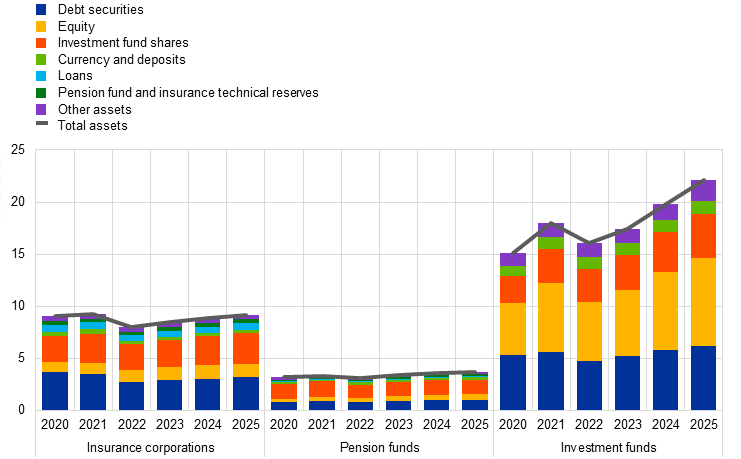
Source: ECB (IVF, ICB, PFBR) and ECB calculations.
Note: The figures shown correspond to end-of-year data. Loans claims are included in Currency and deposits category for the investment funds sector.
Money market funds
The total assets of money market funds (MMFs) stood at €2 trillion in the fourth quarter of 2025, an increase of 36% from the fourth quarter of 2022. MMFs achieved record net inflows – predominantly from non-euro area investors (SA, Chart 42, ST24) – driven by a combination of rapid monetary policy tightening, structural changes in the repo market and investor demand for higher yields in a high-interest-rate environment. Additionally, strong inflows suggest that some investors opted for MMFs as a cash alternative, maintaining a wait-and-see approach in uncertain market conditions. MMF assets remained highly concentrated in Ireland, France and Luxembourg (SA, Chart 41, ST23).
Investment funds
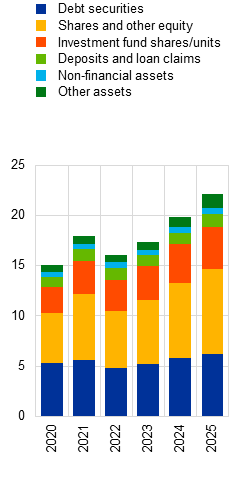
The investment fund (IF) sector experienced substantial growth from the fourth quarter of 2022, with total assets reaching €22.1 trillion by the fourth quarter of 2025. This increase was driven by rising equity valuations and sustained inflows into bond and equity funds, alongside a rise in the value of holdings in non-euro area-issued equity, debt securities and investment fund shares (Chart 1.14, panel a). The IF sector remains concentrated in Germany, Ireland, France and Luxembourg.
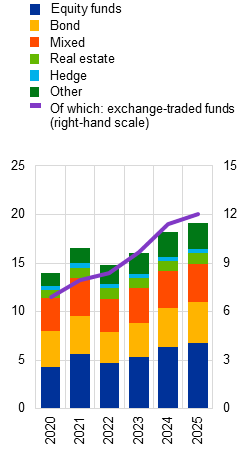
The composition of the IF sector continued to evolve, with equity funds gaining prominence relative to bond and mixed funds. By December 2025, equity, bond and mixed funds collectively accounted for 67% of total assets in the IF sector (Chart 1.14, panel b). Passive investment via exchange-traded funds (ETFs) also grew markedly, with ETF assets more than doubling from €1.2 trillion in December 2022 to €2.4 trillion in December 2025 (SA, Chart 39, ST30). Consequently, the share of ETFs in total IF assets increased by 3.7 percentage points to 12.0%.
Similarly, the share of “other funds” in the IF sector rose to 12.9% in September 2025, partly driven by €180 billion of growth in private equity and credit funds. These funds provide an alternative financing source for the real economy by supporting typically riskier companies that might otherwise face difficulties in accessing bank lending or public debt and equity markets.[9]
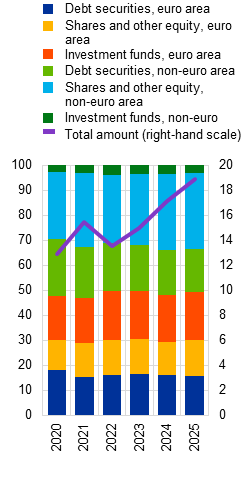
While the growth of the IF sector supports financial integration, around half of its assets are invested outside the euro area (Chart 1.14, panel c). IFs facilitate cross-border financing and risk sharing, offering euro area investors diversified portfolios and access to foreign economies. However, the significant share of assets allocated outside the euro area suggests limited support for domestic companies, reflecting the less developed state of capital markets within the euro area.[10] This dynamic is closely tied to the euro area’s surplus in the current account. In balance-of-payments terms, a surplus on the current and capital accounts corresponds to net lending to the rest of the world, reflected in the financial account. By its very structure, a current account surplus reflects excess savings that must be invested abroad, making the euro area a net lender to the rest of the world. Structural reforms aimed at deepening euro area capital markets are essential in order to reduce reliance on investing savings abroad and channel investment towards domestic markets.
Chart 1.14
Developments in the euro area IF sector
a) Total IF assets, by asset type | b) Share of IF sector total assets, by fund type | c) IF debt securities, equity and IF holdings, by issuer region |
|---|---|---|
(Q4 2020-Q4 2025; € trillions) | (Q4 2020-Q4 2025; left-hand scale: € trillions, right-hand scale: percentages) | (Q4 2020-Q4 2025; left-hand scale: percentages, right-hand scale: € trillions) |
 |  |  |
Source: ECB (IVF).
Notes: The figures shown correspond to end-of-year data. Panel c: “Investment funds” refers to investment fund shares/units including money market fund shares.
Insurance companies and pension funds
Insurance companies and pension funds (ICPFs) recorded significant growth in total assets between 2022 and 2025, driven by strategic shifts and favourable market conditions. The total assets of the sector rose from €11.2 trillion at the end of 2022 to €12.9 trillion at the end of 2025 (SA, FS, Chart 31, ST33). This growth was primarily fuelled by rising interest rates, which improved investment returns, alongside a strategic pivot towards higher-yielding, less liquid assets. Additionally, rebounding equity market valuations and increased, albeit often short-term, debt investments contributed to the sector’s expansion. Both insurance corporations and pension funds increased their equity exposures, predominantly via investment funds in the case of insurance corporations and via direct equity holdings in the case of pension funds.
More broadly, ICPF assets remain highly concentrated in a few euro area countries, with these entities generally focusing on offering their services domestically. Insurance corporations account for over 70% of the sector’s assets (SA, Chart 31, ST33). The assets of insurance corporations are concentrated in Germany, France and Italy, while the Netherlands accounts for most of the euro area pension fund sector (SA, Chart 32, ST34). In addition to providing domestic services, ICPFs typically invest heavily in euro area assets, playing a key role in funding local companies and supporting regional economies.
1.2.5 Role of non-bank financial intermediaries
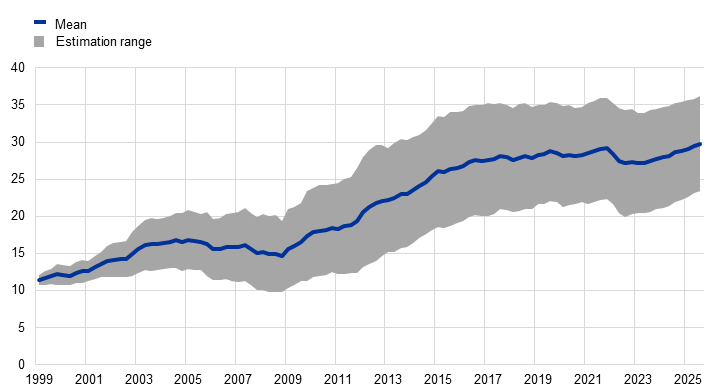
The role of non-bank financial intermediaries (NBFIs) in financing the euro area real economy has recovered over the past two years and reached pre-pandemic highs. NBFIs accounted for 29.8% of outstanding credit to NFCs as of the third quarter of 2025, up from 27.2% in mid-2023 (Chart 1.15). This rise was mainly driven by further increases in NBFIs’ stocks of NFC debt securities.
Chart 1.15
Share of non-bank credit to NFCs
(Q1 1999-Q3 2025; percentages of total credit granted by financial institutions)
Sources: ECB (BSI, FVC, QSA) and ECB calculations.
Note: The measure captures NBFI credit, which is the share of credit provided by the NBFI sector to euro area NFCs relative to bank and NBFI credit, irrespective of whether that financing is provided through loans or purchases of debt securities. Upper bound estimates include a residual of OFIs, while lower bound estimates exclude this. For more details, see the box entitled “Measuring market-based and non-bank financing of non-financial corporations in the euro area”, Financial Integration and Structure in the Euro Area, ECB, April 2022.
Leaving aside the broadly stable lending and increased debt securities exposure among banks, the scale of interconnectedness between banks and non-banks through debt and equity instruments has remained largely unchanged since 2022.[11] As of the second quarter of 2025, cross-exposures between MFIs and non-banks were mainly asset exposures to OFIs, including exposures via loans to OFIs (around €1.6 trillion) and debt securities issued by OFIs (approximately €2.2 trillion) (Chart 1.16, panel a). Aside from OFIs, the most significant link to the non-bank sector are MFI holdings of IF shares. As for NBFIs, IFs hold exposures to banks via loans, while OFIs hold exposures to banks via debt securities issued by banks.
Interconnectedness between non-banks derived predominantly from non-banks holding IF shares, with this type of cross-exposure among non-banks increasing between the fourth quarter of 2022 and third quarter of 2025. Collectively, the ICPF and OFI sectors each held €7.7 and €7.8 trillion respectively in IF shares as of the third quarter of 2025, up from €6.7 and €5.9 trillion respectively in the fourth quarter of 2022 (Chart 1.16, panel b). Holdings of debt securities issued by OFIs represented the next largest cross-exposure among non-banks, with aggregate ICPF, IF and OFI holdings of such securities increasing by €0.4 trillion to €2.9 trillion from the fourth quarter of 2022 to the third quarter of 2025.
Chart 1.16
Trends in cross-exposures among sectors of the euro area financial system, by instrument type and holder sector
a) Exposures via debt instruments | b) Exposures via equity instruments |
|---|---|
(Q4 2022-Q3 2025; € trillions) | (Q4 2022-Q3 2025; € trillions) |
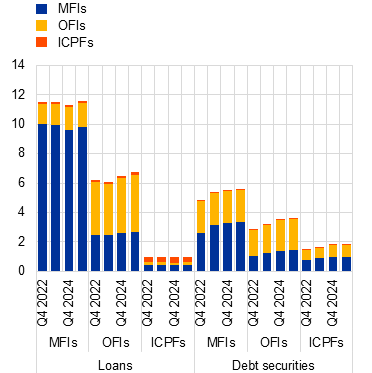 | 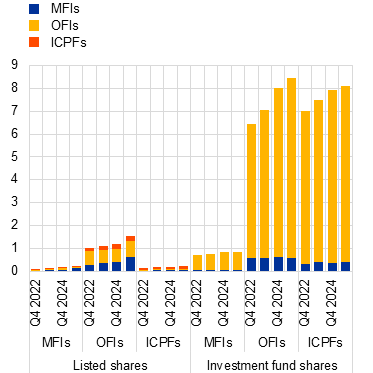 |
Sources: ECB (QSA, BSI) and ECB calculations.
Notes: The data also include intra-group positions. MFIs stands for monetary financial institutions; OFIs stands for other financial institutions; ICPFs stands for insurance corporations and pension funds. OFIs are specifically non-monetary financial corporations, including financial vehicle corporations and excluding non-MMF IFs. Panel a: Loans by MFIs include both interbank lending and longer-term loans and exclude ESCB lending. Holdings of debt securities by MFIs exclude debt securities held by the ESCB in the context of the asset purchase programmes.
1.3 Resilience and risk sharing
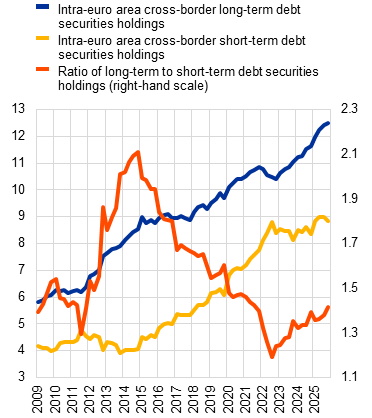
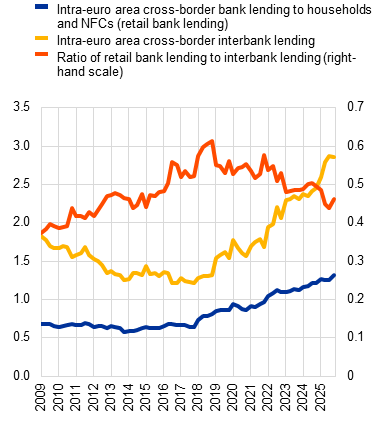
The resilience and persistence of financial integration in the face of large shocks are key dimensions of its quality and are critical for supporting Economic and Monetary Union.[12] While the previous discussion focused on quantifying financial integration, this section examines its ability to withstand disruptions and maintain continuity during crises. The literature consistently indicates that financial integration through equity investment is more resilient to shocks than integration via debt instruments. Furthermore, integration based on longer-maturity debt instruments is less susceptible to sudden stops –sharp declines in gross capital inflows from foreign investors –during times of crisis, unlike integration dominated by shorter maturities.
Overall, the quality of equity market integration in the euro area declined between 2022 and the fourth quarter of 2025. The ratio of intra-euro area cross-border holdings of equities to intra-euro area cross-border holdings of debt instruments declined to the pre-pandemic level (Chart 1.17, panel a). Cross‑border holdings of equities and debt within the euro area rose mainly because of post‑pandemic financial normalisation, improved risk sentiment and structural integration forces that continue to reduce friction in cross‑border investment. The evidence points to stronger balance sheet positions, declining uncertainty and gravity‑type factors (economic size, historical ties and reduced distance‑related frictions) as key drivers.[13] Debt securities have seen stronger intra‑euro area cross‑border growth than equities in the past few years, as bonds benefited more from the post‑pandemic policy environment, regulatory incentives and portfolio‑rebalancing dynamics, while equities remained more sensitive to valuation swings and risk sentiment.
The share of intra-euro area foreign direct investment (FDI) in total cross-border direct and portfolio equity investment has dropped to historically low levels in recent years (Chart 1.17, panel b). Between early 2022 (and hence prior to the start of Russia’s invasion of Ukraine) and the fourth quarter of 2025, this share fell from 42.8% to 38.5%. The decline was primarily driven by stagnant FDI positions, as investment transactions remained subdued amid weak overall investment activity in the euro area. By contrast, portfolio equity investment fluctuated due to volatile but generally rising equity market valuations, with euro area equity markets rebounding by 40% from levels prior to the invasion after experiencing a 20% correction in the initial months of the conflict.
Chart 1.17
Indicators of equity market integration resilience in the euro area
a) Intra-euro area foreign equity investments relative to intra-euro area foreign debt investments | b) Intra-euro area foreign direct investment |
|---|---|
(Q1 2009-Q4 2025; left-hand scale: € trillions, right-hand scale: ratio) | (Q1 2009-Q4 2025; left-hand scale: € trillions, right-hand scale: share) |
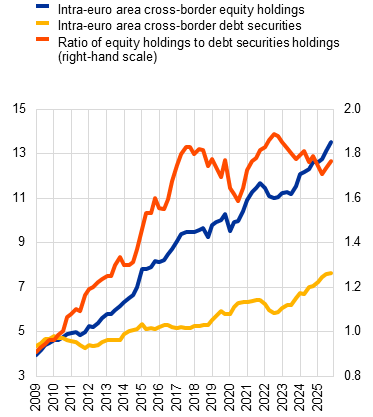 | 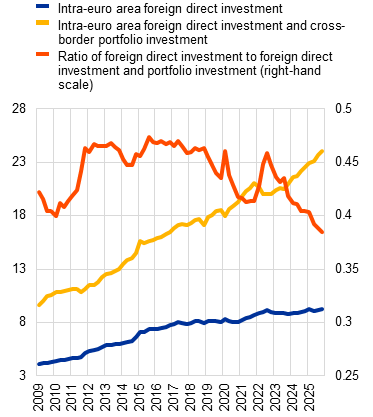 |
Sources: ECB BoP data and ECB calculations.
Notes: Panel a: both portfolio and direct investment holdings are included under equity holdings. For debt securities, only portfolio investment is included, since debt securities are not available for FDI (only total “debt instruments”). Even if the analysis is restricted to portfolio investment only, we still see the rising importance of equities in intra-euro area cross-border holdings. Looking at the sector contribution, we see a general increase in equity holdings for all sectors except MMFs (S.123). Panel b: intra-euro area FDI is calculated as the average of asset and liability positions to account for possible asymmetries. For portfolio investment, only the asset side is used since liabilities are not reported owing to the custodial bias.
The quality of debt market integration has improved (Chart 1.18, panel a). This reflects increased issuance of debt but also euro area investors’ willingness to buy longer-dated bonds from other jurisdictions. The tightening of euro area spreads, as discussed above, reflects these flows, which have been supported by factors including the improved fiscal standing of non-core countries and possibly the increased supply in euro credit markets. These interconnected drivers highlight evolving investor behaviour within the European bond market.
Loan market integration has increased in quantitative terms owing to a rise in interbank lending, which is a less resilient form of banking market integration. A higher level of cross-border retail lending activities helps increase the resilience of the European banking sector by allowing further diversification of bank loan portfolios. Aggregate intra-euro area cross-border lending across counterparty sectors reached a record high in 2025. Cross-border interbank lending continued the ascending trend that started in late 2021. However, direct cross-border retail bank lending within the euro area – although it has slowly but steadily improved since 2018 – remains limited (Chart 1.18, panel b), pointing to continued low integration in retail banking markets.
Chart 1.18
Indicators of equity market integration resilience in the euro area
a) Intra-euro area foreign long-term debt investments relative to intra-euro area foreign short-term debt investments | b) Intra-euro area foreign retail bank lending relative to intra-euro area foreign interbank lending |
|---|---|
(Q1 2009-Q4 2025; left-hand scale: € trillions, right-hand scale: ratio) | (Q1 2009-Q4 2025; left-hand scale: € trillions, right-hand scale: ratio) |
 |  |
Source: ECB BoP data, ECB (BSI) and ECB calculations.
Notes: Panel a: the figures cover not only debt securities liabilities, but also other instruments such as currency deposits and loans (F.2 and F.4), trade advances and accounts payable (F.81 and F.89), insurance and pensions (F.6) and FDI debt instruments (FL). As a convention, F.6 and FL are classified entirely as long-term liabilities. Panel b: the blue line shows the total amount of intra-euro area cross-border bank lending to households and non-financial corporations (NFCs), i.e. retail bank lending. The yellow line shows the total amount of intra-euro area cross-border lending between MFIs, i.e. interbank lending. The red line shows the ratio of the two. For further discussion on the interpretation of these indicators, see the special feature entitled “Financial integration and risk sharing in a monetary union”, Financial integration in Europe, ECB, April 2016.
The generally benign picture of overall financial integration developments is further corroborated by risk-sharing indicators (SA, FI, Chart 4, S7). The correlation between consumption and output across euro area member countries decreased substantially, suggesting that changes in output or, equivalently, income in each country lead, on average, to much smaller changes in consumption.
1.4 Conclusion
Developments over the past two to three years reflect both progress and challenges in euro area financial integration and structure. Improved financial integration indicators, driven by reduced risk premia and structural changes, have supported cross-border activity and resilience within the region. However, subdued external financing across key sectors, coupled with limited intra-euro area equity market integration, point to persistent structural shortcomings. These deficiencies show that continued efforts must be made to deepen capital markets and reduce reliance on external providers. Future policy measures should focus on addressing structural impediments, in particular to equity market integration, while preserving the resilience of cross-border financing mechanisms.
2 What will it take to make the savings and investments union work?
2.1 Introduction
In early 2025, the European Commission launched the savings and investments union (SIU). This new strategy, which draws on the progress already made under the Commission’s capital markets union (CMU) initiative, aims to improve the way the European Union (EU) financial system works. More specifically, its goal is to achieve a better allocation of financial savings to productive investments. There is a broad consensus among experts that the EU economy has great potential which is not being fully used. Its underperformance is due in part to inefficiencies in financial intermediation, which the SIU initiative is designed to address. The Commission provided a detailed description of the SIU in its Communication of 19 March 2025[14], setting out a strategy to foster citizens’ wealth and economic competitiveness in the EU.
This chapter discusses selected policy measures that may contribute to achieving the SIU’s objective, focusing on certain priority areas. The Communication of 19 March 2025 considers a range of policy measures affecting different areas of the financial system. These include measures to: (i) provide retail investors with better savings and investment opportunities, (ii) improve financing opportunities for small and medium-sized enterprises (SMEs), (iii) remove barriers to cross-border financial activities within the EU, and (iv) make supervision more efficient. This chapter focuses on specific areas that market participants appear to attribute the most importance to in their commentaries on the SIU. As described below, we collected these commentaries by carrying out a systematic web-based search of publicly available sources.
The priority areas discussed here were selected using an AI-based approach designed to capture the views of market commentators on the key aspects of the SIU.[15] The analysis focuses on identifying which priorities are most frequently highlighted in public commentaries and relating these views to the policy framework set out by the Commission. The first step was to collect publicly available commentaries on the SIU published in PDF format between January and November 2025.[16] This process resulted in a sample of 172 unique publications from market analysts, academics, think tanks and other public institutions. Up to ten key statements of priorities from each of the 172 commentaries were then extracted using ChatGPT, yielding a total of 1,292 statements. The second step was to use ChatGPT to generate a list of 20 key priorities for the SIU, based strictly on the Commission’s Communication of 19 March 2025. The resulting output is shown in Table 1. From this list, 18 key words or phrases were manually identified to define a corresponding set of priority categories. These categories served as labels for the subsequent classification exercise, ensuring that all priorities identified in the statements extracted from the external commentaries could be consistently assigned to one of the selected categories. The key words and phrases are shown in the “Priorities” column of Table 2. ChatGPT was then asked to assign each of the 1,292 statements to one of the 18 categories identified. Finally, the priorities were ranked according to the number of statements allocated to each category. The resulting ranking is presented in Table 2.
Table 1
20 key priorities of the SIU
|
Note: The 20 key priorities were selected by ChatGPT based on the following prompt, with the Commission’s Communication of 19 March 2025 (referred to in the prompt as the “EC SIU strategy paper”) provided as an attached PDF: “Give me a list of 20 key priorities of the Saving and Investment Union, focus on the EC SIU strategy paper, output them only as a list, no comments to it!”.
Table 2
Ranking of the key priorities of the SIU
Rank | Priorities | Count | Share |
|---|---|---|---|
1 | supervision | 221 | 0.17105 |
2 | retail participation | 152 | 0.11765 |
3 | cross-border investment | 151 | 0.11687 |
4 | pension systems | 109 | 0.08437 |
5 | trading and post-trading infrastructures | 108 | 0.08359 |
6 | venture and growth capital | 89 | 0.06889 |
7 | tax barriers | 81 | 0.06269 |
8 | financial literacy | 69 | 0.05341 |
9 | retail investor protection | 61 | 0.04721 |
10 | EU banking sector | 59 | 0.04567 |
11 | securitisation markets | 52 | 0.04025 |
12 | equity investment | 40 | 0.03096 |
13 | institutional investors | 21 | 0.01625 |
14 | private markets | 20 | 0.01548 |
15 | investment funds | 16 | 0.01238 |
16 | IPOs | 16 | 0.01238 |
17 | deposit insurance | 15 | 0.01161 |
18 | exit options | 12 | 0.00929 |
Notes: To produce this ranking, 1,292 statements of priorities were extracted from the 172 commentaries collected from the web-based search. The extraction was carried out by providing ChatGPT with the following prompt: “You are an expert policy analyst specialised in EU capital markets and policy initiatives. […] Your task is to extract structured insights on the Savings and Investment Union (SIU). You read full economic and finance reports and return […]: list of concrete key priorities regarding the European Savings and Investment Union discussed in the report, up to 10. […]”. ChatGPT was then asked to assign each of these 1,292 priority statements to one (and no more than one) of the 18 priorities in the table using the following prompt: “You are an expert in EU capital markets and the Savings and Investment Union (SIU). Classify the following texts into exactly ONE category from the predefined list [of 18 priorities]. Choose ONLY from this list and return exactly the matching string (no explanations, no extra text).
The top seven priorities identified in Table 2 above are fully consistent with the Commission’s SIU action plan. Specifically, these priorities align with the four areas of work set out in the Commission’s Communication on the SIU and summarised in a fact sheet of 19 March 2025[17]: citizens and savings (retail participation, pension systems), investments and financing (tax barriers to cross-border investments, venture and growth capital), integration and scale (cross-border investment and trading and post-trading infrastructures), and supervision. This configuration is also fully in line with previously identified European Central Bank (ECB) priorities.[18]
This chapter discusses these priorities, which overlap and are interrelated. It starts by looking at supervision (Section 2.2.) and the taxation of investments and financing (Section 2.3). The lack of harmonised rules across Europe is the main issue for both of these topics. The next two sections discuss retail participation in capital markets (Section 2.4) and pension systems (Section 2.5), as pensions are a specific tool for retail participation. Although the topic of private markets is only at number 14 in the ranking shown in Table 2, it is discussed in Section 2.6, as private markets play an important role for venture capital financing (ranked number 6 in Table 2). Venture capital is then discussed in a separate box. The chapter concludes with a section on post-trading infrastructure. The topic of cross-border investments is not covered in a dedicated section but plays an important role throughout all sections.
2.2 Supervision
Financial supervision in the EU is fragmented across Member States, with diverse supervisory models and authorities, as well as a lack of harmonised rules and practices.[19] The European System of Financial Supervision is a network centred around three European Supervisory Authorities (ESAs), along with the European Systemic Risk Board and national supervisors. The three ESAs are the European Banking Authority (EBA), the European Insurance and Occupational Pensions Authority (EIOPA) for insurance corporations and pension funds, and the European Securities and Markets Authority (ESMA) for financial markets. As the European banking supervisor, the ECB cooperates closely with the ESAs, especially the EBA. The national supervisors are the national competent authorities (NCAs) in charge of banking supervision in participating countries. In some cases, the national central bank is also the institution responsible for banking supervision.
Supervisory practices therefore vary significantly across the EU – even where supervisory rules have been fully harmonised, for example using EU regulations (rather than directives). A notable exception is the supervision of significant banks in the EU, as practices are fully harmonised under European banking supervision.
The lack of harmonisation in capital market supervision could hinder cross-border activities for market participants, create a non-level playing field and heighten the risk of regulatory arbitrage. A market participant active in different Member States may need to deal with several supervisory authorities and adhere to different national rules and supervisory practices. This increases operational complexity and compliance costs, which can be a barrier for smaller firms or new entrants seeking to expand across the EU. Variations in supervisory practices may result in the unequal treatment of financial institutions across Member States, as institutions in countries with stricter supervisory regimes may face higher regulatory burdens. Firms may seek to establish operations in Member States with less stringent supervisory practices, exploiting differences in regulatory standards, or may decide not to be active across borders.
Efforts towards supervisory convergence, an integrated approach to EU capital markets supervision and the adoption of EU regulations have the potential to improve harmonisation in supervisory outcomes. Converting directives into EU regulations – where relevant and practical – could help to further harmonise supervisory rules.[20] The three ESAs (the EBA, EIOPA and ESMA) could also tackle diverging supervisory practices across NCAs by using guidelines and other convergence tools. However, greater harmonisation of rules should be accompanied by a more integrated supervisory framework to maximise the benefits of harmonisation. Significant entities – with their strong emphasis on cross-border activities – would be a prime candidate for supervision by central EU authorities. Box 1, entitled “Integrated supervision as a pillar of European capital markets”, provides a detailed description of the current supervisory framework in EU capital markets and discusses how integrated EU supervision could help achieve the objectives of the SIU.
Box 1
Integrated supervision as a pillar of European capital markets
Deepening and integrating EU capital markets are central to the objectives of the savings and investments union (SIU). The SIU aims to mobilise Europe’s high level of savings more effectively, support investment and innovation, strengthen cross-border risk sharing and enhance the EU’s economic resilience and competitiveness. While progress has been made on regulatory harmonisation, outcomes in terms of market integration, depth and scale remain limited. This box focuses on the supervisory dimension as a key missing element in the integration agenda, building on a granular mapping of the existing supervisory architecture in Europe.
More2.3 Investments and financing – taxation
Interest and capital tax rules, as well as corporate tax rules, are not fully harmonised across the EU, making it more difficult for market participants to be active in multiple EU Member States. The EU has achieved significant harmonisation in certain aspects of indirect taxation, such as value added tax (with the VAT Directive[21]) and excise duties (with the Excise Duty Directive[22]). However, little harmonisation has been achieved in areas such as corporate tax, personal income tax and withholding tax regimes, which are largely under the jurisdiction of individual Member States.[23] As a result, market participants that are active in more than one EU Member State may need to deal with many diverging rules, increasing tax compliance costs and uncertainty. Enterprises subject to corporate tax and taxpayers subject to withholding taxes are affected differently, as we discuss in this section.
Enterprises, including financial institutions such as banks and non-bank financial institutions that carry out taxable activities in different EU countries, would benefit from a harmonisation of corporate tax rules. It may not be useful to harmonise tax rates as every country has its own fiscal needs and national policy objectives. However, harmonising corporate tax procedures, including the calculation of tax bases, enforcement and definitions, would provide clear benefits, as it would make it easier for enterprises to carry out investment activities in another EU Member State. For example, an enterprise would not need to acquire a knowledge of a completely new tax system (the rules of which may be only available in a foreign language) or hire tax advisers for each country of activity. Tax compliance costs and legal uncertainty would be reduced. This could encourage more corporate cross-border activity, thereby fostering competition and increasing options for consumers.
Proposals to address the problem have been made by the Commission, but progress has been slow. The Commission made a proposal[24] to address the issue for SMEs in 2023. Under the proposal, SMEs that operate a “permanent establishment” (PE) in another EU country would be allowed to interact only with the tax authority of the home country. Tax rules would not be harmonised. Instead, the tax base for the PE would be calculated according to the tax rules of the home country. The tax rate of the host country of the PE would be applied to that tax base, and the collected tax revenue would be transferred to the host state. Another proposal adopted by the Commission is the Business in Europe: Framework for Income Taxation (BEFIT) proposal.[25] This is aimed at allowing members of a group of corporations active in different EU Member States to calculate their tax base across the EU according to a single set of rules. The BEFIT proposal would thus be beneficial for large corporate groups. Progress on all these proposals has been slow because of conflicting views and interests across Member States.[26]
Instead of aiming for harmonisation across all EU Member States, it could be more fruitful to try to harmonise tax rules across a subset of Member States. Each EU country could be given the option of adopting a set of harmonised tax rules, thereby creating a harmonised tax area within the EU. Full harmonisation across all EU Member States could be achieved at a later stage. This idea is considered in Box 2.
Taxpayers already benefit from double taxation agreements within the EU, but refund procedures for withholding taxes are often cumbersome – a problem that the Faster and Safer Tax Relief of Excess Withholding Taxes (FASTER) Directive[27] is expected to address. Many EU Member States levy withholding taxes on income from financial assets, including those of investors located in other EU countries. These investors must also pay taxes on the same income in their home country. Many countries have put in place double taxation agreements to avoid the same income being taxed twice. However, the procedures for obtaining a withholding tax refund are often complicated. According to the Commission: “Withholding tax procedures applied in each Member State are currently very different. Investors must deal with more than 450 different forms across the EU, most of which are only available in national languages.” Many investors, not least households, are therefore deterred from investing savings outside their home country, which not only reduces investment opportunities but also potentially increases financing costs for many enterprises. The FASTER Directive is expected to address the problem of cumbersome withholding tax procedures for dividends from publicly traded shares and interest from publicly traded bonds. Under the Directive, Member States will issue a standardised digital tax residence certificate. This can be used to reclaim withholding taxes across all Member States that are in the scope of the Directive.[28] Fast track-procedures will be in place to ensure that withholding taxes for which a refund could be claimed are not levied at all (relief at source) or are refunded within 50 days. In this context, relief at source would clearly be the preferable option. The Directive must be transposed into national legislation by the end of 2028, with national rules to become applicable as of 2030.
Taxes could be designed in such a way as to provide households with incentives to increase retail participation in capital markets. For example, specific capital market investments by households could benefit from a reduced tax rate or from an increased tax allowance. A detailed discussion of such an approach can be found in Box 3, entitled “Euro Area household savings allocation and the role of taxation”. The box also provides more information on the FASTER Directive.
Box 2
A harmonised tax area within the EU?
Harmonising (corporate) tax rules across the EU is challenging as it requires unanimity in the Council of the European Union, and the short-term costs of harmonising tax regimes are likely to be high for individual Member States. To quote the European Commission: “Adopting harmonised legislation on taxation requires the unanimous agreement of all Member States in the Council, which has tended to act as a brake on the adoption of common rules”.[29] For EU legal acts on direct taxation, Article 115 of the Treaty on the Functioning of the European Union (TFEU)[30] requires unanimity in the Council. At the same time, harmonising tax rules may prove costly for Member States for at least two reasons. First, individual countries’ tax laws are typically complex. This might make it difficult to rework them with a view to harmonisation. Second, Member States use not only tax rates but also other tax rules, such as provisions on the depreciation of capital assets, to achieve specific policy goals. If tax rules are harmonised, it may no longer be easy for Member States to change them in the way they want.
More2.4 Citizens and savings – retail participation in equity markets
Euro area households save a relatively large part of their disposable income.[31] On aggregate, euro area gross household saving rates are high relative to gross disposable income (15% in the first quarter of 2025) and are consistently above the investment rate (9% in the first quarter of 2025).[32],[33] Over the past three years the gap has started to widen. There is also wide dispersion across EU Member States. Countries such as Germany, the Netherlands and France have elevated saving rates (around 19% in the first quarter of 2025), while the levels in Portugal and Poland are only around half as high (11% and 10% respectively in the first quarter of 2025). As saving rates have gone up in the past years, a sizeable flow of fresh savings each year could be deployed into productive risk capital via listed equities or corporate bonds.
Euro area households have traditionally held a relatively large part of their financial assets in the form of bank deposits and currency, while listed shares have played a smaller role. In the euro area, aggregate household savings have traditionally flowed into low-yielding deposits and to a lesser extent into (life) insurance policies and pension entitlements. The share of deposits and currency in the portfolios of euro area households stands at 32% (as at the second quarter of 2025), up from 28% in the second quarter of 2001 (Chart 2.1). This is about three times higher than in the United States (11% in the second quarter of 2025). Listed shares held directly by euro area households account for 5% of household portfolios (31% in the United States).[34] Investment fund shares, pension entitlements and insurance products (including life insurance policies), through which households can hold equity and other traded financial assets, account for 38%.
Chart 2.1
Development of euro area household financial assets
a) In absolute terms, by type of financial instrument, and ratio to nominal GDP | b) In relative terms, comparing the euro area and the United States |
|---|---|
(Q1 2001-Q4 2025; left-hand scale: € trillions, right-hand scale: ratio) | (Q1 2001-Q4 2025 ; percentages) |
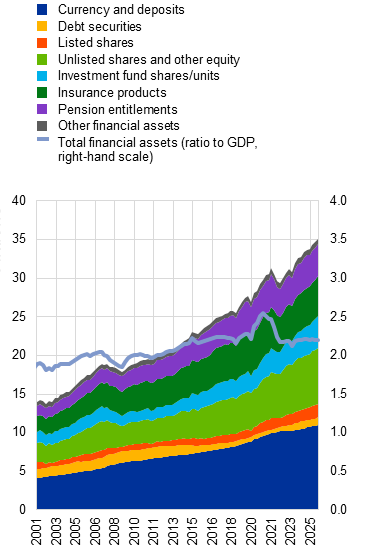 | 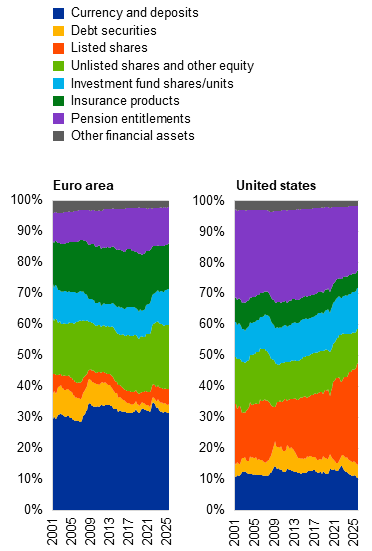 |
Sources: Federal Reserve Bank of St. Louis, OECD, ECB and ECB calculations.
A higher share of equity, held directly or indirectly, would have meant higher returns on household savings over the past decades and therefore could have had a positive effect on the whole economy. Historical data show that listed shares consistently outperform other, safer asset classes such as bonds and bank deposits over the long term. For instance, investing in a savings product consisting of low-cost funds would have given an annualised return of around 6% over the past ten years, similar to the return on European stock indices such as the MSCI Europe.[35] This is substantially higher than the interest rate on deposits, even those with a fixed term, where most savings are currently held. Higher returns on savings would be directly beneficial for households as opportunities for consumption would increase as a result. The additional consumption could have a positive effect on European economic growth. Moreover, in ageing European societies, where unfunded pension systems may turn out to be unsustainable, higher returns on savings would bring important benefits.
A higher share of equity products in the financial assets of households could improve opportunities for enterprises to obtain the finances needed to pursue innovations. Additional household demand for equity investments could increase the depth of equity markets and reduce the cost of equity for companies more generally. This would be likely to improve the innovative potential of the European economy, as equity is a long-term financing source that helps companies to pursue innovations.
The euro area equity market is small compared with those of other major economies, and higher retail participation alone may not provide a strong enough boost. The market capitalisation of listed euro area companies is 67% of euro area GDP, far below the proportion in the United States (about 216%), Japan (about 157%) and the United Kingdom (about 97%).[36] A larger equity market would be beneficial for the euro area economy in terms of improved equity market liquidity and financing opportunities. There is a positive correlation between households’ financial assets and equity market capitalisation in EU countries (Chart 2.2, panel b). However, euro area households only hold about 15% of euro area equities, either directly or indirectly through investment funds and pension funds (Chart 2.2, panel a). This means that euro area household participation in euro area equity markets would need to increase by 67% to achieve a 10% increase in euro area equity market capitalisation, even assuming that euro area households do not crowd out other equity investors.[37]
Chart 2.2
Holders of euro area equity and relationship between household financial assets and market capitalisation
a) Market capitalisation of euro area listed shares, by type of holders | b) Households’ financial asset holdings and market capitalisation in EU Member States |
|---|---|
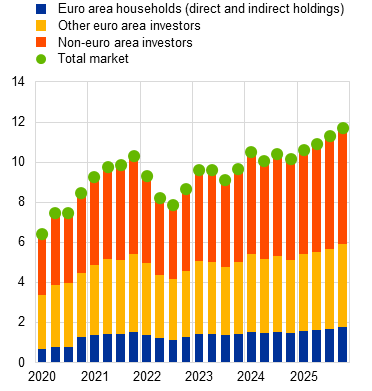 | 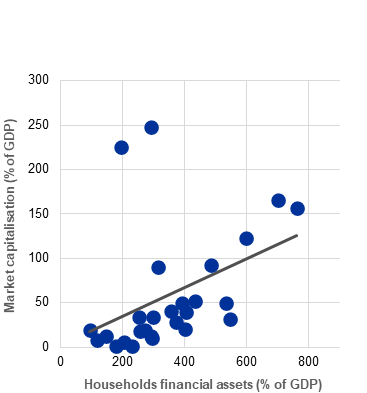 |
Sources: ECB (BSI, CSDB, ICB, IVF, PFBR, SHS) and ECB calculations.
Notes: Panel a: “total market” refers to the size of equity instruments issued by euro area-domiciled entities. The “households” category includes both direct holdings of households and pension funds, as well as their indirect holdings via investment fund shares. “Other euro area” includes all euro area-issued securities held by euro area sectors other than households and pension funds. This category is adjusted to exclude investment fund shares that have been reallocated to the household sector under the look-through approach.
Assets held via investment fund shares are obtained following the look-through approach outlined in Carvalho and Schmitz*.
Panel b: each dot represents an EU country. Households financial assets include households’ holdings of equity, investment fund shares, as well as insurance, pension and standardised guaranteed schemes. Market capitalisation refers to listed shares issued by both non-financial and financial corporates. Both measures are expressed as percentage of the respective country’s GDP.
*) Carvalho, D. and Schmitz, M., “Shifts in the portfolio holdings of euro area investors in the midst of COVID-19: looking-through investment funds”, Working Paper Series, No 2526, ECB, 2021.
There are several factors that could explain the preference of European households for bank deposits and other low-risk, low-return savings products. Risk and loss aversion may play an important role.[38] It is noted that risk aversion is not a sign of irrationality and as such there might be no reason to change this behaviour. However, a lack of knowledge about financial market products may often lead to sub-optimal decisions. Such a lack of knowledge appears to be widespread in Europe. A Eurobarometer study of 2023 found that only 18% of EU citizens overall have a high level of financial literacy, and the countries where financial literacy is highest (e.g. the Netherlands, Denmark and Sweden) are those with a high level of retail capital market participation and successful savings account products.[39] A household member who does not understand a savings instrument may be more likely to avoid it and may perceive capital market products to be relatively complex.[40]
Various measures may be considered for the purpose of increasing retail participation in capital markets in general and equity markets in particular. Table 3 provides a list of seven such measures. For each measure, we asked ChatGPT to specify, for each of the 172 commentaries used for the ranking in Section 2.1, whether the commentary supports or recommends the measure. As Table 3 shows, “using tax incentives” (to encourage households to invest their savings in capital markets) is the highest-ranked measure, supported or recommended in 95 of the 172 commentaries. It is closely followed by “introducing suitable investment products” and “improving financial literacy”, while all other measures lag far behind in the ranking.[41]
Table 3
Ranking of measures to foster retail participation
Rank | Measure | Count | Share |
|---|---|---|---|
1 | using tax incentives | 95 | 55.6% |
2 | introducing suitable investment products | 92 | 53.5% |
3 | improving financial literacy | 90 | 52.3% |
4 | reducing product complexity | 52 | 30.2% |
5 | increasing transparency | 47 | 27.3% |
6 | reducing transaction costs/fees | 47 | 27.3% |
7 | shifting protection from deposits to markets | 25 | 14.6% |
Notes: To obtain this ranking, ChatGPT was asked to decide, for each of the 172 reports used for the ranking in Section 2.1, which of the seven measures in the table was actively supported or recommended by the report. The prompt was as follows: “You are an expert policy analyst specialised in EU capital markets and policy initiatives. […] Your task is to extract structured insights on the Savings and Investment Union (SIU). You read full economic and finance reports […]. The following fields capture whether the report actively supports or recommends [a given measure from the list of seven measures] aimed at increasing retail participation in capital markets. Set each field to "yes" only if the report clearly presents the measure as desirable, necessary, beneficial, or recommended AND links it explicitly to increasing participation of households or retail investors in capital markets. Mere mention, neutral description, or background discussion is not sufficient. If the measure is only referenced descriptively, historically, or without a clear recommendation or positive framing for retail participation, set it to "no".”
Savings and investment accounts (SIAs) as recommended by the Commission could bolster the capital market participation of households. The Commission Recommendation of 30 September 2025[42] proposes that Member States introduce SIAs, which are accounts offered by financial institutions to households via government programmes. Capital gains achieved on them would benefit from a simplified and possibly advantageous tax treatment. As such, introducing SIAs would correspond to the two measures ranked highest in Table 3. SIAs and their possible tax treatment are discussed in Box 3.
Mapping investment fund returns to their costs and asset allocation could provide policymakers with guidance in identifying products that would be eligible to be held in SIAs. There are three key criteria for identifying eligible investment funds: (i) fund performance, to ensure benefits for investors; (ii) low costs, to ensure that fees and charges do not unduly affect the ultimate returns received by savers; and (iii) the allocation of investments to Europe, to support the financing of the EU economy while maintaining an adequate level of diversification. Chart 2.3 maps existing EU funds to these criteria. Looking at the 2025 annualised cumulative return growth over the past 25 years (Chart 2.3, left side), most investments with higher returns and lower costs are clustered in investment funds that have an EU investment share of less than 40%. However, Chart 2.3 (right side) shows that larger funds, i.e. those that have a larger share of assets under management, are located in the lowest EU investments quadrant (0-10%). This indicates that increasing retail participation in the largest funds would lead to channelling financing outside the EU. Overall, focusing on funds which are 10-40% invested in EU assets would increase long-term returns for savers while pursuing the objective of financing EU objectives and maintaining a high degree of diversification. Focusing on a level of investment in EU assets in this range would therefore maximise benefits for both individuals and the EU economy as a whole. At the same time, removing obstacles to market consolidation could provide a particular boost to larger funds in the EU, enabling economies of scale which could ultimately lead to lower fees for savers. In this context, the latest Commission proposals to simplify and streamline fund authorisation procedures, facilitate cross-border financial services and increase trust in the passporting system are a welcome step towards further market integration.[43]
Chart 2.3
Allocation of equity and mixed funds sold to EU retail investors: investment returns and assets under management by share of EU investment
Grid of asset returns (median per bucket) (green, left) and grid of AuM allocation (total per bucket) (blue, right)
(x-axes of both grids: fund costs expressed as TER bucket, percentages; left-hand scale of the grid of asset returns: EU share bucket, percentages; right-hand scale of the grid of asset returns: annualised cumulative annual return, percentages; right-hand scale of the grid of AuM allocation: total AuM, € billions)
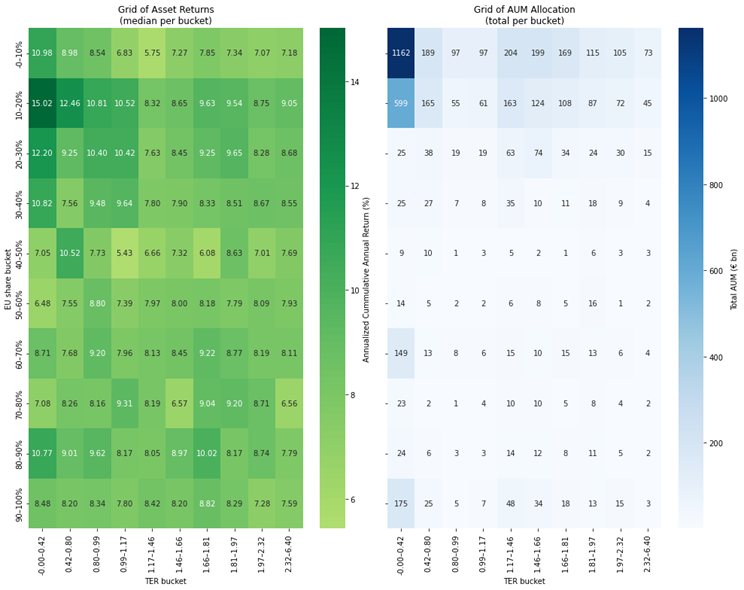
Source: LSEG Lipper.
Notes: The returns were estimated on equity and mixed UCITS funds and computed as annualised cumulative growth rates of annual returns over the period 2000-25. AuM stands for assets under management and the volumes reported are at November 2025; TER stands for total expense ratio. “share of EU investment” refers to the share of assets under management invested by funds in EU countries.
The various elements of the Commission’s recently launched initiatives are interlinked and mutually reinforcing. They include measures to promote the growth of supplementary pensions and encourage long-term individual participation in capital markets. They also comprise the Commission’s retail investment strategy, aimed at streamlining investor protection rules and enhancing the clarity and accessibility of standardised information on retail investment products, and the Communication on a Financial Literacy Strategy for the EU[44], which seeks to empower citizens with the knowledge and skills needed to make informed financial decisions.
Box 3
Euro area household savings allocation and the role of taxation
One objective of the savings and investments union (SIU) agenda is to increase retail participation in EU capital markets with a view to raising returns for savers and deepening capital markets. Taxation policies can affect both the allocation of savings across borders and savers’ investment decisions. Currently, inefficient procedures regarding withholding taxes (WHT) create frictions that act as a barrier to cross-border investment throughout the EU, contributing to home bias and limiting the efficient allocation of capital across the bloc. Addressing this issue is key to fostering deeper financial integration and more effective allocation of savings in the EU. In addition, public policies, such as introducing savings and investment accounts that are transparent and easy to use, can address some of the barriers to increased retail participation in capital markets, while providing benefits for savers and the financing of European firms. Granting capital gains tax relief may provide some incentive to shift savings towards capital markets. The literature, on the other hand, indicates that the impact is likely to be modest, reflecting the persistent strong preference of households for deposits, despite the substantial difference in yields between low-return deposits and higher-return equity investments. There are a variety of reasons for this, including the level of financial literacy, access to adequate information and the structure of pension systems. Understanding these dynamics highlights that, besides the level of tax rates, it is crucial to consider the method of taxation in order to assess the design of potential tax incentives.
More2.5 Citizens and savings – pension systems
Households in the EU mainly save for precautionary reasons (“saving for a rainy day”) and for long-term planning, particularly retirement planning.[45] To meet these retirement savings needs, households largely depend on state pension systems (Pillar I) as the foundation for their essential life-cycle savings. Occupational pensions (Pillar II) and private pensions (Pillar III) play a smaller role.
State pensions in Europe largely operate on a pay-as-you-go (PAYG) basis without accumulating capital market assets, while occupational and private pensions are prefunded, investing significant resources in capital markets (Table 4). Countries with advanced Pillar II and Pillar III systems (in addition to Pillar I systems), such as the United States, Canada, the Netherlands, Denmark and Sweden, benefit from these prefunded models, as they increase retirement adequacy, improve macroeconomic resilience and support capital market development. For instance, Pillar II assets in the Netherlands exceed 150% of annual GDP, illustrating their role in fostering long-term investment pools.
Table 4
The three pillars of pension provision
Feature | Pillar 1: Public | Pillar 2: Occupational | Pillar 3: Private |
|---|---|---|---|
Mandatory | Yes | Varies (mandatory in some countries, voluntary in others) | No |
Financing | PAYG (current contributions finance current retirees) | Funded (employer/employee contributions invested) | Funded (individual contributions invested) |
Coverage | Universal | Employees working in participating firms/sectors (and not opting out) | Individuals who opt in |
Objective | Basic income, poverty prevention | Supplement income, maintain living standards | Additional flexibility, personal choice |
Benefit structures | Earnings‑related PAYG pensions (DB), NDC pensions, basic or flat‑rate pensions, minimum pensions/guaranteed pensions, social assistance pensions (non‑contributory) | Occupational defined contribution DC or DB plans, collective or hybrid schemes, employer‑provided group insurance products | IPPs, life insurance‑based savings, tax‑advantaged long‑term savings accounts, retail investment products used for retirement |
Fosters capital market development | No | Yes | Yes |
Source: ECB.
Notes: DB stands for defined benefit; DC stands for defined contribution; IPP stands for individual pension plan; NDC stands for notional defined contribution; PAYG stands for pay-as-you-go.
Fully funded pension systems yield returns linked to the productivity of capital, often leading to better growth rates than those of PAYG systems, which are constrained by labour force and wage growth. While funded systems are not immune to demographic pressures, international diversification offers partial insulation from local ageing trends. In addition, the investment activities of Pillar II and Pillar III funds – such as allocations to venture capital, private equity and private debt – stimulate innovation, technology and economic growth, as seen in countries such as the Netherlands and Denmark, where pension assets contribute significantly to GDP[46] and equity market development.
Benefit structures under Pillar II and Pillar III shape the development and depth of capital markets. Pension funds, with their long-term investment horizons, can play a significant role in deepening capital markets, fostering liquidity, market discipline and economic innovation. Life insurance companies are pivotal to the development of debt securities markets because their business model requires the long-term investment of premiums, providing a steady, high-volume demand for corporate and government bonds. They act as major institutional investors that increase market depth, lengthen security maturities and provide liquidity to corporate bond markets.[47] Evidence for this can be observed even for the euro area, where pension funds are well developed in only a few countries, and life insurance companies play an important role (Chart 2.4).
Chart 2.4
Links between household pension and life insurance growth and financial market development in the euro area
a) Life insurance policies issued | b) Pension fund entitlements |
|---|---|
(1999-2025; x-axis: life insurance policies issued; y-axis: size of securities markets; ratio to nominal GDP) | (1999-2025; x-axis: pension fund entitlements; y-axis: size of securities markets; ratio to nominal GDP) |
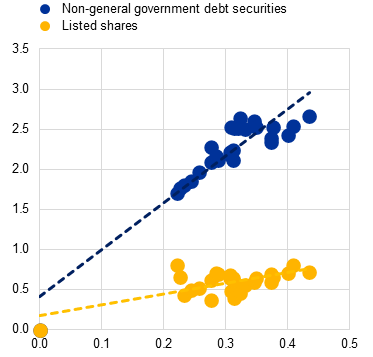 | 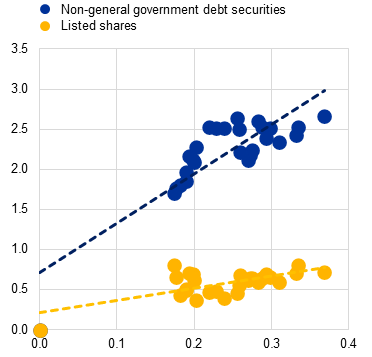 |
Sources: ECB and ECB calculations.
Pension funds have to contend with the inconsistent interpretation of the prudent person principle across Member States, which limits diversification into equities. The prudent person principle – embedded in Solvency II for insurers and in IORP II for occupational pension funds – requires institutions to invest only in assets whose risks they can properly identify, measure, monitor and manage. The prudent person principle itself is not the barrier. The issue is how differently Member States interpret and enforce the principle, which leads to uneven supervisory expectations, de facto constraints on equity exposure in some jurisdictions, reduced cross‑EU consistency in pension fund investment strategies and limited diversification into equities for funds operating under more conservative national regimes.[48]
Additionally, a substantial portion of European pension savings flows to non-EU markets, such as the United States and Asia.[49] This situation reflects limited capacity and investment opportunities within EU capital markets, but it has merits in terms of portfolio diversification. Strengthening EU capital markets is essential to retaining pension savings within Europe, offering households competitive risk-return profiles while aligning investments with strategic priorities such as green and digital transitions.
EU pension systems remain under Member States’ jurisdiction, with the EU playing a complementary role in cross-border mobility, consumer protection and the Internal Market. The EU has established minimum requirements for Institutions for Occupational Retirement Provision (IORPs). These are rules that set common standards for the governance, risk management and transparency of occupational pension funds to better protect members and beneficiaries. It has also created the pan-European Personal Pension Product (PEPP). This is a voluntary, portable and standardised EU‑wide personal pension product designed to help individuals save for retirement across borders under a single framework.
The Commission has proposed targeted measures to boost supplementary pensions and enhance transparency and efficiency in pension systems. They are part of the Commission’s November 2025 proposals[50] which are aimed at strengthening both the demand for and supply of supplementary pensions, addressing demographic shifts and fostering long-term capital mobilisation. The measures include the following.
- Clarifying the prudent person principle: The Commission’s proposals aim to harmonise the interpretation of this principle across Member States, enabling pension schemes to diversify investments into equity, including private and listed equity. This will help citizens achieve higher long-term returns and unlock new sources of financing for the EU economy.
- Modernising the IORP II Directive[51]: To unlock the potential of occupational pensions, the Commission proposes strengthening and modernising the framework to further support efficiency, scale and trust in supplementary pensions.
- Revamping the PEPP Regulation[52]: To make PEPPs more accessible and cost-effective, the Commission proposes a simplified “Basic PEPP” invested in straightforward financial assets, alongside “tailored” PEPPs for savers requiring more complex options with guarantees. These changes are aimed at boosting PEPP adoption.
- Promoting transparency and tracking systems: Comprehensive pension tracking systems and dashboards have been proposed as a means of providing citizens with clear insights into their pension rights and projected benefits. This could improve awareness and address the issue of low participation in supplementary pension schemes. National dashboards will also feed into an EU-level pension dashboard to support policymakers in assessing coverage, adequacy and sustainability.
- Encouraging auto-enrolment: Automatically including workers in supplementary pension schemes, with the option for them to opt out, is recommended as a means of achieving greater participation in supplementary pension schemes and increasing the scale of supplementary pensions markets. This approach draws on lessons from successful EU practices and global examples.
To better retain pension savings within the EU, policymakers must ensure that European capital markets offer competitive returns and diverse opportunities by lowering fees, simplifying products, improving retail access and providing targeted tax incentives. At the same time, the EU needs measures that draw more institutional capital into European assets – including clearer prudential rules that support long‑term investment, a stronger pipeline of high‑quality sustainable and strategic projects, and deeper cross‑border market integration – so that both European and international pension funds see Europe as an attractive destination for long‑term investment. These efforts will reinforce the SIU strategy’s goal of mobilising private capital for sustainability, innovation and other strategic priorities.
Mobilising pension-related savings is vital for addressing demographic and strategic challenges. Europe must mobilise far more pension‑related savings, because an ageing population is straining public pension systems. At the same time, the EU needs deep, resilient capital markets to finance its green and digital transitions, strengthen economic sovereignty and enable it to remain competitive with global economic powers. The Commission’s proposals provide a comprehensive framework to modernise supplementary pensions, unlock long-term capital and enhance citizens’ financial security.
Transitioning from PAYG systems to funded pension models (Pillars II and III) presents significant challenges, including high upfront costs, exposure to market risks, potential inequality in savings accumulation and administrative complexities. Strengthening the funded Pillars II and III entails significant transition costs, as governments must continue financing current PAYG pensions while diverting contributions into new funded schemes. These reforms also create distributional challenges across and within generations, expose retirement incomes to greater market risk and require substantial administrative capacity to manage new systems effectively. Without careful design, high fees, political reversals and implementation complexity can erode the intended fiscal relief for Pillar I. However, strengthening funded models offers notable benefits, such as improved financial sustainability, by reducing reliance on PAYG systems, increasing pension coverage through auto-enrolment[53] and mobilising long-term capital to support economic growth and strategic priorities. To navigate the resulting trade-offs, policymakers must prioritise equitable designs, promote financial literacy and safeguard returns through prudent investment regulations and risk-sharing mechanisms. Achieving this balance is essential for creating resilient, inclusive and impactful pension frameworks.
2.6 Investments and financing – the role of private markets
Euro area private markets remain small but have grown significantly in recent years, providing companies with alternative funding sources beyond public financial markets and bank loans. Private markets are currently small relative to public markets and bank lending in the euro area. However, they have grown significantly since 2010 (Chart 2.5).[54] Their growth has been driven both by investors seeking high returns, especially during the period of ultra-low interest rates, and by companies needing to obtain finance more rapidly and flexibly. Private markets fulfil an important economic function in this regard, as they match the financing needs of riskier corporates with the risk-bearing capabilities of long-term investors and could thereby support the goals of the SIU.[55]
Chart 2.5
Private markets in the euro area remain small compared with public financial markets and bank financing
a) Private market funds’ assets under management, by fund location and fund type | b) Other sources of euro area firm financing: outstanding stocks |
|---|---|
(Q4 2010, Q4 2020, Q2 2025; left-hand scale: € trillions, right-hand scale: percentages) | (Q2 2025; € trillions) |
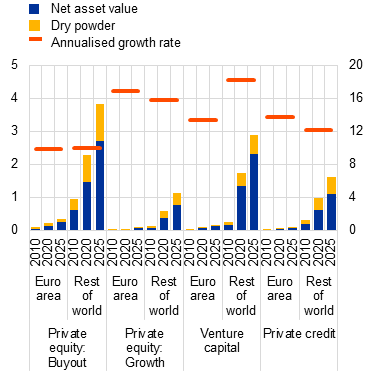 | 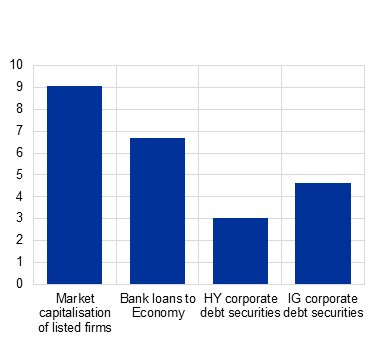 |
Sources: PitchBook Data Inc., a Morningstar company, Bloomberg Finance L.P., ECB and ECB calculations.
Notes: Panel a: private equity is split by funds focused on buyout and growth strategies. Funds are segmented by the location they are managed from. The red line shows the compound annual growth rate of assets under management between Q4 2010 and Q2 2025 for funds split by location and fund type. “Rest of world” includes all funds located in non-euro area countries. Assets under management of a private fund can be split into the net asset value of the fund’s portfolio and its “dry powder” – capital that has been committed but not yet called. Panel b: listed firms are euro area-domiciled constituents of the STOXX Europe Total Market Index as of Q2 2025. As market capitalisation is shown, the size is affected by valuation effects. The data on outstanding debt securities are from Bloomberg. The bonds universe is filtered for country of risk including all euro area countries and the ratings are divided into high-yield and investment grade. “Outstanding HY corporate debt securities” includes companies which are not rated. HY stands for high-yield; IG stands for investment grade.
Private markets focus on more innovative sectors and tend to finance companies that are smaller than those issuing public equity or corporate bonds. Private market funding seems concentrated in sectors that are more innovative, such as business products and services, health care and information technology (Chart 2.6, panel a). Companies within these sectors may find it difficult to obtain bank loans, as banks often rely on collateral, which more innovative and riskier firms may not be able to provide, and may prefer to finance companies that have lower risk profiles and are in the later stages of their corporate life cycles. While market intelligence suggests that, in recent years, private credit funds have moved further up the credit quality spectrum and into larger deals[56], the average company receiving private credit remains smaller than the average corporate bond issuer (Chart 2.6, panel b). As SMEs face hurdles to issuing corporate bonds because of their smaller size, lower ratings or lack of market recognition, private credit markets can provide an alternative funding source to smaller companies. In addition, SMEs’ share in private equity and venture capital transactions is higher than that of listed stocks, which may mean there are obstacles preventing SMEs from obtaining a listing on public stock exchanges. These include administrative burdens, increased disclosure requirements, valuation concerns or a fear of less strategic control over the company.
Chart 2.6
SMEs focus on innovative sectors and make up a higher share of all euro area companies that receive financing from private markets
a) Euro area companies financed by private markets, sector split | b) Euro area companies financed by private and public markets, by size |
|---|---|
(2020-26; left-hand scale: percentages, right-hand scale: € trillions) | (percentages) |
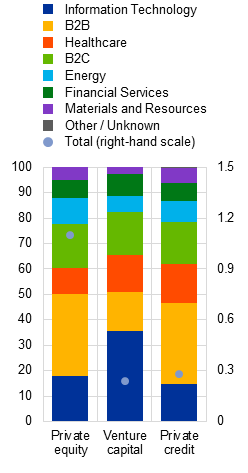 | 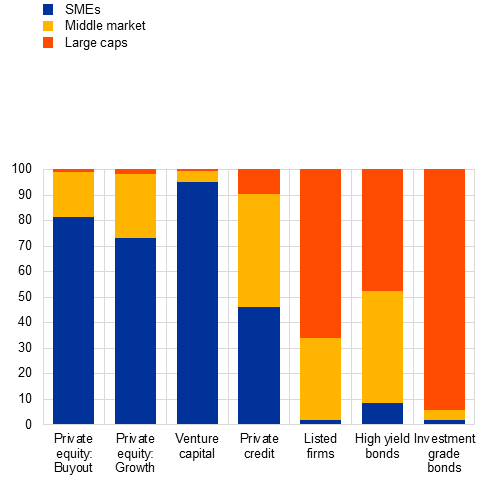 |
Sources: PitchBook Data Inc., a Morningstar company, Bloomberg Finance L.P. and ECB calculations.
Notes: Panel a: the industry classification system developed by PitchBook is very similar to the Global Industry Classification Standards (GICS). Industry sectors as defined by Pitchbook include business products and services (B2B), consumer products and services (B2C), energy, financial services, health care, information technology, and materials and resources. B2B and B2C in the chart stand for business products and services (B2B) and consumer products and services (B2C). Only the primary industry sector is used. Funding volumes are based on deal volumes and refer to volumes of transactions financed, in whole or in part, through private equity, venture capital or private credit. Panel b: Firms that have received funding, by funding source, between January 1, 2023, and April 9, 2026. Firms are segmented into the categories Small and medium-sized enterprises (EUR 0–50 million), Middle market firms (EUR 50–1,000 million), and large-cap firms (above EUR 1,000 million). Listed firms refer to companies included in the STOXX Europe Total Market Index as of April 9, 2026.
Corporates financed via private markets tend to demonstrate higher levels of productivity at the price of worse risk metrics. Companies with access to private market financing show significantly higher productivity levels than companies financed solely by banks.[57] This can be due to the longer-term effects of increases in companies’ intangible assets and the long-term investments that tend to follow after private market financing is added to a company’s financing mix. Similarly, there may be a positive screening effect among private market participants, which may have higher risk-bearing capacities and have better incentives than banks to identify and finance innovative but riskier companies. However, corporates’ risk metrics deteriorate after private market financing is added to their financing mix. For the median company, the entry of private markets is associated with higher indebtedness and decreased capacity to pay interest.
Risk monitoring remains warranted, but the further growth of private markets could facilitate the financing of SMEs and thus help advance the SIU. Several developments and trends in private markets require continued monitoring to observe possible issues at an early stage. These include a deterioration in the quality of private credit, difficulties for private equity funds in exiting investments because of valuation concerns, and a move towards a higher liquidity mismatch as private markets increasingly fund themselves via retail markets. Concerns around high exposure to the software sector, which is under scrutiny due to advances in AI, has triggered a wave of redemption requests from semi-liquid private credit funds in the US since the start of the year. This has reinforced concerns around liquidity mismatches. Exposures of traditional financial entities such as insurers and banks appear limited on aggregate. However, opaqueness and data gaps may conceal risks and hinder a full assessment of the risks arising from interlinkages between private markets and traditional financial entities and there can also be indirect contagion channels. For the wider economy, private markets often link the risk-bearing capabilities of long-term investors with the financing of smaller, riskier and innovative firms that are important for future economic growth. In this respect, growth in euro area private markets can also support the development of the SIU in the euro area. Potential hurdles to that growth should be addressed. These hurdles include fragmented markets and tax regimes, weaker exit opportunities for private equity and venture capital funds due to less developed capital markets, and regulatory disincentives for institutional investors to invest in private markets. The recent proposals for the Solvency II Directive[58] and the IORP Directive to encourage long-term equity investments could help drive up institutional investment in private equity and venture capital (see Box 4).
Box 4
Exploring the investor landscape for venture capital
As venture capital (VC) finances firms that have the potential to grow rapidly and substantially, it is a sector that could increase the productivity of the economy, while boosting strategic autonomy. This box examines VC fund investors, showing that the limited involvement of institutional investors with large financing firepower is one element that constrains VC funds from financing scale‑ups in Europe. The analysis also shows that the European Investment Fund (EIF) plays a key role, which could be leveraged to crowd-in private investors. Finally, the VC fund landscape is mapped against the existing regulatory framework to inform the upcoming review of the framework. This will make it possible to better address the needs of EU VC fund managers and, in turn, potentially expand the availability of VC investment opportunities for investors. Overall, the investor landscape for VC funds affects the broader innovation financing ecosystem in Europe, which would benefit from policies addressing fragmentation within the Single Market.
More2.7 Integration and scale – post-trading infrastructure
2.7.1 State of play
Over the past two decades, substantial efforts have been made in the EU towards integrating the post-trading landscape. At the infrastructure and regulatory levels, progress has been achieved with (i) EU legislation to harmonise rules for wholesale market infrastructures (central counterparties, central securities depositories (CSDs) and payment systems)[59], (ii) the establishment of the TARGET2-Securities (T2S) platform to facilitate the cross-border settlement of securities, and (iii) the creation and ongoing implementation of market standards in settlement and asset servicing. On the regulatory side, the Central Securities Depositories Regulation (CSDR) has strengthened the EU post-trade framework by introducing a harmonised authorisation and supervision regime for CSDs, as well as EU-wide prudential, organisational and conduct requirements. It has supported greater cross-border service provision by instituting passporting rules for CSDs and a right for issuers to choose where they issue securities, subject to certain conditions. The CSDR has also contributed to supervisory convergence through the involvement of the European System of Central Banks and ESMA, although ESMA’s practical role in this area has so far remained more limited than in other sectors. In particular, the CSDR allows relevant authorities such as the Eurosystem, acting as central bank of issue, to provide opinions on CSDs’ compliance to NCAs. With regard to infrastructure integration, the launch of T2S in 2015 marked a major milestone in post-trade integration. T2S provides a single pan-European settlement platform operated by the Eurosystem. The service has harmonised core settlement processes by replacing diverging national procedures, increased safety by enabling delivery-versus-payment in central bank money across participating markets and significantly reduced the technical and operational barriers to cross-border settlement.
However, persistent fragmentation limits the attractiveness of the European financial markets for investors. The post-trade landscape remains fragmented: securities settlement and asset servicing continue to be organised largely along national lines, with most Member States keeping a national CSD as well as national legal and tax frameworks with different rules and market practices. This fragmentation increases costs, complicates cross-border activity and limits the efficiency and attractiveness of EU capital markets, which contributes to the small size and reduced market liquidity of EU markets, particularly when compared with major peer jurisdictions with more integrated post-trade environments. Therefore, despite the progress achieved with the CSDR, national differences in supervisory practices and the persistence of national legal frameworks continue to restrict the full integration of post-trade services across Member States – notably by limiting CSD passporting and cross-border issuance. In practice, issuance for both sovereign and corporate issuers is largely tied to domestic markets, while cross-border investment is constrained by legal requirements (idiosyncratic requirements in national corporate and securities laws), tax processes and the inertia of legacy market practices that prove difficult to change. The CSDR does not address the lack of harmonisation of national corporate and securities laws, which creates barriers to the passporting of CSD services and the freedom of issuance, for instance by limiting the opportunities for issuers to issue in a CSD established in another Member State. This hampers competition between CSDs, and the post-trading landscape remains fragmented across many infrastructures. In addition, although T2S was a decisive step in settlement integration, participating in T2S or creating CSD links is not mandatory but is left as a business decision to be taken by CSDs. The platform has not yet fully achieved its purpose: transactions across CSDs still represent only a minor share of settlement activity on the platform, having increased only slightly over time (Chart 2.7). This indicates that there has been no significant take-up of cross-CSD settlement following the introduction of T2S, as behavioural and business barriers in settlement processes remain prevalent.
Chart 2.7
Cross-CSD settlement in T2S
T2S cross-CSD settlements as a share of all T2S settlements
(Jan. 2020-March 2026; percentages)
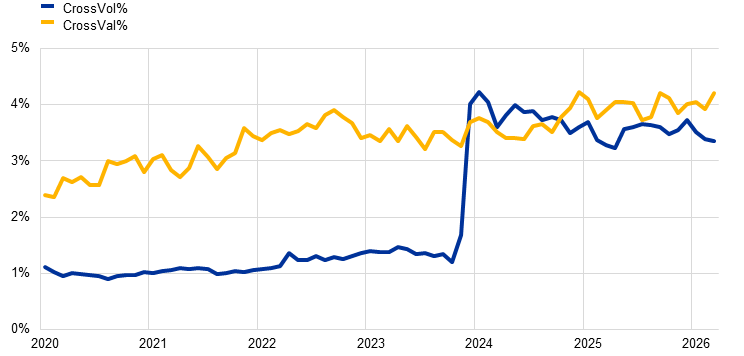
Sources: ECB internal data, TARGET operations and ECB calculations.
Finally, legal, regulatory and tax barriers remain key drivers of this fragmentation. Differences in national corporate law and securities law affect the processing of corporate events, the identification of beneficial owners and the enforceability of investor rights, making it difficult for infrastructures to integrate their platforms across borders, even within cross-border groups. These divergences introduce legal uncertainty for cross-border investors and intermediaries and require market participants to maintain complex, jurisdiction-specific arrangements. Tax barriers, notably in the area of withholding tax relief and reclaim procedures, continue to create operational frictions and discourage cross-border investment by increasing costs and investment risk.
2.7.2 Current work to deepen market integration and leverage innovation
In 2025, EU policymakers announced important initiatives to deepen integration in the post-trade landscape and leverage technological innovation to improve the efficiency of post-trade services and, where possible, overcome technical barriers. The integration measures put forward as part of the Commission’s recent proposals represent an opportunity to address some of the barriers highlighted above.[60] The ECB particularly welcomes the measures aimed at improving supervisory convergence under ESMA, facilitating cross-border service provision by CSDs and reducing unnecessary regulatory frictions that discourage CSDs from operating across borders. This includes proposals to establish networks of links between all CSDs through hubs and to expand the scope of the existing links to cover all securities, which would improve investors’ access to securities across the EU. It also includes a proposal to promote the use of T2S. In addition to regulatory measures, the Eurosystem – via its market advisory body, the Advisory Group on Market Infrastructures for Securities and Collateral (AMI-SeCo[61]) – will continue promoting and sponsoring market harmonisation and standardisation, as well as greater compliance with existing market standards in the areas of settlement, asset servicing and collateral management (e.g. the Single Collateral Rulebook for Europe standards, T2S standards and industry shareholder identification standards). In addition, the EU’s planned migration to a T+1 standard securities settlement cycle by October 2027 also requires a harmonisation of operational processes across the value chain to improve the efficiency of transaction processing and speed up the execution of settlement without running a higher risk of settlement fails.
Innovation also plays a central role in current efforts to transform the EU post-trade landscape. The application of new technologies such as distributed ledger technology (DLT) have the potential to increase the efficiency of the securities ecosystem and to promote integration. Although many of the barriers described above do not stem from technology, the “green field” approach adopted by many stakeholders considering the application of these technologies provides an opportunity to remove or reduce several of these hurdles. The potential of these technologies to lower costs and reduce the complexity involved in exchanging information among stakeholders, and to further standardise key pre-trade and post-trade activities, are perceived by many stakeholders as an avenue to a more integrated capital markets ecosystem.
The DLT Pilot Regime Regulation[62] provides for a controlled environment to test new models for the recording, trading and settlement of securities. The proposed improvements to the pilot regime are an important step in allowing this ecosystem to move towards a more mature stage. The proposed permanent regime would feature more flexible parameters, such as higher activity limits in particular. The Commission proposes new types of licences for specific CSD services. Market stakeholders could use these licences instead of relying on national laws for digital securities, thus reducing legal fragmentation. The review also seeks to improve interoperability across DLT-based infrastructures and with existing market infrastructures.
In parallel, the Eurosystem is working on enabling the settlement of digital assets and facilitating a natively digital ecosystem through the Pontes and Appia initiatives.
- Pontes is the Eurosystem’s DLT solution connecting market DLT platforms and TARGET Services. This will allow market participants to settle tokenised asset transactions in central bank money, giving them the safety and certainty they need today while building operational experience for tomorrow. The Eurosystem will launch a pilot for Pontes by the third quarter of 2026.
- Appia will pave the way to an integrated digital financial ecosystem in Europe based on systematic and wide cooperation between public and private stakeholders. The initiative will combine analytical and practical work focusing on the overall architecture of the future ecosystem – from settlement infrastructures to standards, rules and governance frameworks. Appia will draw on the lessons learnt from Pontes.[63]
2.7.3 Additional measures needed to achieve further integration
Despite the progress made, a fully integrated EU securities issuance and post-trade landscape can only be achieved if the persistent fragmentation of issuance practices, national laws and tax rules is addressed. A key priority is to harmonise corporate, insolvency and securities legislation. This will also help promote market harmonisation and the standardisation of issuance and asset servicing market practices. Targeted measures could focus in the first instance on specific areas of corporate and securities law that directly affect the cross-border issuance, holding and settlement of securities. For instance, harmonising the definition of beneficial owners, including for tax purposes, and standardising the processing of corporate events for both equities and debt instruments would remove significant operational barriers. In practice, this could involve expanding the scope of the Shareholder Rights Directive[64] to cover the full processing of corporate events, potentially by codifying existing market standards into EU law. Establishing a 28th regime for corporate, insolvency and securities law harmonisation would enable EU firms to opt into a framework allowing the cross-border provision of post-trade services for the securities they issue. The full implementation of the FASTER Directive would mark progress towards achieving harmonised tax processing, data requirements and certification requirements, thus reducing the disproportionate costs of cross-border investment.
The regulatory framework for post-trade services should, in the long term, converge towards and support single rulebooks. These harmonised rules should cover the areas of issuance, settlement, asset servicing and collateral management applicable to all infrastructures and their users. They should do so in a way that is technology-neutral and provides a level playing field for EU infrastructures. This could also support the eventual integration of the DLT Pilot Regime Regulation into other pieces of EU legislation, while adapting the legislation to the new ecosystem.
Box 5
The role of the Eurosystem in the scaling-up of a tokenised financial ecosystem
Financial market infrastructures for securities issuance, settlement and servicing are evolving with digital innovation. The use of tokenisation of financial assets – digitally representing an asset in a decentralised database through distributed ledger technology (DLT) – is increasing. It has the potential to make financial services more efficient by automating, integrating and simplifying processes, as well as enhancing transparency. For example, although central securities depositories (CSDs) have traditionally relied on centralised database systems to carry out their activities, in recent years, CSDs and other market players have been exploring the use of tokenisation and DLT. [65] According to Bloomberg data, at the end of 2025 the amount outstanding of euro-denominated debt instruments with some digital exposure, including but not limited to assets issued using DLT, stood at around €2 billion (Chart A). Market intelligence suggests that tokenisation initiatives have focused primarily on the issuance of debt instruments, money market fund units and collateral management activities such as repo transactions. This means that the use of DLT remains limited for the issuance of equities and more complex financial instruments.[66],[67]
MoreBox 6
Closing the gap? Gauging the development and integration of Europe’s capital markets
Empirical evidence points to a set of interrelated structural blockages that continue to limit the effectiveness of European capital markets in supporting innovation and long-term growth. Households’ limited exposure to risk capital contributes to a marked mismatch between Europe’s large savings and its financing needs.[68] Additionally, when households do invest in equity, a substantial share of it is channelled to the United States, supporting, among others, its innovative sectors. To translate the savings and investments union (SIU) agenda into actionable priorities, policymakers need sound and simple metrics that quantify how far European capital markets are from their potential, and where fragmentation remains most binding. Building on previous analytical framing, indicators of market development and integration can be mapped to bottlenecks in the capital markets union (CMU) across three stages: (i) facilitating access to capital markets (“entry”), (ii) enabling cross-border scaling (“expansion”), and (iii) improving opportunities to finance growth and fostering successful outcomes (“exit”).[69] This box sets out a compact set of CMU indicators aligned with these goals. The aim is to highlight key structural gaps and help assess progress on CMU objectives under the SIU strategy.
MoreAcknowledgements The report on financial integration and structure in the euro area is based on regular surveillance activities, analysis and findings from discussions with market participants and academic researchers.The preparation of the report was coordinated by John Fell (Directorate General Macroprudential Policy and Financial Stability; Co-Coordinator of the Committee on Financial Integration (CFI)), Gilles Noblet (Directorate General International and European Relations; Co-Coordinator of the CFI) and Philippe Molitor (Directorate General Macroprudential Policy and Financial Stability; CFI Secretary) and benefited from input, comments and suggestions from the ECB’s Directorate General Macroprudential Policy and Financial Stability (DG/MF), Directorate General Research (DG/R), Directorate General International and European Relations (DG/I), Directorate General Statistics (DG/S), Directorate General Market Operations (DG/M), Directorate General Market Infrastructure and Payments (DG/MIP), Directorate General Horizontal Line Supervision (DG/HOL) and Directorate General Economics (DG/E). Comments from members of the Eurosystem Financial Stability Committee are gratefully acknowledged.The report was approved by the Governing Council on 9 April 2026.Its contents were prepared by with valuable input from:DG/E: Pablo Andrés Anaya Longaric; Michael Fidora;DG/HOL: Massimo Libertucci;DG/I: Elena Banu; Jacopo Carmassi; Andrei Dumitrescu; Zakaria Gati; Laura Parisi; Cyprien Milea; Alessandro Spolaore;DG/M: Virginia Cella Arriga; Francisco Guilherme Nazaré Gaspar; Angelica Ghiselli; Maria de Encio Mugica; Ross James Murphy; Samuel Ryan;DG/MF: Paolo Alberto Baudino; Maria Leonor Carrilho Puga; Katharina Cera; Johanne Evrard; Jaime Hinojosa Laso; Claudia Lambert; Allegra Pietsch; Wagner Eduardo Schuster; Oscar Schwartz Blicke; Jens Tapking; Fabian Wagner; Michael Wedow;DG/MIP: Gergely Koczan; Emmanuelle Lucine Levrier; Clément Rouveyrol;Directorate General On-site and Internal Model Inspections (DG/OMI): Lisa Bellinghausen;DG/R: Toni Ahnert; Maria Antonietta Viola;DG/S: Eleonora Bascilico; Davide Caridi; Tanja Derin; Urszula Kochanska; Daniel Legran.
© European Central Bank, 2026
Postal address 60640 Frankfurt am Main, Germany
Telephone +49 69 1344 0
Website www.ecb.europa.eu
All rights reserved. Reproduction for educational and non-commercial purposes is permitted provided that the source is acknowledged.
For specific terminology please refer to the ECB glossary (available in English only).
PDF ISBN 978-92-899-7834-7, ISSN 1830-7159, doi:10.2866/0962435, QB-01-26-104-EN-N
HTML ISBN 978-92-899-7833-0, ISSN 1830-7159, doi:10.2866/4106694, QB-01-26-104-EN-Q
Financial Integration and Structure in the Euro Area, ECB, March 2020.
Council Directive (EU) 2025/50 of 10 December 2024 on faster and safer relief of excess withholding taxes (OJ L, 2025/50, 10.1.2025).
The review period in this chapter covers developments from the end of 2022 to the end of 2025.
Charts labelled SA, Financial Integration (FI) or Financial Structure (FS), Chart X can be found in the Statistical Annex and the underlying Financial Integration or Financial Structure indicators.
Bańkowski, K. et al., “Four years into NextGenerationEU: what impact on the euro area economy?”, Occasional Paper Series, No 362, ECB, December 2024.
NFCs (often through intercompany loans) and other financial intermediaries are the second and third largest providers of loans to the euro area economy. Both sectors have increased their share of loan provision, offsetting a decline in the role of loan providers from the rest of the world.
The direct cross-border lending approach, where a lender based in euro area country A lends money to a borrower domiciled in euro area country B, is a stronger force for banking market integration in the euro area than the alternative indirect lending approach, where a banking group headquartered in euro area country A lends money – via a branch or a subsidiary located in euro area country B – to a borrower residing in euro area country B. See the box entitled “Intra-euro area cross-border bank lending: a boost to banking market integration?”, Financial Integration and Structure in the Euro Area, ECB, June 2024.
Between July 2022 and September 2023 the ECB raised interest rates from -50 basis points to 400 basis points. Following a nine-month holding phase the monetary policy easing cycle commenced in June 2024. Between June 2024 and June 2025 the ECB lowered its policy rates by a cumulative 200 basis points. Since June 2025 ECB policy rates have remained unchanged.
See the special feature entitled “Private markets, public risk? Financial stability implications of alternative funding sources”, Financial Stability Review, ECB, May 2024.
See Box 6, Chart A.
See the special feature entitled “Systemic risks in linkages between banks and the non-bank financial sector”, Financial Stability Review, ECB, November 2025: “There has been a rapid increase in interconnections between banks and NBFI entities via the repo market, driven by prime brokerage activities concentrated among systemic banks.” Such interconnections are not captured by the structural indicators underlying this analysis.
For an in-depth discussion on the “quality” of financial integration, see the special feature entitled “Financial integration and risk sharing in a monetary union”, Financial Integration in Europe, ECB, April 2016.
Lane, P.R., “Euro area international financial flows: analytical insights and measurement challenges”, keynote speech at the joint conference of Banco de España, the Irving Fisher Committee on Central Bank Statistics and the ECB on “External statistics after the pandemic: addressing novel analytical challenges”, Madrid, 12 February 2024.
For a different but related AI-based approach applied to the CMU, see Arampatzi, A.-S. et al., “Capital markets union: a deep dive. Five measures to foster a single market for capital”, Occasional Paper Series, No 369, ECB, revised May 2025.
The commentaries were identified by carrying out a systematic keyword-based search using Google Scholar, Google Search and Open AI’s ChatGPT Deep Research to locate relevant documents.
See “The Savings and Investments Union. Connecting savings and productive investments” on the Commission’s website.
See Lagarde, C, “Follow the money: channelling savings into investment and innovation in Europe”, speech at the 34th European Banking Congress, Frankfurt am Main, 22 November 2024. See also Arampatzi, A-S. et al., “Capital markets union: a deep dive. Capital markets union: a deep dive. Five measures to foster a single market for capital”, Occasional Paper Series, No 369, ECB, revised May 2025.
The Banque centrale du Luxembourg does not fully share the views and statements made in Section 2.2 and Box 1 regarding centralised supervision.
For example, the Commission recently proposed this option with the Settlement Finality Directive – Directive 98/26/EC of the European Parliament and of the Council of 19 May 1998 on settlement finality in payment and securities settlement systems (OJ L 166, 11.6.1998, p. 4). See Question 27 in “Questions and answers on the market integration package” on the Commission’s website.
The EU Treaties limit legislative instruments in the field of direct taxation to directives, while for indirect taxation, regulations and other acts with direct effect in the legal systems of Member States can be used.
See “Business in Europe: Framework for Income Taxation (BEFIT). A proposal for a new legislative framework for corporate taxation in the EU” on the European Commission’s website.
The EU may benefit from the OECD’s global minimum tax, which ensures that large multinational enterprises pay a minimum 15% effective tax rate on profits in every jurisdiction where they operate. See Council Directive (EU) 2022/2523 of 15 December 2022 on ensuring a global minimum level of taxation for multinational enterprise groups and large-scale domestic groups in the Union.
The Directive is optional, for example, for Member States with a small capital market, i.e. market capitalisation of less than 1.5% of total EU market capitalisation.
See EU tax policy on the European Commission’s website.
Treaty on the Functioning of the European Union (OJ C 326, 26.10.2012, p. 47).
For an analysis of euro area and US saving rates, see “Household saving rates in the euro area and in the US: a counterfactual analysis” on the European Commission’s website.
Eurostat defines the household saving rate as gross household saving divided by gross disposable income, with the latter being adjusted for the change in pension entitlement of households.
Eurostat defines the household investment rate is defined as gross investment (gross fixed capital formation; mainly dwellings) divided by gross disposable income (adjusted for the change in pension entitlements) of the household sector in national accounts. Household investment mainly consists of the purchase and renovation of dwellings. Consumer durables (which include passenger cars) are not considered part of household investment.
Listed and unlisted shares and other equity (representing private ownership in corporations) account for 26% in the euro area and 42% in the United States.
See Banu, E. et al., “Crossing two hurdles in one leap: how an EU savings product could boost returns and capital markets”, The ECB Blog, ECB, 2025.
Figures for the euro area, United States and Japan refer to 2024, while the figure for the United Kingdom refers to 2022. Data sources: ECB for the euro area, World Bank for the United States, Japan and the United Kingdom.
Let denote the total market capitalisation of all euro area listed companies and the market value of shares in these companies held by euro area households. From the text, we know . We assume no crowding out, i.e. . We aim at . From these three equations, we obtain .
See Bekhtiar, K., Fessler, P. and Lindner, P., “Risky assets in Europe and the US: risk vulnerability, risk aversion and economic environment”, Working Paper Series, No 2270, ECB, 2019.
See “Monitoring the level of financial literacy in the EU”, Flash Eurobarometer, No 525, March-April 2023.
For a more detailed discussion of financial literacy in the EU, see Demertzis, M. et al., “The state of financial knowledge in the European Union”, Bruegel Policy Brief, No 04/24, February 2024.
The reason why “shifting protection from deposits to markets”, i.e. weakening deposit insurance, is ranked lowest may be that such a measure could have negative financial stability implications.
See the European Commission’s communication of December 2025 on the market integration package.
See Horioka, C.Y. and Ventura, L., “Why Do Europeans Save? Micro-Evidence From the Household Finance and Consumption Survey”, Review of Income and Wealth, Vol. 71, Issue 2, 2025.
Total assets managed by pension providers represented 207% and 151% of GDP at the end of 2024 for Denmark and the Netherlands respectively. See OECD, “Pension Markets in Focus 2025”, 2025.
See the special feature entitled “The importance of insurance companies for financial stability”, Financial Stability Review, ECB, December 2009.
See EIOPA, “Peer Review Report on the Supervision of the Prudent Person Principle under Solvency II”, 2024. This report found that supervising this principle-based requirement was frequently mentioned by national authorities as challenging. The report identified areas requiring further action in several Member States, particularly regarding non-traditional or complex assets. Industry bodies such as PensionsEuropePensionsEurope answer to the call for evidence on supplementary pensions have noted that existing limitations on riskier investments, such as private equity and venture capital, are often rooted in national legislation. Pension funds in countries using a more principle-based, qualitative approach to personal pensions tend to be less constrained. See PensionsEurope, “”, 2025.
EIOPA’s latest factsheet on IORPs, based on 2024 data, provides insights into how European IORPs allocate the approximately €2.7 trillion they manage across different asset types and jurisdictions.
See “Commission proposes to boost supplementary pensions to help ensure adequate retirement income”, press release, European Commission, 20 November 2025.
Auto-enrolment refers to the automatic inclusion of workers in supplementary pensions, with the full freedom for individuals to opt out.
Private markets are characterised by strong cross-border links as euro area corporates receive a significant share of private market funding from global private market funds: 60-70% of private credit and private equity funding comes from non-euro area countries. At the same time, euro area investors invest significantly in global private market funds: 60% of investments from euro area investors go into funds located outside the euro area.
For an introduction to private markets, see the special feature entitled “Private markets, public risk? Financial stability implications of alternative funding sources”, Financial Stability Review, ECB, May 2024.
According to data from PitchBook covering a sample of 258 deals, median private credit deals in the euro area increased from €75 million in 2021 to €168 million in 2023.
To read the full analysis, see the box entitled “Private markets: risks and benefits from financial diversification in the euro area”, Financial Stability Review, ECB, May 2025.
See the Central Securities Depositories Regulation (CSDR) – Regulation (EU) No 909/2014 of the European Parliament and of the Council of 23 July 2014 on improving securities settlement in the European Union and on central securities depositories and amending Directives 98/26/EC and 2014/65/EU and Regulation (EU) No 236/2012 (OJ L 257, 28.8.2014, p. 1); the European Market Infrastructure Regulation (EMIR) – Regulation (EU) No 648/2012 of the European Parliament and of the Council of 4 July 2012 on OTC derivatives, central counterparties and trade repositories (OJ L 201, 27.7.2012, p. 1); and the ECB Regulation on oversight requirements for systemically important payment systems (SIPS Regulation) – Regulation of the European Central Bank (EU) No 795/2014 of 3 July 2014 on oversight requirements for systemically important payment systems (ECB/2014/28) (OJ L 217, 23.7.2014, p. 16).
See the page entitled “Market integration package” on the European Commission’s website.
See the page entitled “Advisory groups on market infrastructures” on the ECB’s website.
For further details, see the Appia launch paper
CSDs are market infrastructures whose activities typically include the issuance, custody and settlement of securities.
This dynamic is likely supported by the fact that, compared with equities and structured financial products, plain vanilla debt instruments and money market funds impose lower legal/regulatory risks on stakeholders when transacted via new technologies. They are also more easily scalable in terms of duration and amounts issued and generally have a more flexible institutional investor base.
Tokenisation trends information is based on the Eurosystem’s own market intelligence activities and public reports by market associations (see Suarez, J., DLT-Based Capital Market Report, The Association for Financial Markets in Europe, October 2025).
See Nerlich, C. et al., “Investing in Europe’s green future – green investment needs, outlook and obstacles to funding the gap”, Occasional Paper Series, No 367, ECB, 2025.
See Arampatzi, A et al (2025), “Capital markets union: a deep dive. Five measures to foster a single market for Capital”, Occasional Paper Series, No 369, ECB, 2025.