







Published as part of the Financial Integration and Structure in the Euro Area 2026
Deepening and integrating EU capital markets are central to the objectives of the savings and investments union (SIU). The SIU aims to mobilise Europe’s high level of savings more effectively, support investment and innovation, strengthen cross-border risk sharing and enhance the EU’s economic resilience and competitiveness. While progress has been made on regulatory harmonisation, outcomes in terms of market integration, depth and scale remain limited. This box focuses on the supervisory dimension as a key missing element in the integration agenda, building on a granular mapping of the existing supervisory architecture in Europe.
A structurally fragmented supervisory landscape
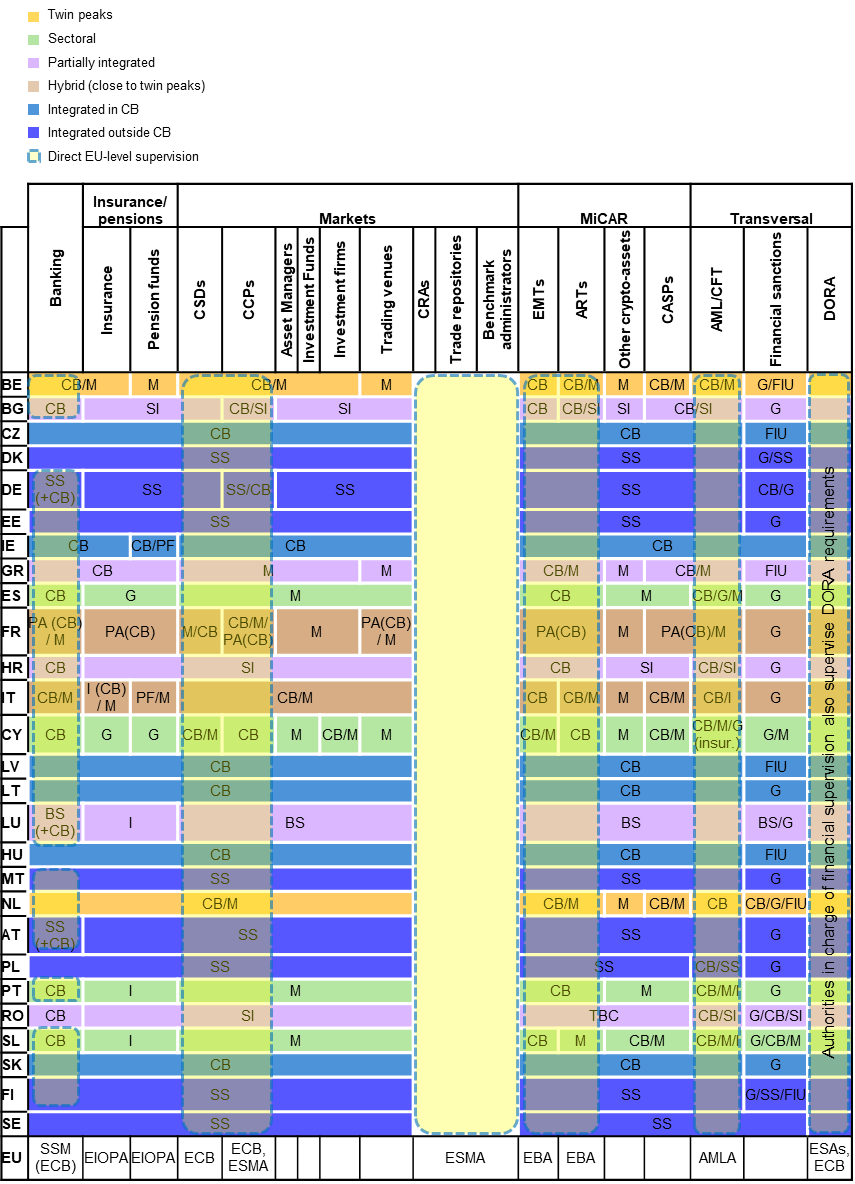
Six archetypal supervisory models for financial markets can be identified, five of which are currently in use across Europe, often in hybrid forms. These models range from fully integrated supervisors covering banking, securities and insurance (outside or within the central bank), to sectoral arrangements with separate authorities for each financial segment (integration across sectors can be full or just partial) and to objective-based “twin-peaks” models distinguishing between prudential and conduct supervision.[1] In practice, EU Member States frequently operate mixed configurations, reflecting incremental reforms and historical developments following financial crises and broader shifts in institutional approaches. As a result, while capital market supervision in Europe broadly reflects five of the six archetypal models, the overall landscape is more complex, encompassing 16 distinct institutional set-ups (Chart A).
Financial sector supervision in Europe is dispersed across 52 national authorities, creating a highly fragmented supervisory landscape.[2] The proliferation of supervisory authorities across Europe results in material differences in mandates, supervisory practices and enforcement outcomes. As a result, even where legal requirements are formally harmonised, their implementation diverges across jurisdictions due to differing interpretations of EU legislation, the application of national discretions and distinct supervisory cultures (regarding matters like intrusiveness), ultimately leading to uneven and fragmented supervisory outcomes.
In addition, EU-level oversight of capital markets plays a limited and uneven role. While the European Securities and Markets Authority (ESMA) contributes to rulemaking and supervisory convergence, and directly supervises a small number of specific entities, the vast majority of capital market participants remain under national supervision. This division of responsibilities means that supervision continues to be organised primarily along national borders, despite the cross-border nature of many market activities.
EU arrangements for capital market supervision also appear highly fragmented when compared with other advanced jurisdictions, such as the United States. In the United States, capital market supervision is largely exercised at the federal level by the Securities and Exchange Commission and the Commodity Futures Trading Commission, which oversee securities and derivatives markets respectively, complemented by self-regulatory organisations and state authorities. Europe’s supervisory architecture features a much heavier stratification of responsibilities with no direct equivalent in the United States. While structural differences in institutional design and the central role of national supervisors mean that the European framework is unlikely to fully converge towards a US-style model, proposed reforms to strengthen ESMA’s role could nonetheless enhance EU-level integration of supervisory powers. Further progress on supervisory convergence could help, but the key, necessary condition to ensure a more consistent implementation and enforcement of EU rules across jurisdictions is EU-level supervision.
Chart A
The EU supervisory architecture
Source: Carmassi et al.*
Notes: CSDs stands for central securities depositories; CCPs stands for central counterparties; CRAs stands for credit rating agencies; EMTs stands for electronic-money tokens; ARTs stands for asset-referenced tokens; CASPs stands for crypto-asset service providers; AML/CFT stands for anti-money laundering/combating the financing of terrorism; DORA stands for the Digital Operational Resilience Act; SS stands for single supervisor; CB stands for central bank; M stands for markets supervisor; I stands for insurance supervisor; BS stands for bank and securities supervisor; SI stands for securities and insurance supervisor; PA stands for microprudential authority; PF stands for pension funds supervisor; G stands for government entity; FIU stands for financial intelligence unit. TBC indicates authorities which still need to be formally designated by the Member States as required by the Markets in Crypto-Assets Regulation (MiCAR).
*) Carmassi, J. et al., “One market, one supervision – Rethinking the supervisory landscape for a truly integrated capital market in Europe”, Occasional Paper Series, ECB, 2026.
The growing cross-border scale and concentration of capital market activities increasingly conflict with supervisory arrangements organised along national lines. Key segments of EU capital markets – including market infrastructures, asset management and crypto-asset service providers – now operate predominantly on a pan-European or even global basis. In several of these sectors, a small number of large entities account for the largest share of cross-border activity and systemic relevance, which does not tally with supervisory responsibilities remaining fragmented across multiple national authorities.
This structural mismatch limits the ability of supervisors to assess risks from a system-wide perspective, while supervisory fragmentation also generates significant inefficiencies and uneven outcomes that weaken both market integration and financial stability. National supervisors are naturally oriented towards domestic risks and entities. No single authority has a comprehensive overview of cross-border exposures, interconnectedness and spillovers across the capital market ecosystem, or the capacity to act on them where warranted. National authorities coordinate the supervisory work and the exchange of relevant information through cooperation frameworks, which often involve ESMA in a coordination role (for example, its role has recently been strengthened the context of CCP supervision). However, these mechanisms cannot fully substitute for a single, system‑wide perspective on risks, which can only be guaranteed through a single supervisor. Additionally, dispersion of supervisory responsibilities increases the likelihood of coordination failures that can delay corrective action and amplify systemic vulnerabilities. It also raises compliance costs and undermines the level playing field, ultimately combining to weaken incentives for cross-border expansion and consolidation.[3]
Why EU-level supervision is needed
First, EU-level supervision would strengthen supervisory effectiveness by aligning oversight with the cross-border nature of capital market risks. EU-level supervision would enable a comprehensive assessment of risks, interconnections and spillovers. It would thus result in improved risk identification and mitigation, and enhanced crisis preparedness through a system-wide perspective that complements national supervision. EU-level supervision, with a EU supervisor endowed with sufficient capacity and resources, should apply to large cross-border firms and inherently cross-border financial sectors (i.e. CASPs). National supervisors would retain supervisory responsibilities for all the smaller capital market players with a predominantly domestic nature, which would be the vast majority overall, thereby ensuring a proportionate and tailored approach.
Second, integrated supervision would improve supervisory efficiency by pooling expertise and reducing duplication. EU-level supervision would allow supervisory resources to be allocated more efficiently, particularly in highly technical or fast-evolving areas where expertise is scarce – while leveraging the expertise of national supervisors. By reducing overlapping activities and streamlining interactions, a more integrated framework would enhance the overall efficiency of supervision for both authorities and market participants.
Third, EU-level supervision would contribute to simplification by reducing complexity both for the supervised entities and for supervisors. EU-level supervision could simplify supervisory processes, enhance predictability and reduce compliance costs for cross-border firms. The adoption of common supervisory methodologies and the reduction in the number of supervisory interlocutors would streamline interactions between supervisors and supervised entities. Furthermore, integrated supervision would make EU-level considerations more prominent when taking supervisory decisions, which would also promote consistency across the EU.
Fourth, EU-level supervision is a necessary condition for advancing capital market integration under the savings and investments union. Consistent application and enforcement of EU rules across jurisdictions would help remove supervisory barriers to cross-border activity, support a level playing field and facilitate consolidation where economically justified. While not sufficient on its own, EU-level supervision represents a critical enabler of deeper, more integrated capital markets, capable of mobilising savings more effectively and supporting investment and economic resilience across the EU.
Strengthening EU-level supervision represents a necessary, feasible and effective lever to advance the objectives of the savings and investments union, while also contributing to further harmonisation. While legislative alignment – for example in the areas of insolvency, tax or company law - would support market integration, such reforms are politically complex and difficult to advance at the current juncture; by contrast, supervisory integration can deliver tangible benefits more rapidly. In this sense, supervisory integration is not a substitute for legal harmonisation but a necessary complement to it, capable of reducing fragmentation and unlocking the full potential of EU capital markets to mobilise savings and support investment seamlessly across the EU.
The “functional” approach, envisaging one supervisor for each activity performed in the financial sector, has not been applied in practice, due to implementation complexity and to the sheer number of authorities that might be needed.
This total includes supervisors of banking, insurance, pension funds, central securities depositories, central counterparties, asset managers and investment funds, investment firms, trading venues, electronic-money tokens, asset-referenced tokens, other crypto-assets and crypto-asset service providers, but excludes AML/CFT and financial sanctions supervisors.
For more on the shortcomings in current arrangements for capital market supervision in Europe, see Carmassi, J. et al, “One market, one supervision – Rethinking the supervisory landscape for a truly integrated capital market in Europe”, Occasional Paper Series, ECB, 30 March 2026.