






Published as part of the Financial Integration and Structure in the Euro Area 2026
As venture capital (VC) finances firms that have the potential to grow rapidly and substantially, it is a sector that could increase the productivity of the economy, while boosting strategic autonomy. This box examines VC fund investors, showing that the limited involvement of institutional investors with large financing firepower is one element that constrains VC funds from financing scale‑ups in Europe. The analysis also shows that the European Investment Fund (EIF) plays a key role, which could be leveraged to crowd-in private investors. Finally, the VC fund landscape is mapped against the existing regulatory framework to inform the upcoming review of the framework. This will make it possible to better address the needs of EU VC fund managers and, in turn, potentially expand the availability of VC investment opportunities for investors. Overall, the investor landscape for VC funds affects the broader innovation financing ecosystem in Europe, which would benefit from policies addressing fragmentation within the Single Market.
Europe lacks large-scale VC funds, which is part of a broader issue with the ecosystem for scale-ups that need access to significant financial resources if they are to grow and expand. European firms report that they face challenges when it comes to both fundraising and exit opportunities in Europe.[1] In addition, limited or unattractive exit opportunities discourage investment in (late-stage) venture capital financing rounds in the first place. This is one of the reasons why many firms seek funding, and ultimately relocate, outside the EU. In turn, the lack of scale-up financing limits the pipeline of firms able to list on European markets, exacerbating exit-related challenges.[2] While early-stage financing is generally available in Europe, the scale‑up investments required exceed the amounts individual VC funds in Europe can provide, as relatively small fund sizes combined with fragmentation of the European market makes it difficult for them to meet these large financing needs.[3] Improving access to and increasing the size of VC markets in Europe would enhance the ecosystem for scale-ups, while also benefiting the savings and investments union (SIU) agenda. The introduction of a 28th regime for corporate law would facilitate the cross-border scaling of venture capital investment by offering the option of a standardised set of rules for investments in non-listed companies.
As VC funds invest in productive sectors, they contribute to increasing competitiveness in the economy. US VC funds are larger and invest more domestically than their EU counterparts. In general, VC funds finance high-risk, potentially high-reward projects, purchasing equity or equity-linked stakes in firms while they are still privately held. EU and US VC funds differ in terms of size, investment focus and geographical allocation. VC funds located in the United States are larger: total fund size amounts to approximately €930 billion in the United States, compared to roughly €150 billion in the EU.[4] They also invest around six times more than their EU counterparts.[5] Across both regions, the majority of VC funds’ investments flow into the information technology sector (IT), particularly software, followed by the healthcare and business-to-consumer (B2C) sectors.[6] The sectoral composition, however, has evolved over time, with a notable reallocation towards IT investments in the United States,[7] a sector that has significantly driven the widening total factor productivity growth gap between the two economies.[8] The geographical destination of investments by US and EU VC funds also diverges markedly: between 2015 and 2025, only about 20% of US VC funds’ investments flowed out of the United States, while more than 50% of EU-located VC funds’ total investments were in firms located outside the EU. This highlights another key issue: European firms face challenges scaling up through the Single Market, owing to barriers limiting their growth and expansion. This in turn restricts the pipeline of viable projects that VC funds can invest in.
End-investors in VC funds have a strategic impact on the performance of ventures, their likely exit options and hence the VC ecosystem more broadly. [9] Institutional investors, such as pension funds, often bring significant financial means, stability and a long-term perspective, while family offices or high-net-worth individuals may provide more flexibility and risk tolerance. Moreover, the composition of the investor base can influence the types of start-ups targeted, the geographical focus and the risk appetite of a fund.[10] As an investor, the public sector can steer investment towards strategic areas and augment the impact of private investment through co-investing. In order to assess a VC fund’s potential impact within the broader ecosystem, it is important to understand the investor base.[11]
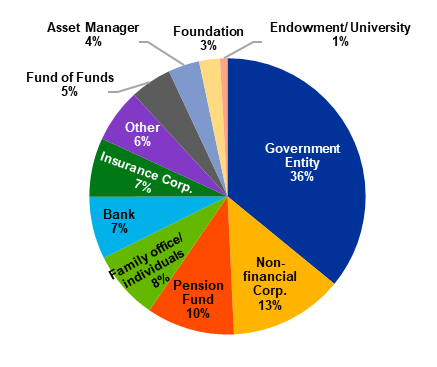
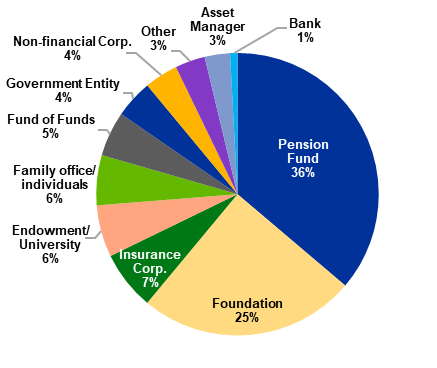
Government entities dominate the EU investor base, while pension funds and foundations lead in the United States, highlighting a gap that European institutional investors could fill. Chart A shows how institutional investors play a less prominent role in the EU VC fund sector than in the United States. In Europe, government entities[12] collectively represent around one-third of total limited partners (LPs) – or investors – in VC funds.[13] By contrast, they account for 4% of LPs in the US market, where pension funds and foundations are the dominant group of institutional investors. Since investors tend to commit to funds located within their own jurisdiction,[14] the comparatively limited participation of EU institutional investors and the home bias of investors[15] has a direct impact on the depth of the EU VC market. In fact, the extensive involvement of government investments in Europe could highlight a market failure. Increasing the buy-in of EU institutional investors and addressing fragmentation in the sector would provide more firepower to EU-based VC funds. This would be particularly relevant for VC scale-up financing, given the larger amounts that institutional investors are able to commit and the greater financing needs of scale-up firms.[16]
Chart A
VC fund investor base in the EU and the United States
LPs that committed capital to VC funds: 2015-25
a) Type of Limited Partners in the EU | b) Type of Limited Partners in the United States |
|---|---|
(percentages) | (percentages) |
 |  |
Sources: PitchBook, a Morningstar company and ECB staff calculations.
Notes: Charts are constructed based on the location of the limited partners (LPs) that committed capital to VC funds, and include data from 2015 to 2025. The breakdown by LP type is constructed based on the number of investments made. Results are robust using estimated commitment sizes, relying on reported commitments where available and otherwise allocating fund size equally across LPs. The overall composition is kept unchanged, with the same LP types accounting for the largest shares, although the EU actually shows a higher share of pension funds (10% to 19%) and the United States a higher share of foundations (25% to 35%). LPs originally classified under other categories but corresponding to public-backed vehicles (i.e. entities with direct or indirect government ownership or primary public-sector funding) were reclassified as government entities. In the EU, over 50% of the original funds of funds reflect the scale of the EIF were reclassified as government entities.
Reforms to the regulatory framework in the United States played a key role in fostering the larger contribution of US pension funds to VC investments. The pension system in the United States underwent a series of reforms in the 1970s, notably through the implementation of the Employee Retirement Income Security Act (ERISA). A key element was the relaxation of the prudent person principle,[17] which ultimately encouraged mixed investment portfolios composed of relatively riskier instruments. Another key reform was the National Securities Markets Improvement Act (NSMIA) of 1996, which facilitated capital raising by deregulating some provisions applicable to private start-ups and private funds.[18]
The EU today is in a similar position to that of the United States before the ERISA reform, with recent EU proposals aiming to increase the role of institutional investors. Across the various types of pension schemes in the United States, allocations to private equity (including VC) typically range from 5% to 15% (or more) of total assets,[19] with some sources assessing the size of the allocation of pension funds to VC at 0.03% of total assets under management in the United States, versus 0.01% in Europe.[20] While in the EU some private third-pillar pension funds invest in VC, the Institutions for Occupational Retirement Provision (IORP) Directive[21] places several constraints on such investments, in order to reduce risk for contributors. IORP entities allocate approximately 40% of their total assets to investment funds, but only 4% of these are alternative investment funds (including VC).[22] With its recent amendments to both the IORP Directive and the pan-European personal pension product (PEPP)[23] the European Commission clarified the prudent person principle,[24] with the aim of increasing investment into equity to help citizens earn higher long-term returns on their savings and free up new sources of financing for the EU economy. Similarly, the 2025 Solvency II review[25] aims to facilitate long-term equity investments.
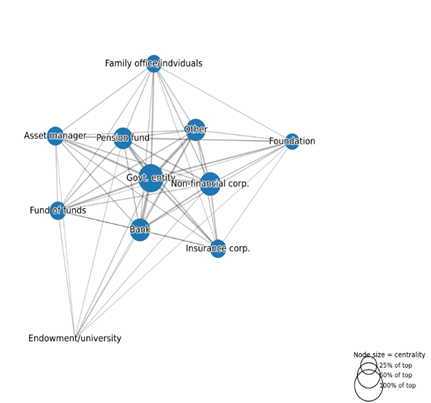
In Europe, the EIF and government-sponsored entities act as the main investor in many funds and, along with other fund-of-fund investors, play a key role in the ecosystem. A network analysis reveals the investment relations between investors and funds, as well as the connections, co-investment patterns and key hubs, providing insights into collaboration dynamics and influence within the ecosystem (Chart B, panel a).[26] The nodes represent investor type, with larger bubbles indicating investors’ influence in terms of number of connections and importance. The EIF is the main government entity and acts as hub: apart from being connected to many investors, it also exhibits a high level of fundraising power as it is connected to many other central investors. Physical proximity between nodes indicates more clustered investors. The network of investors in EU VC funds is made up of a more limited number of nodes than in the United States, which leads to concentration among a few investors. This can have positive implications, such as more efficiency in raising funds, as certain investors gain extensive experience of VC investments. On the flipside, a concentrated network can amplify risks if dominant investors reduce their commitments or withdraw from the market. This highlights the importance of efforts made to crowd-in additional private investors into the EU VC ecosystem, in order to achieve more diversity. As an investment hub, the EIF can act as a signal of credibility and can quality for VC funds. This encourages other investors to participate, thereby strengthening the fundraising capacity of European funds.
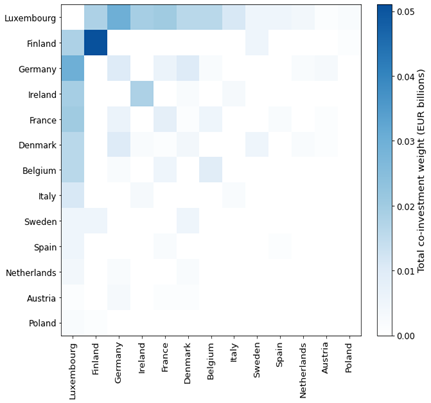
Aggregating investments at the country level highlights the role played by the EIF in connecting investors across the EU, while cross-border investments are otherwise almost absent. Chart B, panel b shows that LPs from Luxembourg (where the EIF is located) appear in most cross-country pairs, showing strong connections with investors in Germany, Ireland and France. In this context, Luxembourg and Ireland are particularly relevant as the large investment fund sector in both countries reflects an established network of service providers with experience in fund structuring and fundraising, flexible legal vehicles and tax treatment. The diagonal also shows that except for Finland, where national public funds-of-funds act as an anchor for investors, VC investors do not connect much domestically (Chart B, panel b).[27] The Chart also illustrates the limited market integration of investors in VC funds across Europe given the low cross-border activity beyond these country pairs. For fund managers investing cross border, limited access to local networks would appear to be a challenge, together with a lack of familiarity with foreign markets and the complexity of having to deal with tax and labour laws.[28]
Chart B
How do EU investors in VC funds connect? Network effects in the EU
a) Network of EU LP (investor) types investing | b) Country-by-country investments of EU LP (investor) network |
|---|---|
(EUR billions) | |
 |  |
Sources: PitchBook, a Morningstar company and ECB calculations. Data covers investments made over the period 2020-2025.
Notes: Panel a) shows the eigenvector centrality measure to highlight the vertices (types of LPs) that have the most influence in the network. The level of influence of a node comes from the connections it has with other influential vertices. We follow Abreu and Saito* to compute the eigenvector centrality measure. For a given year (2025 in this case), we use the investments over the past five years and we only consider LPs or types of LPs which have a minimum of five investments. In order to offer an aggregate presentation of results, we create the network on types of LPs instead of individual LPs. The edges represent the count of bilateral connections. The results do not significantly change when using the edges weighted by the estimated investment amount by each LP type in a given fund – taking the minimum among the LP types (this ensures the connection will not be overestimated if one LP/LP type invests a very small amount while the other invests a very large amount). The closer the bubbles, the more clustered the respective LP types. Panel b: the country-by-country matrix is based on the individual LP network, computed using the same principles as those applied in panel a. This matrix aggregates LP-level co-investments up to country pairs. As a result, first a network is created at the LP level, each LP is mapped to its country and then each weight of an LP-LP edge is added to the corresponding country pair. Darker colours signify a stronger connection, lighter colours a weaker connection.
*) Abreu, J. and Saito, S., “Unlocking the Power of Relationships: Limited Partner Networks and Performance in Private Equity”, SSRN Electronic Journal, March 2025.
Broadening access to a lighter regulatory regime for VC funds and removing frictions to cross-border access could support the market. By default, venture capital funds registered in the EU fall under the Alternative Investment Fund framework,[29] which is mandatory for fund managers whose assets under management exceed €500 million and which imposes comprehensive requirements on authorisation, risk management and investor protection. For smaller funds, the European Venture Capital (EuVECA) framework[30] presents an optional lighter regulatory regime to promote investment in start-ups and small businesses, provided they meet certain eligibility criteria. Furthermore, the European Social Entrepreneurship Funds (EuSEF) framework[31] can be applicable in certain, more specific cases. All three regimes offer the benefit of passporting across the EU and restrict investments in VC to professional investors and, under certain conditions, to sophisticated retail investors. To assess which framework VC funds operate under, Chart C maps the EU-based VC funds identified in PitchBook with the European Securities and Markets Authority (ESMA) public register. The results show that around 69% of VC funds for which a regulatory label could be identified fall under the AIF regime, while around 29% are registered as EuVECA and 2% fall under EuSEF. The application of the EuVECA regime is unevenly distributed across countries. Higher use is observed in countries such as Germany, the Netherlands, Austria, Finland and Sweden, while in some larger markets, notably Spain and France, the EuVECA regime is only applied to a minority of VC funds. In several countries, no VC fund was found to operate under this framework. While reporting obligations are lighter under EuVECA than they are under AIF, the relatively widespread application of EuVECA in markets such as Germany, the Netherlands and Sweden suggests that such obligations are seen as generally sufficient for investors. This may also suggest that the supply of VC investment opportunities could potentially be boosted by making more fund managers eligible for EuVECA (e.g. by reviewing the conditions for the eligibility of the label, addressing operational barriers for its usability and improving its interaction with the AIFMD regime) in the context of the upcoming review of the framework. Making the framework more attractive for larger funds would also be in line with the objective of increasing available funding for the larger investment amounts required for scale-up financing.
Chart C
VC funds, by legal framework and country
(number of funds, percentage of total funds)
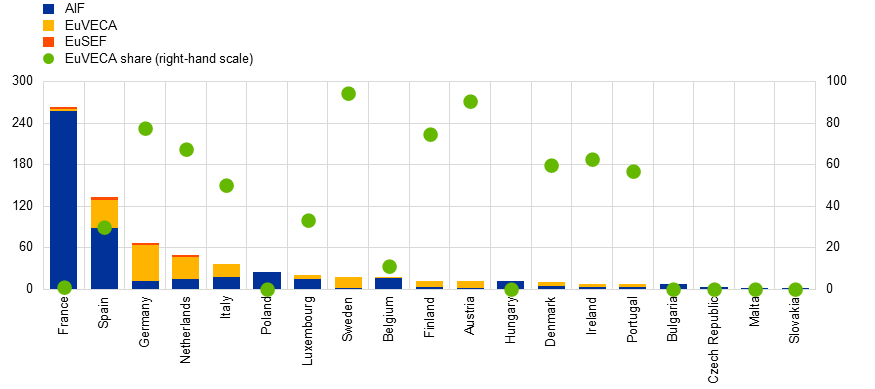
Source: ESMA, PitchBook, a Morningstar company and ECB calculations.
Notes: Based on 2,147 EU VC funds from PitchBook Data, Inc. 704 of these were matched to a fund in ESMA’s public register with an AIF, EuVECA or EuSEF label, using fuzzy matching by fund name. Data was extracted on 16 April 2025. Results are broadly in line with the external study commissioned by the European Commission* on venture and growth capital funds. They support the conclusion that refinements to the EuVECA regime may be necessary to enable broader application and relevance in the context of expanding the capacity of VC financing in the EU. However, because the Commission’s study relies on a different data provider (Dealroom), and because it covers a slightly different scope and therefore uses a different underlying sample from the analysis based on PitchBook data, the detailed results are not directly comparable.
*) European Commission, “Study on venture and growth capital funds”, Directorate-General for Financial Stability, Financial Services and Capital Markets Union, 15 October 2025.
See, for example, Botsari, A. and Lang, F., “EIF VC Survey 2024: Market sentiment”, Working Paper 2024/99, European Investment Fund, 2024. This survey found that three out of the top four challenges currently present in the VC business are related to fundraising.
See Böninghausen, B., Evrard, J., Gati, Z., Gori, S., Lambert, C., Legran, D., Schuster, W.E. and van Overbeek, F., “Should we mind the gap? An assessment of the benefits of equity markets and policy implications for Europe’s capital markets union”, Occasional Paper Series, No 373, ECB, August 2025.
See Fratto, C., Gatti, M., Kivernyk, A., Sinnott, E. and van der Wielen, W., “The Scale-up Gap. Financial market constraints holding back innovative firms in the European union”, EIB Thematic Studies, European Investment Bank, June 2024. Similarly, the Draghi report identified a lack of large-scale VC funds as a challenge for financing start-ups and enabling them to scale up to their full potential. See also Kukies, J. and Noyer, C., “Financing Innovative Ventures in Europe”, Final report of the FIVE taskforce, Federal Ministry of Finance, Germany, January 2026.
Based on PitchBook data. The sample includes funds classified as “VC type” and that have participated in at least one deal classified as a VC deal between 2015 and 2025. Funds are assigned to the United States or the EU based on their reported location.
Considering total fund size (the total amount of capital committed by the fund’s limited partners) and capital invested (the amount actually invested in firms) from 2015 to 2025, based on PitchBook data.
For example, transportation, retail, services and restaurants.
In the EU, investment in the B2C sector was more prominent until 2019 (B2C was the largest sector in 2016 and 2019). However, investment in the sector has declined substantially since then, representing less than 10% today (based on deal-level information from PitchBook Data, Inc.). By contrast, there has been a reallocation towards IT since 2019 in the United States, with VC investments in IT rising to over 75% in 2025, compared with around 40% in 2019.
Corrado, C. and Hulten, C., “How Do You Measure a ‘Technological Revolution’?”, American Economic Review, Vol. 100, No 2, May 2010, pp 99-104.
We refer here to investors who invest in VC funds and not to direct investment in start-ups.
See Gompers, P.A. and Lerner, J., “The Venture Capital Cycle”, 2nd Edition, The MIT Press, Cambridge, 2004.
Studies also suggest that corporate investors or government entities may bring strategic advantages, such as industry expertise or access to networks that enhance a fund’s ability to support companies in their portfolio. See Chemmanur, T.J., Loutskina, E. and Xian T., “Corporate Venture Capital, Value Creation, and Innovation”, The Review of Financial Studies, Vol. 27, No 8, 2014, pp. 2434-2473.
These include public entities such as the EIF, as well as promotional and development banks.
LPs are entities or individuals that make a capital commitment into a VC fund but do not take part in the day-to-day investment decisions of that fund and have limited liability (capped to their capital commitment). For simplicity, the terms LP and “investor” are used interchangeably in this box.
The great majority (approximately 70%) of the number of investment commitments from EU-based LPs are allocated to VC funds located within the EU (based on deal-level information from PitchBook Data, Inc.). This proportion is slightly higher (82%) for commitments from US-based LPs investing in US-based VC funds.
See “Making European Reforms a Success on the Ground”, IMF Notes Volume 2025: Issue 005, discussing the low integration of venture capital market in Europe.
Pension funds account for the largest group of LPs in terms of average commitment size in both the EU and the United States (€198 million and €291 million respectively). These figures are based on commitment amounts reported by PitchBook, where available. For missing commitment values, an estimation is used based on an equal allocation of the fund’s total size across its reported LPs.
This principle means that investments must be made in the best long-term interests of members and beneficiaries, taking account of risks, diversification and security.
See Ewens, M. and Farre-Mensa, J., “The Deregulation of the Private Equity Markets and the Decline in IPOs”, The Review of Financial Studies, Vol. 33, Issue 12, 2020. The authors found that NSMIA increased the supply of private capital to late-stage private start-ups, enabling them to grow significantly larger than private firms traditionally could. This has, however, shifted the balance between going public and staying private, creating a new equilibrium where fewer start-ups pursue IPOs, and those that do are older.
See “Venture & growth capital in Europe – mapping pension funds’ attitudes”, Pensions for Purpose, 2025. This was a contribution to the European Commission’s start-up and scale-up strategy.
See “State of European Tech 2025: a roadmap to unlock further tech growth”, Invest Europe, 2025.
Directive (EU) 2016/2341 of the European Parliament and of the Council of 14 December 2016 on the activities and supervision of institutions for occupational retirement provision (IORPs) (recast) (Text with EEA relevance (OJ L 354, 23.12.2016, p. 37). The IORP Directive is aimed at minimum harmonisation and allows Member States to maintain a high level of flexibility. As a result, some Member States have implemented the rules in a more conservative manner than others. See, for reference, the EIOPA peer review on supervisory practices.
See “Venture & growth capital in Europe – mapping pension funds’ attitudes”, Pensions for Purpose, 2025. This was a contribution to the European Commission’s start-up and scale-up strategy.
See European Commission proposals.
The Communication has clarified that equity investments should be considered as part of pension funds’ portfolios.
See the European Commission’s review of the Solvency II delegated regulation, which makes it easier for insurers to prove their long-term investment strategies. It expands asset scope to include unlisted equity, as long as the portfolio is properly diversified with safeguards to protect policyholders in severe stress scenarios, and provides a mandate for supervisors to monitor developments.
For methodology, see Abreu, J. and Saito, S., “Unlocking the Power of Relationships: Limited Partner Networks and Performance in Private Equity”, SSRN Electronic Journal, March 2025.
For more details on the Finnish VC landscape please see: Arnold et al (2024), Stepping Up Venture Capital to Finance Innovation in Europe, IMF WP/24/146 and KRR funds-of-funds.
See, for example, “EIF VC/PE Barometer Survey Q4 2025”, Working Paper 2025/111, EIF Market Assessment & Research, European Investment Fund, December 2025
Regulation (EU) No 346/2013 of the European Parliament and of the Council of 17 April 2013 on European social entrepreneurship funds Text with EEA relevance (OJ L 115, 25.4.2013, p. 18).