



Published as part of the Financial Integration and Structure in the Euro Area 2026
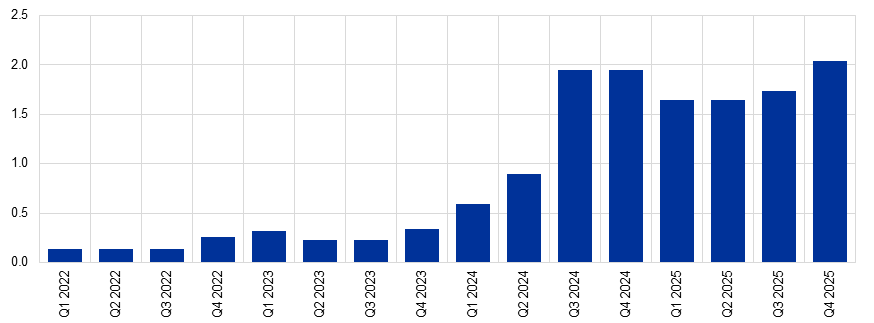
Financial market infrastructures for securities issuance, settlement and servicing are evolving with digital innovation. The use of tokenisation of financial assets – digitally representing an asset in a decentralised database through distributed ledger technology (DLT) – is increasing. It has the potential to make financial services more efficient by automating, integrating and simplifying processes, as well as enhancing transparency. For example, although central securities depositories (CSDs) have traditionally relied on centralised database systems to carry out their activities. in recent years, CSDs and other market players have been exploring the use of tokenisation and DLT. [1] According to Bloomberg data, at the end of 2025 the amount outstanding of euro-denominated debt instruments with some digital exposure, including but not limited to assets issued using DLT, stood at around €2 billion (Chart A). Market intelligence suggests that tokenisation initiatives have focused primarily on the issuance of debt instruments, money market fund units and collateral management activities such as repo transactions. This means that the use of DLT remains limited for the issuance of equities and more complex financial instruments.[2],[3]
Chart A
Estimated amount outstanding of euro-denominated debt instruments with digital exposure
(Q1 2022-Q4 2025, EUR billions)
Sources: Bloomberg Finance L.P. and ECB calculations.
Notes: The estimate for debt instruments with digital exposure includes issuances by governments and corporations and is based on Bloomberg’s digital asset exposure dataset, indicating “whether a debt instrument has direct digital exposure, which is issuance on a digital ledger, digital exchange, and/or digital clearinghouse”. Although this definition may be broader than that of assets issued using DLT, it provides a gauge to estimate the use of tokenisation within debt instrument markets. The estimated amount outstanding at the end of each quarter is calculated assuming the volume outstanding for each asset remains unchanged since its issuance date.
The Eurosystem plays a key role in supporting financial market innovations that could improve financial integration within the euro area. This is carried out while ensuring at the same time the effectiveness of monetary policy and financial stability and the smooth functioning of payment systems, as well as supporting strategic autonomy, increased resilience and the international role of the euro. The adoption of a proactive approach towards market infrastructure and monetary policy implementation, reflects the ECB’s mandate, including its commitment to the European Commission’s savings and investment union.[4]
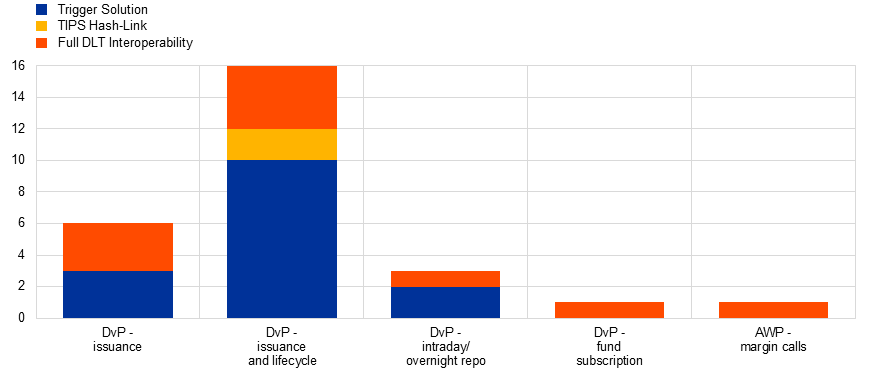
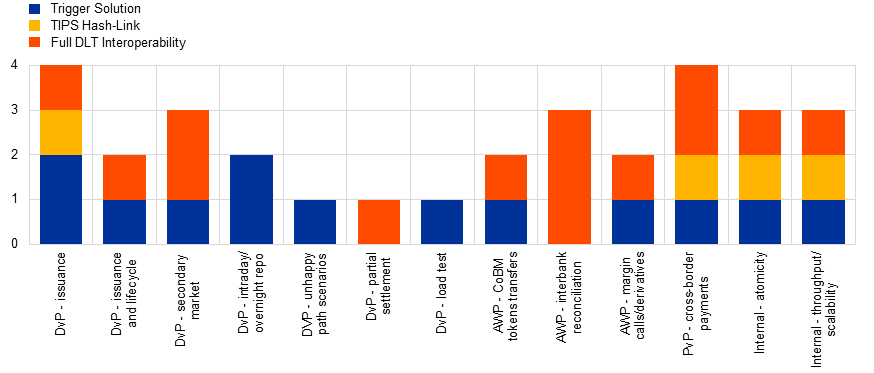
Regarding market infrastructure, the Eurosystem is promoting the safe and integrated development of a European digital asset ecosystem. Notably, the issuance of euro-denominated DLT-based securities during 2024 was supported by the overarching exploratory initiative carried out by the Eurosystem between May and November that year.[5] This work examined how central bank money settlement can be applied to wholesale transactions based on DLT. The Eurosystem carried out trials of real transactions recorded on DLT settled in central bank money in production environments (Chart B, panel a) and experiments of mock transactions in test environments (Chart B, panel b). It involved nearly €1.6 billion in central bank money settlements, with 64 eligible market participants across nine jurisdictions. A total of 58 distinct use cases were conducted, covering payments, securities settlement and the full lifecycle of DLT-based financial assets. The large number of use cases reflects the high level of interest and engagement from market participants, as well as the growing market demand for DLT-based solutions by the industry.[6] Some stakeholders expressed plans to scale up their use of DLT in wholesale financial markets. The results confirmed the potential of DLT to be deployed at larger scale not only in the settlement domain, but also in other phases of the financial transactions lifecycle.
Chart B
Eurosystem use cases
a) Trials of real transactions by settlement solution
(number of use cases)
b) Experiments of mock transactions by settlement solution
(number of use cases)
Source: ECB.
Notes: The Eurosystem offered three solutions for explorations by market stakeholders on central bank money settlement via DLT: Trigger Solution developed by the Deutsche Bundesbank, TIPS Hash-Link solution developed by the Banca d’Italia and Full DLT Interoperability solution developed by the Banque de France. AWP stands for automated wholesale payments; CoBM stands for commercial bank payments; DvP stands for delivery versus payment; PvP stands for payment versus payment. For more details on these solutions, see Exploratory work on new technologies for wholesale central bank money settlement on the ECB’s website. The figures encompass the experiments and trials which took place between May 2024 and November 2024.
Based on the findings of this exploratory work, in July 2025 the Governing Council of the ECB committed to a single Eurosystem work programme to support the safe and integrated development of a European digital asset ecosystem.[7] The programme follows a two-track approach:
- Pontes: The short-term track, bridging the present and the future. Pontes is the Eurosystem’s DLT solution that will connect DLT-based market platforms with the Eurosystem’s TARGET Services. It will enable the settlement of tokenised financial instruments in central bank money, with a pilot phase to be launched as of the third quarter of 2026. Pontes will provide more certainty for market participants using DLT for wholesale transactions and lay the groundwork for future developments. The ECB has established a dedicated governance structure to ensure engagement with national central bank and market stakeholders.
- Appia: The long-term track, paving the way for an integrated digital financial ecosystem in Europe. Appia focuses on developing a blueprint for the future DLT-based European financial markets by 2028, in collaboration with market participants, legislators and regulators. This initiative adopts a holistic approach, examining the architecture of the wholesale financial settlement infrastructure alongside the assets and services supported by it. Further details on Appia are outlined in the recently published roadmap.[8]
In addition to Pontes and Appia, the Eurosystem is supporting financial market innovation via its monetary policy implementation framework. Participation in Eurosystem credit operations is based on the provision of collateral upholding the principles of adequacy, safety, efficiency and a level playing field.[9] For the purposes of receiving marketable assets (i.e. securities) as collateral from counterparties, the Eurosystem central banks rely on CSDs.[10] From 30 March 2026 the Eurosystem accepts marketable assets issued in CSDs using DLT-based services as eligible collateral for Eurosystem credit operations.[11] These assets need to be available for settlement in TARGET2-Securities (T2S) and comply with the relevant Eurosystem collateral framework requirements.[12] As a result, the mobilisation process is the same as that for any other marketable asset accepted by the Eurosystem. It is important to highlight that this initial measure is part of the Eurosystem’s broader strategy announced by the ECB for the acceptance of DLT-based assets as eligible collateral and its commitment to continue to align its collateral framework and collateral management practices with technological advancements in financial markets.
To this end, the Eurosystem has launched an ambitious plan to explore if, and under what circumstances assets issued using DLT but not represented in eligible securities settlement systems could also become eligible and be mobilised as Eurosystem collateral in the future. A staggered approach is being considered that would first look into the most relevant subsets of DLT-based assets and reflect market developments in this area, with a particular focus on issuance and the mobilisation of these assets. The safety and regulatory requirements applicable to DLT-based infrastructures where such assets are issued or represented are also being considered under this plan.[13] As the programme to develop a European digital asset ecosystem (Pontes and Appia) unfolds, the universe of DLT-based assets is expected to grow further. This could mean a wider set of DLT-based assets will meet the Eurosystem collateral requirements. Furthermore, new mobilisation channels for such assets may emerge for potential use by counterparties and Eurosystem central banks. By enabling the acceptance of DLT-based assets as eligible collateral for its credit operations, the Eurosystem provides a clear direction to industry players helping market participants align their efforts and innovate within a common framework.
The Eurosystem’s market infrastructure and monetary policy implementation initiatives reflect a proactive approach to supporting market innovation, building on its commitment to technological progress and contributing to the vision of a more integrated and unified European financial ecosystem. These undertakings complement the continuous efforts made to improve and modernise the Eurosystem’s existing market infrastructures (i.e. TARGET Services).
CSDs are market infrastructures whose activities typically include the issuance, custody and settlement of securities.
This dynamic is likely supported by the fact that, compared with equities and structured financial products, plain vanilla debt instruments and money market funds impose lower legal/regulatory risks on stakeholders when transacted via new technologies. They are also more easily scalable in terms of duration and amounts issued and generally have a more flexible institutional investor base.
Tokenisation trends information is based on the Eurosystem’s own market intelligence activities and public reports by market associations (see Suarez, J., DLT-Based Capital Market Report, The Association for Financial Markets in Europe, October 2025).
See Cipollone, P., “Towards a digital capital markets union”, keynote speech at the Bundesbank Symposium on the Future of Payments, Frankfurt am Main, 7 October 2024.
See “The Eurosystem’s exploratory work on new technologies for wholesale central bank money settlement”, ECB, June 2025.
It is important to note that financial market infrastructures such as CCPs, CSDs and DLT (T)SS are required by applicable regulatory frameworks (incl. the CPMI-IOSCO PFMIs) to ensure the application of a delivery versus payment mechanism for the settlement of transactions in financial instruments. In that regard, availability of central bank money and integration / interoperability of cash settlement and securities settlement systems are necessary for further uptake of DLT or tokenisation of financial instruments.
See “ECB commits to distributed ledger technology settlement plans with dual-track strategy”, ECB, July 2025.
See “Appia Roadmap”, ECB, March 2026.
Eurosystem collateral assets can be divided into marketable assets (typically debt securities) and non-marketable assets (typically credit claims and fixed-term deposits).
In order for a marketable asset to be eligible as Eurosystem collateral, it must be issued in a CSD-operated eligible securities settlement system (SSS) or an SSS with a link to an eligible SSS. For more details, see the List of eligible SSSs on the ECB’s website.
See “ECB paves way for acceptance of DLT-based assets as eligible collateral”, press release, ECB, 27 January 2026.
DLT-based assets accepted as eligible Eurosystem collateral will need to comply with the existing Eurosystem collateral eligibility criteria, which include the requirement for such assets to be listed for trading in an acceptable Eurosystem market. They may also be referred to as “detokenised” assets. In particular, these assets must still be converted into a representation format compatible with the securities settlement systems operated by CSDR-compliant CSDs using T2S before being mobilised as collateral by counterparties. For more details, see the Eurosystem collateral eligibility rules for marketable assets on the ECB’s website.
The legal environment governing DLT market infrastructures and DLT-based assets includes the Central Securities Depository Regulation (CSDR), the DLT Pilot Regime Regulation, the Markets in Crypto-Assets Regulation (MiCAR) and national securities laws in the euro area. Additionally, risk management is being taken into consideration to ensure that any eligible DLT-based asset is adequate as collateral, with sufficient mitigation of financial risks. Ongoing reflections on possible amendments to these acts, in particular the DLT Pilot Regime will also be taken into account in the Eurosystem’s work on its collateral framework.