


TARGET Services Annual Report 2025
Foreword
Europe’s market infrastructures and payment systems are undergoing continuous structural transformation. And while the Eurosystem made significant progress and completed key projects over the past year, this transformation is far from over.
The successful launch of the Eurosystem Collateral Management System (ECMS) on 16 June 2025 marked the completion of the Eurosystem’s Vision 2020 initiative. This initiative encompassed three projects fostering innovation and efficiency in financial market infrastructures: technical consolidation of the Eurosystem market infrastructure by integrating T2 and T2S into a single platform; enhancing instant payments; and a common ECMS. These projects were not isolated measures but provided synergies to the financial market in the provision of liquidity, the mobilisation of collateral and the smooth settlement of payments and securities. This is a big step towards a truly single financial market in Europe where payments, securities and collateral can be moved safely and efficiently between market participants in different countries without friction or restrictions.
2025 saw an increase in transaction volumes across all TARGET Services. This surge was particularly visible in TARGET Instant Payment Settlement (TIPS) due to the strong growth in euro-denominated payments following the implementation of the Instant Payments Regulation and the successful migration of instant payments in Danish krone. As of April 2025, Danish market participants are also settling payments in Danish krone in T2, marking the deployment of the multi-currency functionality in all three settlement services. The further integration of non-euro currencies into the TARGET Services is well under way. This will add value to the TARGET Services in terms of increased transaction volumes and cost-sharing opportunities and will deepen financial integration in Europe.
We are also making progress with a range of technical and operational improvements to existing services. These include exploring longer T2 opening hours, shortening the securities settlement cycle in T2S and strengthening cross-border payments by linking TIPS with other fast payment systems.
At the same time, we need to take bold action to secure the anchoring role of central bank money, strengthen Europe’s strategic autonomy, uphold the euro’s role as a trusted global currency and lay the groundwork for private sector innovation within a secure and interoperable digital financial framework. Between now and 2030, the Eurosystem will focus on two major initiatives. One is preparing to issue a digital euro. The other is linking market distributed ledger technology (DLT) platforms with TARGET Services to settle tokenised wholesale transactions in central bank money while at the same time exploring a long-term vision for a futureproof, integrated European tokenised financial ecosystem.
Overall, through the combination of our existing suite of TARGET Services and the new initiatives that we have launched, the Eurosystem is delivering on its commitment to provide market infrastructures that Europe can rely on and that provide sound foundations for innovation, integration and prosperity.
Frankfurt am Main, June 2026
Piero Cipollone
Member of the Executive Board of the ECB
Facts and figures
Eurosystem Collateral Management System (ECMS): fully integrated with other TARGET Services New TARGET Service The ECMS went live on 16 June 2025 | Strong growth in TIPS settlement volume 82.5% growth in TIPS transaction volumes The number of TIPS transactions increased from 1.35 billion in 2024 to 2.47 billion in 2025, driven by an upsurge in euro-denominated payments following implementation of the Instant Payments Regulation and the successful migration of instant payments in Danish krone to the platform |
Robust growth in T2 transaction volumes 431,067 transactions in euro per day on average T2 transaction volumes showed consistent growth over the year (+3.6%); settlement value marked a return to growth (after two years of decreases), mainly driven by an increase in interbank payments (+6.3%) | Record volume settled in T2S 922,533 transactions per day on average Record T2S transaction volumes were achieved (+16.1%); total value increased by 12.8%, driven by increased turnover in debt instruments |
High level of performance and technical availability of TARGET Services, with some exceptions T2: 99.8% technical availability, two incidents with major impact T2S: 99.8% technical availability TIPS: 99.99% technical availability ECMS: 99.96% availability during critical operational hours | Extension of T2 operating hours Public market consultation Phased approach favoured, starting with liquidity management improvements |
Further deployment of multi-currency capability in TARGET Services Multi-currency settlement The Danish krone joined T2 and TIPS in April 2025; agreements with further non-euro currencies in the making | TIPS cross-currency settlement and interlinking Cross-currency capability implemented in June 2025 Initiatives to interlink TIPS with other fast payment systems globally further explored |
1 Introduction
The Eurosystem has the statutory task of promoting the smooth operation of payment systems, and one of the ways it does this is by providing settlement facilities. This is essential for maintaining a sound currency, conducting monetary policy, ensuring efficient market functioning and securing financial stability.
The Eurosystem’s TARGET Services consist of three settlement services: T2, a real-time gross settlement (RTGS) system for payment transactions supporting the Eurosystem’s monetary policy operations, bank-to-bank transfers, commercial payments and transactions related to settlement in other financial market infrastructures (FMIs), TARGET2-Securities (T2S), a single platform for securities settlement in Europe, and TARGET Instant Payment Settlement (TIPS), which settles instant payments in central bank money on a 24/7 basis.
On 16 June 2025 the Eurosystem successfully launched the Eurosystem Collateral Management System (ECMS), after migration to the new set-up was completed over the weekend of 13-15 June. The ECMS thus becomes the fourth TARGET Service in operation, advancing the Eurosystem’s vision for a harmonised, efficient and innovative European financial system.
The ECMS manages assets used as collateral in Eurosystem credit operations. Together with the other TARGET Services, the ECMS ensures that cash, securities and collateral can flow freely across Europe.
With the ECMS having gone live, the Eurosystem now offers a single system that harmonises the management of collateral for Eurosystem credit operations and facilitates mobilisation both domestically and cross-border through enhanced integration and standardisation. The ECMS replaces the individual national collateral management systems previously operated by the 20 euro area national central banks, and has been serving 21 national central banks since Bulgaria joined the euro on 1 January 2026.
2 Activity in TARGET Services
2.1 Activity in all currencies
In 2025 traffic across all TARGET Services reached all-time highs, driven by sustained activity in existing settlement currencies and the onboarding of the Danish krone in T2 and TIPS in April 2025. Denmark is the first non-euro area country to join T2 and the second to join TIPS with its national currency after Sweden.
T2 settled on average 431,067 payments in euro per day worth €1,932.8 billion, and 11,425 payments in Danish krone, worth DKK 1,641.9 billion (Table 1) in 2025. Combining euro and Danish krone[1], T2S settled a daily average volume of 922,533 transactions worth €1,101.4 billion. With the implementation of the Instant Payments Regulation (IPR)[2], euro-denominated TIPS activity reached 2,735,053 payments worth €2.2 billion on average per day in 2025. Daily activity denominated in Swedish krone averaged 2,884,723 payments worth SEK 1.6 billion, while daily activity denominated in Danish krone averaged 1,632,664 payments worth DKK 1.4 billion.
In addition, on 16 June 2025 a new TARGET Service went live with the Eurosystem Collateral Management System (ECMS). It became the fourth TARGET Service and is fully integrated with others, particularly T2 and T2S. ECMS processed an average of 6,087 transactions daily, mainly related to mobilisations and demobilisations of credit claims as collateral. The value of the corresponding stock of mobilised collateral averaged €1,579.4 billion.
Table 1
Daily average traffic settled in the TARGET Services in 2025
Volume (number of transactions) | Value (in each currency) | ||
|---|---|---|---|
T2 | EUR | 431,067 | €1,932.8 bn |
DKK | 11,425 | DKK 1,641.9 bn | |
T2S | EUR + DKK | 922,533 | €1,101.4 bn |
TIPS | EUR | 2,735,053 | €2.2 bn |
SEK | 2,884,723 | SEK 1.6 bn | |
DKK | 1,632,664 | DKK 1.4 bn | |
ECMS | EUR | 6,087 | €1,579.4 bn |
Source: TARGET.
Notes: There were 255 operating days in 2025 for the euro. For ECMS, the reported daily average value corresponds to the value of the mobilised collateral, instead of the value settled as for the other TARGET Services.
Growth in the activity settled in the TARGET Services was solid not only in comparison to 2024, but also looking at historical trends over the last years.
In 2025 the total volume of payments settled in T2 reached a total of 111,910,103 transactions, exceeding the previous peak of 107,999,982 transactions in 2024 (Chart 1). Payments denominated in Danish krone represented around 1.8% of these volumes. Volumes have been increasing in T2 since 2020, with yearly growth of 1.6% in 2023 and 3.6% in both 2024 and 2025 (Chart 1), mainly driven by an increase in the number of customer payments. The corresponding total value of payments settled in T2 amounted to €492,859.0 billion for the euro, a 6.3% increase compared with 2024. This growth exceeded the growth in the gross domestic product (GDP) of the euro area, which amounted to 3.8%.[3] For the Danish krone, total values settled reached DKK 285,699.1 billion.
Chart 1
Volumes settled in T2 by currency over time
(left-hand scale: yearly totals, number of transactions; right-hand scale: percentages)

Source: T2.
Notes: Data before 20 March 2023 relate to TARGET2. The Danish krone became available for settlement in T2 as of April 2025.
In 2025 total volumes settled in T2S increased by 16.1%, reaching a record of 235,245,836 transactions (Chart 2) worth €280,864.9 billion. This marks the second consecutive year of considerable growth in activity (+14.0% in 2024), after two years of small declines (-2.9% in 2022 and -2.3% in 2023). Settlement efficiency[4] in volume terms stood at 93.5% in 2025. This represented a 0.9 percentage point decrease compared with 2024 and was mainly affected by the phased onboarding of a new participant in one central securities depositary (CSD) in the first half of 2025.
Chart 2
Volumes settled in T2S and settlement efficiency over time
(left-hand scale: number of transactions, yearly totals; right-hand scale: settlement efficiency at end of day, percentages)
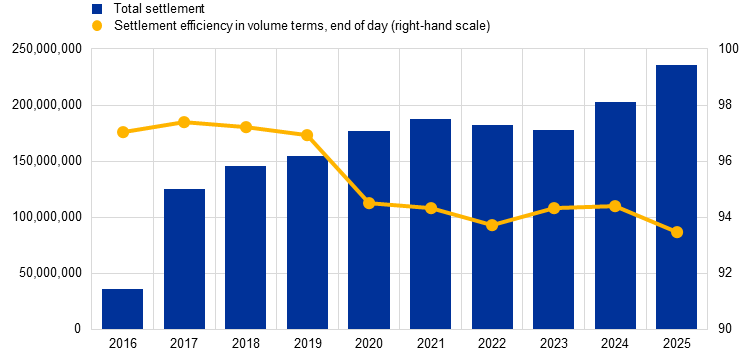
Source: T2S.
Notes: CSDs joined T2S in several migration waves and subsequent expansions: 22 June-31 August 2015 (wave 1); 29 March 2016 (wave 2); 12 September 2016 (wave 3); 6 February 2017 (wave 4); 18 September 2017 (wave 5); 27 October 2017 (NCDCP); 29 October 2018 (Danish kroner); 11 September 2023 (BNBGSSS, CDAD, SKDD, Euroclear Finland and Euroclear Bank). The migration day of 11 September 2023 is excluded from the statistics reported.
In 2025 a total of 2,472,445,752 instant payments were settled in TIPS, compared with 1,354,847,183 in 2024 (Chart 3). This 82.5% growth was driven by an upsurge in euro-denominated payments following implementation of the IPR and the successful migration of instant payments in Danish krone to the platform in April 2025. The volume of instant payments in euro settled in TIPS increased 119.5% compared with 2024, reaching 998,294,509 transactions worth €792.8 billion, representing 40.4% of all transactions. With 1,052,924,004 transactions worth SEK 600.6 billion, instant payments in Swedish krone contributed 42.6% of the total volume. Since April 2025 TIPS has settled 421,227,239 transactions denominated in Danish krone worth DKK 366.5 billion, corresponding to 17.0% of the total volume in TIPS in 2025.
Chart 3
Volumes settled in TIPS by currency over time
(number of transactions, yearly totals)

Source: TIPS.
These developments highlight the dual role of the Eurosystem as owner and technical operator of multi-currency FMIs to meet the demands and support the evolution of the financial industry. The remainder of the report focuses on the trends in activity in euro.
2.2 Activity in euro
2.2.1 T2
Volume developments
In 2025 the average daily volume settled in euro in T2 stood at 431,067 payments, compared with 421,875 in 2024, a growth rate of 2.2%. The lowest volume of the year was recorded on 15 August (the Feast of the Assumption), which was a holiday in many EU Member States. On that day traffic amounted to 280,081 payments (Chart 4). The highest volume was recorded at the end of the second quarter on 30 June, when the figure rose to 679,624 payments. Overall, the seasonal pattern of T2 volumes in 2025 was similar to that of previous years, although the minimum and maximum occurred on different days.
Chart 4
Volumes settled in T2 in euro in 2025
(number of transactions)
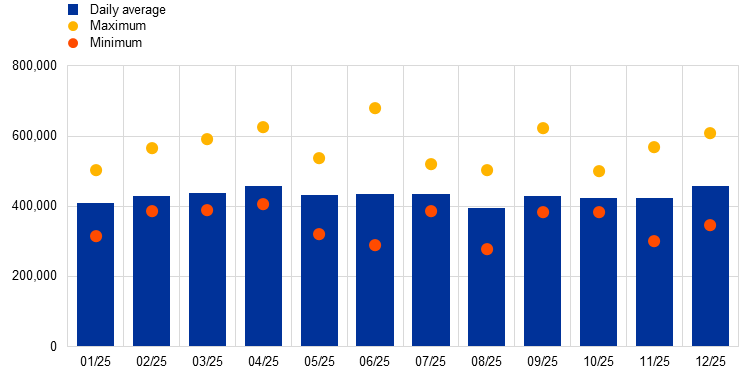
Source: T2.
Traffic in T2 can be divided into six categories: (i) interbank payments, (ii) customer payments (payments made on behalf of customers), (iii) operations with central banks (such as monetary policy operations, banknote and coin withdrawals and deposits), (iv) ancillary system settlement, (v) liquidity transfers, and (vi) other payments (a residual category comprising, for instance, return payments).
Customer payments represent the majority of T2 volumes, accounting for 64.9% of the total in 2025. The daily average number of customer payments was 279,913 (Chart 5), which was 1.7% higher than 2024 but slightly below the overall T2 growth rate of 2.2%. Next came interbank payments, with an average of 115,607 daily payments (26.8% of the total). This category grew particularly strongly in the second half of the year, leading to annual growth of 3.0% over 2024. Ancillary system settlement was the third most frequent category, with a daily average of 27,856 payments (6.5% of the total), 2.0% lower than in 2024. Operations with central banks, liquidity transfers and other payments together accounted for less than 2% of T2 volumes.
Most months in 2025 saw an increase in daily average volume compared with the equivalent month in 2024, ranging between 0.8% and 5.6%; June and December experienced negative growth of 0.3% and 2.2% respectively. The decrease in June was primarily attributed to technical changes in participation and payment routing within one retail payment system in Germany, resulting in reduced volumes that persisted throughout the remainder of the year. Conversely, the decline in December was largely driven by a drop in customer payment volumes in Italy, likely linked to a migration to instant payments.
Chart 5
Volumes settled in T2 in euro by payment category in 2025
(left-hand scale: number of transactions, daily averages; right-hand scale: year-on-year growth, percentages)
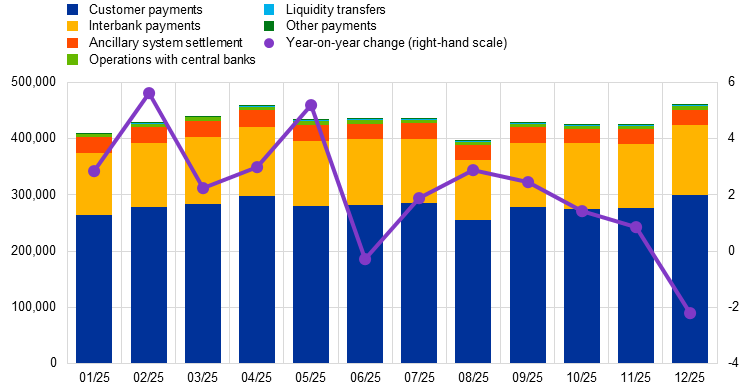
Source: T2.
Each payment in T2 has an assigned priority, which influences its speed of settlement. In general, payments in T2 are settled immediately on a “first in, first out” basis, as long as sufficient liquidity is available in the debited participant’s account. If this is not the case, payments are queued according to their priority. While liquidity transfers and ancillary system settlement are processed with the highest priority, T2 also offers its participants the possibility of actively assigning and managing priorities for the remaining payments in the RTGS service and reserving a certain amount of their account balance for such payments.
In the RTGS service, 91.5% of payments had “normal” priority in 2025 (Chart 6). Only 1.7% of payments had the intermediate “high” priority, while 6.8% of payments had the highest “urgent” priority. These were consistent with the percentages recorded in 2024. It should be noted that, in value terms, urgent payments represented more than one-fifth of the turnover. This is in line with expectations, as urgent payments are typically low in number but high in value.
Chart 6
Volumes settled in the RTGS service in euro by priority in 2025
(percentages)

Source: T2.
The distribution of T2 volumes in euro across banking communities was largely unchanged compared with previous years. The largest contributors in 2025 were Germany, which accounted for almost half of the transactions settled in the system (48.3%) and France (15.3%) (Chart 7). Next came Italy (9.4%) and Spain (7.3%). The Netherlands and Belgium contributed similar amounts to T2 volumes, namely 3.5% and 3.0% respectively. All other countries together accounted for 13.1%.
This concentration is a consequence of several factors, including the size of the national banking system, the location of banking groups’ headquarters and the role of institutions based in the country in providing access to T2 to non-euro area banks. Moreover, from a technical viewpoint, the system allows the activities of banking groups to be consolidated in a single RTGS account held by the group’s head office, increasing concentration in countries where a large number of such groups are domiciled.
Chart 7
Volumes settled in T2 in euro by country in 2025
(percentages)

Source: T2.
Note: The country is identified as the location of the central bank of the debited participant for each payment.
Value developments
The total value of payments in euro settled in T2 amounted to €492,859.0 billion in 2025, reflecting a 6.3% increase compared with €463,735.6 billion in 2024 (Chart 8). This marked a return to growth in value, following two consecutive years of decline.[5] The recovery was mainly driven by an increase in interbank payments, with higher activity involving international CSDs.
On average, T2 settled the equivalent of the GDP of the euro area in around eight days of operations in 2025. This reflects the efficiency of the system and the crucial role it plays, providing intraday finality for transactions and allowing the funds credited to participants’ accounts to become available for other payments immediately.
Chart 8
Values settled in T2 in euro over time
(left-hand scale: EUR billions, yearly totals; right-hand scale: percentages)
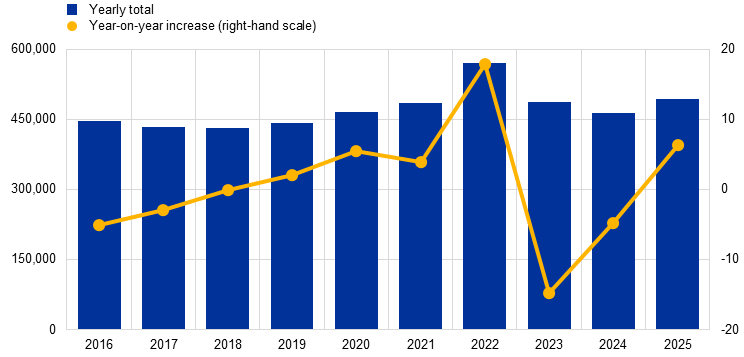
Source: T2.
Note: Data before 20 March 2023 relate to TARGET2.
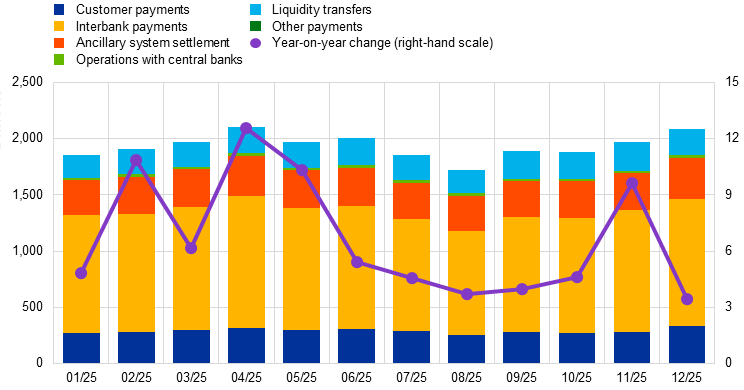
T2 settled on average €1,932.8 billion worth of payments each day in 2025, which was 6.7% higher compared with 2024. The daily average ranged between €1,725.1 billion in August 2025 and €2,106.6 billion in April 2025 (Chart 9). The lowest daily turnover was €1,287.2 billion on 11 November 2025 (Armistice Day) while the highest daily turnover was €2,936.8 billion on 30 April 2025.
Chart 9
Values settled in T2 in euro in 2025
(EUR billions)

Source: T2.
More than 70% of payments in T2 had a value of €50,000 or less in 2025, while transactions with a value of more than €1 million accounted for 9.2% of traffic (Chart 10). Although the average payment size was €4.5 million, the median value was much lower at €6,770, meaning that half of the transactions settled in 2025 were below this amount. These results are fully in line with previous years, showing that T2 continued to be widely used for low-value payments in 2025, in particular for urgent customer payments. It remains to be seen whether the increased prominence of instant retail payments will have an impact on this trend in the future.
Chart 10
Distribution of T2 transactions in euro across value bands in 2025
(percentages, cumulative)

Source: T2.
While customer payments represent the majority of T2 volumes (as shown in Chart 5), interbank payments are traditionally the largest contributors to T2 values (54.8% in 2025). Compared with 2024, they experienced growth of 7.5%. The daily average value of interbank payments ranged between €927.1 billion in August and €1,174.0 billion in April (Chart 11). The average daily value of ancillary system settlement in 2025 was €331.9 billion, followed by customer payments at €289.6 billion and liquidity transfers at €229.3 billion, corresponding to 17.2%, 15.0% and 11.9% of T2 values respectively.
The daily average value of payments settled in T2 was consistently higher than in 2024. Each month in 2025 saw an increase in value settled compared with the equivalent month in 2024, ranging between 3.4% and 12.6%.
Chart 11
Values settled in T2 in euro by payment category in 2025
(left-hand scale: EUR billions, daily averages; right-hand scale: year-on-year growth, percentages)
Source: T2.
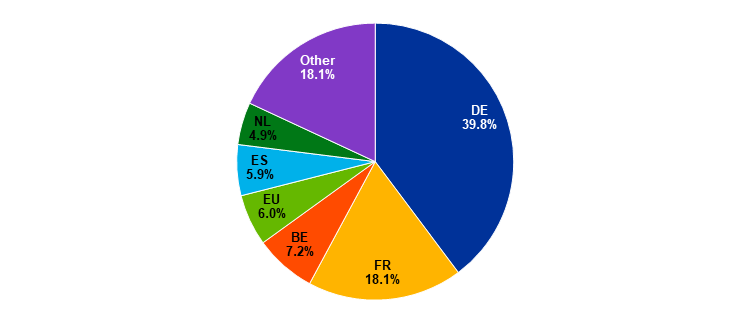
As in the case of volumes, the distribution of T2 values across banking communities was largely unchanged in 2025 compared with 2024, with Germany (39.8%) and France (18.1%) being the two largest contributors (Chart 12). Belgium followed with 7.2%. The ECB, Spain and the Netherlands accounted for similar shares of 6.0%, 5.9% and 4.9% respectively. All other countries together accounted for 18.1%.
Chart 12
Values settled in T2 in euro by country in 2025
(percentages)
Source: T2.
Note: The country is identified as the location of the central bank of the debited participant for each payment.
As in 2024, the ECB was among the top contributors in terms of value. Like any other Eurosystem central bank, the ECB has its own TARGET component system. However, the ECB’s participants include FMIs of European or international relevance, such as CLS, EURO1 and STEP2. These conduct relatively few transactions, but the amounts are very large, which explains why the ECB’s component system makes up a significant share of total T2 turnover.
The asymmetry in the contributions to T2 volumes and values indicates that T2 traffic in France, the Netherlands and Belgium tends to be relatively more value-intensive, while in Germany, Italy and Spain it tends to be relatively more volume-intensive. As discussed in relation to Chart 7, this is a result of the characteristics of each national banking community.
Intraday credit
The intraday credit line is a facility in T2 that allows participants to overdraw their main cash account (MCA) against eligible collateral.[6] Intraday credit is provided interest-free on participants’ accounts in the central liquidity management (CLM) component and has to be repaid by the end of the business day. At the end of 2025 the average daily credit line granted to all T2 participants for settlement in euro at the start of the day amounted to €2,160.4 billion, largely in line with the previous year (-0.2%) (Chart 13). This value has been growing since the end of 2022 and has returned to levels last recorded in early 2015. This is linked to the release of collateral following the repayment of targeted longer-term refinancing operations (TLTROs) by Eurosystem counterparties. These counterparties were able to use the freed-up collateral to obtain intraday credit in T2.
Chart 13
T2 intraday credit line for settlement in euro
(left-hand scale: EUR billions, daily averages; right-hand scale: percentages)

Source: T2.
Notes: The intraday credit line is calculated as the sum of the individual intraday credit lines granted at the start of day to all T2 participants (including for example public entities and state agencies). The share of payments settled via the credit line does not include the activity carried out by central banks and ancillary systems. Data before 20 March 2023 relate to TARGET2.
In general, T2 participants can rely on three sources of liquidity to fund their payments: incoming payments, their account balance, and intraday credit. Intraday credit is used when the other two sources are not sufficient. Over time, abundant central bank reserves have made participants less reliant on this facility. Payments settled via the credit line declined from 10.5% in January 2016 to 3.6% in March 2023. When the T2-T2S consolidation project went live, this led to a downward shift (methodological adjustments also had an impact). In 2025 only a small share of the T2 payment values was settled via the credit line, corresponding to between 1.3% and 1.8% of T2 traffic by value.
Business day phases
The RTGS business day is composed of four main phases: (i) the start of the day, which lasts from 18:45 CET to 19:30 CET; (ii) real-time settlement window I (RTGS RTS I) from 19:30 CET to 02:30 CET; (iii) real-time settlement window II (RTGS RTS II) from 02:30 CET to 18:00 CET; and (iv) the end of the day. RTGS RTS II may be interrupted by an overnight maintenance window, which is optional between two consecutive business days and mandatory over the weekend.
During RTGS RTS I, only ancillary system settlement and liquidity transfers can be processed. In 2025 on average 1,975 payments were settled each day during this phase. In value terms, this corresponded to €61.9 billion and represented a fraction of the daily T2 traffic. Ancillary system settlement represented on average 82.4% by value and 97.7% by volume, in line with 2024. Since the system is closed to other forms of payment processing during this part of the operational day, ancillary systems can take advantage of participants’ stable and predictable liquidity positions and settle their transactions efficiently and safely. In general, this phase is mainly used by retail payment systems to settle or to prefund their members’ positions.
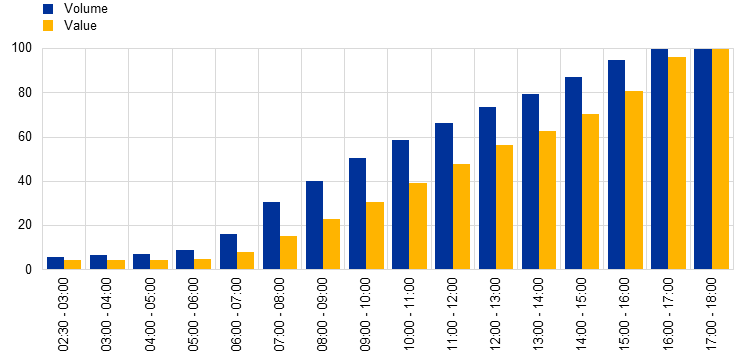
During RTGS RTS II, all categories of payments can be processed. In 2025, on average 16.4% of payments by volume and 8.2% of payments by value were settled between 02:30 CET and 07:00 CET (Chart 14). Within the next hour, from 07:00 CET to 08:00 CET, these percentages nearly doubled, reaching 30.6% and 15.4%, respectively. Payment settlement continued smoothly throughout the day. By 17:00 CET, which is the cut-off time for customer payments, 99.7% by volume and 96.3% by value were settled. During the last hour until 18:00 CET, which is the cut-off time for all other types of transactions, the remaining payments (typically low in number but large in value) were settled. This distribution gives confidence to the T2 operator that settlement is evenly spread throughout the day.[7]
Chart 14
RTGS RTS II traffic distribution for settlement in euro in 2025
(x-axis: time (CET); y-axis: percentages, cumulative)
Source: T2.
Payments in T2 can be introduced in advance in the form of “Warehoused payment orders”. These are submitted to T2 for settlement on specific days and at specific times up to ten calendar days later. As most warehoused transactions are settled immediately after the opening of the RTGS service, a significant share of them fall between 02:30 CET and 03:00 CET.
Box 1
Extending T2 operating hours
Extending RTGS operating hours has been a key focus in the G20’s work on cross-border payments and has also gained importance in the context of fast payment systems operating 24/7, which may create liquidity challenges when RTGS is closed. Reflecting this global trend, the Eurosystem has also explored the implications for its own FMIs. While the Eurosystem has already implemented significant modernisation efforts in T2 – transforming it into a state-of-the-art RTGS system operating 22.5 hours per weekday – the growing reliance on liquidity routed through TIPS and upcoming developments, such as the digital euro and Pontes[8], underscore the case for further extending operating hours.
Recognising that a transition to a continuously operating RTGS system would have wide-ranging implications for the ecosystem, the Eurosystem sought industry input to assess market demand and identify potential challenges. Between June and September 2025 a public market consultation was conducted.[9] Rather than outlining a definitive roadmap or timeline for achieving 24/7 operations, the consultation presented various options and examined the benefits, risks and costs associated with extension. The main aim was to gauge market needs and concerns without prescribing the specific form the changes might take. The consultation received input from a high number of participants and associations across several countries, collectively accounting for the majority of T2 traffic, both in volume and value. This broad participation ensured that the Eurosystem’s proposals would reflect the perspectives of key stakeholders.
The consultation’s findings highlighted that the most compelling need for extending T2 operating hours lies in enhancing liquidity management for instant payments, which are seeing rapid adoption, as well as supporting (possible) future services such as Pontes and the digital euro. Additionally, aligning T2’s operating hours with those of other major RTGS systems worldwide would facilitate cross-border payments, support late-day margin calls, and strengthen the euro’s role in global financial markets.
Respondents generally favoured a phased approach, starting with liquidity management improvements and progressing incrementally toward full 24/7 operations over the medium to long term. While there was no immediate push to alter TARGET Services’ main cut-off times or the value dating logic, participants acknowledged that such adjustments might become necessary as market demands evolve.
Nonetheless, extending T2 operating hours poses certain challenges. Key concerns include the costs of upgrading IT systems, automating liquidity processes, and meeting additional staffing requirements. Liquidity risks were also highlighted, particularly during periods when RTGS systems remain operational but traditional funding sources, such as money markets, are unavailable.
Based on the feedback received, the Eurosystem has proposed a phased approach to the extension. In the short term, over the next two years, the focus will be on addressing immediate liquidity management challenges linked to instant payments through three key measures. First, starting in June 2026, liquidity held overnight on TIPS Dedicated Cash Accounts (DCAs; as well as on other TARGET accounts) that exceeds the minimum reserve requirements will automatically earn remuneration, reducing the need for overnight liquidity transfers out of TIPS. Second, also in June 2026, TIPS liquidity transfer automation will be enhanced by introducing floor and ceiling functionalities on TIPS DCAs. Third, a short settlement window of one to two hours will be introduced in T2 on weekends, between Saturday evening and early Sunday morning, to enable participants to adjust their funding positions in TIPS over the weekend. Combining the second and third change will enable participants to automatically adjust their liquidity over the weekend without manual interventions.
Looking further ahead, the Eurosystem is considering additional measures to extend T2 operating hours over the medium to long term. However, these will require more substantial changes, further deliberation, and broader collaboration with stakeholders. To support this process, a follow-up market consultation is planned towards the end of 2026 or the beginning of 2027. The findings of the 2025 market consultation and the Eurosystem’s roadmap for extending T2 operating hours are detailed in the outcome paper[10].
Unsettled traffic
Payments that are not settled by the end of the business day, either because they were erroneous, insufficient funds were held in the account to be debited, or the sender’s limit was breached, are ultimately rejected when the cut-off time is reached in T2, and thus count as unsettled transactions at the end of the day. Other unsettled transactions occur, for example, when a participant actively cancels a queued payment.
The T2 operator carefully monitors the number of transactions rejected by the system, as this may have operational risk implications. In 2025 the daily average number of rejected payments in euro in the RTGS service ranged between four in August and 74 in February (Chart 15). The peak in February was the result of the incident that occurred on 27 February (see Box 3 for more details). The month with the second-highest average number of rejected transactions was May. In this case, the average was affected by an incident that took place on 29 May and impacted ancillary system settlement in the RTGS as well as CLM transactions. In value terms, unsettled payments ranged between a daily average of €0.2 billion in October and €39.5 billion in August. The peaks in August and December were driven by a few high-value unsettled payments on individual days, due to problems or errors on the participants’ side.
Chart 15
Rejected payments in euro in the RTGS service in 2025
(left-hand scale: number of transactions, daily averages; right-hand scale: EUR billions, daily averages)

Source: T2.
These results were in line with previous years, confirming that rejected payments have been stable at a very low level since T2 went live.
Cross-border traffic
T2 contributes to strengthening financial integration among EU Member States and plays a key role in sustaining the global reach of the euro. Information on the full payment chain (originator, sending settlement bank, receiving settlement bank, beneficiary and any intermediate agents) can help shed light on both the European and global dimensions of T2.
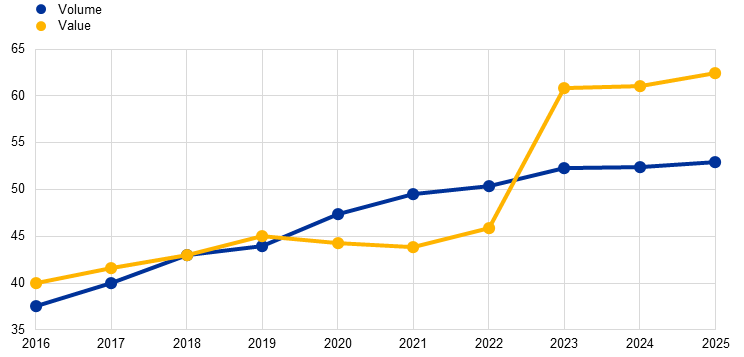
Focusing on the sending and receiving settlement banks in the RTGS service, the share of cross-border traffic indicates the percentage of traffic exchanged between direct participants belonging to different banking communities.[11] In 2025 the share of cross-border traffic in euro was 53.0% in volume terms and 62.5% in value terms (Chart 16), which was slightly higher than the levels in 2024 of 52.4% and 61.0% respectively. This indicator increased, especially in value terms, between 2022 and 2023, primarily as a result of a change in the calculation methodology when T2 replaced TARGET2.[12]
Chart 16
Cross-border traffic in euro in the RTGS service over time
(percentages)
Source: T2.
Note: Data before 20 March 2023 relate to TARGET2.
Tiered participation
Tiered participation arrangements are made in a system such as T2 when a direct participant in that system provides services that allow other participants to access the system indirectly. The indirectly connected participants benefit from the clearing and settlement facility services offered by direct participants.
While indirectly connected parties (referred to as “addressable BIC holders” in T2) benefit from a settlement facility that would otherwise be costly to access directly, such arrangements also entail risks. Tiered participation arrangements can create dependencies that may lead to credit, liquidity or operational risks for the payment system and its participants and, ultimately, risks to the stability of the banking system. Close monitoring of the tiering level in T2, especially in value terms, has always been of paramount importance. It is also an oversight requirement under Article 17 of the SIPS Regulation.[13]
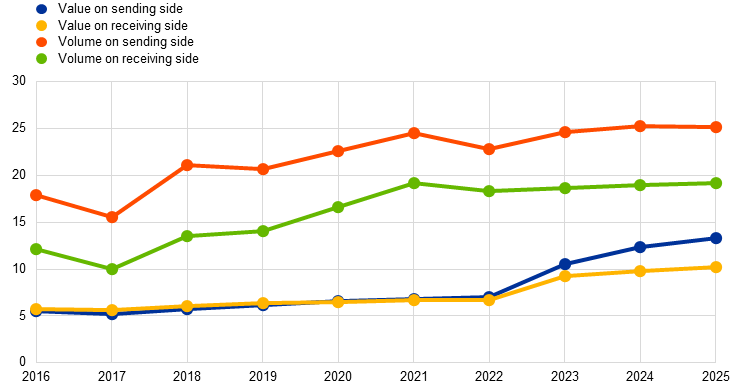
Over the last ten years the share of payments in euro sent or received by direct participants in T2 has followed an upward trend. The level of tiered traffic in value terms ranged between 5.2% and 7.0% between 2016 and 2022 on both the sending and the receiving side (Chart 17). The methodological changes applied when T2 went live explain most of the increase observed in 2023[14], which was followed by a further move to 12.4% on the sending side and 9.8% on the receiving side in 2024. In 2025 tiered values increased slightly to 13.4% and 10.2%. This means that, on average, for every euro sent by direct participants in T2 during the year, only 13.4 cents were settled on behalf of indirectly connected parties outside their banking group. Meanwhile, between 2016 and 2024 the tiered volume increased from 17.9% to 25.3% on the sending side and from 12.1% to 19.0% on the receiving side. In 2025 they stabilised at 25.2% and 19.2% respectively.
In line with previous years, more than 75% of the tiered business (consolidated at banking group level) came from outside the European Economic Area (EEA), showing that T2 contributes to the international role of the euro and makes it possible for institutions around the world to access the euro market.
Chart 17
Tiering levels in T2 for settlement in euro over time
(percentages)
Source: T2.
Note: Data before 20 March 2023 relate to TARGET2.
2.2.2 T2S
Volume developments
T2S settled an average of 922,533 transactions per day in 2025 (Chart 18), reflecting a 16.6% increase compared with 791,416 in 2024. The lowest daily volume, amounting to 335,566 transactions, was recorded on 3 January, owing to seasonal effects. Lower trading on 31 December translated into lower settlement two business days later. The highest daily volume settled was recorded on 9 April, when it reached 1,469,271 transactions, as a result of market volatility following US tariff-related announcements. Overall, the seasonal pattern of T2S volumes in 2025 was largely similar to that of the previous years.
Chart 18
Volumes settled in T2S in 2025
(number of transactions, thousands)

Source: T2S.
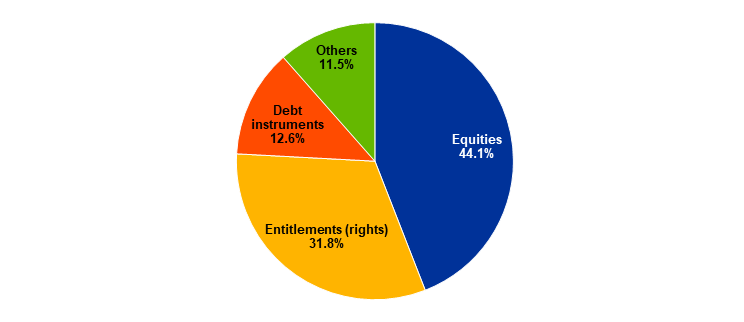
The three largest securities categories contributing to T2S traffic are equities, debt instruments and entitlements (rights). Equities and entitlements (rights) typically represent the bulk of settled volumes, while debt instruments are the largest category by values settled. In 2025 equities represented 44.1% of the total volume, followed by entitlements (rights) with 31.8% (Chart 19). Together, they accounted for an average of 699,727 transactions per day. Debt instruments stood at 12.6% of the total volume, corresponding to a daily average of 116,692 transactions. The remaining securities categories represented 11.5% of settled volumes. Compared with 2024, entitlements (rights) were the securities category that experienced the largest year-on-year increase, reaching 33.5% and mainly driving the platform’s growth.
Chart 19
Volumes settled in T2S by securities category in 2025
(percentages)
Source: T2S.
There are five transaction types in T2S: delivery-versus-payment (DVP), free-of-payment (FOP), payment-free-of-delivery (PFOD), delivery-with-payment (DWP) and settlement restrictions on securities (SRSE).[15] The majority of transactions in T2S are either DVP or FOP, as these are the two main methods for securities settlement. In 2025 DVP transactions accounted for 66.9% of the total volume (Chart 20). This corresponded to a daily average of 617,494 transactions. FOP transactions followed with 29.1%, or 268,900 transactions daily. Taken together, DVP and FOP transactions accounted for 96.0% of total volumes settled in T2S, in line with previous years. PFOD transactions, SRSE transactions and DWP transactions together accounted for 3.9%, or 36,139 transactions on average per day.
Chart 20
Volumes settled in T2S by transaction type in 2025
(percentages)

Source: T2S.
Note: “Other” includes PFOD, SRSE and DWP.
Value developments
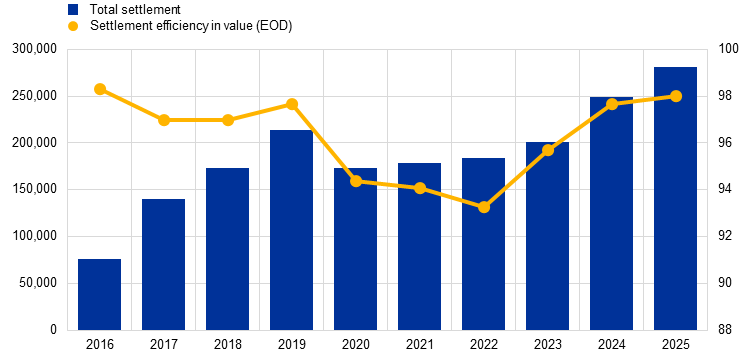
In 2025 the total value settled in T2S increased 12.8%, reaching a record of €280,864.9 billion (Chart 21). This followed consecutive increases of 3.2% in 2021, 3.3% in 2022, 9.0% in 2023 and 24.0% in 2024.
Settlement efficiency[16] in value terms reached 98.0% in 2025, a 0.3 percentage point increase compared with 2024, the third consecutive year of improved settlement efficiency. The improvement was spread across multiple markets. This represents a notable achievement, considering the strong growth in the overall values settled in the platform, and marks a return to levels last observed before the changes in the T2S statistical framework in 2020.
Chart 21
Values settled in T2S and settlement efficiency over time
(left-hand scale: yearly totals, EUR billions; right-hand scale: settlement efficiency at end of day, percentages)
Source: T2S.
Notes: CSDs joined T2S in several migration waves and subsequent expansions: 22 June-31 August 2015 (wave 1); 29 March 2016 (wave 2); 12 September 2016 (wave 3); 6 February 2017 (wave 4); 18 September 2017 (wave 5); 27 October 2017 (NCDCP); 29 October 2018 (Danish kroner); 11 September 2023 (BNBGSSS, CDAD, SKDD, Euroclear Finland, and Euroclear Bank). The migration day of 11 September 2023 is excluded from the statistics reported.
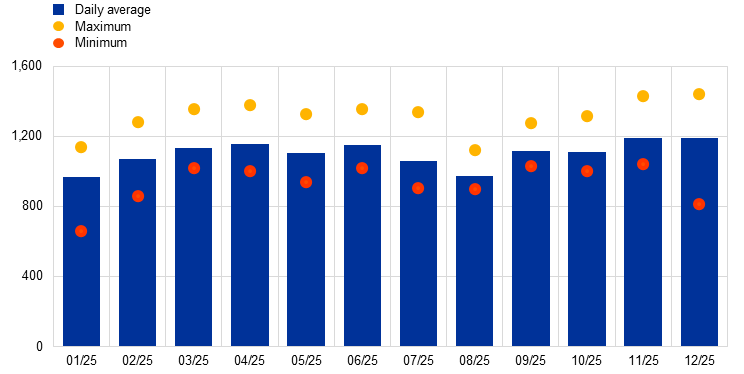
In 2025 T2S settled €1,101.4 billion on average per business day, 13.3% more than the previous year (Chart 22). The lowest daily value was recorded on 3 January with €661.6 billion, coinciding with the day of lowest volume. The highest daily value settled was reached on 1 December with €1,438.0 billion.
Chart 22
Values settled in T2S in 2025
(EUR billions)
Source: T2S.
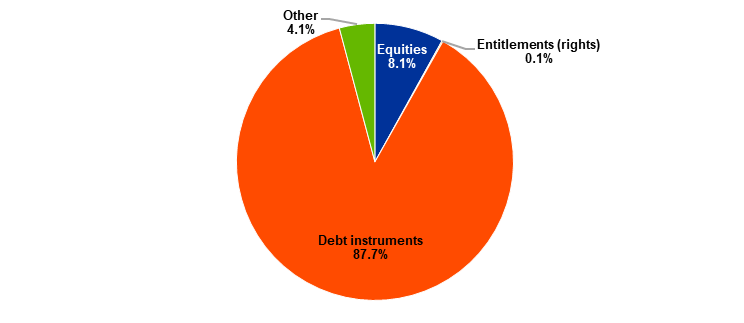
With a daily average of €965.7 billion, debt instruments accounted for 87.7% of overall T2S turnover in 2025 (Chart 23), in line with 2024. The turnover of debt instruments increased by 12.8% compared with the previous year, driving the record values processed by T2S in 2025. Equities were the second largest category with 8.1%, corresponding to €88.7 billion on average per day. While representing the second largest category by volume, entitlements (rights) only represented 0.1% by value, or €1.5 billion. The remaining securities categories contributed 4.1% of T2S turnover.
Chart 23
Values settled in T2S by securities category in 2025
(percentages)
Source: T2S.
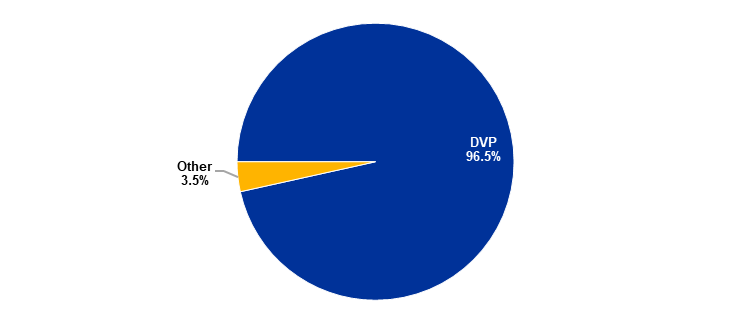
In terms of transaction type, 96.5% of the value settled in T2S in 2025 came from DVP (Chart 24), corresponding to €1,063.2 billion. The remaining 3.5% was either DWP or PFOD, as SRSE and FOP transactions do not imply a cash movement on a dedicated cash account (DCA) and are therefore not included in the calculation of value-based statistics. These results were largely in line with previous years.
Chart 24
Values settled in T2S by transaction type in 2025
(percentages)
Source: T2S.
Note: “Other” includes PFOD and DWP.
Business day phases
In T2S the business day starts at 18:45 CET with preparation for night-time settlement (NTS). NTS processing starts at 20:00 CET and it is normally completed before 22:00 CET. Once NTS ends, there is a short preparation period for real-time settlement (RTS), followed by the actual RTS phase. RTS is concluded at 18:00 CET, although it may be interrupted by an optional maintenance window, which, when activated, starts at 03:00 CET and ends at 05:00 CET. The mandatory weekly maintenance window is activated every weekend from 02:30 CET on Saturday to 02:30 CET on Monday. During the maintenance window T2S is closed for all settlement activities.
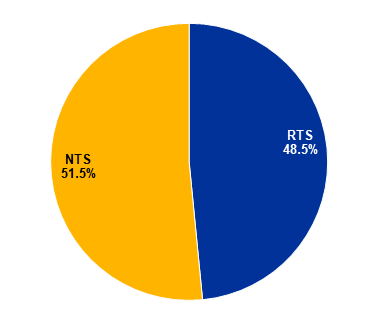
In 2025 transactions settled during the NTS accounted for 51.5% of the total volumes, while those settled during the RTS accounted for 48.5% (Chart 25). However, most of the value, 66.0%, is settled during the RTS. This indicates that the RTS phase is typically more value-intensive, featuring transactions with a higher average value than the NTS cycles. By contrast, the NTS cycles are more volume-intensive. The distribution between NTS and RTS is consistent with the previous year and did not vary much across the year.
Chart 25
NTS and RTS volumes and values in T2S in 2025
a) Volume | b) Value |
|---|---|
(percentages) | (percentages) |
 |  |
Source: T2S.
Intraday credit
Auto-collateralisation in T2S is a form of intraday credit operation granted by the central banks. The operation is triggered when a T2S DCA holder does not have enough funds to settle securities transactions. Its ultimate purpose is to improve the buyer’s cash position and secure the funds necessary to settle the transaction. Auto-collateralisation is an automatic process aimed at facilitating smooth real-time DVP settlement in central bank money.[17]
Two types of auto-collateralisation are available in T2S:
- auto-collateralisation on-flow is the use of the securities which are about to be purchased as collateral to secure the credit needed to complete the transaction;
- auto-collateralisation on-stock is the use of other securities already held by the buyer as collateral to complete the transaction.
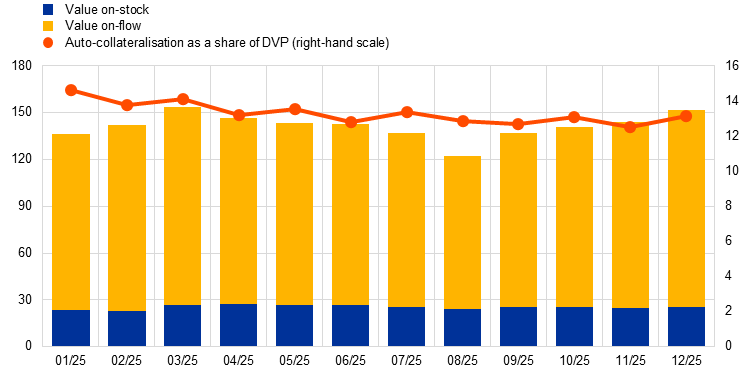
In 2025 auto-collateralisation reached a daily average value of €141.4 billion, up 4.5% compared with 2024 (Chart 26). The daily average value of auto-collateralisation on-flow was €116.0 billion, while the daily average daily value of auto-collateralisation on-stock was €25.4 billion. In other words, 82.0% of auto-collateralisation use by value was on-flow, almost unchanged compared with the previous year.
The use of auto-collateralisation largely follows a similar pattern to that observed for DVP transactions settled throughout the year. In 2025 it accounted for 13.3% of the total value settled via DVP. This means that, on average, for every euro of DVP settlement in T2S during the year, 13.3 cents were settled thanks to auto-collateralisation.
Chart 26
Auto-collateralisation use by type in 2025
(left-hand scale: daily averages, EUR billions; right-hand scale: percentages)
Source: T2S.
Unsettled traffic
Not all transactions submitted for processing in T2S are settled on the intended settlement date (ISD). There are several possible reasons for this, including the cash and/or securities needed for settlement not being available, one of the two instructions underlying the transaction being set to on-hold status, and the instruction being submitted late. Unsettled transactions have a negative impact on settlement efficiency.
In 2025 the daily average number of unsettled transactions was 10,796, 16.2% higher than in 2024 (Chart 27). It peaked in April at 13,421, driven by higher activity amid market volatility and the onboarding activities described in the “Settlement efficiency” section below. The daily average value of unsettled transactions stood at €14.9 billion in 2025, which was 5.7% below the figure for 2024, despite the higher turnover. After following a declining trend between February and August, values unsettled experienced an increase from September until the end of the year, with a peak at €19.5 billion in December.
Chart 27
Unsettled transactions in T2S in 2025
(left-hand scale: number of transactions, daily averages; right-hand scale: EUR billions, daily averages)

Source: T2S.
At the end of each day, unsettled transactions are not deleted but instead automatically postponed (“recycled”) by T2S to the following business day. T2S attempts to settle such transactions over a period of time referred to as the “recycling period” (set at 60 business days for matched instructions), after which they are automatically cancelled. In 2025, 30.6% of unsettled payments were settled on the first recycling day, while 67.9% of unsettled payments were settled within five recycling days (Chart 28). 10.2% of unsettled payments still remained unsettled after 19 recycling days.
Chart 28
Unsettled transactions and number of recycling days before settlement in December 2025
(y-axis: percentages; x-axis: number of recycling days)
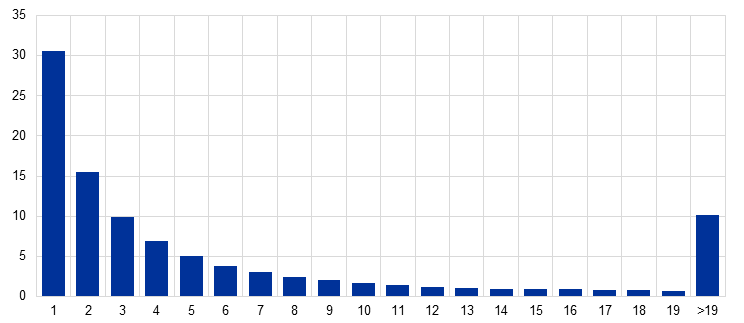
Source: T2S.
Notes: For data availability reasons, the chart shows the situation of unsettled transactions in December 2025. However, typically the situation is similar across the year. The maximum recycling period for matched settlement instructions is 60 business days.
Settlement efficiency
In 2025 settlement efficiency at end of day was on average 93.5% in volume terms and 98.0% in value terms (Chart 29). This represented a 0.9 percentage point decrease in volume and a 0.3 percentage point increase in value compared with 2024. In volume terms, the average declined to 92.6% in May, followed by a progressive rebound to 94.4% in September. After that it steadily declined to 92.4% in December. In value terms, settlement efficiency ranged between 97.3% in February and 98.6% in August, a much smaller variation compared with the volumes. These asymmetric developments in the first half of 2025 were mainly driven by the phased onboarding of a new participant in one CSD. The related onboarding activities were executed via FOP transactions. Some of these transactions failed to settle during the process of portfolio transfer between different CSDs, which affected settlement efficiency in volume, but not in value terms, due to their FOP nature.
Average settlement efficiency after NTS[18] reached 58.2% in volume terms and 47.7% in value terms in 2025. This represented a 3.1 percentage point decrease in volume and a 0.4 percentage point increase in value compared with 2024, confirming the direction of the trend at the end of the day. Compared with the end of the day its range of variation was much wider, reaching 2.7 percentage points in volume and 7.9 percentage points in value.
Chart 29
T2S settlement efficiency in 2025
(percentages)

Source: T2S.
Penalty mechanism
The entry into force of the settlement discipline regime under the Central Securities Depositories Regulation[19] on 1 February 2022 introduced cash penalties for late matching[20] and settlement fails for trades settled in the EU to promote efficiency. Accordingly, T2S implemented a penalty mechanism that provides for (i) daily calculation and reporting of cash penalties for settlement fails, and (ii) monthly reporting of the aggregate amounts of cash penalties computed for a given month.
In 2025 T2S participants paid an average of 1,157,008 cash penalties per month for late matching and settlement fails (Chart 30), which was 31.8% higher than in 2024. This was mostly a consequence of the increase in settlement fails in the first half of the year due to the onboarding of a new participant in one CSD, which also affected other statistics, such as settlement efficiency in volume. The number of cash penalties peaked in March at 1,358,348. In value terms, cash penalties averaged €43.1 million per month in 2025, which was 18.3% lower than in 2024. The value of cash penalties spiked in May at €98.7 million. The average value of a cash penalty in 2025 was €38.6.[21]
Chart 30
T2S cash penalties in 2025
(left-hand scale: number of penalties, monthly totals; right-hand scale: EUR millions, monthly totals)

Source: T2S.
Other settlement-related aspects
Internally and externally matched settlement instructions
In order to settle a securities transaction, the delivering and receiving parties provide the necessary details in the form of settlement instructions. The two settlement instructions have to be compared to ensure that both parties agree on the terms of the transaction. If the comparison is successful, the two settlement instructions are matched, generating a settlement transaction. This process can take place either inside T2S (internally matched), i.e. in the life cycle management and matching (LCMM) module, or outside T2S (externally matched), such as in a CSD.[22]
In 2025 most settlement instructions (52.3%) were matched externally (Chart 31), in line with previous years. The number of externally matched settlement instructions consistently exceeded the number of internally matched settlement instructions. On average, 1,008,754 were matched externally on a daily basis, while 921,431 were matched internally.
Chart 31
Internally and externally matched settlement instructions in 2025
(number of instructions, daily averages)

Source: T2S.
Intra-CSD, cross-CSD and external CSD settlement
Investors can access the different markets linked to T2S through multiple technical channels. Depending on the number of CSDs involved, it is possible to distinguish between intra-CSD, cross-CSD and external CSD traffic.[23]
- Intra-CSD traffic refers to securities transfers where the delivering and receiving parties belong to the same CSD.
- Cross-CSD traffic occurs when the delivering and receiving parties belong to different CSDs, both of which are in T2S.
- External CSD traffic occurs when the delivering and receiving parties belong to different CSDs, one of which is not in T2S.
Intra-CSD transactions represent the majority of all transactions settled in T2S in both volume and value terms. In 2025 they accounted for 95.7% of the total volume and 96.0% of the total value. Cross-CSD transactions accounted for 3.5% of the settled volumes and 4.0% of the values settled (Chart 32). External CSD transactions accounted for a minor fraction of T2S traffic, and always remained below 1%.
Chart 32
Share of cross-CSD settlement
(percentages)

Source: T2S.
Taking a longer-term perspective on the evolution of cross-CSD traffic, a 2 to 3 percentage point increase in volume can be observed between 2023 and 2024. This was mainly driven by a change in transaction routing practices within one CSD group in December 2023, which began channelling centrally cleared traffic to T2S through a single entity rather than distributing it across several. Additionally, the introduction of a new functionality enabling settlement via alternative security CSD links (implemented via change request CR797) in June 2025 further broadened the options available to market participants. However, this has not yet translated into a notable rise in cross-CSD activity. After the 2024 increase, the volume of cross-CSD activity slightly decelerated in 2025. The value of cross-CSD activity, on the other hand, grew slightly over the past three years, but this growth was not material. It should also be noted that cross-CSD settlement is not limited to the dedicated T2S functionality. For instance, CSDs may directly participate in one another’s systems, with such activity being recorded at T2S level as intra-CSD rather than cross-CSD traffic. As a result, these figures do not fully capture the entirety of cross-border settlement activity in the European post-trade landscape.
2.2.3 TIPS
Volume developments
With a daily average of 2,735,053 transactions in 2025[24], instant payments settled in TIPS grew by 110.8%[25] from a daily average of 1,297,241 transactions in 2024. Payments increased almost every month in 2025, reaching 3,845,376 in December (Chart 33). In 2025, TIPS reached the maximum daily volume of 5,759,570 transactions on 1 December.
The uptake of instant payments in euro – especially in the final months of 2025 – was driven by the entry into force of key provisions of the (IPR). First, on 9 January 2025 all banks in the euro area had to be able to receive instant payments. Second, as of 9 October 2025 all banks in the euro area must also offer to send instant payments at costs no higher than those of SEPA credit transfers. The second stage also removed value limits at scheme level.[26]
Chart 33
Volumes settled in TIPS in euro in 2025
(number of transactions)
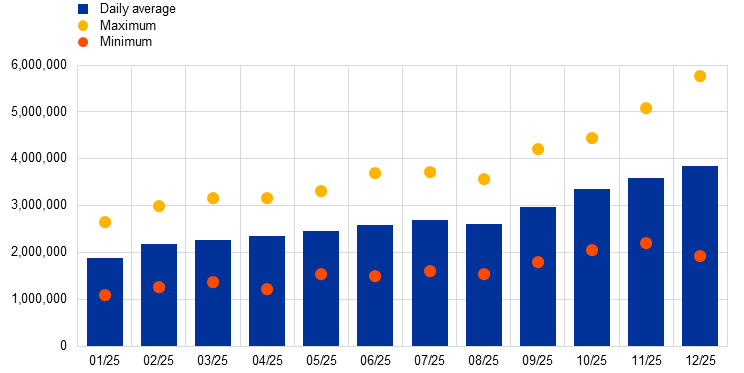
Source: TIPS.
Payment service providers (PSPs) can settle instant payments either directly on their DCAs in TIPS or via clearing and settlement mechanisms (CSMs) outside of TIPS. Instant payments sent from TIPS DCAs represented 76.0% of the total volume settled (Chart 34), with the share growing during the year from 72.6% in January to 78.7% in December. Conversely, on average 24.0% of the total volume was sent from the technical accounts of CSMs. These accounts are referred to as ancillary system technical accounts (ASTAs). The substantial share of payments originating from TIPS ASTAs shows that TIPS continues to fulfil its dual objective of providing instant payment settlement services to PSPs and supporting interoperability across other CSMs.
Chart 34
Volumes settled in TIPS in euro by account type in 2025
(number of payments, monthly totals)
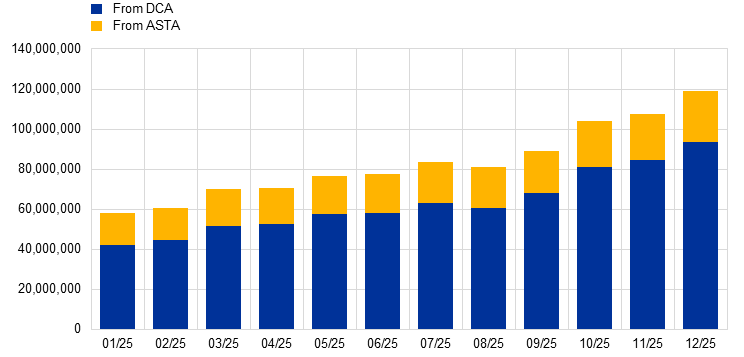
Source: TIPS.
Note: The account type is identified by the account number of the debited participant for each payment.
In volume terms, PSPs across all communities saw an increase in traffic. The top six contributing countries (Chart 35) experienced significant growth in their instant payment traffic in TIPS in 2025 compared with the previous year, ranging from 75.2% in the Netherlands to 302.0% in Luxembourg. Some traditionally had a strong adoption of instant payments even before the IPR (such as Slovakia, Lithuania and the Netherlands), while others are a financial hub with large retail PSPs (such as Luxembourg).
The three largest contributors, Germany, Italy and Slovakia, remained unchanged compared with last year, although their order changed. Volume originating from Germany grew much strongly than the average, increasing from 15.2% in 2024 to 19.8%, making it the largest contributor in 2025. Italy’s share of volume also grew, from 15.5% to 16.3%. The share of volume originating from Slovakia remained almost unchanged at 13.3% (+0.1 percentage points). Among the remaining contributors, the volume share of payments originating from Luxembourg increased the most, growing from 7.2% to 11.2%, making it the fourth-largest contributor in 2025.
Chart 35
Volumes settled in TIPS in euro by country in 2025
(percentages)

Source: TIPS.
Note: The country is identified by the BIC of the originator PSP for each payment.
Value developments
The total value of instant payments in euro settled in TIPS stood at €792.8 billion in 2025, up 179.7% compared with 2024, reflecting both strong growth in volumes and regulatory changes (with the further implementation of the IPR in October 2025, the maximum limit of €100,000 for instant payments at scheme level was removed).
The daily average value of TIPS payments stood at €2.2 billion in 2025 (Chart 36), compared with €0.8 billion in 2024. The daily average value increased most substantially in the last quarter, after the further implementation of the IPR. While the average daily value in January was €1.2 billion, it increased to €4.8 billion in December. TIPS settled the maximum daily value on 29 December: €9.1 billion.
Chart 36
Values settled in TIPS in euro in 2025
(EUR billions)
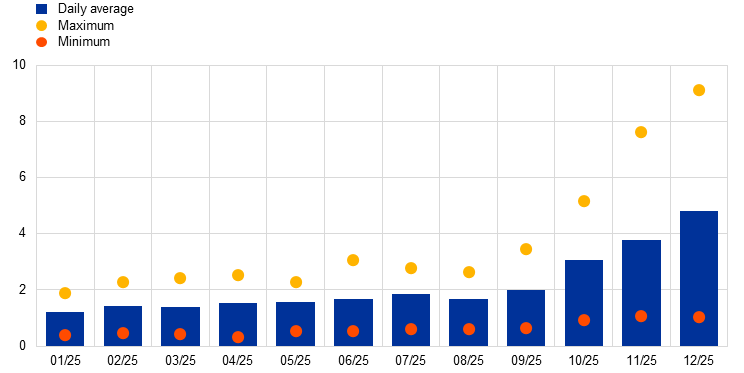
Source: TIPS.
Coinciding with the value limit removal at scheme level, the average value of instant payments in euro increased. In 2025 the average value was €794.2, increasing 27.4% from €623.2 in 2024. This increase was mostly driven by payments with higher values occurring after 9 October.
TIPS continued to settle mostly low-value retail payments. The median transaction value in 2025 was €100.0. Further, 88.0% of all payments were below €1,000 and 99.4% were below €15,000 (Chart 37). Still, there was a non-negligible number of payments with higher values, as 445,961 transactions were above €100,000. This suggests that corporate clients have started adopting instant payments via TIPS, as also indicated by PSPs.[27]
Chart 37
Distribution of TIPS instant payments in euro across value bands in 2025
(percentages, cumulative)

Source: TIPS.
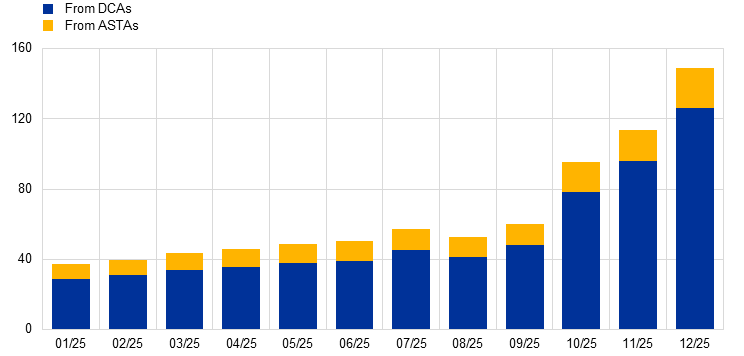
Mirroring the distribution in volumes (shown in Chart 34), instant payments sent from TIPS DCAs were also the largest payment category in value terms in 2025. 80.9% of the total value settled originated from TIPS DCAs (Chart 38). Conversely, 19.1% of the total value settled originated from TIPS ASTAs. The share of value originating from TIPS DCAs increased throughout the year, from 77.6% in January to 84.7% in December.
Chart 38
Values settled in TIPS in euro by account type in 2025
(EUR billions, monthly totals)
Source: TIPS.
Note: The account type is identified by the account number of the debited participant for each payment.
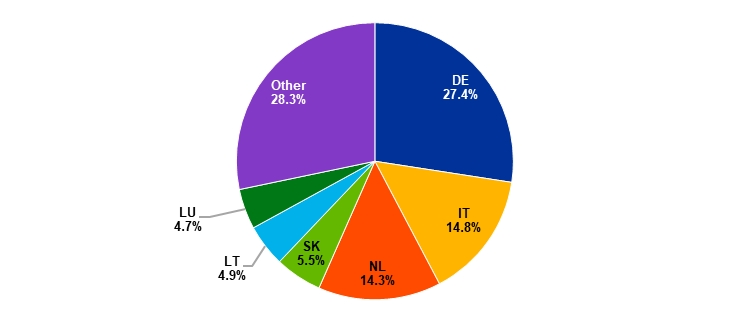
The top six contributors to instant payment value in TIPS in 2025 were the same as in volume terms (Chart 39). However, their ordering and share varied significantly. At 27.4% (+7.2 percentage points compared with 2024), PSPs from Germany contributed more than a quarter of the total value in TIPS. Since the volume from Germany only contributed 19.8% to the total volume, instant payments originating from the country had a significantly higher average value than the average across all payments. Similarly, payments from the Netherlands tended to be of higher value than the average. The removal of the limitation on payments with higher values partly explains the higher average instant payment value – most of the largest individual payments after October 2025 stemmed from the Netherlands and Germany.
Chart 39
Values settled in TIPS in euro by country in 2025
(percentages)
Source: TIPS.
Note: The country is identified by the BIC of the originator participant for each payment.
Unsettled traffic
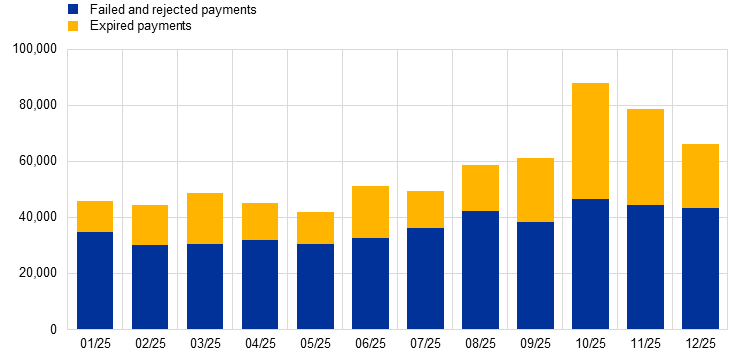
Instant payments that are not settled in TIPS are either failed, rejected or expired. A payment fails if an error occurs (for instance, there are insufficient funds); it is rejected if the receiving party does not accept it (e.g. for anti-money laundering reasons); it expires if the receiving party does not accept it in time. As TIPS is a platform designed to process a very high number of payments within seconds, and this is also mandated by the IPR, it is of great importance for the TIPS operator to identify settlement failures and their reasons.
In 2025 the daily average number of unsettled instant payments in euro in TIPS ranged between 41,987 in May and 87,847 in October (Chart 40), representing between 1.7% and 2.6% of the system’s daily average traffic in euro. Failed and rejected transactions together accounted for between 53.0% and 76.4% of all unsettled payments in euro each month.
Chart 40
Unsettled instant payments in TIPS in euro in 2025
(number of transactions, daily averages)
Source: TIPS.
In 2025 the settlement ratio of traffic in euro in TIPS was 98.0% in volume, and 95.8% in value terms (Chart 41). Both indicators were mostly stable through the first nine months of the year. The settlement ratio in value dropped substantially to 93.1% in October – coinciding with full adoption of the IPR – but recovered to 96.5% by December.
Failures and rejections are not linked to the design of the TIPS platform, but rather to participant behaviour or operational issues on the part of participants, such as technical issues upon initial connection to the platform or as a result of upgrades. The decreased settlement ratio in October stemmed from participants adapting to the shorter timeline for instant payment processing implemented by the IPR and some newly connected participants facing challenges in operating their systems 24/7, yielding an increased number of timed out transactions. Participants also encountered occasional challenges processing a much higher volume of larger-value instant payments after the IPR-induced uptick in instant payments. However, the settlement ratio in December returned to the levels observed before October, indicating that these challenges were temporary. The Eurosystem promptly engaged with the participants to investigate the drivers behind the fails, and will continue to monitor the number of unsettled payments closely and maintain efforts to reduce them with the support of TIPS participants.
Chart 41
Settlement ratio in TIPS in euro in 2025
(percentages)

Source: TIPS.
Cross-border traffic
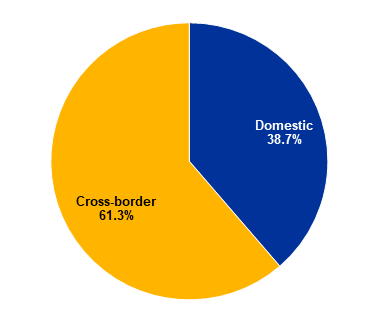
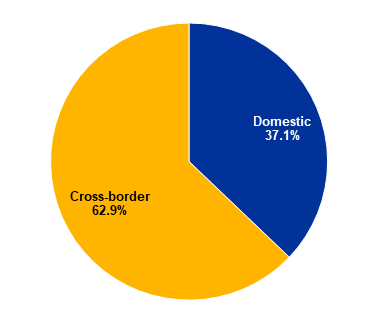
The share of cross-border traffic indicates the percentage of traffic that is exchanged between direct participants belonging to different banking communities in TIPS. In 2025 the share of cross-border traffic was 61.3% in volume terms (-0.7 percentage points compared with 2024) and 62.9% in value terms (-0.4 percentage points) (Chart 42). Such results are largely impacted by the participation model and technical set-up of some large players that are active in different Member States but chose to centralise access via a single point to rationalise euro liquidity management. Both in volume and value, the share of cross-border traffic was lowest at the beginning of the year (in volume: 56.7% in January; in value: 56.6% in February) and peaked before full implementation of the IPR (in volume: 63.7% in September; in value: 66.1% in August). The magnitude of these fluctuations is in line with 2024. These results suggest that the IPR appears to have had a negligible impact on the share of cross-border traffic via TIPS.
Chart 42
Share of cross-border traffic in TIPS in euro in 2025
a) Volume | b) Value |
|---|---|
(percentages) | (percentages) |
 |  |
Source: TIPS.
Notes: Traffic is considered domestic if the country codes of the BICs owning the debited and credited accounts for each payment are identical. Otherwise, traffic is considered cross-border.
2.2.4 ECMS
Volume developments
ECMS manages processes related to the centralised management of collateral for Eurosystem credit operations. These processes encompass the management of the assets pledged to secure monetary policy operations, such as open market operations (OMOs) and recourse to the marginal lending facility, the intraday credit provided in T2 and other transactions within the Eurosystem. In addition to collateral management, ECMS facilitates the settlement of these monetary policy operations, processes corporate actions, manages entitlements (rights) and handles payments. Between its launch on 16 June 2025 and the end of the year, ECMS processed a total of 858,289 transactions.
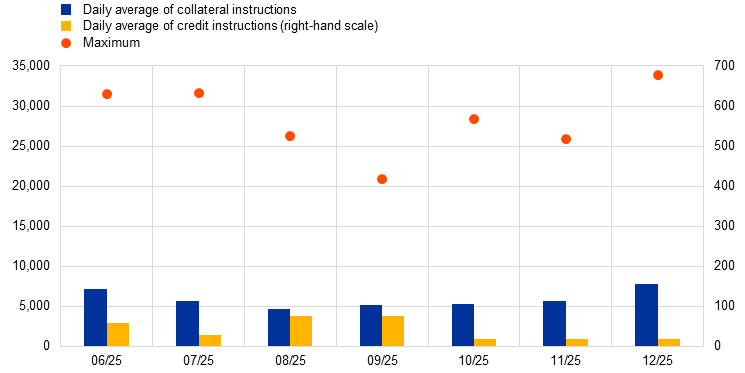
Collateral-related instructions dominate ECMS activity, representing the majority of transaction volumes. In 2025 ECMS settled an average of 5,821 collateral instructions and 41 credit instructions daily (Chart 43). The peak in transaction volume was recorded on 3 December, with 33,843 transactions settled. Seasonal factors influence ECMS activity, leading to increased collateral usage at the end of the year.
Chart 43
Volumes of collateral and credit instructions settled in ECMS in 2025
(number of instructions)
Source: ECMS.
Notes: Collateral instructions are computed as the sum of marketable assets instructions, non-marketable assets instructions, including externally managed collateral (EMC) instructions, and triparty instructions. Credit instructions are computed as the sum of automatic marginal lending, marginal lending on request, OMOs and credit freezing instructions.
Collateral instructions represented more than 95% of all the transactions settled in ECMS in 2025, driving fluctuations and peaks in traffic. They reflect the behaviour of euro area credit institutions eligible to access Eurosystem monetary policy operations (MPOs) (i.e. eligible MPO counterparties). These institutions mobilise collateral to address liquidity needs.
Collateral instructions involve the mobilisation and demobilisation of two main asset categories: (i) marketable assets, such as central government debt instruments or covered bank bonds or asset-backed securities and (ii) non-marketable assets, including credit claims.
While non-marketable assets typically have lower individual values than marketable assets, they represent the majority of mobilised and demobilised transactions by volume. This is mainly attributable to credit claims, which constitute the largest type of non-marketable asset and are primarily used in some of the largest national communities. In 2025 credit claims accounted for between 74.8% and 87.4% of the daily average volume of collateral-related instructions processed in ECMS.
In absolute terms, daily average mobilisations and demobilisations of non-marketable assets ranged from a minimum of 3,180 (in September) to a maximum of 6,279 (in December), with a peak at 31,058 on 3 December, mirroring the overall transaction peak (Chart 44).
Chart 44
Volumes of collateral instructions settled in ECMS by type in 2025
(number of instructions, daily averages)

Source: ECMS.
Note: Non-marketable assets mobilisation and demobilisation instructions include credit claims instructions, EMC instructions and cash collateral instructions, but exclude triparty instructions.
The collateral-related instructions processed daily result in outstanding positions at the end of the day. Monitoring these positions is important for central banks, providing a clear overview of collateral composition among eligible MPO counterparties, while ensuring that operators actively oversee the successful processing of these instructions and offer support to their counterparties when needed.
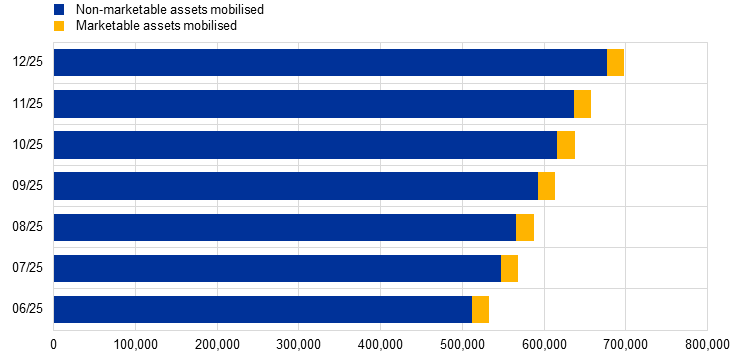
By the end of 2025 non-marketable assets constituted the majority of outstanding collateral volumes mobilised through ECMS, increasing from 511,831 in June to 676,934 by December, an increase of 32.3% (Chart 45). Conversely, outstanding positions for marketable assets fluctuated between 21,081 in June and 21,663 in October. It is worth highlighting that non-marketable assets managed by three national central banks, as well as all pools of non-marketable assets, were operated via local central bank systems, with only aggregate collateral values registered in ECMS. Once mobilised within ECMS, non-marketable assets are subject to frequent updates by MPO counterparties, ensuring the system remains current and accurate. Counterparties using internal ratings-based (IRB) systems also regularly update the credit claims ratings in ECMS, significantly contributing to the transaction volumes.
Chart 45
Volumes of collateral mobilised in ECMS by type in 2025
(number of individual collateral positions)
Source: ECMS.
Notes: Data as of the end of each month. Non-marketable assets include only credit claims; triparty instructions are excluded.
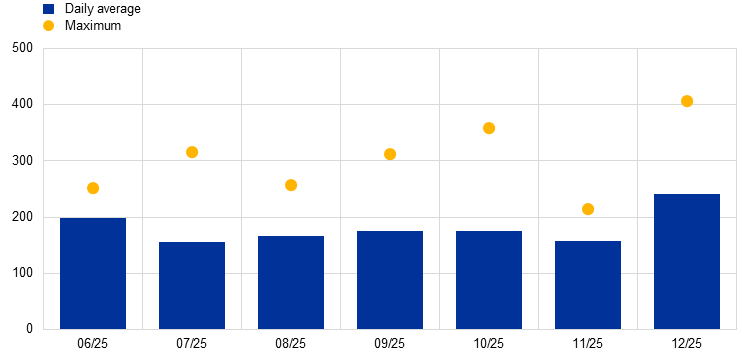
Corporate action events, such as coupon payments and principal repayments, can directly impact the valuation, eligibility or availability of securities used as collateral within ECMS. Between 16 June 2025 and the end of 2025 ECMS processed 26,539 corporate action events, an average of 180 daily (Chart 46). The peak number on a single day occurred on 29 December, with 407 events processed, driven largely by end-of-year payments related to interest and principal maturities.
Chart 46
Corporate action events settled in ECMS in 2025
(number of transactions)
Source: ECMS.
Value developments
ECMS keeps track of the individual collateral and credit positions of eligible MPO counterparties. These positions are aggregated within each counterparty’s designated pool, enabling ECMS to calculate the available credit line for each counterparty. This credit line is determined as the difference between the total collateral available in the pool and the amount of outstanding Eurosystem MPOs. The resulting information is transmitted to CLM, where it is converted into available intraday credit lines in T2. Credit lines are dynamically updated throughout the day to reflect changes in collateral or credit positions[28], ensuring counterparties can dynamically adjust their positions in real time.
In 2025 the value of collateral mobilised in ECMS was €1,579.4 billion on average per day. After subtracting the value of outstanding Eurosystem MPOs and credit freezing positions, this resulted in an average credit line value of €1,056.8 billion in T2 (Chart 47). Seasonal factors contributed to the peak collateral value of €1,641 billion on 31 December 2025, while the highest credit line value of €1,080 billion occurred on 18 December 2025. Despite fluctuations in collateral mobilisations due to seasonal effects, daily collateral positions remained stable, increasing modestly by 4.9% between June and December 2025. This stability underscores the dynamic and resilient nature of collateral mobility within the Eurosystem.
Chart 47
Collateral positions and credit line values in ECMS in 2025
(EUR billions, daily averages)

Source: ECMS.
Note: The collateral position and the credit line values are determined by aggregating all values in the Eurosystem per day and calculating the monthly average.
Business day phases
The ECMS business day is composed of four main phases: (i) the start of the day (SOD), which lasts from 18:45 CET to 19:00 CET, (ii) the night-time process (NTP) from 19:00 CET to 07:00 CET, including a maintenance window from 00:30 CET to 02:30 CET, (iii) the daytime process (DTP) from 07:00 CET to 18:00 CET[29], and (iv) the end of the day from 18:00 CET to 18:45 CET.
During the NTP, key activities include updating collateral positions, calculating accruals on outstanding credit or debit operations, and settling and reimbursing OMOs or marginal lending on request by sending the corresponding payments to the CLM.
Conversely, the DTP is dedicated to processing instructions sent by counterparties, such as the mobilisation and demobilisation of marketable assets and credit claims, as well as requests for recourse to the marginal lending facility. Information provided by triparty agents, including reporting on flows, is also processed during this phase. Other key activities include handling corporate actions events, recording the results of OMOs, and transmitting updated credit lines to CLM.
During the day ECMS also interacts with T2S for the settlement of securities, and to supply a list of eligible assets and pricing elements for the management of the auto-collateralisation process.
2.2.5 Liquidity interaction between TARGET Services
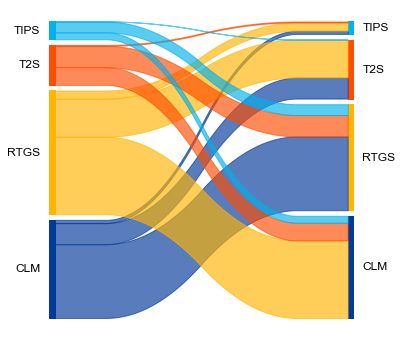
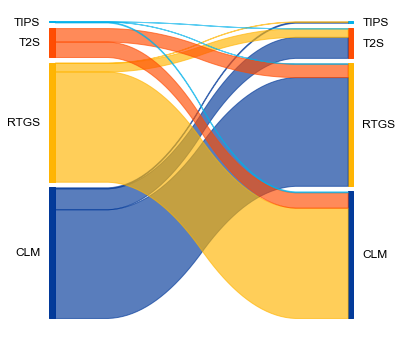
Most liquidity in euro flows between the CLM and the RTGS components (i.e. within T2), both in volume and in value terms (Chart 48). In 2025, on average 2,298 liquidity transfers worth €2,424.3 billion were sent to the RTGS system each day, as participants mostly rely on their account balances to settle payments. Similar volumes and values were recorded in the opposite direction, as the liquidity was repatriated to the CLM component to be placed in the overnight deposit facility. Liquidity transfers to the other services were smaller in magnitude. Each day, on average, 799 liquidity transfers worth a total of €303.7 billion were sent from T2 to T2S, while 549 liquidity transfers worth a total of €303.4 billion were sent back. The higher value of liquidity transfers to and from T2S reflected the higher traffic settled on the platform. As regards TIPS, the daily average volume of liquidity transfers from T2 to TIPS stood at 205, with a total value of €14.5 billion, while there were 269 transfers in the opposite direction with a total value of €14.2 billion. Liquidity transfers picked up starting from October 2025 because of the second stage of implementation of the IPR.
Chart 48
Inter-service liquidity transfers in euro in 2025
a) Volume | b) Value |
|---|---|
(number of transactions, daily averages) | (EUR billions, daily averages) |
 |  |
Source: TARGET.
Liquidity can remain in any of the TARGET Services overnight without having to be repatriated to the CLM component. For eligible MPO counterparties, liquidity left in the RTGS, T2S and TIPS DCAs overnight counts towards fulfilling minimum reserve requirements. However, in order to earn interest on their excess liquidity, until June 2026 eligible MPO counterparties had to repatriate it to the CLM component and place it in the overnight deposit facility.[30] Conversely, liquidity that is not held by eligible MPO counterparties falls under the perimeter of non-monetary policy deposits and is therefore subject to a separate remuneration regime.[31]
As a result, only a fraction of total liquidity remained in the RTGS service, T2S and TIPS overnight. In 2025, most of it was held in the RTGS, followed by TIPS and T2S. Out of all liquidity in DCAs and ancillary systems’ accounts, between €135.4 billion and €148.7 billion on average stayed in the RTGS overnight each day in the first half of the year, compared with €26.9-29.9 billion in TIPS and €6.6-14.5 billion in T2S (Chart 49). Once the ECMS went live in June the average liquidity held in T2S overnight increased, reaching €22.4 billion in December. Moreover, full implementation of the IPR in October led to a significant increase in the average liquidity held in TIPS overnight, which surged from €32.3 billion in September to €73.5 billion in October and €88.8 billion in December (see Box 2).
Chart 49
Overnight liquidity in euro in RTGS, T2S and TIPS in 2025
(EUR billions, daily averages)

Source: TARGET.
Notes: For RTGS, liquidity held in DCAs and in ancillary systems’ technical and guarantee funds accounts is considered. For T2S, liquidity held in DCAs is considered, while liquidity held in T2S central bank accounts is not included. For TIPS, liquidity held in DCAs and ASTAs is considered.
Box 2
The impact of the IPR on liquidity in TIPS
The timeline for implementation of the IPR followed a staggered approach, with two key milestones set for 2025. First, all PSPs in the euro area had to be able to receive instant payments by 9 January. Second, all PSPs in the euro area also had to be able to send instant payments at the same price as SEPA credit transfers by 9 October. At the same time, the value limit of €100,000 per instant payment was lifted.
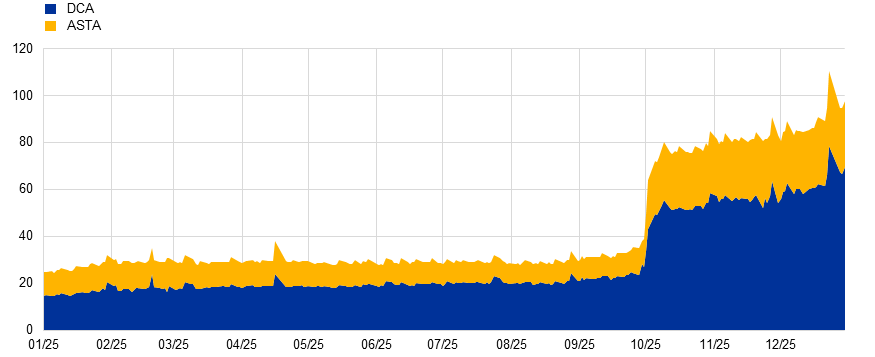
These changes, particularly the second one on 9 October, caused a major increase in TIPS traffic.[32] As a result, participants substantially increased their liquidity holdings in TIPS. While the average daily liquidity left in TIPS DCAs and ASTAs overnight stood at €26.9 billion in January, this figure increased 173.2% to €73.4 billion in October upon further implementation of the IPR (Chart A). Liquidity levels continued to grow after that, reaching a daily average of €88.8 billion in December (260.3% growth compared with December 2024), with a spike to €110.7 billion on the 24th of that month. Most liquidity continued to be held in DCAs. The increasing share of liquidity left on DCAs compared with ASTAs reflects the strong increase in the number of active TIPS DCAs in October; the number of TIPS DCAs that sent at least one instant payment per month increased from 197 in September to 281 in October.
Chart A
Liquidity left in TIPS accounts overnight by account type in 2025
(EUR billions)
Source: TIPS.
Note: As TIPS operates 24/7/365, a snapshot of liquidity positions in TIPS is taken at the end of the T2 business day.
Throughout the year, participants maintained ample liquidity in TIPS to fund instant payments. This was reflected in very high ratios of end-of-day liquidity in TIPS DCAs compared with the daily average payment value sent from DCAs. However, it should be taken into account that participants can transfer liquidity during the day from their DCA to an ASTA to support traffic settled in CSMs, which is not visible to the Eurosystem. Nevertheless, there are indications that the overall liquidity in TIPS is highly sufficient to fund all payments directly in TIPS and in CSMs.
Participants manage their liquidity in TIPS by funding and defunding their DCAs via liquidity transfers during T2 opening hours to ensure sufficient buffers. These liquidity transfers exhibited a consistent pattern in 2025; liquidity was sent from T2 to TIPS right after the start of the business day at 19:30 CET and came back shortly before the end of the business day at 18:00 CET (Chart B) to be placed in the overnight deposit facility.[33] Between August and September, participants transferred on average around €3 billion from T2 to TIPS at the start of the day. Cumulative net liquidity transfers remained relatively constant until the last two hours of the business day between 16:00 CET and 18:00 CET, when the cumulative daily net liquidity transfer reduced again to almost zero due to the defunding before the end of the day.
This pattern continued as the IPR was fully implemented in October, but its magnitude quintupled. That month participants sent an average €15.1 billion from T2 to TIPS at the start of the business day. After a slight decrease in the late morning as a few participants started sending liquidity to the deposit facility, cumulative net liquidity transfers remained essentially stable during the day until the late afternoon. As before, participants repatriated liquidity to T2 shortly before the end of the business day at 18:00 CET. Combining the cumulative intraday liquidity transfers and the end-of-day balance, in December participants had an average of €106.3 billion of liquidity available in TIPS during the business day. Starting in June 2026, liquidity held overnight on TARGET accounts (including TIPS DCAs) exceeding the minimum reserve requirement will be remunerated automatically[34], reducing the need for temporary liquidity transfers outside TIPS for remuneration purposes. This policy change might lead to participants retaining liquidity overnight in TIPS instead of transferring it back to T2.
Chart B
Cumulative net intraday liquidity transfers to TIPS by hour of the day in 2025
(EUR billions, daily averages)
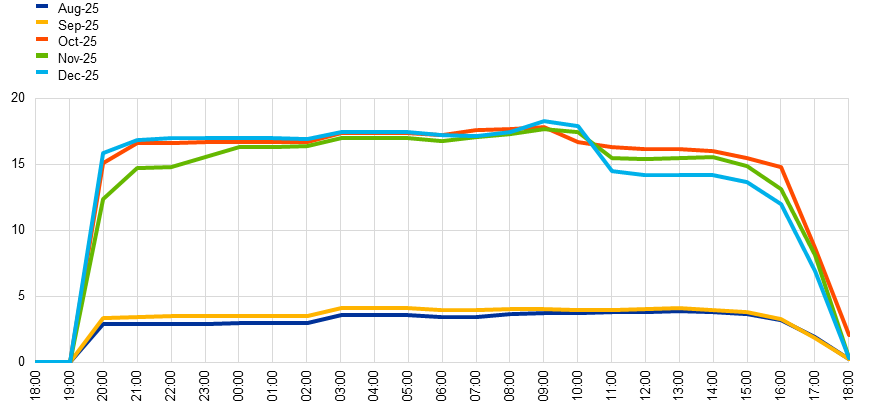
Source: TIPS.
Note: Positive values indicate a net inflow into TIPS DCAs, negative values a net outflow.
2025 saw substantial growth in instant payment traffic and liquidity as the IPR came into effect for euro area banks. However, further implementation deadlines for the IPR lie ahead in 2027 and 2028.[35] Amongst other things, banks in non-euro area EU Member States, and electronic money institutions and payment institutions across all EU Member States, will have to be able to send and receive instant payments at the same cost as SEPA credit transfers. To encourage smooth adoption of the new arrangements, since April 2025 non-bank PSPs have been permitted to access settlement in central bank money in TARGET, provided they have the relevant safeguards in place and are able to demonstrate the ability to meet the operational and technical requirements applicable to other participants.[36] The Eurosystem will continue closely monitoring traffic and liquidity developments surrounding instant payments in TIPS.
Ancillary systems can hold technical accounts, because T2 and TIPS allow them to hold funds set aside by their participants to back their positions, a practice known as “prefunding”. Prefunding helps reduce credit risk while enabling settlement outside central bank RTGS operating hours. However, excessive reliance on prefunding may negatively impact overall market efficiency by causing liquidity fragmentation.[37]
Monitoring liquidity levels in these accounts can help assess the extent of recourse to prefunding in TARGET. Overall, little liquidity was left on prefunding accounts in the RTGS and in TIPS in 2025, ranging between a minimum of €14.7 billion (in August) and a maximum of €32.7 billion (in December) (Chart 50). Until July, most liquidity related to prefunding was held in the RTGS. However, a change in one ancillary system active in the RTGS between June and July and full implementation of the IPR in October led to a shift. As a result, more than 80% of this liquidity was held in TIPS by December 2025. Since excess liquidity averaged €2,463.1 billion in that month, this suggests prefunding-related liquidity represented around 1.3% of excess liquidity. The level indicates no liquidity fragmentation risk has emerged so far.
Chart 50
Liquidity held by ancillary systems in prefunding accounts in 2025
(EUR billions, daily averages)
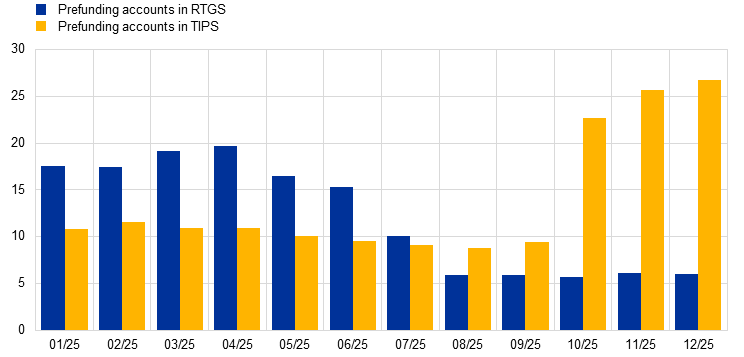
Source: TARGET.
Notes: For RTGS, liquidity held in ancillary systems’ technical and guarantee funds accounts is considered. For TIPS, liquidity held in ASTAs is considered.
2.2.6 Participation
Direct participation in TARGET
Participation in TARGET Services enables access to the Eurosystem’s MPOs and payment and securities settlement in central bank money (money held in an account at a central bank).[38] Financial institutions can choose to access TARGET Services directly (as direct participants) or indirectly (via a direct participant).
Direct participants can hold the following main types of accounts:
- MCA in the CLM; to participate in central bank refinancing operations, make use of the Eurosystem’s standing facilities, access the intraday credit line, and manage liquidity for settlement purposes across TARGET Services. An MCA in the CLM is a pre-requisite to access settlement in any TARGET service.
- DCA in each TARGET Service; for the settlement of bank-to-bank payments, customer payments and transactions related to settlement in other FMIs in the RTGS, for the cash leg of securities settlement in T2S, and for the settlement of instant payments in TIPS.
- ASTA in TIPS; for the funding and defunding of positions related to other instant payment systems. Only ancillary systems can open ASTAs.
In December 2025 there were a total of 2,709 MCAs in the CLM and 1,047 DCAs in the RTGS, 798 DCAs in T2S, 418 DCAs in TIPS and 13 ASTAs in TIPS (Table 2). The number of MCAs in the CLM, DCAs in the RTGS and in T2S, as well as that of ASTAs in TIPS, was broadly unchanged compared with 2024 and 2023. Conversely, the number of DCAs in TIPS increased by 39.3% in 2025 compared with 2024, and by 37.0% in 2024 compared with 2023, as a result of the gradual adoption of instant payments.
Table 2
Accounts in euro per TARGET service
2025 | 2024 | 2023 | |
|---|---|---|---|
CLM MCAs | 2,709 | 2,728 | 2,736 |
RTGS DCAs | 1,047 | 1,053 | 1,052 |
T2S DCAs | 798 | 795 | 763 |
TIPS DCAs | 418 | 300 | 219 |
TIPS ASTAs | 13 | 12 | 11 |
Source: TARGET.
Note: Only active accounts at the end of December each year are included.
In 2025 the Eurosystem granted non-bank PSPs access to central bank-operated payment systems, including TARGET and central bank accounts.[39] As a result, non-bank PSPs have become eligible to hold accounts in T2 and TIPS. However, at the end of 2025 no non-bank PSP was connected yet to these TARGET services in production.
Participation in RTGS
At the end of December 2025, 951 direct participants held an RTGS account in T2 for euro settlement (Table 3).[40] Through these, 3,677 correspondents worldwide were able to settle transactions in T2. Including the branches of direct participants and correspondents, a total of 39,154 BIC holders around the world (55.8% of which were located in the European Economic Area) were accessible via T2 at the end of 2025. This figure represents a decrease of 2.5% compared with 2024, mainly driven by a reduction in the number of registered correspondents. All the participants and institutions addressable in the RTGS system are listed in the T2 RTGS directory.
Table 3
T2 RTGS participants for settlement in euro by type
2025 | 2024 | 2023 | |
|---|---|---|---|
Direct participation | 951 | 957 | 956 |
Multi-addressee – credit institution | 47 | 49 | 8 |
Multi-addressee – branch of direct participant | 933 | 926 | 920 |
Addressable BIC – correspondent | 3,677 | 5,471 | 5,368 |
Addressable BIC – branch of direct participant or entity that is part of the same group | 22,918 | 22,831 | 22,792 |
Addressable BIC – branch of indirect participant or entity that is part of the same group | 1 | 1 | 0 |
Addressable BIC – branch of correspondent or entity that is part of the same group | 10,627 | 9,907 | 9,778 |
Source: T2.
Besides banks and investment firms, FMIs can also participate directly in the RTGS service. In T2 these are referred to as “ancillary systems”. A total of 69 ancillary systems used the RTGS service for euro settlement purposes at the end of 2025 (Table 4). These were mainly retail payment systems (31), securities settlement systems (18) and central counterparties (14).
Table 4
Ancillary systems in T2 by type in 2025
Participation in TIPS
TIPS allows the settlement of instant payments in central bank money. PSPs can choose to become direct participants in the service, opening one or more TIPS DCAs, or to be addressed indirectly as reachable parties within TIPS.[41] Like the T2 RTGS directory, the TIPS directory lists all participants and reachable parties and is available to TIPS participants for information and routing purposes. Through the direct participants listed in Table 2, over 15,300 parties were reachable via TIPS in 2025, compared with 14,884 parties in 2024.
3 Service level and availability
3.1 T2
3.1.1 Service level and availability
In 2025, 99.7% of all payments received in T2 were processed in less than two minutes, while 0.1% of payments were processed in two to five minutes. Only 0.2% of payments took longer than five minutes to be processed. These figures are very much in line with the corresponding figures for 2024[42], showing that a high level of performance was maintained.
Service delivery times and payment processing times generally remained stable in 2025, confirming the high performance level of T2. This was advantageous for the banking community, and particularly for its real-time liquidity management. All requests and queries were processed in less than one minute in 2025, maintaining the 100.0% performance level achieved in 2024.[43]
Chart 51 provides a clearer quantification of the system’s performance by illustrating the distribution of processing times in the RTGS service.[44] It shows the percentage of traffic meeting specific thresholds. The reference point for this analysis is the peak day of the year, 30 June, when 692,911 payments were settled.[45] The chart shows that on that day 51.2% of transactions were settled within 25 seconds and 91.1% within 36 seconds, again confirming the high performance level of the T2 service.
Chart 51
Processing times on 30 June 2025
(x-axis: seconds; y-axis: percentages, cumulative)

Source: RTGS.
In view of the importance of T2 for the functioning of the financial system and the potential knock-on effects of any malfunction on other market infrastructures, the Eurosystem is committed to maintaining smooth operations. This is demonstrated by the 99.8% technical availability[46] achieved in 2025, which was above the target level of 99.7%.
The technical availability measure is not designed to measure the impact of partial outages affecting T2. For instance, it does not capture incidents that only affect the processing of ancillary system transactions without affecting other payment processing activities. Nevertheless, these incidents do have an overall impact on T2 and are considered when assessing the system’s performance. They are also taken into account in processing time measurements where applicable, and are reported transparently and followed up accordingly.
3.1.2 Incidents
In 2025 the T2 platform experienced 43 incidents in total, almost exactly as many as in 2024 (Chart 52). Two of those had major impacts on the community. One occurred on 27 February (see Box 3) and the other on 24 November. The latter incident led to a delay in the interbank payment cut-off by 90 minutes and delayed the start of RTS I the next operating day by more than 210 minutes. All other incidents had a low impact on T2 activities, as they related to the unavailability of user-to-application (U2A) access to graphical user interfaces (GUIs), delays in data provisioning in the Data Warehouse, or business day events taking longer than usual. The interbank payment cut-off was delayed beyond 18:00 CET on only six occasions, exactly matching the previous year.
Chart 52
T2 incidents and delays in closing the system
(left-hand scale: number of incidents/delays; right-hand scale: percentages, yearly data)

Source: T2.
Note: Data before 20 March 2023 relate to TARGET2.
All incidents in T2 were systematically followed up with a detailed incident report and risk management process. The aim of this approach is to learn from these events in order to avoid a recurrence or incidents of a similar nature.
3.2 T2S
3.2.1 Service level and availability
The availability of the T2S platform is measured continuously and objectively at predefined components of T2S throughout each settlement day, excluding the maintenance window. Key performance indicators (KPIs) are one of the measures used to monitor how effectively T2S is achieving its punctuality objectives. T2S punctuality is measured by calculating the real duration of three critical phases of the business day and comparing them with the expected target durations.
- Start of day (SOD) measures the time elapsed between the start-of-day phase (event BDCD) and the end of start of day (event ESOD).
- NTS including reporting (NTS + reporting) measures the time elapsed between the start of NTS (event C1P0) and the end of NTS reporting (event ENTS).
- End of day (EOD) measures the time elapsed between the start of the end-of-day phase (event SEOD) and the end-of-day reports (event EEOR).
Chart 53 compares the average monthly durations of the different phases of the business day with the respective target durations in 2025. Average punctuality remained well within the target durations. Only the two major incidents described in Box 3 resulted in a longer duration than expected for the NTS in February and March.
Chart 53
Punctuality in T2S
(number of minutes)
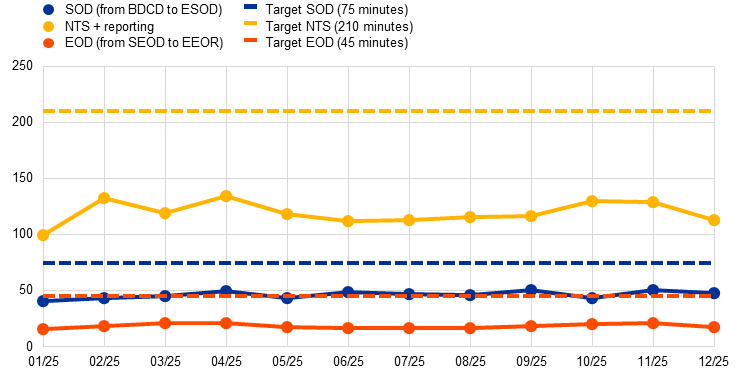
Source: T2S.
3.2.2 Incidents
In 2025 the T2S platform experienced four major incidents – defined as unplanned interruptions or reductions in the quality of an agreed service for which a Crisis Managers’ conference call was required. The Eurosystem actively follows up all incidents in T2S (including non-major incidents) with a detailed report, which serves as input to continuously improve the service and enhance the ability to prevent or mitigate such incidents in the future.
Chart 54 indicates that in 2025 the overall service level indicator for the availability of T2S, calculated as the weighted average of platform services, stood at 99.8% and exceeded the KPI target of 99.7%, except for February, when it stood at 98.7% as a result of the incident on the 27th. Additionally, incidents in May, September and November affected the DVP cut-off, the start of the NTS and/or the availability of the U2A component, resulting in minimal impact on the service level indicator.
Chart 54
T2S service level indicator in 2025
(percentages)
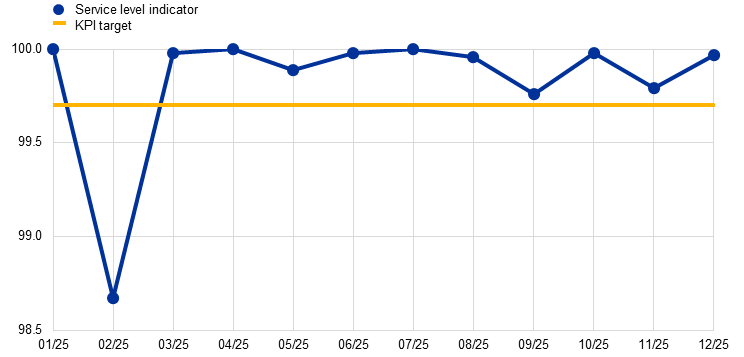
Source: T2S.
3.3 TIPS
3.3.1 Service level and availability
In 2025 the TIPS platform demonstrated its strength and dependability by maintaining a remarkable 99.99% technical availability over the entire year. This achievement is especially important due to the critical role TIPS plays in enabling settlement in real time for instant payments across the Eurosystem, where uninterrupted 24/7 availability is essential to meet the needs of end customers.
3.3.2 Incidents
In 2025 TIPS experienced six minor incidents with an impact on the settlement of instant payments (Chart 55), such as temporary increases in latency or brief interruptions in TIPS settlement. These were swiftly addressed by the platform’s advanced self-healing mechanism. In every instance, disruptions were resolved within a timeframe of between 16 seconds up to a maximum three minutes, ensuring minimal impact on a small number of instant payments and maintaining the platform’s commitment to seamless service.
Chart 55
Incidents in and availability of TIPS in 2025
(left-hand scale: number of incidents, monthly totals; right-hand scale: percentages)
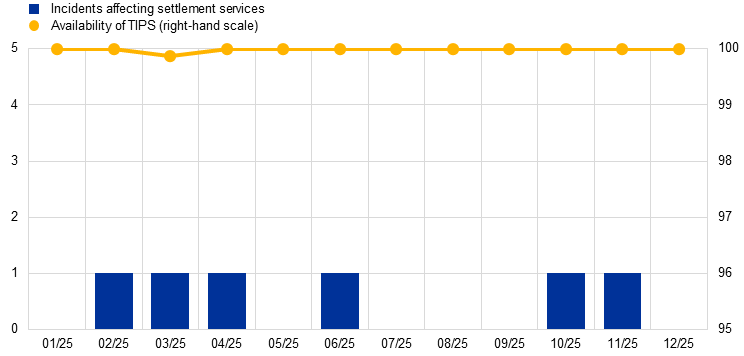
Source: TIPS.
TIPS also experienced a few minor incidents, such as issues with account statement distribution or temporary GUI availability, none of which impacted the TIPS settlement engine. Thanks to swift resolution measures, these events were quickly addressed, ensuring that TIPS’ core mission of delivering reliable settlement in real time remained completely unaffected.
TIPS also demonstrated excellent performance in terms of throughput, successfully processing a significantly increased transaction volume without compromising execution speed. The platform more than doubled its traffic for the second year in a row while still executing 99.99% of instant payments within five seconds, which was far above the target of 99%.
This combination of negligible interruptions in availability, high resilience and scalable performance reinforces TIPS’ position as a robust and reliable platform.
3.4 ECMS
3.4.1 Service level and availability
Since going live in production ECMS has maintained 99.96% availability during the critical operational hours from 07:00 CET to 19:30 CET. The system’s availability is continuously monitored based on specific business day events, with particular attention on the completion of the first NTP event. The NTP1 process, which includes collateral revaluation, credit line updates and the settlement and reimbursement of OMOs, is required to be finalised by 19:30 CET to ensure liquidity is available in CLM prior to the execution of standing orders.
Chart 56 illustrates the punctuality of sending credit line updates and the completion of the NTP1 process by the 19:30 CET deadline in 2025. On 19, 20, 25 and 27 November and 2 December the ECMS operational day experienced delays due to incidents on the T2 or T2S side. Despite these isolated disruptions, overall punctuality remained consistently high, underscoring the reliability and robust performance of ECMS.
Chart 56
Punctuality in ECMS in 2025
(time)

Source: ECMS.
3.4.2 Incidents
ECMS encountered a total of 53 incidents in 2025 (Chart 57). The most critical ones occurred on 21 and 22 October after the inter-regional rotation, during which multiple issues affected timely transmission of updated credit lines to T2, resulting in a decrease in availability to 99.8%. In addition to these critical events, ECMS also experienced a few minor incidents between launch and December, but they did not impact the management of collateral or the settlement of MPOs. These minor incidents were primarily linked to incorrect configurations identified in the initial few days after going live and challenges with data reporting to central banks.
Despite the big-bang migration approach and the system’s complexity, all incidents in ECMS were resolved promptly thanks to the readiness and collaboration of users and operational teams. The Eurosystem plays a vital role in actively monitoring incidents affecting multiple central banks, producing detailed reports that provide valuable insights for continuous improvement. These efforts contribute to enhancing the system’s resilience, improving preventative measures and mitigating similar incidents in future.
Chart 57
Incidents in and availability of ECMS in 2025
(left-hand scale: number of incidents, monthly totals; right-hand scale: percentages)
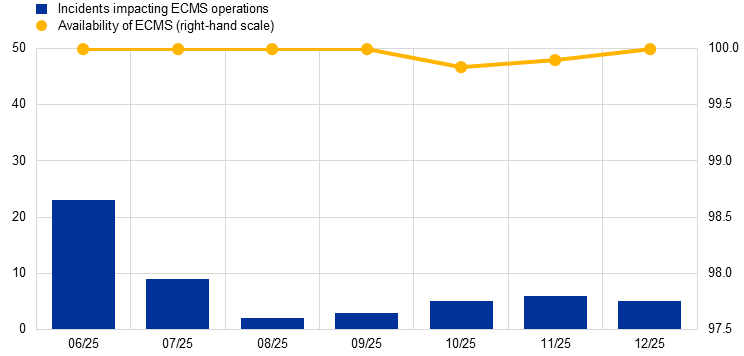
Source: ECMS.
Box 3
Follow-up to the TARGET incident on 27 February 2025
On 27 February 2025 a major hardware failure in the storage system caused disruptions across TARGET Services.[47] T2 and T2S were unavailable for around 10 and 8 hours respectively, while TIPS experienced partial disruptions for one hour due to the T2 outage. This led to the suspension of securities settlement instructions, payments, ancillary system settlements and liquidity transfers. Initially suspected to be a database malfunction, the issue was later identified simultaneous failure of a critical hardware component and its redundancy mechanism, a scenario deemed unprecedented by the vendor. Failover to the secondary site was delayed to allow precautionary checks, linked to the initial suspicion of a database malfunction, with services resuming after 18:00 CET and closing by midnight.
In addition to the TARGET Services operator replacing the malfunctioning hardware component immediately after the incident, the vendor issued updates to address the vulnerability, and enhanced monitoring mechanisms have since been implemented. Contingency measures in T2 supported critical payments, but the dual outage of T2 and T2S created challenges for collateral mobilisation, delaying some processes.
The ECB Executive Board tasked the Market Infrastructure Board with analysing the incident and developing a comprehensive action plan to prevent future occurrences. The post-mortem report outlines 20 actions addressing technical monitoring, business continuity, decision-making and communication. Some time-critical measures were implemented immediately, while the rest are set for completion at a later stage. Significant progress has been achieved, with most implemented by the fourth quarter of 2025. Only a few actions remain ongoing. These have been assessed as non-time-critical support measures, such as market consultations or discussions within technical groups focused on enhancing testing and related activities. Finally, the annual external audit of T2S will provide an external assessment of the appropriateness of the implemented measures and enhancements.
4 Financial performance
4.1 Cost recovery
T2S, TIPS and the RTGS component of T2 operate on a full cost‑recovery, non‑for‑profit basis, i.e. operational and investment costs are covered by fees. T2S and TIPS are broadly on track to recover all costs within their amortisation periods, although the need for fee adjustments may arise. ECMS and CLM are deemed necessary for the implementation of monetary policy and therefore no cost-recovery takes place.
For T2/RTGS, fees are set under the Eurosystem’s pricing policy to cover all related operational and investment costs. A degressive fee model is used to secure the volumes that will enable the attainment of full cost recovery, targeted by March 2033. In parallel, work is ongoing to review and update the T2/RTGS pricing framework to ensure continued alignment with cost recovery objectives. This revision is based on the findings of the two-year review period (March 2023–March 2025), as anticipated, and addresses the structural imbalance between transaction volumes and revenues under the current pricing framework. The updated pricing policy aims to rebalance contributions from high-volume participants, stabilise revenues, and address the revenue shortfall observed during the review period. Any changes to the pricing framework, including their timing, will be communicated separately in accordance with the applicable governance and publication arrangements.
For T2S, all incurred costs are also to be recovered by revenues under a full cost‑recovery model. The pricing structure is defined in Schedule 7 of the T2S Framework Agreement and in the TARGET Services Pricing Guide. Cost recovery depends on settled transaction volumes, applicable fees, the predefined cost‑recovery period and cost developments over time.
For TIPS, all costs must likewise be recovered by revenues, ensuring efficient and affordable instant payment settlement. The pricing structure is laid down in the TARGET Guideline and in the TARGET Services Pricing Guide, and was revised with effect from 1 January 2024.
4.2 Financial performance
4.2.1 T2
The structure of revenues that T2 collected in 2025 indicates that, on average, 78% were collected from variable fees, and the remainder from fixed ones (see Chart 58).

Overall, for 2025 T2 recorded a surplus of around €1.0 million (see Chart 59).
Chart 59
T2 financial performance (profit/loss)

Source: T2.
Notes: The chart shows figures since T2 go-live in March 2023. Financial performance is defined as system revenues minus yearly operational (running) costs since go-live. These costs comprise mainly operational costs, costs related to TARGET Services common components, cyber security, risk management and additional development costs in the operational phase. The surplus generated after covering the annual running costs is used to reduce liabilities towards the financing central banks, mainly related to pre-go-live development costs, interest expenses, and other liabilities associated to the national service desk at central bank level. Some additional costs may in the future be retroactively attributed to the years covered in the chart.
4.2.2 T2S
The overall financial position of T2S is detailed in the annual financial statements. For more information on the financial position, see the T2S financial statements for 2024.[48]
The increase in the settlement services portion of T2S revenues in recent years is driven by overall volume trends resulting in periods of increased transaction volumes.

Table 5 displays the share of T2S revenues per information and settlement tariff items.
Table 5
T2S revenue split between services tariff items (%)
Service category | Tariff Item | Billing date | ||||
|---|---|---|---|---|---|---|
2021 | 2022 | 2023 | 2024 | 2025 | ||
Information tariff items | A2A queries | 0.10 | 0.10 | 0.09 | 0.09 | 0.08 |
A2A reports | 3.07 | 3.33 | 3.40 | 3.88 | 3.79 | |
Messages bundled into file | 5.97 | 9.53 | 9.73 | 8.86 | 8.12 | |
Transmission | 10.12 | 4.76 | 4.67 | 4.65 | 4.86 | |
U2A queries | 0.15 | 0.55 | 0.46 | 0.14 | 0.15 | |
Total | 19.43 | 18.27 | 18.35 | 17.62 | 17.00 | |
Settlement tariff items | Account allocation | 0.10 | 0.11 | 0.10 | 0.52 | 0.47 |
Auto-collateralisation | 0.12 | 0.10 | 0.11 | 0.07 | 0.07 | |
Daytime settlement | 4.36 | 4.53 | 4.57 | 4.95 | 5.31 | |
Delivery versus payment | 51.90 | 53.19 | 53.04 | 52.75 | 54.63 | |
Fail on ISD | 6.55 | 5.88 | 5.70 | 4.23 | 5.18 | |
Free of payment | 9.85 | 10.04 | 10.17 | 11.22 | 11.91 | |
Internal liquidity transfer | 0.00 | 0.00 | 0.00 | 0.00 | 0.00 | |
Intra-balance movements | 0.00 | 0.00 | 0.00 | 0.00 | 0.11 | |
Intra-position movements | 0.19 | 0.18 | 0.18 | 0.24 | 0.25 | |
Matching | 6.36 | 6.30 | 6.37 | 6.82 | 3.49 | |
Payment free of delivery | 1.14 | 1.39 | 1.37 | 1.46 | 1.59 | |
Total | 80.57 | 81.72 | 81.63 | 82.38 | 83.00 | |
Grand total | 100.00 | 100.00 | 100.00 | 100.00 | 100.00 | |
Source: T2S.
4.2.3 TIPS
The TIPS pricing policy applicable as of 1 January 2024 was designed to support wide adoption across the euro area. The structure of the TIPS revenues is highlighted in Chart 61.
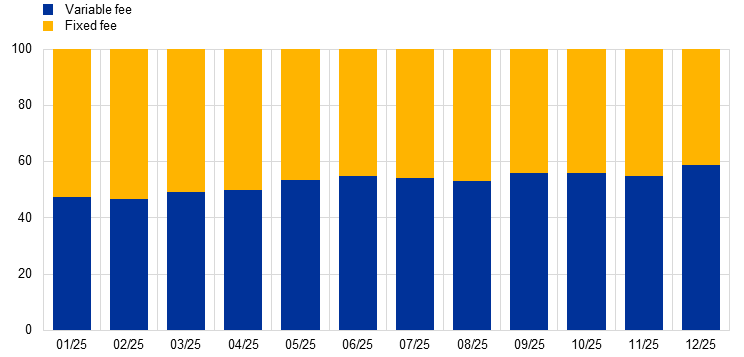
TIPS has been recording a net annual loss since its inception, reflecting the yearly Eurosystem investment to develop, improve and operate the service. In 2025, TIPS recorded a net annual loss of €1.8 million. The upward trajectory in financial performance indicates that the service is on track to achieve a net annual profit in the coming years.
Chart 62
TIPS financial performance (profit/loss)

Source: TIPS.
Notes: Financial performance is defined as system revenues minus yearly operational (running) costs since go-live. These costs comprise mainly operational costs, costs related to TARGET Services common components, cyber security, risk management and additional development costs in the operational phase. The surplus generated after covering the annual running costs is used to reduce liabilities towards the financing central banks, mainly related to pre-go-live development costs, interest expenses, and other liabilities associated to the national service desk at central bank level. Some additional costs may in the future be retroactively attributed to the years covered in the chart.
4.2.4 Data protection
TARGET Services also process limited personal data relating to system users, transaction participants and individuals referenced in transaction messages. These processing activities are carried out within an established data protection framework, in line with the applicable EU data protection rules and the principles of privacy by design and accountability, and are described in the ECB’s privacy statements.
5 TARGET Services evolution
5.1 General organisation of releases
The evolution of the TARGET Services infrastructure entails the deployment of new functionalities through predefined yearly releases. Release management is a structured process for assessing and prioritising change requests and production problems. This process ensures that all proposed changes to TARGET Services are properly assessed from functional, technical, legal, operational and cost/benefit perspectives before being considered for inclusion in a release. Users of TARGET Services are closely involved in this process.
Interdependencies with other TARGET Services and potential impacts on the common components are also taken into account. These include the Eurosystem Single Market Infrastructure Gateway (ESMIG), Common Reference Data Management (CRDM), Business Day Management (BDM), the billing component (BILL), the Data Warehouse (DWH) and Legal Archiving (LEA).
Each TARGET Service follows an annual release cycle consisting of two types of functional releases. For T2, T2S and ECMS, one major release is scheduled for June and one minor release for November. For TIPS, the major release takes place in November to align with updates to the SCT Inst Scheme rulebook of the EPC.
The content of the TARGET Services’ releases, including key milestones and related documentation, is published on the respective T2, T2S, TIPS and ECMS pages on the ECB’s website, alongside a list of change requests.
5.2 T2 releases
In 2025 the T2 service underwent two releases: one in June and one in November. Both included fixes for production problems as well as important changes relating to upgrades of T2 RTGS ISO 20022 payment messages to adhere to the most recent High Value Payments Systems Plus (HVPS+) market practice.
In addition, work progressed on the T2 adaptations for potential issuance of the digital euro. A related change request has been scoped for delivery with the T2 June 2027 release.
With the changes already allocated to the 2026 releases, enhancements are anticipated to maintain alignment of T2 RTGS ISO 20022 core payment messages with HVPS+ market practices and of remaining CLM/RTGS messages with ISO annual upgrade. In addition, functionalities are planned to support the dual connectivity of critical participants in the event of network service provider failure scenarios.
5.3 T2S releases
The major release in June 2025 introduced a broad range of functional enhancements, including new capabilities for cross-CSD settlement, focused on optimising the configuration of links between CSDs and increasing CSD interoperability. The release also introduced new tools designed to support the management of credit institutions’ liquidity needs for MPOs based on T2S cash transactional data.
Several other functional changes have been implemented specifically to enhance internal operational monitoring tools and billing processes, resulting in stronger authentication and more streamlined access rights management.
The subsequent minor release in November covered changes to allow improved processing of securities transactions via hold/ partial release controls on settlement instructions and enhanced partial settlement functionalities, fostering higher settlement efficiency rates in T2S. In addition, the release introduced a new mechanism enabling liquidity provision to central banks for specific scenarios at the end of the operational day, further strengthening their liquidity management toolkit.
Additional functional changes included new means for managing digital certificates, reinforcing authentication protocols, and enhancements to settlement day processes across T2S currencies, further consolidating the platform’s multi-currency capabilities.
Together, the 2025 releases supported key T2S business objectives, such as facilitating cross-CSD settlement, enhancing settlement efficiency, and optimising settlement and operational tools. They also advanced policy and harmonisation goals, including improved liquidity management and alignment of multi-currency settlement processes within the TARGET Services.
In parallel, the broader post‑trade landscape is preparing for the transition to a T+1 settlement cycle. In May 2024 the USA moved to T+1, reducing settlement from two business days to one. The European Commission has proposed a similar transition in Europe for 11 October 2027, following the European Securities and Markets Authority’s recommendation, to enhance the efficiency and competitiveness of post‑trade financial market services in the EU. To support the shorter cycle, T2S Governance raised two T2S change requests, one related to extending the night‑time settlement schedule and the other to facilitating management of liquidity for securities financing transactions. These changes are due to be implemented in T2S in June 2027, and T2S Governance will continue monitoring whether further adjustments are needed after T+1 goes live in October 2027. Looking ahead, T2S remains committed to responding to evolving market requirements. The Steering Level has endorsed an Evolution Roadmap for 2026-2028, defining strategic priorities and implementation timelines. Over the next three years key priorities will include supporting the transition to T+1 settlement, ensuring compliance with new CSD Regulation penalty exemptions, expanding CSD business and activities in T2S, developing end investor capabilities and qualifying enhanced cyber resilience tools.
Further enhancements will focus on improving cross-CSD settlement efficiency, annual upgrades of ISO messages, and aligning with evolving market practices and regulatory developments. In parallel, the Steering Level is exploring measures to strengthen end-to-end release management and streamline governance processes. As a cornerstone of EU financial market integration, T2S is well positioned to play a key role in advancing the savings and investment union agenda and promote greater efficiency and harmonisation in the post-trade landscape.
5.4 TIPS releases
In 2025 the TIPS service underwent two releases: one in June and another, exceptionally, in October. The shift of the major release from November to October followed the announcement that updates to all five 2025 EPC payment scheme rulebooks would take effect on Sunday, 5 October 2025. Since TIPS is based on the EPC’s SCT Inst scheme, its release schedule had to be aligned accordingly. The adjustment was also driven by the deadlines set by the IPR, which required certain changes to the existing schemes to be implemented by October 2025.
Both releases introduced several important enhancements. These included adapting TIPS to support the settlement of cross‑currency transactions in line with the G20 roadmap for improving cross‑border payments, upgrading the simulator to enable more comprehensive testing of TIPS production scenarios, and implementing broadcast functionality to ensure timely information sharing in cases of insolvency or the unavailability of a participant. Additional updates addressed discrepancies between the Nordic Payment Council’s Nordic Credit Transfer (NCT) Inst rulebook and the EPC SCT Inst rulebook affecting the Danish market, in preparation for Denmark’s participation in TIPS for Danish kroner.
With the changes already allocated to the 2026 releases, further enhancements are anticipated between TIPS and T2, particularly in liquidity management. Moreover, additional functionalities are planned to further strengthen the settlement of cross‑currency transactions. Beyond these developments, continuous improvement efforts will focus on aligning TIPS registered messages with the latest ISO versions of the underlying base messages and their associated usage guidelines.
Box 4
TIPS cross-currency settlement and interlinking
Improving cross-border payments by interlinking fast payment systems
A key goal of the Eurosystem’s comprehensive payments strategy is to make it easier for businesses and consumers in Europe to send and receive payments to and from abroad. More efficient cross-border payments would also help to enhance the international role of the euro.
Today, payments that cross EU borders can still be relatively slow, costly and complex, hindering trade, investment and remittances. To address these challenges, the ECB and the euro area national central banks continue to work towards improving speed, costs, transparency and accessibility of euro payments, making it attractive in the global payments’ ecosystem.
In particular, in October 2024 the Governing Council launched initiatives to improve cross-border and cross-currency payments within the EU and beyond, leveraging on TIPS.
These initiatives are supported by the baseline cross-currency capability implemented in TIPS in June 2025, which is based on the European Payments Council’s One-Leg Out (OLO) Instant Credit Transfer (OCT Inst) scheme and enables interactions between TIPS and fast payment systems based outside the euro area. There are two main areas of work.
Cross-currency settlement service in TIPS
The Eurosystem has implemented a cross-currency settlement service in TIPS in collaboration with Sveriges Riksbank and Danmarks Nationalbank, building on the exploratory technical work started in 2020.
This service is already available to all TIPS participants. It allows instant payments originating in one TIPS currency to be settled in another TIPS currency and in central bank money.
Initially, three currencies (the euro, the Swedish krona and the Danish krone) have been included. Other currencies that join TIPS at a later date would similarly benefit from cross-currency instant payments, subject to a decision by the relevant central bank.
The TIPS Consultative Group Cross-Currency Business Development Task Force was set up in 2025 to bring together market participants to ensure the service is implemented and adopted successfully, and to explore potential enhancements.
Interlinking TIPS with other fast payment systems
At the global level, the Eurosystem is looking at linking TIPS with other fast payment systems as a way to further improve interoperability, reduce costs and increase the speed and transparency of cross-border payments, including remittances.
Interlinking helps prevent fragmentation in the global payments landscape and supports a more efficient and competitive cross-border payments architecture by leveraging existing domestic infrastructures. Moreover, it contributes to safeguarding monetary sovereignty by mitigating the risk of currency substitution and limiting excessive dependence on a small number of global PSPs.
Progress was made in November 2025 when the Governing Council decided to further advance the ongoing initiatives to interlink the Eurosystem’s TIPS service with other fast payment systems globally. The decision follows the positive findings of the exploratory work initiated in October 2024 to connect TIPS with India’s Unified Payments Interface (UPI) and Nexus Global Payments. More specifically, the Governing Council decided to start the realisation phase for interlinking TIPS with UPI while in parallel completing the legal arrangements and technical implementation, and to continue exploring the feasibility of a potential connection to Nexus Global Payments while in parallel completing the necessary legal arrangements and agreements.
In September 2025 the Governing Council approved the initiation of an exploratory phase to evaluate the potential establishment of a bilateral link between the Eurosystem’s TIPS service and the Swiss Interbank Clearing Instant Payments (SIC IP) system. This will involve assessing the technical, legal and economic feasibility of the project, and will be conducted in collaboration with the Swiss National Bank over the course of 2026.
Challenges and areas of focus
Interlinking fast payments systems is demanding and requires the involvement of multiple stakeholders across several jurisdictions. Technical challenges arise from differences in payment standards and system designs. Other key challenges include establishing appropriate governance and oversight frameworks and ensuring compliance with anti-money laundering and countering the financing of terrorism (AML/CFT) requirements. Legal complexities such as differences in regulatory frameworks and the need to ensure settlement finality must also be addressed.
The Eurosystem continues to analyse these benefits and challenges as an integral part of its exploratory and implementation work.
Box 5
Onboarding activities – integrating further currencies into TARGET Services
In April 2025 the Danish krone became available as a settlement currency in T2 and TIPS. The successful migration was the result of a long journey that started in December 2020, when Danmarks Nationalbank signed the letter of intent to join T2 and TIPS TARGET Services; the Currency Participation Agreement (CPA) between Danmarks Nationalbank and the Eurosystem was signed in March 2024.
The onboarding of Danmarks Nationalbank marked a significant milestone in the evolution of the TARGET Services and for the Eurosystem, representing the transition of T2 from a mono-currency service to a multi-currency one and the adoption of a third currency in TIPS.
The Swedish krona was the first non-euro currency to join TIPS in February 2024. Since its integration, close to two billion transactions[49] in Swedish kronor have been settled on the platform.
Sveriges Riksbank is currently conducting a feasibility assessment to investigate the possibility of the Swedish krona joining T2; onboarding is currently envisaged for 2030. Sveriges Riksbank has also reaffirmed its intention of joining T2S; the Swedish central securities depository, Euroclear Sweden, submitted a letter of intent to do so in September 2025.
Norges Bank signed a CPA with the Eurosystem in November 2024 and is now actively planning the migration of the Norwegian krone into TIPS, tentatively scheduled for the second half of 2028.
Following a letter of intent signed in April 2024, Seðlabanki Íslands is advancing in its feasibility assessment phase to investigate possibly onboarding the Icelandic króna into TIPS. Seðlabanki Íslands aims to sign the TIPS CPA in the first half of 2026, and to onboard the Icelandic market in 2028. The letter of intent also expressed the formal intention of Seðlabanki Íslands to explore the possibility of its currency joining T2.
For the Eurosystem, onboarding non-euro currencies brings numerous advantages in terms of enhancing the financial integration capabilities of TARGET Services. TARGET Services adopt the latest harmonisation standards, both in Europe and globally, while at the same time providing safe and efficient FMI services in central bank money. These are important elements supporting European financial integration and the capital markets union. Moreover, directly connecting other currencies with the euro enhances the single currency’s international role. Beyond the mutual non-financial benefits for all institutions involved, integrating non-euro currencies adds value in terms of increased transaction volumes and cost-sharing opportunities, such as sharing the development costs of the core payment infrastructure, including costs related to cyber security and resilience measures.
5.5 ECMS releases
In July 2025 the ECMS had an additional release, after its successful go-live, to resolve critical defects discovered shortly before go-live and during the first few weeks of operations.
The ECMS had its first normal release in November 2025. This included fixes for production problems and release defects, as well as eight change requests related to the regular ISO update for meeting announcement and corporate action messages, an important policy change on the risk control framework, and several operational change requests to improve the efficiency of national central banks, amongst other things.
There will also be two ECMS releases in 2026. The functional releases in June and November will include 23 change requests implementing multiple policy and operational changes, as well as changes in line with the TARGET Services ISO unfreeze strategy and fixes for production problems.
© European Central Bank, 2026
Postal address 60640 Frankfurt am Main, Germany
Telephone +49 69 1344 0
Website www.ecb.europa.eu
All rights reserved. Reproduction for educational and non-commercial purposes is permitted provided that the source is acknowledged.
For specific terminology please refer to the ECB glossary (available in English only).
PDF ISBN 978-92-899-7921-4, ISSN 3094-5437, doi:10.2866/2752075, QB-01-26-164-EN-N
HTML ISBN 978-92-899-7920-7, ISSN 3094-5437, doi:10.2866/4410487, QB-01-26-164-EN-Q
In the case of T2S, statistics by currency are not available. Statistics throughout the report sum up activity in euro and in Danish krone. Danish krone values are converted into euro at an exchange rate of DKK 1 = EUR 0.134.
Regulation (EU) 2024/886 of the European Parliament and of the Council of 13 March 2024 amending Regulations (EU) No 260/2012 and (EU) 2021/1230 and Directives 98/26/EC and (EU) 2015/2366 as regards instant credit transfers in euro (OJ L, 2024/886, 19.3.2024).
Nominal GDP of the euro area (20 countries) stood at €15.2 trillion in 2024 and €15.8 trillion in 2025, as reported by Eurostat.
Settlement efficiency measures the volume (or value) of transactions that are settled on a given day relative to the total volume (or value) of transactions eligible for settlement on that day. The level shift recorded in 2020 can be attributed to the introduction of the new T2S statistical framework (see Box 1 “Changes in the T2S statistical framework” in the T2S Annual Report 2019).
The decline was mainly a consequence of the technical changes brought about by the T2-T2S consolidation project going live.
Access to intraday credit is subject to specific criteria set out in the TARGET Guideline.
Ideally, the value and volume distribution should be as linear as possible, to avoid liquidity risk and operational risk.
Pontes is the Eurosystem’s future distributed ledger technology (DLT) solution that links market DLT platforms and TARGET Services to settle transactions in central bank money. See the ECB website for more information.
See the ECB website for details.
See Outcome of the public consultation on the extension of T2 operating hours.
When analysing these data, it should be borne in mind that whether a payment is sent or received by a given banking community may depend more on a bank’s internal organisation than its actual geographical domicile. For example, a subsidiary of a French bank located in Italy may send payments to another bank also located in Italy via its headquarters in France. In this case, the payment flow will be cross-border in T2, even though the payment takes place between two entities located in the same country. By contrast, banks located in EEA countries whose central banks do not provide direct access to T2, such as the Czech Republic and Sweden, may participate in T2 component systems provided by central banks in other countries. For example, if a Swedish bank participating in T2-Bank of Finland sends payments to banks in Finland that also participate in T2-Bank of Finland, the payment flow would be considered domestic, even though it is taking place between entities located in different countries.
For more detail, see Chapter 1.12 of the TARGET Annual Report 2023.
Regulation (EU) 2025/1355 of the European Central Bank of 2 July 2025 on oversight requirements for systemically important payment systems (ECB/2025/22) (recast) (OJ L, 14.7.2025).
For more detail, see Box 5 of the TARGET Annual Report 2023.
DVP is commonly used for transactions where securities, such as equities or debt, are exchanged for cash. FOP is applied when no cash payment is involved or when the payment is processed separately (e.g. for securities conversions or portfolio transfers). PFOD occurs when no securities delivery is involved (e.g. in dividend payments). DWP is used in similar cases to DVP, but allows the cash and securities legs to be processed in separate steps or different systems (e.g. T2 and T2S). SRSE is a mechanism that allows the earmarking of securities in T2S to prevent them from being used for settlement.
Settlement efficiency in T2S measures the value (or volume) of transactions that are settled on a given day relative to the total value (or volume) of transactions eligible for settlement on that day. Eligible transactions may fail to settle for several reasons, for example due to lack of cash, lack of securities or because they are put on hold by the participants. The settlement efficiency indicator provides an indication of the efficiency of T2S and the behaviour of participants on the platform. Although it can be measured at different points in time, the T2S operator typically looks at its levels at the end of the NTS and at the end of the day.
Access to auto-collateralisation by participants is subject to criteria set out in the TARGET Guideline.
The NTS works in sequences and admits only a pre-defined set of transactions or instruction types to settlement.
Late matching occurs when transactions are matched either after their cut-off on the ISD has been reached or after their ISD.
This was calculated as the total value of cash penalties over the total number of cash penalties.
Externally matched settlement instructions are typically submitted to T2S when the two counterparties to a transaction are participants in the same CSD. This reduces the risk of mismatches and settlement delays and supports smoother processing overall. By contrast, internally matched settlement instructions are more common in scenarios where the two counterparties submit instructions to T2S separately, for instance when they are participants in two different CSDs or one of them is a market participant directly connected to T2S.
These categories can include cross-border settlement, depending on the individual set-up of the CSDs.
While statistical reporting for T2 and T2S is based on business days, statistical reporting for TIPS is based on calendar days. As TIPS is open for settlement on a 24/7/365 basis, payments are also processed at weekends and on public holidays. Reporting based on business days would result in inflated figures on Mondays and the first business day after a holiday. However, this effect is eliminated when considering calendar days.
The growth rates calculated using the total number of transactions differ slightly from growth rates calculated using the daily average number of transactions due to the different number of calendar days in 2024 (366) compared with 2025 (365).
Until 9 October 2025 the default limit set at scheme level was €100,000. Banks can apply custom value limits for their clients.
This was confirmed at the AMI-Pay meeting of 5 May 2026, where participants reported an increased use of instant payments by corporate clients for transferring large amounts following the removal of the transaction limit brought about by the Instant Payments Regulation. Participants also reported that, in general, corporates were reported to value the lower fees applicable to instant payments as well as the more flexible cut-offs compared with large-value payment systems.
ECMS converts counterparties’ instructions to mobilise and demobilise marketable assets into settlement instructions which are sent to and settled in T2S.
To ensure no messages are blocked between CLM, T2S and ECMS, the cut-off for incoming messages is set to 15 minutes before the DTP ends, and the end of day starts at 17:45 CET. For receipt of credit claim files, the cut-off is set to 17:30 CET. Additional cut-offs may apply for specific tasks, such as accessing the marginal lending facility on the last day of a reserve maintenance period.
A new policy will enter into force on 17 June 2026: excess liquidity held in the MCA as well as in the RTGS, T2S and TIPS DCAs overnight is automatically remunerated at the deposit facility rate, based on the average daily excess reserves held by each eligible MPO counterparty during the maintenance period. Eligible MPO counterparties will have the option to either continue transferring excess liquidity to the deposit facility daily or make use of the new automated remuneration or use both. See the Decisions taken by the Governing Council of the ECB (in addition to decisions setting interest rates), January-February 2026 published on 27 February 2026.
For most non-monetary policy deposits held with the Eurosystem a remuneration rate set at €STR minus 20 basis points applies. See ECB press release of 17 April 2024.
See Section 2.2.3 of this report.
Liquidity left on TIPS DCAs at the end of the day counts towards fulfilling the MRR. In 2025 participants had to transfer funds exceeding the MRR to the deposit facility before 18:15 CET (18:30 CET on the last day of the reserve maintenance period) to benefit from overnight remuneration of reserves. At the start of the next business day excess liquidity was returned to participants, who could then transfer it to their RTGS, T2S and TIPS DCAs. However, since 17 June 2026 excess liquidity held in MCAs as well as in RTGS, T2S and TIPS DCAs overnight has been automatically remunerated at the deposit facility rate (see section 2.2.5).
See the Decisions taken by the Governing Council of the ECB (in addition to decisions setting interest rates), January-February 2026 published on 27 February 2026.
For a full overview of the stages of implementation of the IPR, refer to Table 1 here.
See the MIP News article “Eurosystem sets policy on access by non-bank payment service providers to its central bank payment systems”.
See the Eurosystem’s Policy on the use of prefunding by ancillary systems.
Participation criteria are defined in the Guideline (EU) 2022/912 of the European Central Bank of 24 February 2022 on a new-generation Trans-European Automated Real-time Gross Settlement Express Transfer system (TARGET).
Decision (EU) 2025/1148 of the European Central Bank of 2 June 2025 amending Decision (EU) 2025/222 of the European Central Bank of 27 January 2025 on access by non-bank payment service providers to Eurosystem central bank operated payment systems and central bank accounts (ECB/2025/2) (OJ L 2025/222, 6.2.2025).
This figure represents the number of direct participants with at least one account in the T2 RTGS service. Direct participants may have more than one account, which is why the figure is lower than the number of RTGS accounts shown in Table 2.
As far as euro-denominated instant payments are concerned, participation in TIPS, either directly or indirectly, is mandatory for PSPs which have signed up to the SEPA Instant Credit Transfer (SCT Inst) scheme of the European Payments Council (EPC) and are also reachable via T2.
The slight increase observed in 2025 compared with 2024, when the share stood at 0.1%, can be attributed to the impact of the TARGET incident on 27 February 2025.
The figure for requests and queries covers messages received by the RTGS service in both user-to-application (U2A) and application-to-application (A2A) modes.
Payment processing times are measured for all payments processed in the RTGS service with the exception of (i) ancillary system settlement transactions using the ancillary system settlement procedures and (ii) liquidity transfer orders.
The volume settled on 30 June 2025 mentioned in section 3.2.1 differs due to the use of distinct methodologies for reporting statistical developments and operational performance.
Technical availability is measured on TARGET business days during RTGS RTS II including end-of-day processing), which runs from Monday to Friday between 02:30 CET and 18:45 CET (and until 19:00 CET on the last day of the minimum reserve period). Any extensions to this period required to complete the operational day, such as delays due to technical issues in T2 or T2S (which can impact T2) or major problems in ancillary system settlements in T2, are also included. The availability measurement excludes systems or networks not directly managed by T2, particularly the services of network service providers. Incidents occurring during RTGS RTS I are not included.
See the Post-mortem Report of the TARGET Services incident of 27 February 2025.
The T2S financial statements for 2025 will be made public in the second or third quarter of 2026. After publication, the T2S Annual Report will be updated to include a link to these.
As at 31 December 2025