





Published as part of the ECB Economic Bulletin, Issue 3/2026.
The January 2026 release of the HICP introduced a major change in how consumer products are classified. The HICP, which the European Central Bank (ECB) uses as its principal measure of inflation in the euro area, serves as a yardstick for assessing price stability, the ECB’s primary monetary policy objective. A key feature of the HICP is the availability of detailed price indices by product – with products classified according to their consumption purpose – and predefined aggregate indices, for example, for food (unprocessed and processed), energy, non-energy industrial goods and services. The HICP classification is based on the Classification of Individual Consumption according to Purpose (COICOP), which was introduced in 1999 and later refined at the European level as European COICOP (ECOICOP).[1] A comprehensive update has been made to the HICP as of January 2026, aligning the European classification with the international COICOP 2018 standard to establish ECOICOP version 2. In addition, the index reference year for the HICP has changed from 2015 = 100 to 2025 = 100. The euro area aggregate has also been extended to include Bulgaria, following its entry into the euro area on 1 January 2026.[2]
One major objective of reclassifying HICP items was to achieve a clearer separation between goods and services. The HICP’s new classification allows for finer delineation of services, some of which had previously been included in goods. For example, whereas delivery fees were previously included in the total price of delivered goods, they are now classified separately as a service. Separately invoiced delivery fees for goods are allocated to “Delivery of goods”.[3] There is also a “Courier and parcel delivery services” category for online purchases delivered by a standalone courier or parcel delivery company.[4] Repair, maintenance, rental and installation services are now listed separately, and IT hardware and software have moved from “Recreation and culture” to “Information and communication”. Insurance and financial services have been separated from other personal services. The new HICP classification has also been further aligned with international standards, with games of chance (such as lotteries, betting and gaming) being included as a new item.[5]
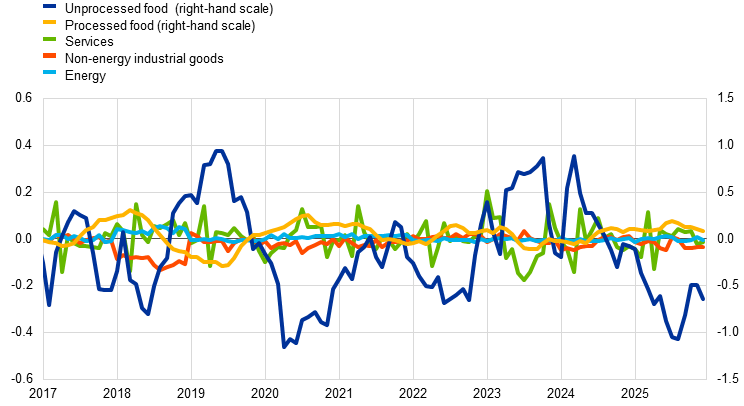
The new classification has not affected headline inflation or led to major changes in HICP main aggregates. While, in principle, recalculations using ECOICOP version 2 would have led to adjustments in total inflation rates, European statisticians left headline HICP inflation rates unchanged.[6] Some minor differences (up to 0.1 percentage points) materialised in the annual rates of change of the all-items HICP for the euro area. However, these differences only reflect the impact of rounding, which was applied in the process of updating the index reference year from 2015 to 2025.[7] At the level of sub-components, the recalculation of historical data using the new classification led to some changes in price indices and weights, with the largest impact being seen in aggregates of food items. In the food category, some chilled and frozen food is now classified as unprocessed rather than processed. As a result, unprocessed food inflation based on the new classification is slightly less volatile (Chart A, panel a). The maximum absolute revision in monthly year-on-year rates amounts to around 1.2 percentage points for unprocessed food and 0.3 percentage points for processed food. For the other main components (energy, non-energy industrial goods and services), the maximum absolute revision ranges between as little as 0.1 and 0.2 percentage points (Chart A, panel b).
Chart A
ECOICOP version 1 versus ECOICOP version 2: revisions by main HICP components
a) Annual rates of change in HICP food under ECOICOP version 1 and ECOICOP version 2
(percentages)

b) Revisions in HICP annual rates of change under ECOICOP version 2, by HICP component
(percentage points)
 |
|---|
Sources: Eurostat and ECB calculations.
Notes: Panel a): solid lines refer to ECOICOP version 2; dashed lines refer to ECOICOP version 1. Panels a) and b): the latest observations are for December 2025.
The changes in the HICP classification have also affected measures of underlying inflation, triggering small revisions to permanent and temporary exclusion-based indicators while leaving their overall dynamics broadly unchanged. The range of underlying inflation indicators monitored by the ECB includes permanent and temporary exclusion-based indicators as well as model-based ones.[8] Overall, the recalculation using the new classification has had only minor effects on permanent and temporary exclusion-based indicators. For example, historical data for HICP excluding energy and food (HICPX), HICP excluding energy, food, air travel-related items, clothing and footwear (HICPXX) and trimmed-mean indicators have changed very little.[9] For these indicators, the maximum absolute revision is around 0.2 percentage points for monthly year-on-year growth rates. By contrast, the weighted median exhibits somewhat larger revisions, reaching up to 0.4 percentage points in some months. The resulting range of exclusion-based underlying inflation measures is barely affected by a recalculation of historical data (Chart B, panel a).
Chart B
Underlying inflation indicators
a) Range of exclusion-based measures
(annual percentage change)

b) Persistent and Common Component of Inflation (PCCI), Supercore and domestic inflation
(annual percentage change)

Sources: Eurostat and ECB calculations.
Notes: The range of exclusion-based measures covers the following underlying inflation measures: HICP excluding energy and food, HICP excluding energy, HICP excluding energy and unprocessed food, HICP excluding energy, food, air travel-related items, clothing and footwear, trimmed means (10% and 30%) and the weighted median. Panel b): solid lines refer to ECOICOP version 2; dashed lines refer to ECOICOP version 1. The latest observations are for December 2025 for ECOICOP version 1 and March 2026 for ECOICOP version 2.
The PCCI and domestic inflation have shown little change in light of the new classification, while the larger revisions in Supercore mainly reflect an adjustment in the underlying methodology (Chart B, panel b). The PCCI captures the common and persistent components across the ECOICOP four-digit classes of HICP items from 12 euro area countries.[10] It has not been significantly affected by the introduction of ECOICOP version 2, despite now being based on a larger set of components. Domestic inflation captures HICPX items with a low import content. In addition to the reclassification, this indicator has also been updated using more recent information on import shares. Together, the two updates result in a different threshold for inclusion, but the indicator has been revised only moderately for the past few years. By contrast, Supercore – a proxy for cyclical inflation – has been revised to a larger degree. While part of the change in the indicator can be attributed to the switch to ECOICOP version 2, the largest impact stems from an adjustment in the estimation method itself, which has been implemented alongside the change in classification.[11] Previously, cyclical items were identified using the output gap in a forecast-based framework.[12] In the revised approach, cyclical items are identified based on the sign and statistical significance of the coefficient on the business cycle stance in Phillips curve regressions, estimated using the unemployment gap in the sample period preceding the COVID-19 pandemic. These estimates are based on ECOICOP version 2 HICPX items. While the overall dynamics have not changed significantly (for example, the two versions peaked at the same time), the updated and reassessed Supercore measure shows somewhat higher peaks during periods of tight labour markets compared with the previous version.
Overall, the introduction of ECOICOP version 2 is beneficial for inflation monitoring and forecasting. The enhanced HICP provides a more accurate representation of consumer price developments, reflecting more recent changes in consumption patterns and market structures. By providing a clearer separation between goods and services, the new classification allows drivers of inflation to be identified more easily and captures consumption expenditure shares more accurately, for example in the case of delivery fees and games of chance. Most underlying inflation measures have been only marginally affected by the classification changes, and their overall dynamics remain broadly unchanged.
References
Bańbura, M. and Bobeica, E. (2020), “PCCI – a data-rich measure of underlying inflation in the euro area”, Statistics Paper Series, No 38, ECB, October.
Bańbura, M., Bobeica, E., Bodnár, K., Fagandini, B., Healy, P. and Paredes, J. (2023), “Underlying inflation measures: an analytical guide for the euro area”, Economic Bulletin, Issue 5, ECB.
Bodnár, K., Höynck, C., Fagandini, B., Healy, P. and Rousseau, F. (2026), “Domestic and cyclical inflation in the euro area”, Statistics Paper Series, ECB, forthcoming.
European Central Bank (ECB) (2025), “An overview of the ECB’s monetary policy strategy - 2025”, ECB, June.
Eurostat (2026), “Questions & Answers on the improvements in the Harmonised Index of Consumer Prices (HICP) effective January 2026”, Luxembourg, 25 February 2026.
O’Brien, D. (2018), “The Supercore measure of underlying inflation”, Economic Bulletin, Issue 4, ECB.
The United Nations classification by consumption purpose, which was first established in HICPs in 1999 and updated in 2018, is the worldwide reference for classifying private consumption. See Eurostat (2026) for more information on the classification changes.
The weight of Bulgaria in the euro area HICP is around 0.9% in 2026. The inclusion of Bulgaria in the euro area all-items HICP has therefore not had a significant impact.
The weight of the “Delivery of goods” category in the euro area HICP is around 0.15% in 2026.
The weight of the “Courier and parcel delivery services” category in the euro area HICP is around 0.7% in 2026.
See Commission Delegated Regulation (EU) 2024/3159 of 2 September 2024 amending Regulation (EU) 2016/792 of the European Parliament and of the Council on harmonised indices of consumer prices and the house price index as regards the classification of consumption and the inclusion of games of chance. Games of chance have a weight of around 1% in the euro area HICP in 2026, with a range of 0.01% (Ireland) to 3.12% (Cyprus) across euro area countries. According to the preliminary assessment based on HICP data for January to March 2026, the impact of games of chance on HICP services is negligible. Owner-occupied housing (OOH) has not yet been included in the new HICP classification. European statisticians are working on various approaches to the treatment of OOH in consumer price indices. See ECB (2025).
Any differences implied by the bottom-up aggregation under ECOICOP version 2 were distributed across components, in order to keep the overall HICP inflation rate unchanged.
While overall HICP inflation rates were unaffected by the back-calculation according to the new classification, the change in base year from 2015 to 2025 in conjunction with HICP rounding rules resulted in some small changes in historical all-items HICP data. Some minor corrections may still be made to the historical series during the course of 2026.
See Bańbura et al. (2023).
Comparison of indicators from 2001 up to the latest available data point.
See Bańbura and Bobeica (2020).
The revised methodology for domestic inflation and Supercore will be published soon (Bodnár et al., 2026). The previous domestic inflation indicator included 29 items out of 94 HICP items, whereas the updated indicator includes 53 items out of 118 HICPX items. It is also based on a constant composition, in contrast with the previous approach, where the composition could change from year to year if import shares changed. In the case of Supercore, while the previous approach identified 47 cyclical items out of 72 HICPX items at the COICOP four-digit level, the revised approach identifies 29 cyclical items out of 118 HICPX items. Since ECOICOP version 2 introduces a more detailed classification of HICP items and changes the dynamics of some time series, a simple comparison of the cyclical items using the old and new classifications would not be meaningful.
See O’Brien (2018).