


- SPEECH
Presentation of the ECB Annual Report 2025 to the Committee on Economic and Monetary Affairs of the European Parliament
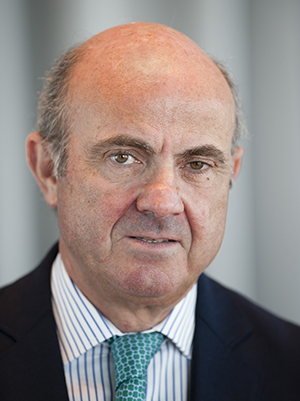
Introductory remarks by Luis de Guindos, Vice-President of the ECB, at the ECON Committee of the European Parliament
Brussels, 4 May 2026
It is a privilege to present the ECB’s Annual Report for 2025 to this Committee. As you may know, it is the last time I will do so, as my eight-year mandate as Vice-President comes to an end later this month. That makes today’s exchange particularly meaningful for me.
Alongside the Annual Report, we are publishing our formal response to the European Parliament’s resolution on last year’s report. These two documents are at the heart of the ECB’s accountability to the Parliament and our ongoing dialogue.
I will start my remarks by reviewing economic and monetary policy developments during the year before discussing our broader activities and efforts to strengthen the Economic and Monetary Union.
The euro area economy in 2025 from an ECB perspective
The euro area economy experienced a moderate and broad-based recovery in 2025, despite a challenging global environment. Growth picked up to 1.4% for the year, underlining the resilience of the euro area economy.
Growth was partly boosted by strong exports in the first quarter, reflecting frontloading ahead of anticipated higher US tariffs. As that momentum faded, growth was sustained by domestic demand, which helped counter external headwinds in an environment of elevated uncertainty. A robust labour market, moderating inflation and the effects of our interest rate cuts also supported the recovery.
The disinflation process continued broadly on track in 2025, with euro area inflation averaging 2.1%, close to the ECB’s medium-term target of 2.0%. The progress made on inflation and a favourable inflation outlook allowed the Governing Council to reduce the deposit facility rate further, by 100 basis points, to 2.0% by mid-2025, where it has remained since. The gradual normalisation of the Eurosystem balance sheet, which began in 2022, also continued.
In 2025 we also concluded the assessment of the ECB’s monetary policy strategy. It reaffirmed the symmetric 2% medium-term inflation target and recognised the importance of an appropriately forceful or persistent response to large, sustained deviations from the inflation target in either direction. The assessment also underlined how important it is for our monetary policy deliberations to consider not only the most likely path for inflation and growth, but also the surrounding risks and uncertainty – for example by actively using scenarios.
The ECB remains focused on its mandate of price stability. The current economic situation is highly uncertain in light of the war in the Middle East, and energy markets remain volatile. The Governing Council, which continues to follow a data-dependent, meeting-by-meeting approach, decided to keep interest rates unchanged at its latest meeting last week. We will monitor developments carefully to deliver on our mandate.
The ECB’s broader contribution in 2025 – progress, growth and resilience
Beyond monetary policy, 2025 was also a year of important progress in strengthening the Economic and Monetary Union. Let me highlight three areas where the ECB made a meaningful contribution.
First, the ECB continued work on the payments and market infrastructures of the future. The ECB advanced to the next phase of the digital euro project. This phase focuses on technical readiness, market engagement and the legislative process and aims to ensure the ECB is prepared for a pilot exercise in 2027 and a potential first issuance in 2029.[1]
Work also advanced on a modern cash framework and a new series of euro banknotes, reaffirming the ECB’s commitment to cash as a safe and inclusive payment method.
In parallel, the ECB continued to work on a strategy to enable a tokenised European financial ecosystem. It consists of two initiatives: Appia, which is exploring how to create the necessary architecture, and Pontes, which aims to enable the settlement in central bank money of wholesale financial transactions based on distributed ledger technology. This strategy supports efficiency and innovation, strengthens the EU’s strategic autonomy, and creates an opportunity to design integrated market infrastructures from the ground up. This provides strong foundations for deeper financial integration in Europe.
Second, a robust regulatory framework and the savings and investments union. Both are crucial for ensuring financial stability and channelling capital to productive investment, which supports the smooth transmission of monetary policy. The ECB’s contributions included opinions, analytical work, policy advice and technical input – most notably on the European Commission’s proposals on the savings and investments union. Looking ahead, it will be important to remain ambitious, particularly on the Market Integration and Supervision package, and pursue the completion of the banking union.
Third, the simplification of the regulatory and reporting framework. I had the honour to participate in the Governing Council’s High-Level Task Force on Simplification, which proposed streamlining the European prudential regulatory, supervisory and reporting frameworks for banks, noting that simplification efforts should preserve the current level of resilience. These conclusions served as input to the Commission’s forthcoming report on the competitiveness of the banking sector.
All these contributions show that the ECB is moving forward with purpose, building a strong, secure and prosperous economy for Europe.
Conclusion
Allow me to conclude. Since the start of my mandate in 2018, the euro area has experienced major progress – as well as significant challenges.
Through all of this, two main things have struck me.
First is the resilience of our Economic and Monetary Union: the euro has remained strong and attractive, as evidenced by Bulgaria joining the euro area this year and by public support for the single currency reaching record levels.[2]
Second is the importance of the relationship between the ECB and the European Parliament – where independence is matched by accountability. I am confident that my successor, Boris Vujčić, will continue to cultivate this important relationship.
You can rest assured that, whatever the future may bring, the ECB will remain firmly committed to its mandate of price and financial stability – a foundation of Europe’s prosperity and strength.
I now look forward to your questions.
We aim to be ready for a potential first issuance of the digital euro during 2029, assuming the necessary regulation on the establishment of the digital euro is adopted in the course of 2026.
See Dreher, F. et al. (2025), “Hitting record highs: unpacking support for the euro”, Economic Bulletin, Issue 7, ECB.
Banco Central Europeo
Dirección General de Comunicación
- Sonnemannstrasse 20
- 60314 Frankfurt am Main, Alemania
- +49 69 1344 7455
- media@ecb.europa.eu
Se permite la reproducción, siempre que se cite la fuente.
Contactos de prensa