






Global safe assets and their convenience yields
Published as part of the The international role of the euro, June 2026.
A safe asset is a financial instrument with negligible default risk that is highly liquid, maintains a stable value and is widely trusted by investors.[1] It is often compared to a “good friend” on whom one can count when needed: it remains highly liquid and tends to hold its value even during systemic crises, making it a reliable store of value and source of collateral.[2] In the international financial system, global safe assets primarily consist of highly rated sovereign debt securities. Central banks invest a significant portion of their foreign exchange reserves in these securities.
Safe assets provide benefits to issuers by reducing borrowing costs, while investors value their liquidity and capital-preservation features, and are therefore willing to pay a higher price. US Treasuries, widely regarded as the global safe asset benchmark, command a convenience yield, that is, the additional, non-pecuniary benefit an asset holder gains from their safety, liquidity, use as collateral and denomination in US dollars. Put differently, investors accept lower yields than they might otherwise demand, enabling the US government to borrow at reduced costs.
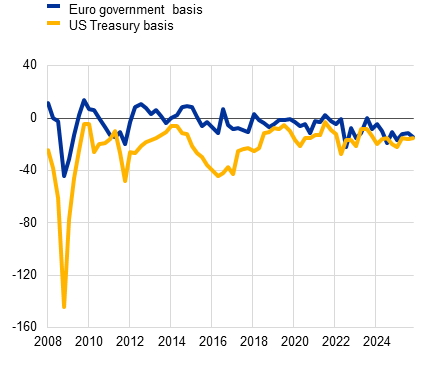
A key measure of foreign demand for a country’s safe asset is the government basis.[3] It is defined as the difference between the yield on a government security (for example, the US Treasury) and a synthetic (US dollar) yield constructed from a basket of foreign government securities hedged against exchange rate risk.[4] A negative basis indicates that US Treasuries trade at a premium (that is, at a lower yield) relative to their currency-hedged foreign counterparts. Historically, the US Treasury basis has been more negative than the euro government basis, where German government bonds are used as the euro area safe asset benchmark, as is standard in the literature.[5] The more negative US Treasury basis suggests stronger foreign demand and convenience benefits for US Treasuries relative to the government bonds of other G10 currency issuers. In recent years, the gap between the US Treasury basis and the euro government basis constructed from German government bonds has narrowed (Chart A, panel a).[6]
Chart A
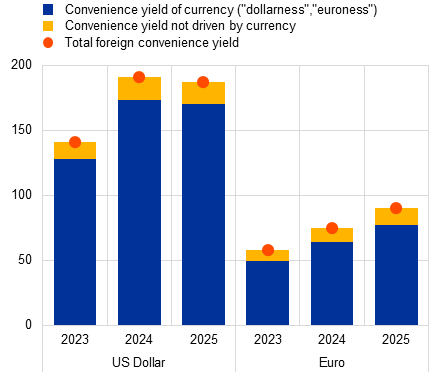
Government bases and foreign convenience yields of US dollar and euro safe assets
a) US Treasury and euro (German government) bases | b) Foreign convenience yield of euro (German government) and dollar safe assets |
|---|---|
(basis points) | (basis points) |
 |  |
Sources: Bloomberg, LSEG and ECB staff calculations.
Notes: Based on quarterly data on one-year government securities from 2008 to 2025 using the average within each quarter. In panel a) the US Treasury (euro) basis is the difference between the yield of the US Treasury (German government bond) and the synthetic US dollar (euro) yield, where the latter is constructed as the yield of a representative foreign government security obtained as the average yield of government securities issued by Australia, Canada, Japan, New Zealand, Norway, Sweden, Switzerland and the United Kingdom, with returns converted into the same currency using FX forwards to hedge exchange rate risk. In panel b), the implied foreign investor convenience yields and “currenciness” (i.e. “dollarness”, “euroness”) are calculated following Jiang, Krishnamurthy and Lustig (2021). For dollarness, regressing exchange rate innovations on innovations to the basis gives a statistically significant coefficient of -13.3, which results in an estimated dollarness of 91%. For euroness, the estimated coefficient is -7.3 and statistically significant at the 95% confidence level, resulting in an estimated euroness of 85%. The total foreign convenience yield is proportional to the US Treasury (euro) basis, with a scaling factor equal to 1 / (1 - currenciness). For instance, in 2025 the euro (German government) basis equalled -13 basis points on average, resulting in a total foreign convenience yield of 90 basis points, calculated as 13 / (1-0.85). Dollarness and euroness are estimated over the full 2008-2025 sample and are thus constant. Results are robust to controlling for VIX and interest rate differentials and to alternative constructions of the government bases.
The estimated foreign convenience yield on the euro benchmark safe asset has been rising in recent years. The extra convenience yield that foreign investors gain from holding government bonds has two components: (i) the convenience of holding a safe and liquid asset and (ii) the value of currency exposure.[7] Jiang et al. (2021) find that, on average, foreign investors earn an extra convenience yield of 200 basis points (bps) on Treasury holdings, with 90% of this yield directly attributable to their dollar denomination (or “dollarness”). Following the same methodology, this box confirms this finding for US Treasuries: it estimates that foreign investors earned a convenience yield of around 190 bps on US Treasuries in 2025, of which roughly 90% (about 170 bps) reflected US dollar exposure (“dollarness”) rather than US Treasuries’ safety and liquidity (Chart A, panel b). These estimates were broadly in line with those observed in 2024, despite the April US tariff announcement on 2 April 2025.[8] This box also estimates the foreign convenience yield for German government bonds: it increased from almost 60 bps in 2023 to around 90 bps in 2025, with approximately 85% (77 bps) attributable to the exposure to the euro (“euroness”).[9]
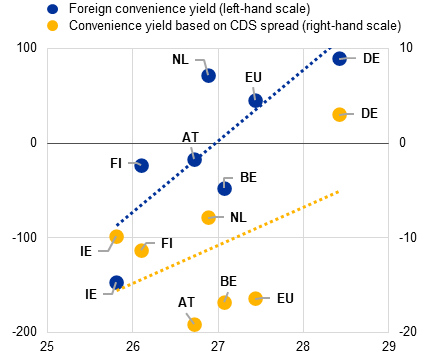
Larger markets are generally associated with higher convenience yields.[10] This pattern holds true not only for US Treasuries and German government bonds, but also for highly rated (AA or above) government bonds within the euro area (Chart B, panel a).[11] The relationship is evident both when estimating the convenience that foreign investors obtain by holding a highly rated euro-denominated asset (blue dots) but also when estimating it from the perspective of domestic investors and accounting for default risk differentials (yellow dots).[12]
Chart B
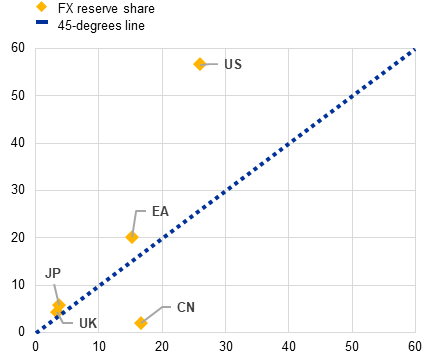
Convenience yields, the supply of safe assets and foreign exchange reserves in 2025
a) Convenience yields and market size within the EU | b) Share of foreign exchange reserves and global GDP |
|---|---|
(x-axis: natural logarithm of market size; y-axes: basis points) | (x-axis: percentage of global GDP; y-axis: percentage of foreign exchange reserves) |
 |  |
Sources: Bloomberg, LSEG, IMF and ECB staff calculations.
Notes: Figures refer to 2025. Panel a) includes sovereign debt securities rated AA- or higher by Standard and Poors. The method based on the government basis (blue dots) aligns with the approach outlined in Chart A, panel b). For euro area countries, the euroness applied corresponds to the value estimated for German government bonds (85%). For instance, the Belgium government basis equalled 7 basis points on average in 2025, resulting in a total foreign convenience yield of -48 basis points, calculated as -7 / (1-0.85). The method based on CDS spreads (yellow dots) estimates the convenience yield as the sum of the OIS rate and CDS spread on the five-year sovereign bonds minus the corresponding bond yield; see Jiang, Z., Lustig, H., Van Nieuwerburgh, S. and Xiaolan, M., “Bond convenience yields in the eurozone currency union”, NBER Working Paper, 2025. The one-year and five-year yields on EU bonds are derived from a Nelson-Siegel-Svensson yield curve model based on debt securities issued by the European Union. The EU CDS spread is constructed as the GDP-weighted average of the CDS spreads of EU Member States. In panel b), the share of global GDP is based on nominal GDP.
Compared against economic size, the euro plays a much smaller role as a reserve currency than the US dollar (Chart B, panel b). While the US represents a quarter of global GDP, the US dollar represents almost 60% of global foreign exchange reserves, more than double its share of global GDP. In comparison, the euro area’s share of global GDP is only slightly lower than its proportion of global foreign exchange reserves.
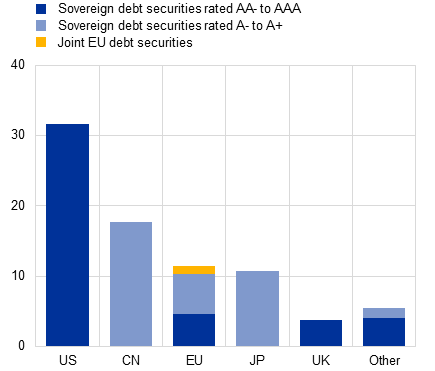
The euro’s role as a reserve and safe asset currency may be constrained by the limited supply of highly rated euro area government debt (Chart C, panel a). With more than USD 31 trillion outstanding, the US Treasury market is by far the largest and most liquid sovereign debt market in the world. Sovereign debt issued in the EU rated A or above totals around USD 11 trillion, including joint EU debt. Yet only half of that is highly rated (AA or above), and fragmentation across multiple issuers limits liquidity. Among highly rated debt, German government bonds represent the largest segment, with almost USD 2.2 trillion (or €2.0 trillion) outstanding. France and Spain account for USD 3.1 trillion (or €2.8 trillion) and USD 1.7 trillion (or €1.5 trillion) respectively, being A-rated as of April 2026. Despite their recent growth, euro-denominated EU bonds still represent a relatively small amount (USD 1.2 trillion or €1.1 trillion). As foreign exchange reserves typically consist of highly rated sovereign debt and deposits, the limited supply of such debt in the euro area may constrain growth in the euro’s role as an international reserve currency, especially if central bank demand increasingly shifts toward higher-yielding, longer-duration investments. Outside the EU, Japanese and UK government debt securities amount to around USD 11 trillion and USD 4 trillion respectively. The stock of Chinese government debt securities is the world’s second largest. While restrictions have loosened, China still enforces capital controls, which limit the appeal of those securities to international investors.[13]
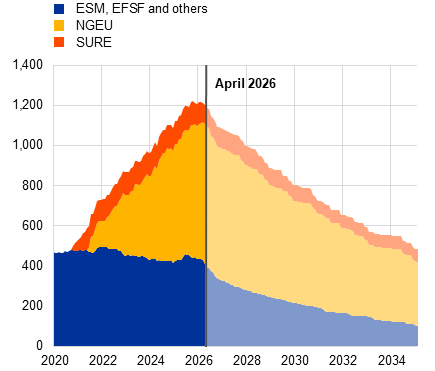
EU bonds have become the second largest highly rated instrument in the EU after German government bonds, but their temporary nature and still relatively small scale limit their safe-asset properties. Although issuance has grown rapidly since the COVID-19 pandemic, it remains linked to purpose-specific and time-limited programmes and does not constitute a unified benchmark asset (Chart C, panel b). Going forward, the EU has agreed to issue bonds, starting in 2026, to support Ukraine (€90 billion) and strengthen defence spending (€150 billion).[14] For 2028-2034, two new loan-based instruments – “Catalyst Europe” (€133 billion) and “Crisis Mechanism” (€350 billion) – financed through EU bond issuance, have been proposed for strategic investments and crisis support, together with budget headroom for these and potentially new instruments.[15] At the same time, the bonds issued during the COVID-19 pandemic are expected to mature from 2028 onwards, with no roll-over.[16] Segmented issuance linked to purpose-specific and time-limited programmes constrains liquidity and, in turn, the ability to generate convenience yields.[17] Establishing a genuine (highly rated) European safe asset could address these constraints, while facilitating the financing of European public goods, such as defence, and strengthening the euro’s role as an international reserve currency.[18]
Chart C
Market size of highly rated euro area sovereign and EU debt securities
a) Outstanding amount of highly rated sovereign debt securities by issuer jurisdiction in April 2026 | b) Outstanding amount of joint EU debt securities issued as at April 2026 and their maturity profile |
|---|---|
(USD trillions) | (USD billions) |
 |  |
Sources: Bloomberg, European Commission and ECB staff calculations.
Notes: Figures refer to the end of April 2026. Panel a) shows sovereign debt securities where the issuer is rated in the A- to A+ or AA- to AAA ranges by Standard and Poor’s. Joint EU debt securities refer to debt securities issued by the European Commission, the European Stability Mechanism (ESM) and the European Financial Stability Facility (EFSF) (USD 1.2 trillion or €1.1 trillion). EU sovereign debt securities include debt securities issued by EA member states (USD 9.4 trillion or €8.4 trillion) and by non-EA EU Member States (USD 0.8 trillion or €0.7 trillion). Euro area countries in the A- to A+ range include Croatia, France, Latvia, Lithuania, Malta, Portugal, Slovakia and Spain. Euro area countries with a rating of AA- and above include Austria, Belgium, Finland, Germany, Ireland, Luxembourg, the Netherlands and Slovenia. In panel b), joint EU debt securities refer to debt securities issued by the European Commission. NGEU and SURE are the abbreviations for two EU programmes related to COVID-19 (NextGenerationEU and Support to mitigate Unemployment Risks in an Emergency). For the months after April 2026, the values represent the difference between the estimated outstanding amount at the beginning of a given month and the amount maturing during that month.
See Gorton, G., “The history and economics of safe assets”, Annual Review of Economics, 9, 2017, pp. 547-586.
See Brunnermeier, M., James, H. and Landau, J-P., The Euro and the Battle of Ideas, Princeton University Press, 2016.
See Jiang, Z., Krishnamurthy, A. and Lustig, H., “Foreign safe asset demand and the dollar exchange rate”, Journal of Finance, 76(3), 2021, pp. 1049-1089. For further details on the estimation and computations, see the notes to Chart A.
For the US dollar, it is defined as: , where denotes the yield of the US Treasury, is the yield of an average foreign highly rated government bond, is the log of the nominal exchange rate in units of foreign currency per US dollar and denotes the log of the forward exchange rate. For more details see the notes to Chart A.
See, for example, Jiang et al. (2021), op. cit. or Jiang, Z., Krishnamurthy, A., Lustig, H. and Richmond, R., “Dollar erosion: understanding the loss of reserve currency status”, Stanford University Graduate School of Business Research Paper, 2025.
See also Jiang, Z et al. (2025), op. cit.; Jiang, Z., Richmond, R. and Zhang, T., “Convenience lost”, NBER Working Paper 33940, 2025; Chen, Y. and Bloodworth, K., “The Declining Convenience Yield and Quantitative Tightening”, Federal Reserve Bank of St. Louis Economy Blog, 2026; and Kozlowski, J. and Sullivam, N., “Are U.S. Treasuries Still ‘Convenient’?”, Federal Reserve Bank of St. Louis Economy Blog, 2025.
See also Du, W., Im, J. and Schreger. J., “The U.S. Treasury premium”, Journal of International Economics 112, pp. 167-181, 2018; Liao, G., “Credit migration and covered interest rate parity”, Journal of Financial Economics 138(2), pp. 504-525, 2020; Caramichael, J., Gopinath, G. and Liao, “U.S. dollar currency premium in corporate bonds”, IMF Working Paper, Issue 185, 2021; and Du, W., Keerati, R. and Schreger, J., “Decoupling dollar and treasury privilege”, International Finance Discussion Paper 1427, 2025.
While yearly aggregates do not show substantial change in the 2025 US Treasury convenience yield compared with 2024, several recent papers have focused on analysing the impact of “Liberation Day” – see for example Jiang, Z. et al. (2025), op. cit. and Baudino, P. et al., “What safe haven after the April US tariff announcement? Implications for euro area financial stability”, Financial Stability Review, ECB, November 2025.
In other words, if safe and liquid German government bonds were not issued in euro but in another G10 currency other than the US dollar, German government bonds would have carried only a very small additional convenience yield (of around 13.5 bps) for their safety and liquidity.
See, for example, He, Z., Krishnamurthy, A. and Milbradt, K., “What makes US government bonds safe assets?”, American Economic Review 106(5), pp. 519-23, 2016, He, Z., Krishnamurthy, A. and Milbradt, K., “A model of safe asset determination”, American Economic Review 109(4), pp. 1230-1262, 2019 and Arvai, K. and Coimbra, N., “Privilege lost? The rise and fall of a dominant currency”, Banque de France Working Paper 932, 2023.
Highly rated government bonds are defined as those with rating AA and above. This threshold captures securities with very low default risk, and sovereign bonds with this rating also receive the most favourable regulatory treatment under the Basel III liquidity and capital framework, reflecting their role as high-quality liquid assets. This definition is also standard in the literature; see, for example, Eichengreen, B., “Global Monetary Order”, paper presented as part of the ECB Forum on Central Banking on “The future of the international monetary and financial architecture”, Sintra, 27-29 June 2016.
The two measures of convenience yields differ in several ways. For instance, the foreign convenience yield is defined relative to the convenience of holding assets from other G10 currency issuers, whereas the domestic convenience yield is derived from country-specific sovereign yields and CDS spreads. Consequently, their time trends may diverge.
See, for example, Clayton, C., Dos Santos, A., Maggiori, M. and Schreger, J., “Internationalizing like China”, American Economic Review, 115(3), pp. 864-902, 2025.
Security Action for Europe (SAFE), adopted by the Council of the European Union on 27 May 2025, is an EU financial instrument to strengthen the defence readiness of EU Member States (and is also open to selected non-EU countries). It provides loans to countries based on national plans and commitments to coordinated procurements.
See the proposal of the European Commission for the 2028-2034 Multiannual Financial Framework, 6 July 2025.
NextGenerationEU (NGEU) is a temporary recovery instrument to address the economic and social impacts of the COVID-19 pandemic in the EU, which was complemented by the temporary Support to mitigate Unemployment Risks in an Emergency (SURE). Both programmes are financed through joint EU debt.
For a discussion of EU bonds’ shortcomings in terms of robustness and liquidity, and the obstacles to and factors promoting their safe-asset status, see Box 7, “EU bonds as safe assets” in “Capital markets union: a deep dive. Five measures to foster a single market for capital”, Occasional Paper Series, ECB, revised May 2025. See also Bletzinger, T., Greif, W. and Schwaab, B., “Can EU bonds serve as euro-denominated safe assets?”, Journal of Risk and Financial Management, 15(11), 2022.
For discussions of proposals on how to expand the supply of EU safe assets, see, e.g., Lane, P. R., “Expanding the supply of euro safe assets”, Keynote speech at the joint workshop of the European Systemic Risk Board Advisory Technical Committee and Advisory Scientific Committee on “A European Safe Asset and Financial Stability”, 22 April 2026 and Gossé J.-B. and Mourjane, A., “A European safe asset: new perspectives”, Bulletin 234/6, Banque de France, 2021.