





Drivers of investor behaviour in highly valued equity markets
Published as part of the Financial Stability Review, May 2026.
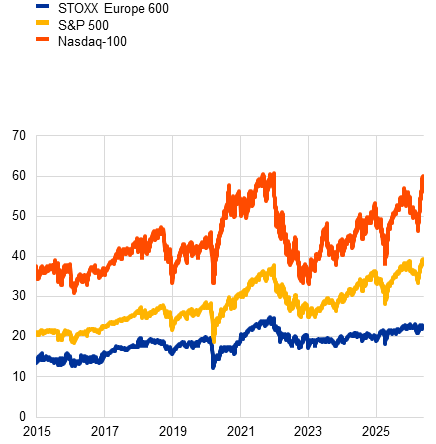
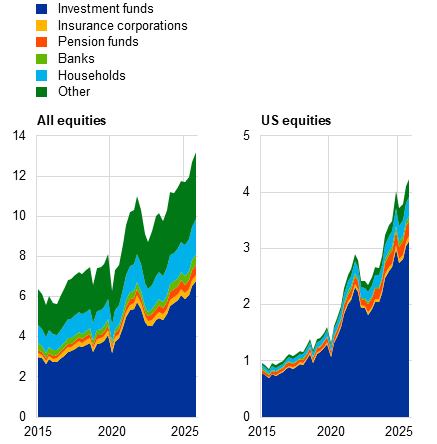
Asset price valuations are particularly high in the technology and artificial intelligence (AI) sectors, where euro area investors have significant exposures. Price/earnings ratios remain historically elevated across many equity markets, with US equity indices trading at notably higher levels than their European counterparts (Chart A, panel a). While euro area investors have doubled their holdings of all equities in the past decade, their holdings of US equities have quadrupled, driven both by positive valuation effects and asset purchases.[1] The investment fund sector is the single largest euro area holder of equities overall and of US stocks in particular (Chart A, panel b). This concentration places investment funds at the centre of euro area exposures to assets with stretched valuations. Analysing investor flows into funds focused on such asset classes can, therefore, help gain an understanding of the observed drivers of the high market valuations and the associated financial stability risks.
Chart A
Investment funds are by far the largest holder of assets with currently high valuations
a) Cyclically adjusted price/earnings ratios of selected stock indices | b) Global and US equity holdings, by euro area sector |
|---|---|
(1 Jan. 2015-19 May 2026, ratios) | (Q1 2015-Q4 2025, € trillions) |
 |  |
Sources: Bloomberg Finance L.P., ECB (CSDB, SHS) and ECB calculations.
Notes: Panel a: the chart shows cyclically adjusted price/earnings ratios, where earnings for the last ten years are adjusted by inflation and averaged.
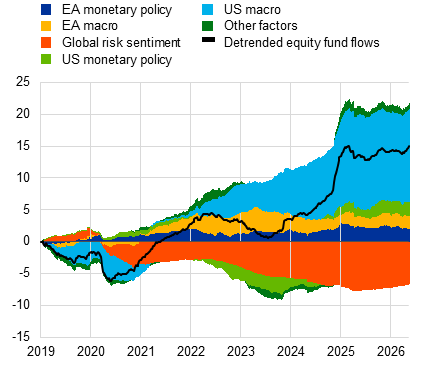
The rapid advancement of AI and the associated surge in capital expenditure have driven euro area investment towards US tech equities. Breaking down euro area equity fund flows into five underlying drivers, based on a BVAR model, indicates that US macroeconomic factors (including the AI-related boom and investments) were the leading factor behind euro area inflows into US equities in recent years (Chart B, panel a). By contrast, negative global risk sentiment (partly reflecting ongoing geopolitical shifts) has exerted increasingly downward pressure on investor flows. Other factors have had a more limited impact. Accommodative US monetary policy, reflecting the Federal Reserve System’s policy rate cuts starting in late 2024, has supported inflows recently, while euro area monetary policy and macroeconomic factors have been playing a small but supportive role for several years now.
Chart B
Euro area investment into US equities is driven by macroeconomic expectations of AI, with stronger outflows in the event of negative shocks
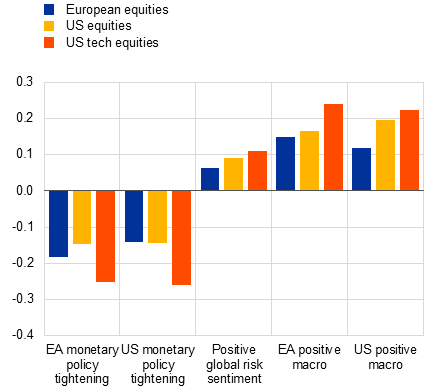
a) Drivers of detrended European investment fund flows into US equities | b) Euro area-domiciled investment fund flow responses to various shocks after four weeks |
|---|---|
(3 Jan. 2019-13 May 2026, cumulative percentage change in total net assets) | (percentage change in total net assets) |
 |  |
Sources: ECB (SDW), EPFR Global and ECB calculations.
Notes: Impulse response and historical decomposition based on the BVAR model of Kaufmann and Mazzolini*, estimated on weekly data from January 2007 to May 2026. The model includes detrended cumulative percentage flows of past total net assets of euro area-domiciled equity funds focusing on Europe, the United States and the US technology sector, US and German ten-year yields, the EUR/USD exchange rate, the EURO STOXX 50 and the S&P 500. Shocks are identified using sign restrictions, following Brandt et al.** Restrictions on fund flows are set in such a way that any monetary loosening or positive macro news in the euro area or the United States, or higher global risk appetite, all lead to inflows into equity funds. Detrended flows are deviations from the long-term trend in flow data, ensuring that the analysis focuses on the cyclical drivers of fund flows instead of explaining the structural drivers of the investment fund sector’s long-term growth. EA stands for euro area.
*) Kaufmann, C. and Mazzolini, G., “Changing tides across the Atlantic: drivers of investor flows in the US and Europe”, mimeo, February 2024.
**) Brandt, L., Saint Guilhem, A., Schröder, M. and Van Robays, I., “What drives euro area financial market developments? The role of US spillovers and global risk”, Working Paper Series, No 2560, ECB, May 2021.
Euro area fund flows into highly valued equity markets, such as the US technology sector, tend to react more strongly to shocks than flows into lower-valued stocks. Generally, flows react positively to positive macroeconomic shocks and, similarly, a positive risk sentiment shock is associated with inflows (Chart B, panel b). On the other hand, tightening monetary policy shocks correlate negatively with flows. Notably, fund flows into US tech stocks react more strongly to monetary policy, macro and risk shocks than flows into broad US or euro area stocks. This points to elevated investor sensitivity in these segments, making these funds vulnerable to sudden flow reversals in the event of any adverse developments.[2] The drivers underpinning strong inflows into US (tech) equity funds could weaken quickly, should for example AI adoption, productivity gains or future profits from AI investments fail to meet expectations, or should the geopolitical environment deteriorate further. Given funds’ limited cash buffers and pockets of leverage in US tech stocks, the resulting outflows could lead to asset sales, amplifying adverse market shocks.
A rapid repricing of highly valued equities could spill over to other key euro area markets and have a negative effect on the wealth of euro area investors. A deterioration in investor sentiment could propagate to other market segments, including the equities and bonds of European firms, thereby tightening their financing conditions and weakening their resilience to shocks. Additionally, significant exposures to markets with elevated valuations leave investors vulnerable to valuation losses. Given that investment fund share ownership is rising fast among households both directly[3] and indirectly[4] (through unit-linked insurance and defined contribution pension schemes), the implication is that there could be potentially significant second-round effects on consumption and the real economy.
According to ECB calculations, around 70% of the increase in euro area holdings of US equities between 2015 and 2025 was driven by valuation effects, while the remaining 30% reflect net transactions. Valuation changes stem primarily from price developments, with exchange rate movements playing only a limited role.
It is not immediately clear whether this increased sensitivity stems from structurally high valuations in the technology sector during the past decade or the more cyclical nature of the technology industry. Splitting the sample into before and after the COVID-19 pandemic, when the technology rally really took off in US equity markets, does not produce differential results of any statistical significance.
For more on euro area households’ increasing holdings of investment fund shares, see Baudino, P.A., Metzler, J., Storz, M. and Wagner, F., “The role of household investors in market downturns”, Financial Stability Review, ECB, November 2025.
For changes in the composition of investment portfolios held by insurance and pension fund schemes, see Gardó, S., Klaus, B., Kurig, D. and Storz, M., “Navigating financial stability in an ageing world”, Financial Stability Review, ECB, May 2025.