




Published as part of the ECB Economic Bulletin, Issue 2/2026.
Trade policy uncertainty has risen significantly in recent years, reaching historically high levels throughout the past year. It initially rose during the US-China trade conflict in 2018-19, under the first Trump Administration, and intensified again around the 2024 US presidential election and the start of the second Trump term, when trade policy moved to the centre of the US economic agenda. A series of tariff announcements in early 2025 marked a major policy shift that pushed trade policy uncertainty to a peak well above the levels seen during the 2018-19 trade dispute (Chart A).[1] Uncertainty eased somewhat following the US-China trade truce in May 2025 and the US-EU framework agreement in late July of the same year, but it has remained elevated by historical standards. This persistent uncertainty weighed on euro area activity during 2025 and continues to pose risks, given the region’s deep integration into global trade networks. In the second half of 2025 and early 2026, renewed trade tensions between the United States and China, together with the events related to Greenland, illustrated that further episodes of heightened trade policy uncertainty remain likely. This box outlines the channels through which trade policy uncertainty affects euro area activity, estimates its impact so far and discusses the factors that have supported resilience despite the challenging global environment.
Chart A
Trade policy uncertainty
(index)
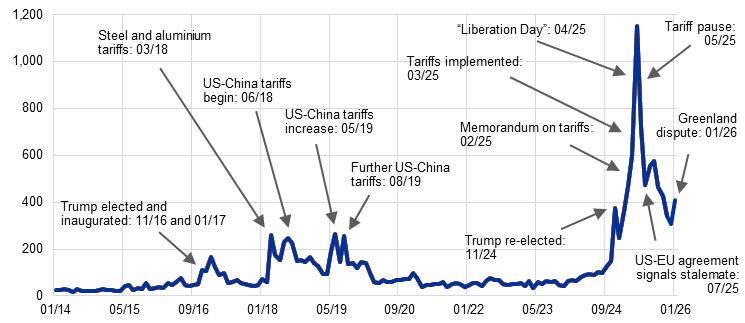
Sources: Caldara et al. (2020) and ECB staff calculations.
Notes: The chart shows the trade policy uncertainty index as set out in Caldara et al. (2020). The latest observations are for January 2026.
Trade policy uncertainty affects the economy through several channels. The most direct impact is on trade itself. Threats of tariffs and other trade barriers, as well as policy reversals, can disrupt trade flows and global supply chains, raising costs and reducing efficiency. These disruptions are particularly relevant for the euro area, given its high degree of openness and the relatively large share of investment goods in its exports. Moreover, repeated episodes of heightened trade policy uncertainty can lead to long-term structural shifts, such as trade diversion or the reshoring of supply chains, which may put further pressure on euro area exporters and their competitiveness. Beyond the direct trade effects, there is a more subtle but equally significant impact on investment. As with other forms of elevated economic policy uncertainty, trade policy uncertainty prompts firms to adopt a “wait-and-see” approach, leading them to postpone investment, hiring activities and cross-border commitments.[2] Evidence from the ECB’s contacts with non‑financial companies highlights that elevated uncertainty has been a key factor weighing on the investment outlook.[3] Prolonged uncertainty may also lead to more persistent supply-side effects, including weaker productivity growth, as firms scale back or delay capital expenditure (Bloom, 2009; Boer and Rieth, 2024).
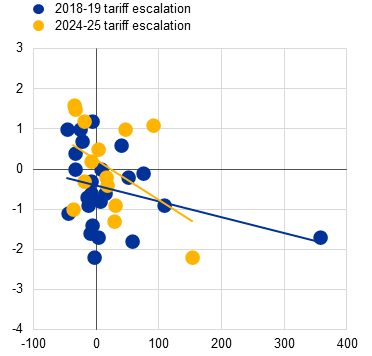
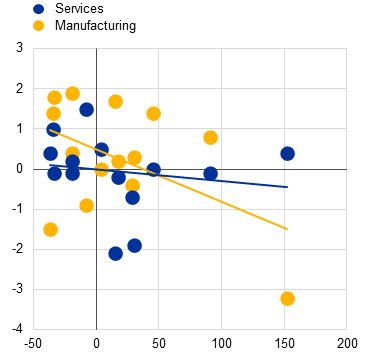
The confidence channel further amplifies the economic impact of uncertainty. Declines in trade flows and investment caused by elevated uncertainty reduce firms’ revenues and profitability, which in turn weakens broader economic sentiment. Chart B, panel a) illustrates this channel by showing a negative correlation between the European Commission’s euro area Economic Sentiment Indicator and the trade policy uncertainty index of Caldara et al. (2020) during the two episodes of tariff escalation from March 2018 to December 2019 and from October 2024 to December 2025 respectively. Panel b) shows that this negative relationship is more pronounced in the manufacturing sector, which was directly affected by the tariff escalations.
Chart B
Economic sentiment and trade policy uncertainty
a) Economic sentiment and trade policy uncertainty | b) Sectoral sentiment and trade policy uncertainty |
|---|---|
(percentage points) | (percentage points) |
 |  |
Sources: European Commission, Caldara et al. (2020) and ECB staff calculations.
Notes: Panel a) shows fitted regression lines of monthly changes in the European Commission’s euro area Economic Sentiment Indicator (y-axis) on lagged monthly changes in the trade policy uncertainty index (x-axis) based on Caldara et al. (2020). “2018-19 tariff escalation” refers to the period from March 2018 to December 2019 and “2024-25 tariff escalation” refers to the period from October 2024 to December 2025. Panel b) shows the correlation between sectoral economic confidence indicators and trade policy uncertainty during the 2024-25 tariff escalation.
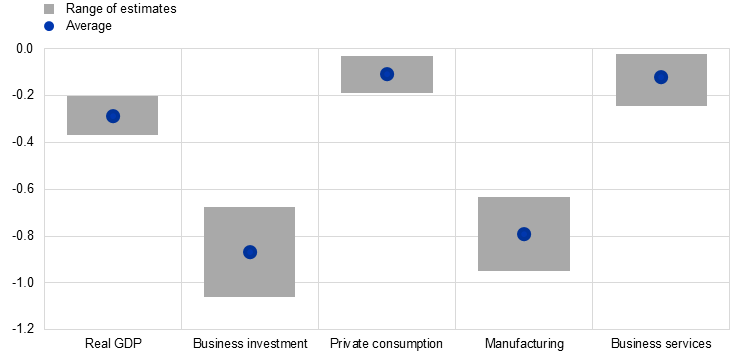
Model-based analysis suggests that elevated trade policy uncertainty weighed on euro area real gross domestic product (GDP) in 2025 (Chart C). To assess the macroeconomic implications of rising trade policy uncertainty, a Bayesian vector autoregression was estimated for the euro area, covering the period from the first quarter of 1999 to the fourth quarter of 2025. The analysis relies on two measures of trade policy uncertainty. The first is the aforementioned text-based index set out in Caldara et al. (2020). However, this unadjusted measure tends to be highly volatile and may capture not only uncertainty shocks but also actual policy changes and shifts in media attention. To address these limitations, the analysis also uses an adjusted measure developed by Schröder (2025) that strips out the influence of media attention, effective tariff rates, financial conditions and supply chain pressures. Two baseline specifications were estimated. The first includes, in turn, each of the two trade policy uncertainty measures together with real GDP, domestic demand indicators (business investment and private consumption), HICP inflation and the short-term interest rate. The second replaces the domestic demand indicators with sectoral value-added components (manufacturing and business services). Across the specifications, the results indicate that the increase in trade policy uncertainty in 2025 is associated with an average decline in real GDP growth of approximately -0.3 percentage points relative to 2024 (Chart C). The estimated effects vary across uncertainty measures.[4] Notably, the unadjusted measure typically implies a larger impact than the adjusted measure, as its volatility and pronounced spikes amplify estimated shocks. For the domestic demand indicators, the estimated impact on business investment is around three times larger than that on private consumption. Similarly, the sectoral models also point to stronger effects on manufacturing than on business services.
Chart C
Impact of trade policy uncertainty on euro area real economic activity in 2025
Sources: Eurostat, Caldara et al. (2020), Schröder (2025) and ECB staff calculations.
Notes: The estimates are based on the unadjusted trade policy uncertainty index set out in Caldara et al. (2019) and the adjusted trade policy uncertainty measures in Schröder (2025). The impact is identified using two approaches – Cholesky decomposition and sign and zero restrictions – applied to each uncertainty measure separately. The models include real GDP, real business investment, real private consumption, HICP inflation and the short-term interest rate; an alternative specification also includes equity prices. In the sectoral models, business investment and private consumption are replaced with gross value added in manufacturing and business services respectively, while all other variables are kept unchanged. The models are estimated from the first quarter of 1999 to the fourth quarter of 2025. The estimates are scaled to the size of the trade policy uncertainty shock observed between first and fourth quarters of 2025 and represent the impact on growth rates. The blue dots depict the average effects across the suite of model specifications. Business services are proxied by the sum of the following sectors: information and communication; financial and insurance activities; and professional, scientific and technical activities. The latest observations are for the fourth quarter of 2025.
Despite heightened trade policy uncertainty weighing on growth, euro area real GDP proved more resilient than expected in 2025. While the March 2025 projection had estimated real GDP growth of 0.9%, it ultimately grew by 1.5%. Several offsetting factors helped mitigate the negative impact of trade policy uncertainty. First, firms adjusted their production and exports in anticipation of higher tariffs, effectively frontloading economic activity.[5] Second, monetary policy normalisation provided supportive conditions for growth, aided by the overall health of private sector balance sheets. Third, fiscal measures – such as the implementation of the Next Generation EU programme, increased defence spending and targeted fiscal support – helped underpin economic activity.
References
Andersson, M., Bobasu, A. and De Santis, R.A. (2024), “What are the economic signals from uncertainty measures?”, Economic Bulletin, Issue 8, ECB.
Baker, S.R., Bloom, N. and Davis, S.J. (2016), “Measuring Economic Policy Uncertainty”, The Quarterly Journal of Economics, Vol. 131, No 4, November, pp. 1593-1636.
Battistini, N. and Gareis, J. (2025), “Manufacturing versus services: how frontloading and uncertainty shaped recent developments”, Economic Bulletin, Issue 6, ECB.
Bloom, N. (2009), “The Impact of Uncertainty Shocks”, Econometrica, Vol. 77, No 3, May, pp. 623-685.
Boer, L. and Rieth, M. (2024), “The Macroeconomic Consequences of Import Tariffs and Trade Policy Uncertainty”, IMF Working Papers, No 24/13, January.
Caldara, D., Iacoviello, M., Molligo, P., Prestipino, A. and Raffo, A. (2019), “Does trade policy uncertainty affect global economic activity?”, FEDS Note, September.
Caldara, D., Iacoviello, M., Molligo, P., Prestipino, A. and Raffo, A. (2020), “The Economic Effects of Trade Policy Uncertainty”, Journal of Monetary Economics, Vol. 109, January, pp. 38-59.
Handley, K. and Limão, N. (2017), “Policy Uncertainty, Trade, and Welfare: Theory and Evidence for China and the United States”, American Economic Review, Vol. 107, No 9, September, pp. 2731-2783.
Melemenidis, A., Morris, R. and Roma, M. (2025), “Main findings from the ECB’s recent contacts with non-financial companies”, Economic Bulletin, Issue 5, ECB.
Schröder, M. (2025), “From text to trouble: understanding the limits of text-derived trade policy uncertainty measures”, Economic Bulletin, Issue 8, ECB.
The measure of trade policy uncertainty used follows Caldara et al. (2020). It is constructed by counting how often trade-related and uncertainty-related keywords appear in close proximity in seven major US newspapers. Alternative measures draw on firms’ earnings calls and on tariff rate volatility. Additionally, one component of the broader Economic Policy Uncertainty index is the trade policy uncertainty measure developed by Baker et al. (2016). Other related high-frequency indicators, such as the Bloomberg Economics Global Trade Policy Uncertainty Index, apply text mining techniques to news flows. See Andersson et al. (2024) for additional uncertainty measures.
The “wait-and-see” approach has been described by Baker et al. (2016), Handley and Limão (2017) and Caldara et al. (2020). Household consumption typically reacts less than investment, as it is dominated by services and more closely tied to uncertainty regarding the financial expectations of households (Boer and Rieth, 2024).
See Melemenidis et al. (2025).
The effects are robust to different methods used to identify the uncertainty shock.
See Battistini and Gareis (2025).