



- SPEECH
Analytical perspectives on energy supply shocks
Dinner remarks by Philip R. Lane, Member of the Executive Board of the ECB, at the Centre for European Reform
London, 13 May 2026
My aim in this speech is to outline some of the analysis carried out by ECB economists in relation to energy supply shocks. I do not attempt to provide a comprehensive account; rather, I will focus on a selective set of issues.[1][2] In the final part of the speech, I will discuss the implications for monetary policy.
The economic impact of supply-driven oil price increases
In order to quantify the impact of the current oil price shock on the euro area economy, ECB staff have estimated a Bayesian vector autoregressive (VAR) model. The model includes a series of identified geopolitical oil supply shocks along with the global real price of oil, a global economic activity indicator, euro area real GDP, private consumption, investment, consumer prices, and short and long-term interest rates.[3] The source of an oil price movement is crucial in assessing its macroeconomic impact. Unlike a demand-driven increase, which typically reflects stronger global growth and supports economic activity, a supply-driven increase weighs on activity in oil-importing economies such as the euro area. This has an impact through higher production costs, lower real household income, weaker global demand and elevated uncertainty, with the latter typically more pronounced when shocks are geopolitical in nature.
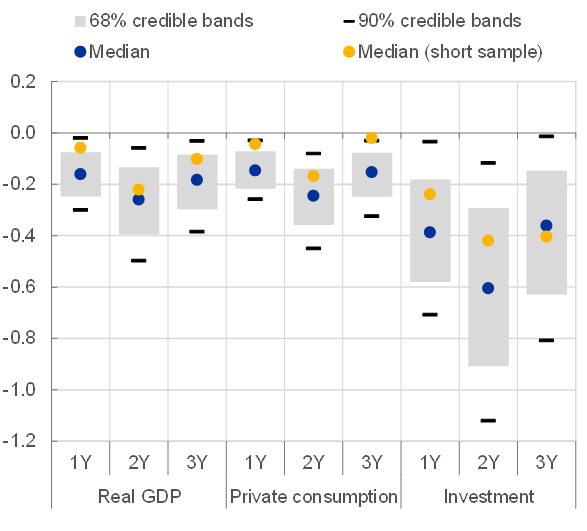
Following a geopolitical oil supply shock that raises the real oil price by 10 per cent on impact, euro area real GDP growth is estimated to be around 0.2 to 0.3 percentage points lower in each of the first three years following the shock (Chart 1, a). Both private consumption and investment growth are lower. The adverse impact on investment is more pronounced, which is consistent with investment being more sensitive to the elevated uncertainty that follows geopolitical oil supply disruptions.
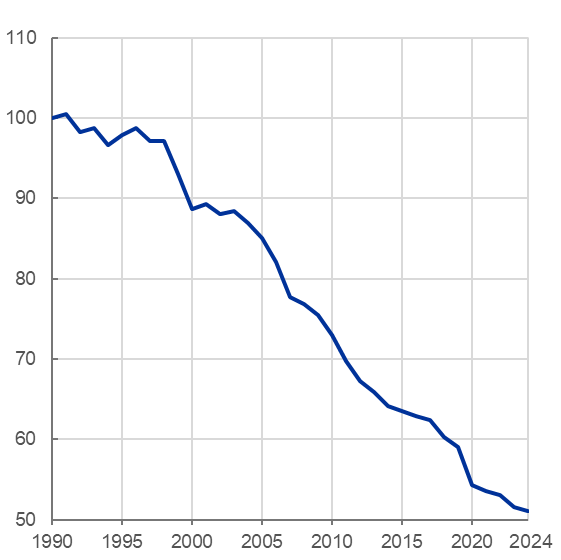
The model is estimated over 1985 to 2023. However, the oil intensity of the euro area economy has declined steadily over this period (Chart 1, b). Re-estimating the model over a shorter sample starting in 2003 suggests that the effects may have weakened somewhat over time (see the yellow dots in panel a), especially through a smaller response of private consumption.
Chart 1
Estimated effects of oil supply shocks on output, consumption and investment
a) Responses normalised to a 10% increase in the real oil price | b) Oil intensity of euro area real GDP over time |
|---|---|
(percentage points) | (index, 1990 = 100) |
|
|
Sources: Panel a) Verduzco-Bustos and Zanetti (2026), Baumeister and Hamilton (2019), U.S. Energy Information Administration (EIA), Bureau of Labor Statistics (BLS), Eurostat, New Area-Wide Model database, ECB and ECB staff calculations. Panel b) Eurostat, New Area-Wide Model database and ECB staff calculations.
Notes: Panel a) The chart shows the estimated impact of a temporary geopolitical oil supply shock that raises the real oil price by 10% on annual growth in euro area real GDP, private consumption, and investment in the first three years following the shock. Estimates are derived from a Bayesian VAR with identified geopolitical oil supply shocks from Verduzco-Bustos and Zanetti (2026), along with the global real price of oil, a global economic activity indicator, euro area real GDP, private consumption, investment, consumer prices, and short- and long-term interest rates. Estimates are reported for the full sample (first quarter of 1985 to fourth quarter of 2023) and for a shorter sample starting in the third quarter of 2003. See Gareis J. (forthcoming), Higher oil prices from the war in the Middle East: assessing the headwinds for euro area growth, Economic Bulletin, Issue 4, ECB; Baumeister and Hamilton (2019), Structural Interpretation of Vector Autoregressions with Incomplete Identification: Revisiting the Role of Oil Supply and Demand Shocks, American Economic Review, 109(5), 1873-1910. Estimated effects of oil supply shocks on output, consumption and investment
Panel b) Oil intensity is measured in kilograms of oil equivalent per euro of real GDP and indexed to 100 in 1990. The latest observation are from 2024.
Energy shocks: global versus regional
The ongoing disruption in energy markets is intrinsically more global than the 2022 shock stemming from Russia’s invasion of Ukraine, which was relatively more localised and Europe-centric. This difference can fundamentally alter the transmission channels through which output and inflation are affected. ECB staff have compared the impact of a global energy shock with a regional energy shock through the lens of a multi-country, multi-sector DSGE model with production networks and trade linkages, calibrated with four regions: the EU, the United States, China and the Rest of the World (RoW).[4] For comparability, the local and global energy shocks are both scaled to imply a 10 per cent rise in the price of energy in the EU on impact.[5]The exercise assumes that monetary policy reacts to inflation and growth according to a standard Taylor rule with inertia.
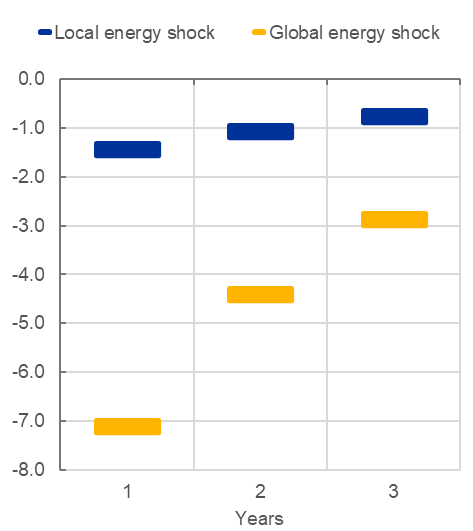
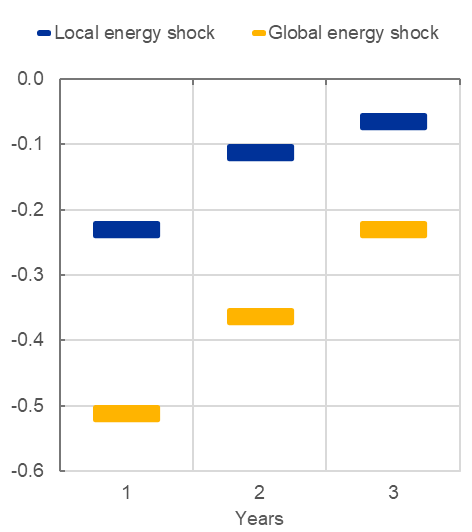
Compared with a regional shock, a global shock not only directly raises the price of imported energy but also indirectly raises the price of all energy-intensive imported goods. This leads to a larger increase in overall import prices and thereby generates a more pronounced deterioration in the terms of trade (Chart 2, panel a).
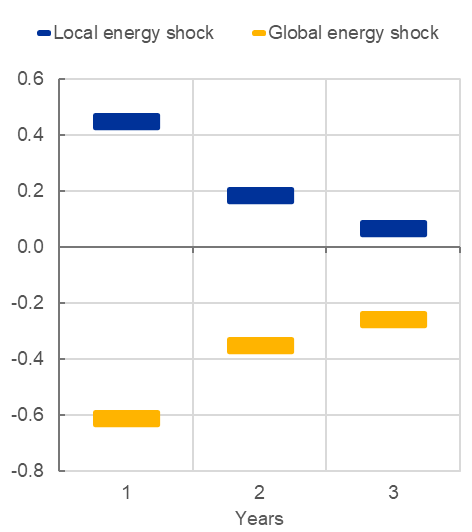
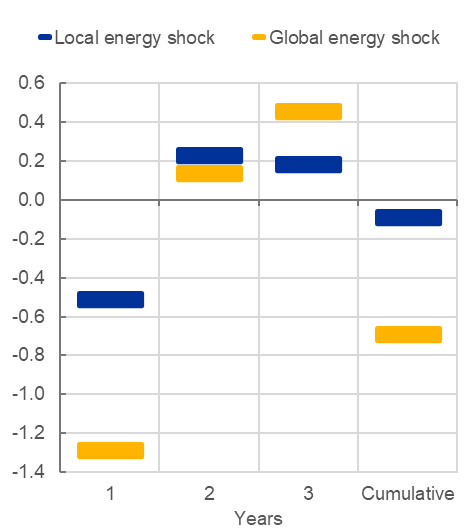
Although the global shock is partially cushioned by real exchange rate depreciation (since it is experienced even more acutely in other countries), the adverse impact on EU output is larger relative to a regional shock since the drop in global demand reduces EU net exports (Chart 2, panel b and panel c). In contrast, although the real exchange rate appreciates in the case of the regional shock according to the model (since monetary policy tightens to counter the upward pressure on inflation), the ability of domestic households and firms to switch towards cheaper imports mitigates the adverse impact on output (Chart 2, panel b; Chart 3, panel a).
Chart 2
Effects of global versus regional energy shocks: impact on EU trade and exchange rates
a) EU terms of trade | b) EU real effective exchange rate | c) EU trade balance |
|---|---|---|
(percentage points) | (percentage deviation from steady state) | (percentage point deviations from steady state) |
 |  |  |
Sources: Gnocato, N., Montes-Galdón, C. and Stamato, G. (see footnote 4) and ECB staff calculations.
Notes: Simulations from a multi-country, multi-sector DSGE model with production linkages and trade. The local energy shock arises from trade frictions on EU imports of oil and gas from the RoW; the global shock from a decline in productivity in the RoW oil and gas sector. The shocks are both scaled to imply a 10 per cent rise in the EU energy price on impact, with a half-life of eight quarters. Panel a: difference between the change in export prices and import prices. Panel b: an increase in the EU real effective exchange rate indicates appreciation.
By contrast, a global shock means that costs are increasing around the world such that there is no relief via the import channel. This creates a compounding effect where the final price of a good reflects not just the direct increase in the local energy price but the cumulated effects of price increases across international suppliers. Consequently, the total drain on output is more severe, as producers along the entire global value chain are simultaneously affected (Chart 3, panel a).[6]
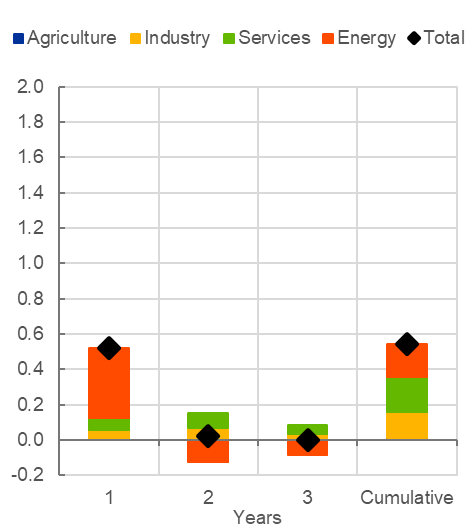
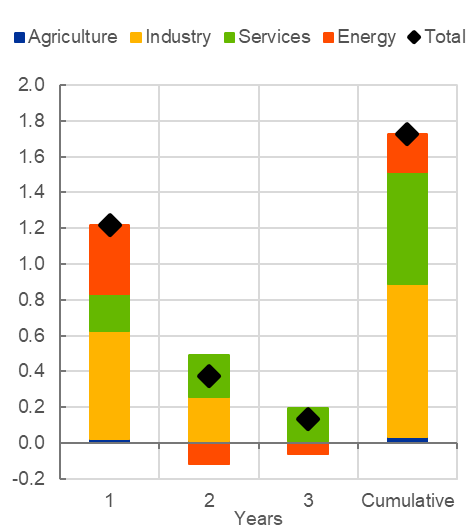
Accordingly, a global shock has larger indirect effects on inflation than a regional shock. The direct impact on inflation is the same by construction: both shocks imply a 10 per cent rise in the price of energy on impact and a cumulative increase of around 0.2 percentage points in the energy component of inflation over a 3-year horizon (Chart 3, panel b and panel c). However, the indirect spillovers are larger in a global shock.
In both cases, higher energy prices also increase domestic production costs, which are passed through to the prices of consumer goods and services. According to the model, currency appreciation partly mitigates the impact on inflation in a regional shock, while depreciation amplifies that of a global shock. In a regional shock, the indirect spillovers through higher costs for domestic producers are more limited and build up more gradually, with the non-energy component of inflation contributing to overall inflation by about 0.4 percentage points cumulatively (Chart 3, panel b). In a global shock, not only energy, but also production inputs and consumer goods become more expensive. These larger indirect effects have two main consequences compared with a regional shock. First, the rise in consumer prices of non-energy goods and services is more front-loaded (Chart 3, panel c). Second, the indirect impact is larger overall, with the non-energy component contributing to total inflation by 1.5 percentage points cumulatively. The relatively larger contribution of non-energy tradable goods (industry and agriculture) further underscores the role of imported inflationary pressures in a global shock.
Overall, the global shock exerts more severe damage on output and inflation relative to a regional shock. While cast in linear approximations, the simulations capture a rich set of indirect channels — such as international trade and global value chains. That said, the results can be interpreted as a worst-case scenario along certain dimensions. In particular, given the short-run focus, oil and gas are assumed to be close to non-substitutable in production. In reality, however, producers can adapt over time by switching to alternative energy sources and adjusting their input mix.[7]
Chart 3
Effects of global versus regional energy shocks: impact on activity and prices
a) EU GDP growth | b) Contributions to inflation – local shock | c) Contributions to inflation – global shock |
|---|---|---|
(percentages year-on-year) | (percentage points year-on-year) | (percentage points year-on-year) |
 |  |  |
Sources: Gnocato, N., Montes-Galdón, C. and Stamato, G. (see footnote 4) and ECB staff calculations.
Notes: Simulations based on a multi-country multi-sector DSGE model with production linkages and trade. The local energy shock arises from trade frictions on EU imports of oil and gas from the RoW; the global shock from a decline in productivity in the RoW oil and gas sector. The shocks are both scaled to imply a 10 per cent rise in the EU energy price on impact, with a half-life of eight quarters. Panel b and c: “Agriculture” refers to NACE section A; “Industry” to sections C and F; “Services” to sections E, G-H-I, J, M-N and R-S; and “Energy” to sections B and D.
Energy price shocks: indirect and second-round effects
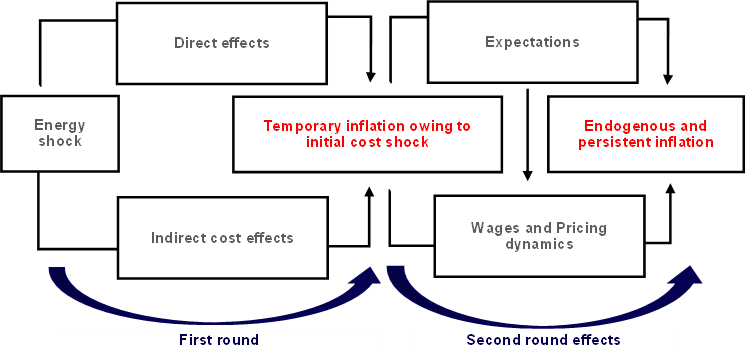
Assessing whether the latest rise in energy prices will lead to broader and more persistent inflationary pressures requires close monitoring of early indicators of indirect and second-round effects. An energy price shock affects consumer prices directly via HICP energy items but also indirectly through higher input costs that are passed through to non-energy goods and services (Chart 4, first round).
Direct first-round effects tend to be immediate and mechanical in relation to transport fuels, but the pass-through to electricity and home heating prices can take some time. Indirect first-round effects arise more gradually, as higher energy and transport costs are passed through the supply chain to non-energy goods and services. Food prices are a case in point, as higher energy and transport costs can significantly raise production and distribution costs. Taken together, these first-round effects mainly shift the price level and only have a temporary effect on inflation.
By contrast, second-round effects arise when the initial inflationary impulse feeds into wage-setting, the pricing and margin decisions of firms and inflation expectations, making inflation more broad-based and persistent (Chart 4, second round). Moreover, second‑round effects also tend to depend more on strategic considerations, such as market‑share objectives, medium‑term profit targets and bargaining power in the labour market.
Chart 4
Stylised transmission channels of an energy price shock to consumer prices
 |
Source: ECB.
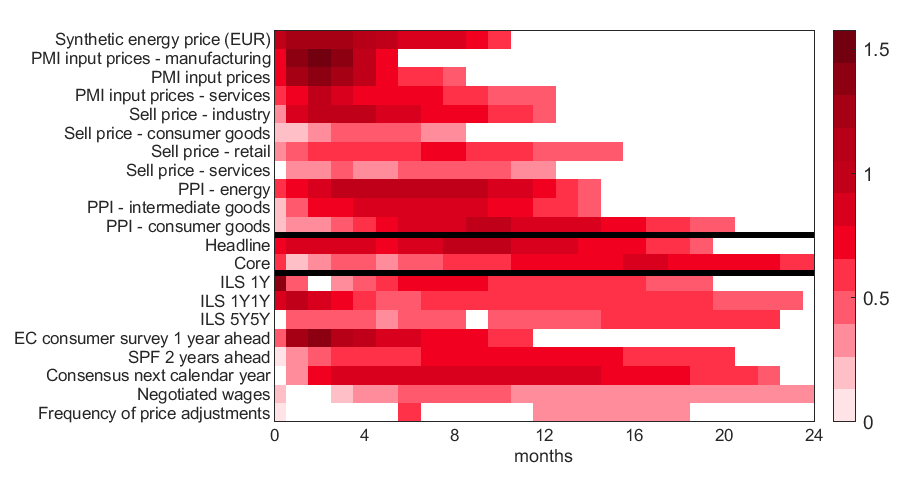
Indirect effects first appear in the upstream pricing indicators of the most affected sectors before moving to food inflation and core inflation. Second-round effects are reflected in broader wage and price-setting indicators, and longer-term expectations. The impulse responses estimated by a BVAR model confirm that energy price shocks feed quickly and strongly into the directly exposed variables, such as synthetic energy commodity prices and headline inflation. Evidence of indirect pass-through also shows up quickly in the indicators of firms’ selling price expectations and producer prices in more upstream sectors before gradually feeding into core inflation (Chart 5).
While an increase in shorter-term inflation expectations is inescapable and likely to be quick to emerge in relation to an energy shock, any increase in medium-term or longer-term inflation expectations may take some time to develop. In similar vein, any increase in the frequency of price adjustment may also not be immediate, as firms wait to see if the shock is persistent or rather unwinds rapidly. Any second-round impact on wage dynamics is plausibly the slowest adjustment mechanism.
Chart 5
Impulse responses of indicators of indirect and second-round effects to energy price shocks
(standard deviations) |
 |
Sources: Eurostat, ECB Statistical Data Warehouse, Haver and ECB staff calculations.
Notes: Median responses normalised to an energy price shock that raises energy prices by one standard deviation. Responses are expressed in standard deviations. White segments indicate responses that are not significant based on the 68 per cent credibility bands. The PMI delivery times response is multiplied by -1. The results are based on three BVAR models identified using the energy price shocks from Bańbura et al. (2023) as internal instruments. The expectations block differs across specifications and includes either market-based inflation expectations, consumer inflation expectations together with either ECB Survey of Professional Forecasters or Consensus forecasts, or firms’ selling price expectations. The model including the frequency of price adjustments is estimated separately. The latest observations are for December 2024 for the model, including the frequency of price adjustments, and January 2026 for all other models.
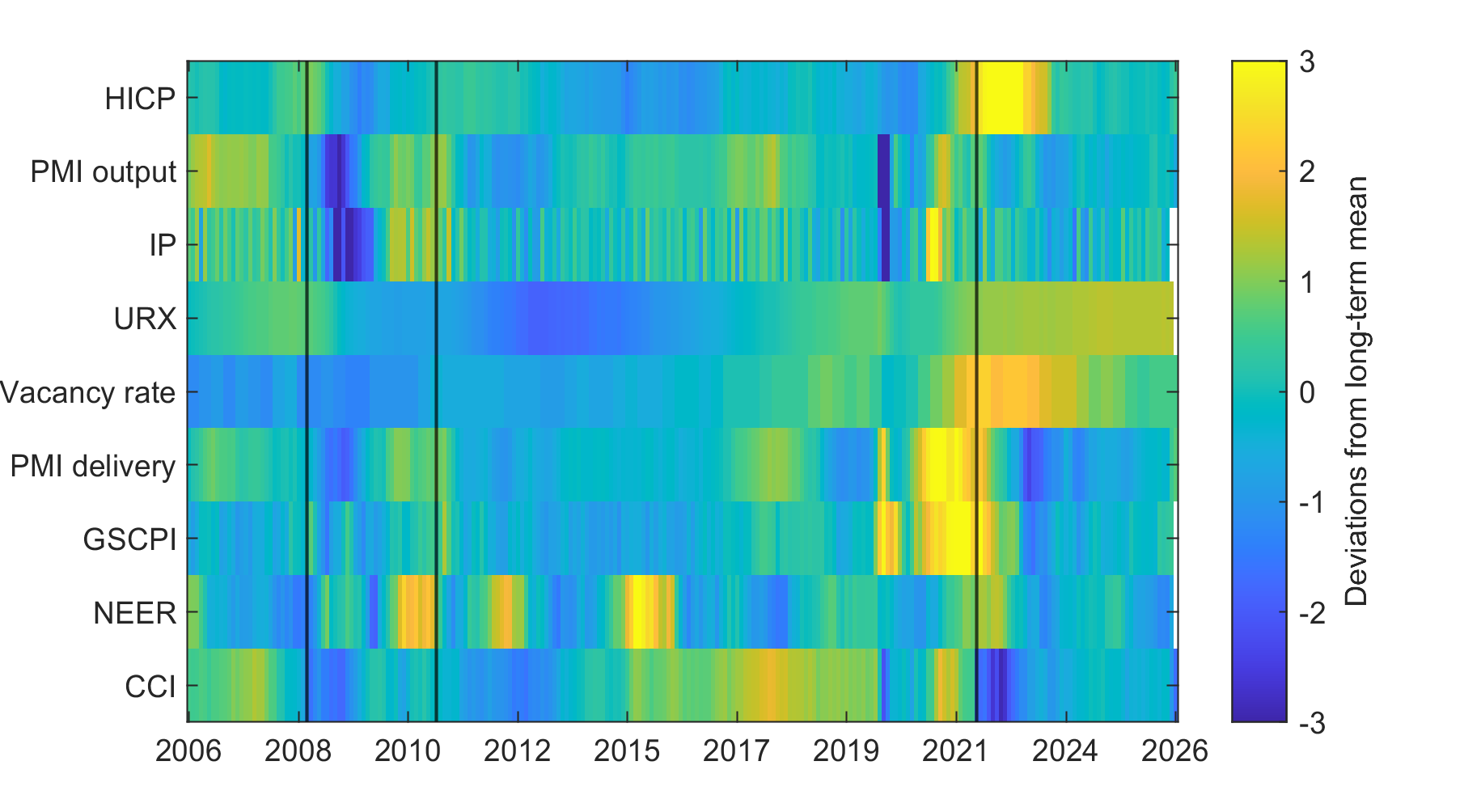
The strength of the energy shock propagation and the extent of second-round effects will depend on the strength of the economy, prevailing price pressures, labour market and the broader supply and demand conditions. Putting the current shock into a longer-term context, Chart 6 summarises key economic conditions over the past two decades and highlights previous episodes of energy price shocks. In early 2011 when oil prices jumped due to the Arab Spring, the euro area economy was more balanced and had more slack across several dimensions. In early 2022 when Russia invaded Ukraine, the energy shock hit against a backdrop of already high inflation, very tight supply conditions, a weak euro and unusually low unemployment and high vacancies, making strong pass-through along the pricing and wage-setting chain more likely.[8] Prior to the current conflict in the Middle East, headline inflation had moved back close to the medium-term target, supply bottlenecks had largely normalised and vacancy rates had fallen, although unemployment remained low.
At the same time, the current shock is also more global in nature and comes shortly after a major inflation surge, which may heighten “inflation attention” in price and wage-setting. For this reason, even if the broader propagation of the shock might be more contained than in 2022, it may be stronger and faster compared to historical averages.
Chart 6
Indicators of economic conditions
(standard deviations) |
 |
Sources: Eurostat, Haver and ECB calculations.
Notes: The heatmap shows monthly indicators of economic conditions – headline HICP, PMI output, industrial production (IP), unemployment rate (URX), vacancy rate, PMI delivery times (inverted), the global supply chain pressure index (GSCPI), the nominal effective exchange rate (NEER) and consumer confidence index (CCI) – expressed as deviations from their long‑term means. Each series is transformed into year‑on‑year growth rates and standardised over the full sample; colours therefore denote the number of standard deviations above (yellow) or below (blue) the historical average for each indicator, with green shades indicating values close to the average. White areas correspond to missing data. The latest observations are for March 2026.
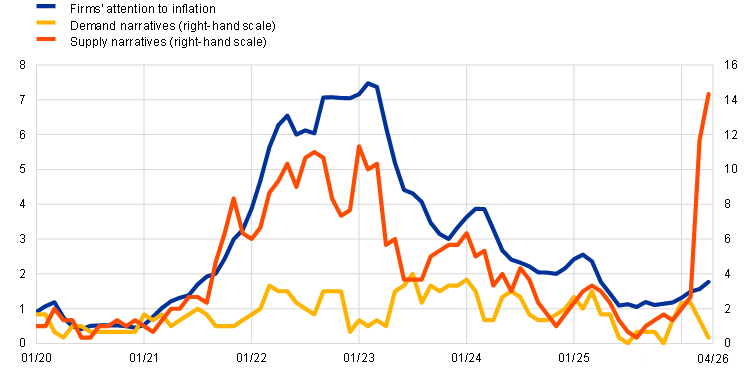
Firm-side and news-based indicators suggest that the current energy shock is unfolding in a less demand-supportive environment than in 2022. In line with “rational inattention” theories, the attention paid by firms to inflation can shape their expectations when inflation signals become more salient.[9][10] Measured from euro area earnings calls, the attention paid by firms to inflation has increased following the outbreak of the Iran war but less intensely than in the aftermath of Russia’s invasion of Ukraine. Another high-frequency indicator that analyses newspaper narratives on the drivers of inflation suggests that, while the 2022 surge in supply-side narratives was accompanied by a comparatively larger role for demand-related narratives, the recent episode has been characterised much more clearly by supply factors (Chart 7). Taken together, these high-frequency indicators suggest that energy-related cost pressures have re-emerged, but against a more subdued broader demand environment.
The increase in selling price expectations in recent firm surveys suggest that the input cost pressures will map into higher output prices in the coming months at least in some sectors but the scale and breadth of the price increases remains uncertain.
Chart 7
Attention paid by firms to inflation and news-based narratives
(left-hand scale: inflation attention in units, right-hand scale: narratives in article volume) |
 |
Sources: NL Analytics, Financial Times and ECB calculations.
Notes: Firms’ attention to inflation is calculated as the three-month moving average of the cross-sectional average of the number of NL Analytics earnings calls sentences mentioning inflation keywords. Calculated as three-month moving averages, demand and supply narratives are derived from inflation articles according to Trebbi, G. (2025), “Inflation narratives and expectations”, Working Paper Series, No 3158, ECB. The latest observations are for April 2026.
So far, the incoming information on wage agreements reached since the outbreak of the war in the Middle East continue to signal an easing of wage pressures and indicate that wage negotiations have not yet reacted to the jump in energy prices (Chart 8). The food price-setting frequencies indicate some increases at the beginning of this year, even the pace of repricing is slower than in 2022 (Chart 9). We will closely monitor these important early warning indicators for second-round effects in the coming months.
Chart 8
Timely indicators of trends in wages
a) ECB wage tracker | b) Latest agreements indicator |
(annual percentage changes) | (percentages) |
|
|
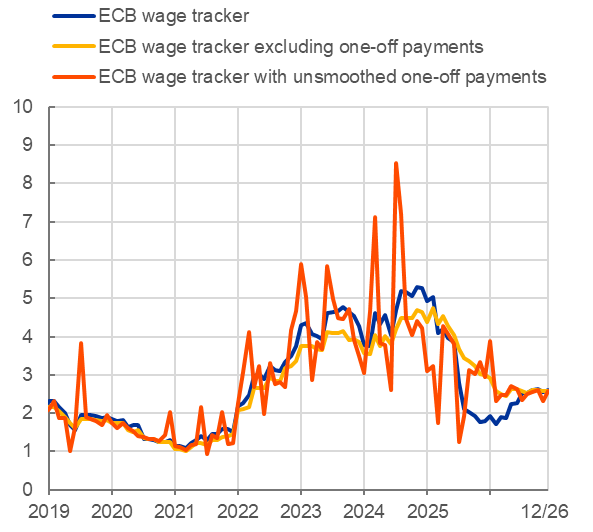
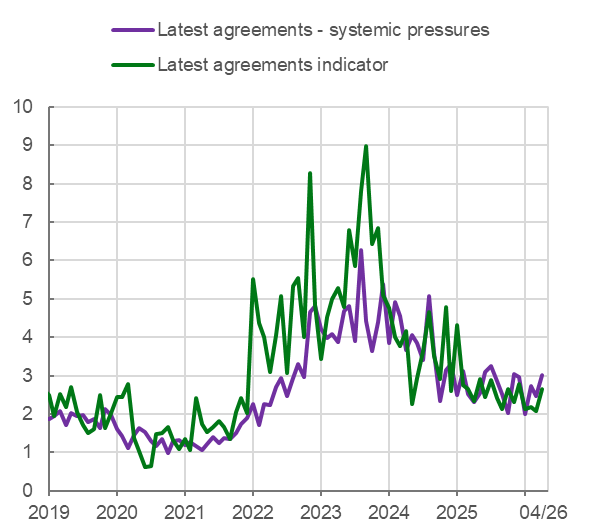
Sources: For details on the sources of the ECB wage tracker, see Chart 1 of the ECB wage tracker press release. The latest agreements indicator is based on Górnicka, L. and Koester, G. (eds.) (2024), “A forward-looking tracker of negotiated wages in the euro area”, Occasional Paper Series, No 338, ECB.
Notes: The latest agreements indicator measures the strength of the newly signed agreements in a given month, over the first 12 months in which the agreement is active. It is the increase in the total negotiated wage compensation the worker earns over this period and includes one-off payments. The systemic pressures indicator is estimated by accounting for agreement-level heterogeneity across the different countries and sectors. The latest observations are for December 2026 for the ECB wage tracker and for April 2026 for the latest agreements indicator.
Chart 9
Timely indicators of trends in food prices
a) Selling price expectations for next three months | b) Monthly frequency of price changes |
(left-hand side: percentage points; right-hand side: seasonally adjusted balances) | (month-on-month frequency of price change) |
|
|
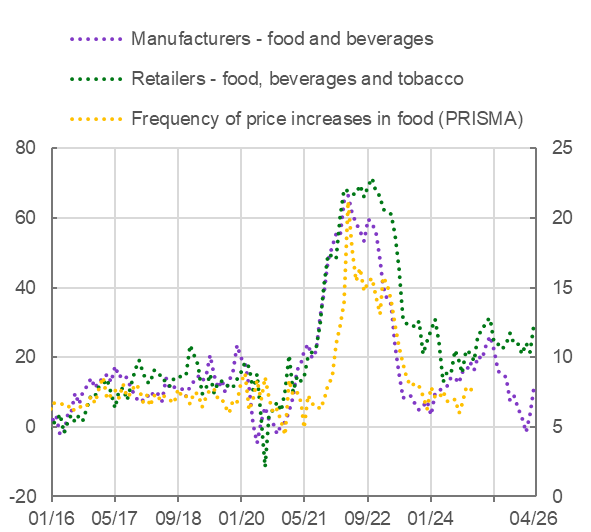
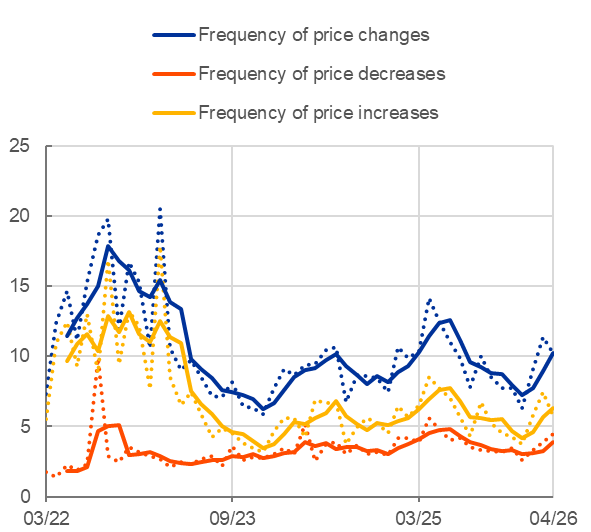
Sources: ECB Daily Prices Dataset (DPD); BIS Project Spectrum; Gautier, E. et al. (2026), “Consumer price stickiness in the euro area during an inflation surge”, Working Paper Series, No 3181, European Central Bank; European Commission; and ECB calculations.
Notes: In panel a), balances are constructed as the difference between the percentages of respondents giving positive and negative replies. The frequency of price increases is based on consumer microdata sets from Gautier et al. (2026) in the context of the ESCB Research Network “Price-setting Microdata Analysis Network” (PRISMA). Panel b) shows the average monthly frequency of price changes, increases and decreases of food products across Germany, France, Spain and Italy (dotted lines) and their three-month moving averages (solid lines). Observations before May 2023 are subject to methodical changes also relating to the classification of products and the exclusion of France. The latest observations are for December 2024 for frequency of price increases from PRISMA and April 2026 for the remaining measures.
Finally, while the current indicators suggest that the inflation impact has been relatively contained so far, the range of possible outcomes to the war and the uncertainty about propagation channels mean that scenario analysis is essential in mapping out the range of possible medium-term outcomes. The ECB staff macroeconomic projections exercise in March laid out adverse and severe scenarios in addition to the baseline path and scenario analysis will also be an intrinsic element in the June macroeconomic projections exercise.
Implications for monetary policy
The appropriate monetary policy response to the upward inflation pressures from an adverse energy supply shock should take into account that such a shock has different characteristics relative to an equivalent shock to domestic demand. First, an increase in the relative price level of energy will lower activity levels in energy-using sectors, with more slack in the economy putting downward pressure on inflation over the medium term. Second, since energy has a high import content, an increase in the relative price level of energy constitutes a deterioration in the terms of trade for a net energy importing region such as the euro area, reducing the real incomes of households and the profits of firms and thereby working against medium-term inflation pressures. Third, if the energy supply shock is the product of geopolitical tensions that might have broad and long-lasting implications for the global economy and international trading system, the associated rise in uncertainty may induce a rise in precautionary saving and delay investment plans. Fourth, if the adverse supply shock also reduces asset prices and causes banks and other financial intermediaries to restrict credit supply, demand will also be lowered through the tightening of financial conditions. All else equal, these “demand destruction” channels limit the required adjustment in the monetary stance to ensure the timely return of inflation to the target. Running in the opposite direction, expansionary fiscal measures would reduce the scale of demand destruction and could thereby require a larger monetary policy response.
In terms of the calibration of monetary policy, we have a graduated set of options (as laid out in the recent ECB Watchers speech by President Lagarde).[11] It is straightforward that small inflation deviations that are not expected to persist do not call for a monetary policy response. Most obviously, lags in the transmission of monetary policy mean that it would be counterproductive to seek to respond to near-term deviations that are solidly expected to be transitory. Moreover, a small and transitory deviation is unlikely to trigger the adjustment dynamics that can turn temporary deviations into longer-lasting ones.
However, a sufficiently material and persistent deviation from the target requires a monetary policy response: a mid-size but not-too-persistent overshoot could warrant some measured adjustment of the policy stance, while if the inflation shock is expected to be larger and more persistent, the response must be appropriately forceful or persistent.
For the reasons outlined above, the optimal response might be smaller for an exogenous supply disruption than for a demand shock but there are several reasons why an active response may be required.
First, through the cost-of-living channel, the current inflation rate may influence subsequent price and wage-setting, as firms and workers respond to the increase in the level of prices and costs.
Second, the real interest rate channel can reinforce an inflation shock that is expected to display some persistence: if an increase in inflation today is associated with ongoing elevated inflation for a material period of time, this translates into a lower real interest rate (nominal rate minus expected inflation) over the relevant horizon. In turn, this puts upward pressure on consumption and investment, adding to the inflationary impulse.
Third, a persistent-albeit-temporary shift in the inflation rate can influence the formation of inflation expectations if people put some weight on simple extrapolation in forming expectations. Under such extrapolative behaviour, if inflation runs above target for a year or two, there is some risk that people might update their beliefs about the de facto medium-term inflation target. This concern may be especially acute if an upside inflation shock can be interpreted as the recurrence of an underlying structural pattern of repeated upside inflation shocks, with the memory of the 2021-2022 inflation shock shaping the reactions of firms and households.[12]
Fourth, a material inflation deviation that does not trigger a monetary policy response poses a communication risk, since markets, firms and households may find it difficult to understand the reaction function if there is no reaction.[13]In turn, greater uncertainty about the reaction function can give rise to higher volatility in expectations about inflation and the policy rate path.
Since the cost-of-living, real interest rate, expectations-deanchoring and communication channels operate in a plausibly non-linear manner (individually and collectively), the appropriate monetary policy is also non-linear, with an incremental adjustment to mid-sized deviations but a more forceful or persistent adjustment to large deviations.
Clearly, determining the appropriate monetary policy stance under these complex conditions is a judgement call. Especially in an environment of elevated uncertainty, such judgement calls are best made on a meeting-by-meeting, data-dependent basis that draws on a comprehensive and rigorous analytical framework to take account of the unfolding evidence in relation to the shocks driving inflation deviations, the extent to which there are signs that the relative price shocks are transforming into broader inflation dynamics and the extent to which the demand destruction channels are operating. This analytical approach underpins our commitment that our interest rate decisions will be based on our assessment of the inflation outlook and the risks surrounding it, in light of the incoming economic and financial data, as well as the dynamics of underlying inflation and the strength of monetary policy transmission, with no pre-commitment to a particular rate path.
The views expressed in this speech are personal and should not be interpreted as reflecting the collective view of the Governing Council. For their contributions to this speech, I am grateful to Pablo Anaya Longaric, Vasco Botelho, Leonardo Carrai, Johannes Gareis, Nicolo Gnocato, Christian Hoynck, Boryana Ilieva, Thore Kockerols, Gerrit Koester, Peter McQuade, Romanos Priftis and Giovanni Trebbi.
See also Lagarde, C. (2026), “The energy shock: where we stand and what we need to know”, keynote speech at the annual reception of the Association of German Banks, Berlin, 20 April; and Cipollone, P. (2026), “The new energy shock: economic scenarios and policy implications”, keynote speech at the 2026 Sustainable Development Festival, Milan, 6 May.
The shocks are taken from Verduzco-Bustos and Zanetti (2026) and are constructed using a high-frequency instrumental variable that isolates oil price movements around geopolitical supply disruptions. These shocks are typically associated with sharp increases in oil prices and persistent declines in oil production, making them well suited for analysing the current shock. See Verduzco-Bustos, G. and Zanetti, F. (2026) "The Effects of Geopolitical Oil Price Shocks," CESifo Working Paper Series 12606.
The model is a four-region extension of Gnocato, N., Montes-Galdón, C. and Stamato, G. (2025), “Tariffs across the supply chain”, Working Paper Series, No 3081, ECB.
To put a 10 per cent shock in perspective, in November 2022 the energy component of the euro area HICP peaked at about 35 per cent above its December 2021 level in terms of 3-month rolling averages.
While a stronger monetary policy reaction contributes to the larger GDP drop in a global shock, the decline remains greater even with constant monetary policy across both shocks.
See, amongst others, on the role of the elasticity of substitution of energy in production in Bachmann, R., Baqaee, D., Bayer, C., et al. (2024), “What if? The macroeconomic and distributional effects for Germany of a stop of energy imports from Russia”, Economica, Vol. 91, No 364, pp. 1157-1200.
Crude oil prices rose from around USD 80 per barrel in late 2010 to peaks above USD 120 in 2011, and from around USD 80 in late 2021 to highs above USD 120 in early 2022. However, the associated gas-price dynamics differed markedly across episodes. European wholesale gas prices stood at around EUR 24/MWh in late 2010 and fluctuated within a relatively narrow range of EUR 17–26/MWh during 2011, suggesting that the 2011 oil-price shock was not accompanied by a clear gas-price shock. By contrast, gas prices were already elevated before the 2022 shock, averaging around EUR 113/MWh in December 2021, and subsequently rose to peaks of around EUR 330/MWh in 2022, alongside a much more pronounced and broad‑based surge in European and electricity prices, implying a larger and more persistent terms‑of‑trade shock for the euro area than in 2011.
Maćkowiak, B., Matějka, F. and Wiederholt, M. (2023), “Rational Inattention: A Review”, Journal of Economic Literature, Vol. 61, No 1, March, pp. 226-273.
Coibion, O., Gorodnichenko, Y. and Kumar, S. (2018), “How Do Firms Form Their Expectations? New Survey Evidence”, American Economic Review, Vol. 108, No 9,pp. 2671-2713.
See Lagarde, C. (2026), “Navigating energy shocks: risks and policy responses”, keynote speech at the “ECB and its Watchers” conference, Frankfurt am Main, 25 March. This discussion also draws on Lane, P.R. (2025), “Inflation deviations and monetary policy”, keynote speech at the 15th workshop on exchange rates, Llubjana, 3 December.
One variant is that people might not question that the inflation target will be delivered over the longer term but are not sure about how quickly inflation will return to target. The “repeating sequence” narrative of upside shocks does not require that all shocks are identical in size and persistence.
That said, the recent tightening cycle showed the ECB’s commitment to an activist monetary response in ensuring inflation returned to target in a timely manner. This episode reduced uncertainty about the reaction function.
European Central Bank
Directorate General Communications
- Sonnemannstrasse 20
- 60314 Frankfurt am Main, Germany
- +49 69 1344 7455
- media@ecb.europa.eu
Reproduction is permitted provided that the source is acknowledged.
Media contacts-
13 May 2026